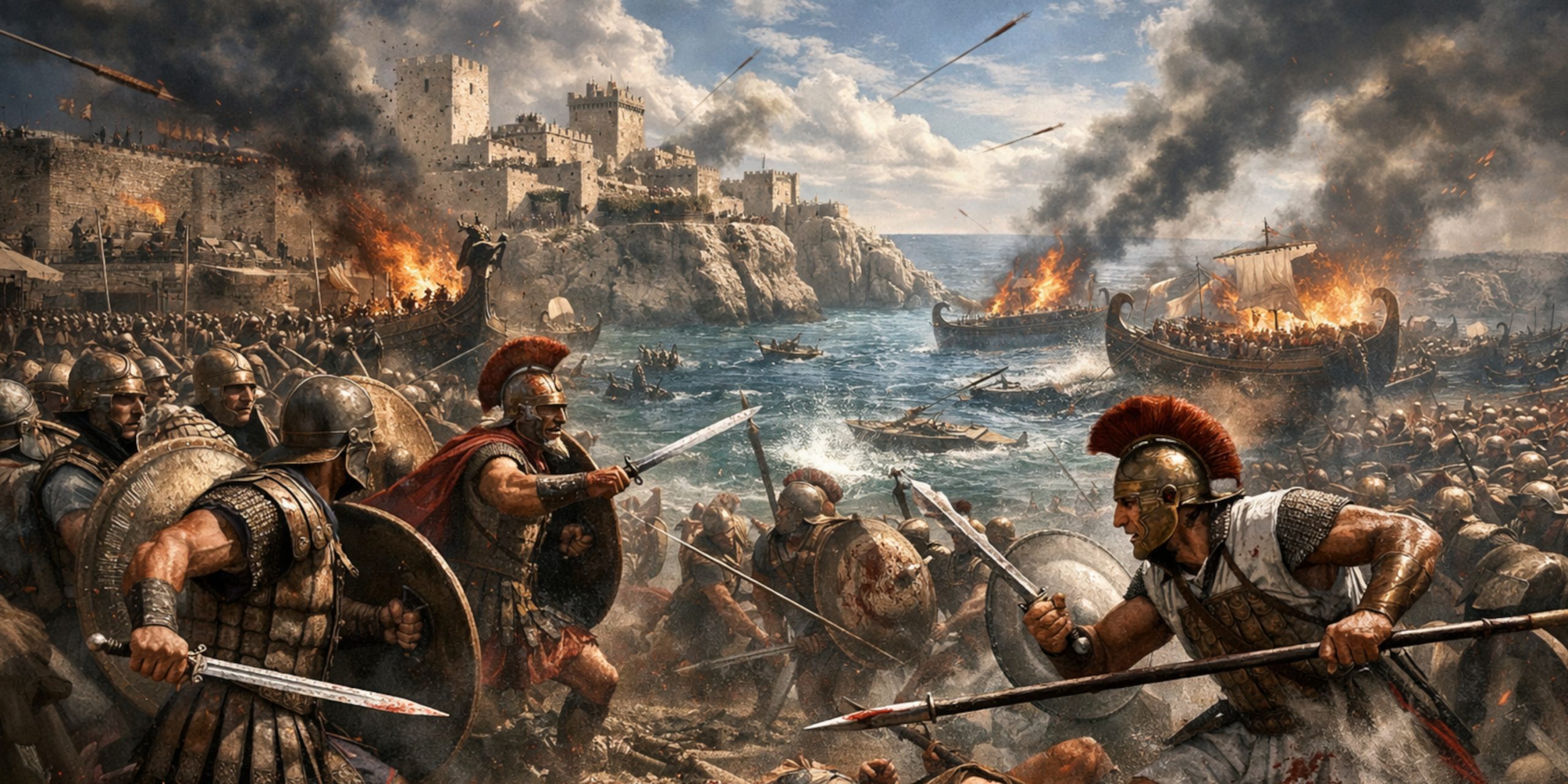
The Battle of Syracuse in 413 BC was one of the most disastrous military defeats in ancient Greek history. What began as Athens’ ambitious attempt to conquer Sicily ended in ruin beneath the walls and harbour of Syracuse. An entire army was destroyed, a fleet was lost, and two of Athens’ leading generals met a grim end.
There is something almost painfully Greek about the whole affair. Athens arrived in Sicily with magnificent ships, splendid confidence and the sort of political optimism that tends to end with somebody shouting in the assembly and everyone pretending they supported a different plan all along.
By September 413 BC, the Athenian expedition had collapsed. Syracuse, aided by Sparta and Corinth, trapped the Athenians by land and sea. The survivors staggered inland, only to be hunted down and captured.
The defeat marked the turning point of the Peloponnesian War. Athens survived for another decade, but after Syracuse it never truly recovered.
Background to the Battle
In 415 BC Athens launched a huge expedition to Sicily. Officially, the Athenians intended to help the city of Segesta against Selinus and Syracuse. In reality, many Athenians dreamed of far more. Sicily was wealthy, fertile and strategically important. If Syracuse could be conquered, perhaps the rest of Sicily might follow. Some even imagined future campaigns against Carthage.
The expedition was led by three generals:
- Nicias, cautious and deeply sceptical of the campaign
- Alcibiades, brilliant, ambitious and never knowingly guilty of modesty
- Lamachus, an experienced soldier who favoured immediate action
Almost as soon as the fleet reached Sicily, matters began to unravel. Alcibiades was recalled to Athens to stand trial and defected to Sparta. Lamachus was later killed during the fighting. Nicias, left in command, hesitated repeatedly while Syracuse strengthened its defences.
In 414 BC the Spartan general Gylippus arrived in Sicily and transformed the war. Syracuse became more confident, more aggressive and much better organised. By 413 BC, when Athenian reinforcements under Demosthenes arrived, the campaign had become a desperate struggle.
Forces
| Side | Estimated Strength |
|---|---|
| Athens and allies | Around 10,000 hoplites, thousands of light troops, 100+ triremes remaining |
| Syracuse and allies | Around 20,000 troops, strong cavalry force, 80 to 100 triremes |
The original Athenian expedition had sailed with over 130 triremes and more than 5,000 hoplites. Reinforcements later brought the army to perhaps 10,000 heavy infantry, together with archers, slingers, javelin-men and sailors.
The Syracusans possessed fewer trained hoplites at first, but they enjoyed strong cavalry, local support and increasing reinforcements from Sparta, Corinth and other Sicilian cities.
One of the decisive advantages was cavalry. Syracuse had over 1,000 horsemen, while the Athenians had only a few hundred at best. Throughout the campaign the Syracusan cavalry harassed Athenian troops, cut off supplies and prevented organised retreat. It is difficult not to sympathise with the Athenians here. Marching through hostile countryside while enemy cavalry circle around you is rather like trying to leave a crowded theatre after the fire alarm has gone off, except everyone has spears.
Leaders and Commanders
| Athens | Syracuse and Allies |
| Nicias | Gylippus |
| Demosthenes | Hermocrates |
| Eurymedon | Sicanus |
| Menander | Agatharchus |
Athenian Command
- Nicias
- Senior commander after Alcibiades and Lamachus were gone
- Deeply cautious and frequently ill
- Delayed retreat after a lunar eclipse, one of the most unfortunate astronomical decisions in military history
- Demosthenes
- Arrived with major reinforcements in 413 BC
- Favoured bold action and later urged immediate withdrawal
- Captured and executed after the defeat
- Eurymedon
- Commanded part of the Athenian fleet
- Killed during the final naval battle in the harbour
Syracusan Command
- Gylippus
- Spartan general sent to aid Syracuse
- Reorganised the Syracusan army and directed the defence
- One of the most effective commanders of the war
- Hermocrates
- Syracusan statesman and general
- Urged resistance from the beginning and helped secure outside support
Arms and Armour
The battle combined land fighting, siege warfare and brutal naval combat. Both sides fielded heavily armed hoplites supported by missile troops and cavalry.
| Troop Type | Typical Equipment |
| Hoplite infantry | Bronze helmet, cuirass or linen armour, large round shield, spear, sword |
| Cavalry | Spear, short sword, light armour |
| Archers and slingers | Bow or sling, dagger, little armour |
| Sailors and marines | Shield, spear, sword, lighter armour suitable for boarding actions |
Specific Sword Types Used
- Xiphos
- The standard Greek short sword
- Straight, double-edged blade usually around 45 to 60 cm long
- Used by both Athenians and Syracusans once spear fighting broke down
- Kopis
- Curved, forward-heavy chopping sword
- Favoured by cavalry and some mercenaries
- Particularly effective in close combat and mounted fighting
- Machaira
- Similar to the kopis but often slightly slimmer and more versatile
- Likely carried by some cavalry and light infantry
Armour and Defensive Equipment
- Bronze Corinthian and Chalcidian helmets
- Linen thorax or bronze cuirass
- Greaves protecting the lower legs
- Large hoplite shield, or aspis
- Spears roughly 2 to 3 metres long
The naval fighting in Syracuse’s Great Harbour was especially savage. Ships collided at close range where there was little room to manoeuvre. Boarding parties fought hand-to-hand on crowded decks with spears, swords and shields. Thucydides describes scenes that sound less like orderly warfare and more like a dockside riot conducted by several thousand heavily armed men.
The Battle in the Great Harbour
By the summer of 413 BC the Athenians realised the siege had failed. Demosthenes urged immediate withdrawal, but Nicias hesitated. Then a lunar eclipse occurred on 27 August. Nicias, being deeply religious, delayed the retreat for nearly a month.
The Syracusans took full advantage.
They blocked the entrance to the Great Harbour with ships and chains. The Athenians now had no easy route to escape. Forced into battle in confined waters, the Athenian fleet lost the very advantages that had once made it feared throughout the Greek world.
The final naval battle took place inside the harbour.
- Syracusan ships were reinforced and adapted for close combat
- Athenian triremes struggled to manoeuvre in the confined space
- Boarding actions replaced traditional ramming tactics
- Eurymedon was killed
- Large numbers of Athenian ships were sunk, captured or driven ashore
When the fleet was destroyed, the land army had little choice but to retreat inland.
The Retreat and Destruction of the Athenian Army
The surviving Athenians abandoned their camp and marched inland in two separate columns under Nicias and Demosthenes.
The retreat quickly became a nightmare.
- Syracusan cavalry harassed the columns constantly
- Food and water ran short
- Narrow roads and rough terrain slowed the march
- Morale collapsed
Demosthenes, surrounded and exhausted, surrendered first.
Nicias continued on with the remainder of the army until they reached the River Assinarus. There, desperate for water, thousands of exhausted soldiers rushed into the river. Syracusan troops attacked them from the banks.
Thucydides’ account is horrifying. The river became clogged with bodies, shields and weapons. Men fought one another simply to drink.
It was the final destruction of the expedition.
Nicias surrendered shortly afterwards.
Both Nicias and Demosthenes were executed despite Gylippus reportedly wishing to take them alive.
Battle Timeline
| Date | Event |
| 415 BC | Athens launches the Sicilian Expedition |
| Late 415 BC | Alcibiades recalled and defects to Sparta |
| 414 BC | Athenians begin siege of Syracuse |
| 414 BC | Gylippus arrives with Spartan support |
| Summer 413 BC | Demosthenes arrives with reinforcements |
| August 413 BC | Athenians decide to retreat |
| 27 August 413 BC | Lunar eclipse delays withdrawal |
| September 413 BC | Syracusans block harbour and destroy Athenian fleet |
| September 413 BC | Athenian army retreats inland |
| September 413 BC | Demosthenes and Nicias captured and executed |
Casualties
| Side | Casualties |
| Athens and allies | Nearly the entire expedition destroyed or captured |
| Syracuse and allies | Unknown, but far lighter |
Ancient sources suggest at least 7,000 prisoners were taken. Many were imprisoned in the stone quarries of Syracuse, where thousands died from hunger, thirst and exposure.
The fate of the survivors was bleak. Athenians who had once sailed proudly from Piraeus ended up in the limestone quarries beneath Syracuse, a miserable conclusion to one of the grandest military adventures of the ancient world.
Archaeology
Archaeological work around Syracuse has shed light on the battle and siege.
Key Sites
- The Epipolae plateau, where much of the fighting over the siege walls took place
- The remains of ancient defensive walls built by Syracuse during the siege
- The Great Harbour, where underwater archaeology has identified wrecks and harbour structures
- The Latomia del Paradiso and other stone quarries where Athenian prisoners were held
Important Archaeological Finds
- Greek arrowheads and sling bullets
- Fragments of hoplite armour and shields
- Pottery and camp remains from the Athenian siege lines
- Sections of Syracusan counter-walls built to block the Athenian circumvallation
The quarries are particularly haunting. Standing inside them today, one can still understand why ancient writers considered them a place of misery. They are steep, enclosed and oppressively hot. Even on a pleasant Sicilian afternoon they have a rather determined way of ruining your mood.
Contemporary Quotes
“The Athenians were destroyed with a total destruction; their fleet, their army, everything was destroyed.”
Thucydides, History of the Peloponnesian War
“Few out of many returned home.”
Thucydides
“The river became foul at once, though the men still drank from it, muddy and bloody as it was.”
Thucydides, describing the River Assinarus
These lines remain among the most powerful in ancient military history. Thucydides was not given to dramatic exaggeration, which somehow makes his account feel even more chilling.
Why Syracuse Was Such a Disaster for Athens
Several factors explain the scale of the defeat:
- Poor strategic planning from the beginning
- Divided and ineffective leadership
- Delay and hesitation by Nicias
- Underestimation of Syracuse and Sicily
- Spartan intervention under Gylippus
- Syracusan superiority in cavalry
- The fatal delay caused by the lunar eclipse
- Fighting a naval battle in confined waters
The Athenians had entered Sicily expecting another imperial triumph. Instead they found themselves trapped at the far edge of the Greek world, far from home, short of supplies and facing an enemy that grew stronger with every passing month.
Legacy
The Battle of Syracuse transformed the Peloponnesian War.
Athens lost:
- One of its largest armies
- Much of its fleet
- Thousands of trained sailors and hoplites
- Huge sums of money and prestige
After Syracuse, subject states rebelled, Persian support flowed to Sparta and Athens was forced onto the defensive.
Although Athens fought on until 404 BC, the defeat in Sicily was the moment when its hopes of victory truly began to die.
Syracuse, meanwhile, emerged as one of the great powers of the western Greek world. Its victory became legendary.
Ancient historians often saw Syracuse as a warning against arrogance, overconfidence and distant wars launched with too much ambition and too little sense. History has provided no shortage of similar examples since. Human beings, rather depressingly, do have a talent for learning absolutely nothing from the previous disaster.
Where to See Artefacts Today
Important finds from the battle and the wider Sicilian Expedition can be seen at:
- Museo Archeologico Regionale Paolo Orsi, Syracuse, Sicily, Italy
- Archaeological Park of Neapolis, Syracuse, Sicily, Italy
- British Museum, London, England, UK
- National Archaeological Museum of Athens, Athens, Greece