Cornwall’s Royalist Gamble That Paid Off
The Battle of Stratton, fought on 16 May 1643 near the Cornish town of Stratton, was a decisive Royalist victory during the early phase of the English Civil War. It was not the largest clash of the conflict, nor the bloodiest. Yet its consequences were considerable. Cornwall, already inclined toward the King, became firmly Royalist territory, and Parliament’s western position faltered.
The engagement pitted Sir Ralph Hopton’s Royalist army against the Parliamentarian force commanded by the Earl of Stamford. Hopton was outnumbered. His men were weary, short of powder, and heavily dependent on local Cornish levies who had more enthusiasm than uniform. Stamford’s army occupied high ground. On paper, the outcome should have been straightforward. On the ground, it proved otherwise.
Background to the Campaign
In early 1643, control of the West Country remained contested. Parliament held key towns in Devon and sought to press into Cornwall. The Royalists, by contrast, relied heavily on regional loyalty. Cornwall in particular produced fierce support for King Charles I, drawn from gentry, miners, and farmers alike.
Hopton had already shown skill in earlier engagements, but he faced the constant problem of supply. The Parliamentarian army at Stratton was positioned to block Royalist movement eastward. Stamford’s objective was clear. He intended to crush Hopton’s force before it could gather further strength.
Forces
Below is a summary of the opposing armies at Stratton.
| Side | Commander | Estimated Strength | Artillery |
|---|---|---|---|
| Royalists | Sir Ralph Hopton | 2,400 to 3,000 | 4 to 5 guns |
| Parliamentarians | Earl of Stamford | 5,000 to 5,500 | 8 to 10 guns |
The Parliamentarian army enjoyed superior numbers and artillery. Hopton’s army was smaller, though arguably more cohesive in spirit.
Royalist Command Structure
- Sir Ralph Hopton – Overall commander
- Sir Bevil Grenville – Cornish infantry leader
- Sir Nicholas Slanning – Infantry officer
- John Berkeley – Cavalry commander
Parliamentarian Command Structure
- Henry Grey, Earl of Stamford – Overall commander
- Major-General James Chudleigh – Field officer
- Colonel John Ruthin – Infantry commander
Arms and Armour
The battle reflected the transitional nature of mid seventeenth century warfare.
Infantry Equipment
- Matchlock muskets
- Pikes, often 15 to 18 feet in length
- Swords for close combat, typically basket hilt broadswords and mortuary swords
- Buff coats worn beneath partial armour
Cavalry Equipment
- Backsword or mortuary sword
- Pair of flintlock or wheellock pistols
- Breastplate and backplate
- Lobster tailed helmet
The mortuary sword was particularly associated with Parliamentarian cavalry, featuring distinctive engraved hilts. Royalist horse often carried simpler basket hilted swords, robust and practical. Pikes remained crucial in infantry formations, particularly when cavalry broke into close quarters.
Hopton’s men were not lavishly equipped. Cornish levies often wore minimal armour. Their strength lay in determination rather than uniformity.
The Battle
16 May 1643, Early Morning
Hopton divided his army into four attacking columns. This was bold. He would assault Stamford’s position on multiple fronts, despite inferior numbers.
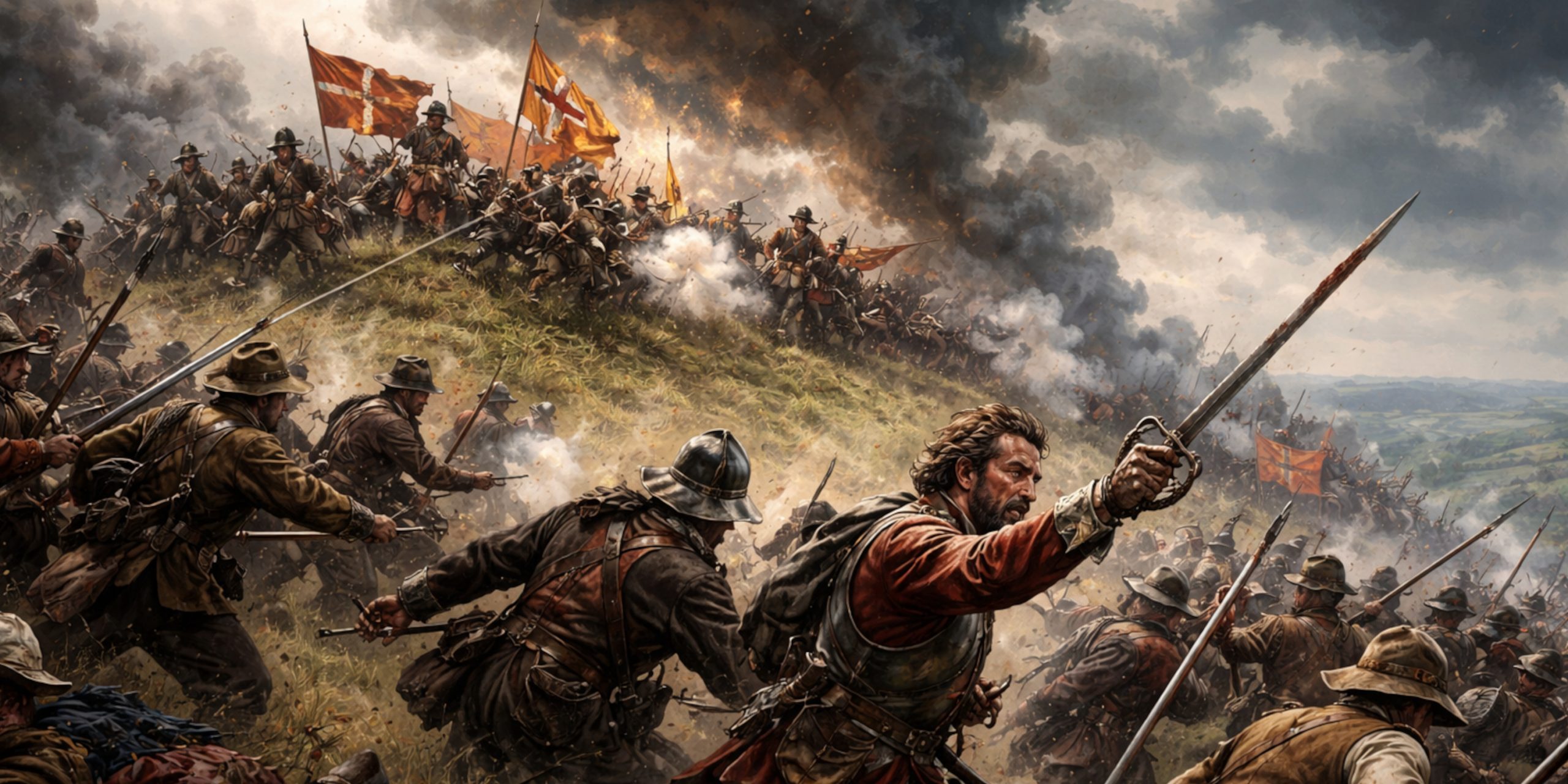
At dawn, Royalist forces advanced uphill under artillery fire. Stamford’s guns inflicted casualties, but coordination among Parliamentarian units proved inconsistent.
Mid Morning
Grenville’s Cornish infantry pressed hard on one flank. Fighting became intense and close. Muskets gave way to swords and pikes. One contemporary described the clash as “a most fierce and obstinate encounter.”
Royalist cavalry exploited weak points in Parliamentarian lines. Stamford’s army, though larger, struggled to maintain cohesion across the extended hilltop position.
Early Afternoon
Parliamentarian resistance began to collapse. Retreat turned to disorder. Stamford fled the field toward Exeter. Royalist troops captured artillery and supplies, a vital gain for Hopton’s strained army.
Casualties
Precise figures vary, though estimates suggest:
- Parliamentarian dead and wounded: 300 to 600
- Royalist casualties: 200 to 300
For a battle of this scale, the losses were significant but not catastrophic. The psychological impact outweighed the numbers.
Contemporary Accounts
Clarendon later wrote that the victory “advanced the King’s affairs in the West beyond expectation.” His tone suggests surprise at the scale of the success.
A Royalist pamphlet described the Cornish soldiers as “men who fought as if their country stood upon the point of the sword.” This was propaganda, certainly, but it captures the pride attached to the victory.
Parliamentarian correspondence was more restrained, attributing defeat to confusion and poor coordination. Stamford himself faced criticism for abandoning the field.
Archaeology and Landscape
Stratton’s battlefield has not produced vast troves of artefacts, yet scattered finds offer insight.
- Musket balls recovered from surrounding fields
- Fragments of seventeenth century uniform fittings
- Evidence of artillery shot embedded in earthworks
Metal detecting surveys have confirmed the approximate line of engagement. The terrain remains revealing. Stamford’s hilltop position is still visible, and the steep approaches explain the intensity of the assault. Walking the ground clarifies one thing quickly. Hopton’s men attacked uphill into artillery fire. It was not a gentle stroll.
Tactical Assessment
Hopton’s decision to divide his force and attack simultaneously carried risk. Had any column faltered, the smaller Royalist army might have been crushed in detail. Instead, coordinated pressure disrupted Parliamentarian command.
Stamford’s deployment was defensive and strong on paper. Yet communication across his line proved fragile. The Royalist assault exposed that weakness.
The victory secured Cornwall for the King and enabled further Royalist advances into Devon. It did not end the war in the West, but it shifted momentum decisively.
Legacy
The Battle of Stratton strengthened Royalist confidence during a critical phase of the war. It demonstrated that disciplined aggression could overcome numerical inferiority.
Cornish identity became closely linked with the victory. Sir Bevil Grenville emerged as a local hero, later dying at Lansdowne. His reputation was forged in part on the slopes of Stratton.
Today, the battle receives less attention than Edgehill or Marston Moor. Yet for those interested in the regional dynamics of the English Civil War, Stratton offers a revealing study in leadership, morale, and the unpredictable nature of warfare.
History is rarely tidy. At Stratton, a smaller, under supplied army climbed a hill and won. That alone makes it worth remembering.
Battle Timeline
Early May 1643
Hopton manoeuvres through Cornwall, gathering support.
15 May 1643
Parliamentarian forces under Stamford take position near Stratton.
16 May 1643, Dawn
Royalist assault begins in four coordinated columns.
Mid Morning
Heavy fighting across the ridge. Close combat dominates.
Early Afternoon
Parliamentarian line collapses. Stamford retreats.
Aftermath
Royalists secure artillery and supplies. Cornwall firmly Royalist.
Takeaway
The Battle of Stratton was a turning point in the West Country campaign of 1643. It was a contest of nerve as much as numbers. Hopton’s gamble paid off, and Cornwall remained loyal to the Crown for much of the war.
As a historian, I find Stratton compelling precisely because it defies expectation. It reminds us that wars are not won by arithmetic alone. They are won by cohesion, timing, and occasionally by men willing to run uphill into cannon fire.
And sometimes, against the odds, they succeed.