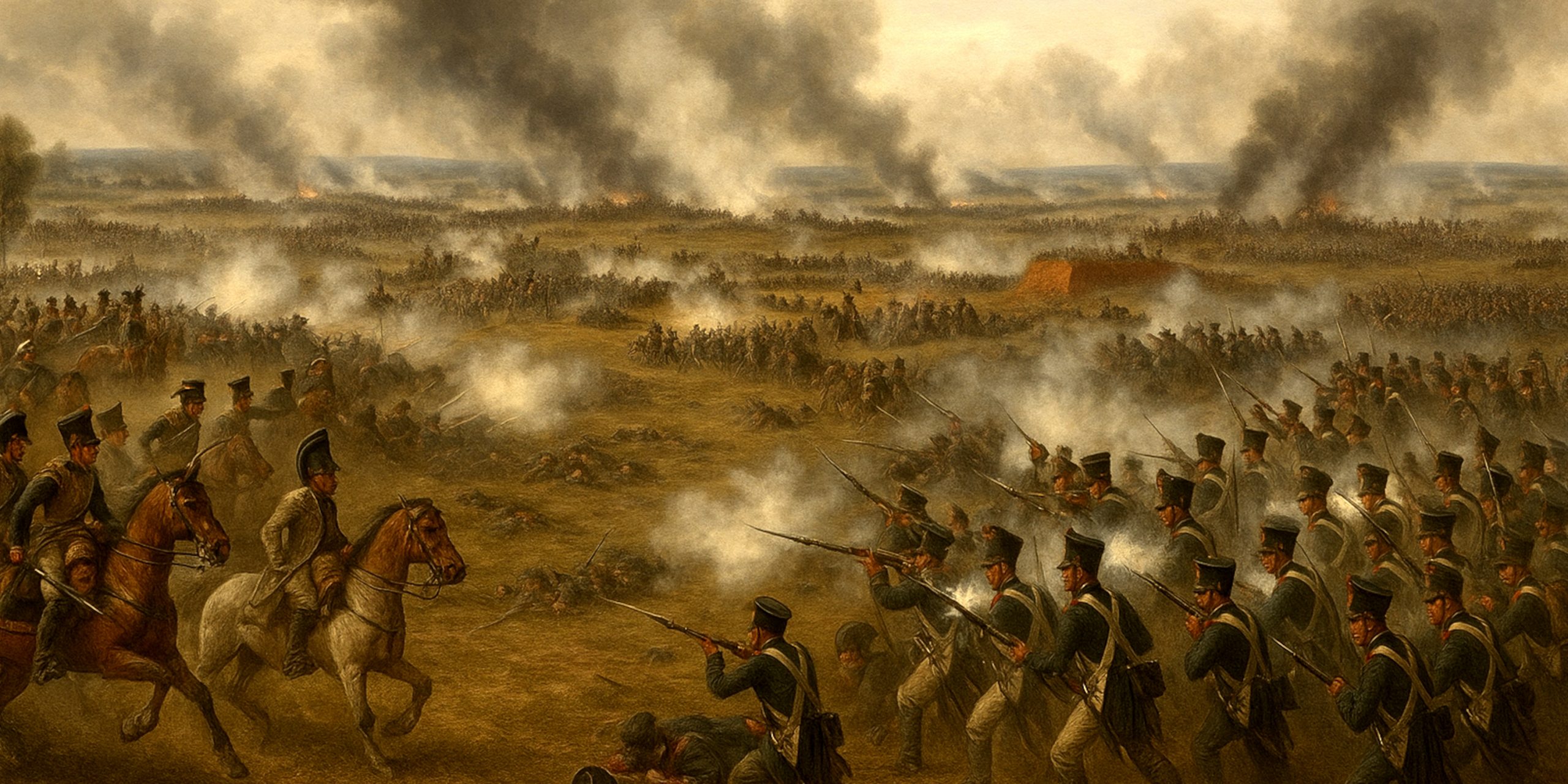
The Battle of Borodino, fought on 7 September 1812, was the largest single-day engagement of the Napoleonic Wars. It took place during Napoleon’s invasion of Russia and pitted the French Grande Armée against the Russian Imperial Army near the village of Borodino, west of Moscow. The fighting was intense, with enormous casualties on both sides, yet no decisive victory. While Napoleon’s forces captured the field, the Russian army remained intact, withdrawing in good order and setting the stage for the eventual French retreat from Moscow.
Background
In the summer of 1812, Napoleon invaded Russia to compel Tsar Alexander I to cease trade with Britain and accept French dominance in Europe. The Russian strategy, led by General Mikhail Kutuzov after Barclay de Tolly was replaced, was to trade space for time, drawing Napoleon deeper into Russian territory. By early September, the Russians chose to stand and fight at Borodino, defending the approach to Moscow.
Forces
Both armies were immense by the standards of the time. The French forces, though reduced by attrition during the campaign, were still formidable. The Russians were determined to make a stand, constructing strong defensive positions along the Kolocha River.
| Side | Commander-in-Chief | Strength (approx.) | Artillery (approx.) |
|---|---|---|---|
| France | Napoleon Bonaparte | 130,000 men | 587 guns |
| Russia | Mikhail Kutuzov | 120,000 men | 640 guns |
Leaders and Troop Composition
French Grande Armée
- Commander: Napoleon Bonaparte
- Key Subordinates:
- Marshal Louis-Nicolas Davout (I Corps)
- Marshal Michel Ney (III Corps)
- Prince Eugène de Beauharnais (IV Corps)
- Marshal Joachim Murat (Cavalry Reserve)
- Composition:
- Infantry: Line infantry, light infantry, grenadiers
- Cavalry: Cuirassiers, dragoons, hussars, chasseurs à cheval
- Artillery: Foot batteries, horse artillery
Russian Imperial Army
- Commander: Mikhail Kutuzov
- Key Subordinates:
- General Pyotr Bagration (2nd Army of the West)
- General Mikhail Barclay de Tolly (1st Army of the West)
- General Matvei Platov (Cossack Corps)
- Composition:
- Infantry: Musketeers, jaegers, grenadiers
- Cavalry: Cuirassiers, hussars, dragoons, Cossacks
- Artillery: Heavy batteries, horse artillery
Arms and Armour
French
- Infantry muskets: Charleville Model 1777 and bayonets
- Cavalry sabres: AN IX light cavalry sabre, cuirassiers’ heavy straight swords
- Pistols and carbines for cavalry
- Artillery: 6- and 12-pounder guns, howitzers
- Armour: Cuirasses for heavy cavalry
Russians
- Infantry muskets: Model 1805 and earlier patterns
- Cavalry weapons: Sabres, lances (Cossacks), pistols
- Artillery: 6-, 12-, and 18-pounder guns, licornes (Russian howitzers)
- Armour: Cuirasses for some heavy cavalry units
Battle Timeline
6 September 1812
- Skirmishes and reconnaissance
- Russian defensive works, including the Great Redoubt and Bagration flèches, completed
7 September 1812
- 6:00 a.m. – French artillery bombardment begins
- Early morning – Davout attacks the Bagration flèches
- Mid-morning – Ney and Murat reinforce the attack; heavy fighting at the flèches
- Late morning – Prince Eugène assaults the Great Redoubt
- Midday – Bagration wounded; Russian left begins to falter
- Afternoon – French capture the Great Redoubt after repeated assaults
- Evening – Russian army withdraws in good order, preserving its core strength
Outcome and Casualties
- French tactical victory; strategic stalemate
- Estimated casualties:
- France: 30,000–35,000 killed, wounded, or missing
- Russia: 38,000–45,000 killed, wounded, or missing
Contemporary Quotes
Napoleon Bonaparte: “Of all my battles, the most terrible is the one I fought at Moscow. The French proved themselves worthy of victory, but the Russians have won the right to be invincible.”
Mikhail Kutuzov: “With the loss of the battle, Russia has not lost her honour. Our retreat will save our army and ultimately our country.”
Archaeology
Archaeological work at Borodino has uncovered musket balls, uniform buttons, artillery fragments, and personal items belonging to soldiers. Mass graves have been located, and analysis of bone fragments has provided insight into injuries sustained in battle. Battlefield preservation efforts have made Borodino one of the best-documented Napoleonic sites in Russia.
Legacy
Borodino is remembered in Russian history as a heroic defence, immortalised in literature by Leo Tolstoy’s War and Peace. For the French, it was a costly step toward Moscow that failed to deliver a decisive blow. The enormous losses weakened the Grande Armée, contributing to the disastrous retreat that followed the occupation of Moscow.
Watch the documentary: