The Battle That Made Alexander the Great
Few battles in ancient history feel quite as decisive as Gaugamela. Some engagements alter a campaign. Others topple a dynasty. Gaugamela did both.
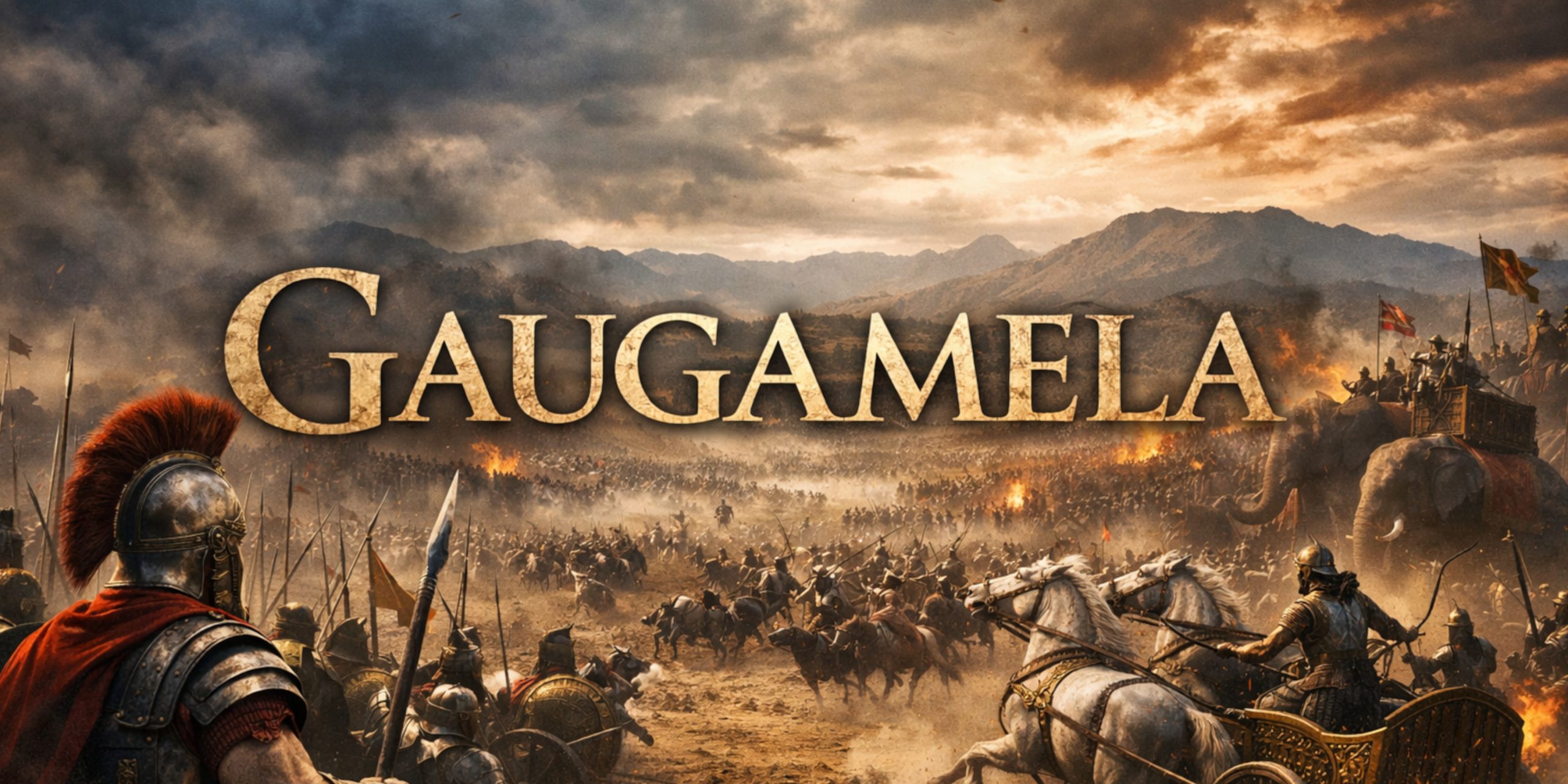
Fought in 331 BC between Alexander of Macedon and Darius III of Persia, the battle ended the Achaemenid Empire as a meaningful power and opened the gates of the Near East to Macedonian rule. The Persians had numbers, ground prepared for chariots, and every reason to believe they could crush the invading army.
Alexander had something else entirely. Discipline, tactical brilliance, and a habit of doing the unexpected at the worst possible moment.
The result was one of the most famous victories in military history.
Background to the Battle
After defeating the Persians at the Battle of Issus in 333 BC, Alexander spent two years securing the eastern Mediterranean. Tyre fell after a brutal siege, Gaza followed, and Egypt welcomed him as a liberator.
Darius III had escaped Issus and began assembling another army deep inside the Persian Empire. This time he chose the battlefield carefully.
Near the village of Gaugamela, on a broad plain east of the Tigris River, Persian engineers levelled the terrain so that chariots and cavalry could manoeuvre freely. It was essentially a battlefield custom built to neutralise the Macedonian phalanx.
Darius also gathered forces from across his empire, including cavalry from Central Asia, Greek mercenaries, Indian troops and elite Persian guards.
The Persians expected to overwhelm Alexander with sheer scale.
History had other plans.
Forces
Ancient sources exaggerate Persian numbers wildly. Some claim over a million men, which is clearly fantasy. Modern estimates still show a significant Persian advantage.
Macedonian Army
| Category | Estimate |
|---|---|
| Total strength | 40,000 to 47,000 |
| Infantry | ~31,000 |
| Cavalry | ~7,000 |
| Commanders | Alexander, Parmenion, Hephaestion, Cleitus |
Persian Army
| Category | Estimate |
|---|---|
| Total strength | 80,000 to 100,000 |
| Infantry | 40,000+ |
| Cavalry | 40,000+ |
| Special units | Scythed chariots, elephants |
| Commander | Darius III |
The Persians held clear superiority in cavalry and overall manpower.
Alexander’s army relied on coordination, discipline, and the deadly synergy between cavalry and the Macedonian phalanx.
Leaders and Command Structure
Macedonian Command
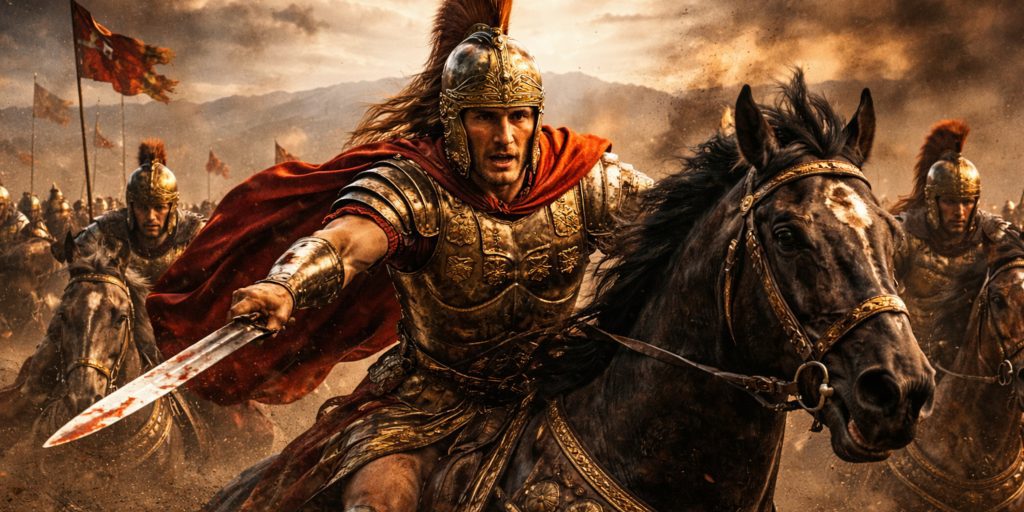
• Alexander the Great, supreme commander, leading the Companion Cavalry on the right flank
• Parmenion, experienced general commanding the left wing
• Hephaestion, cavalry officer and close companion of Alexander
• Cleitus the Black, senior cavalry commander
Alexander placed his strongest cavalry units on the right flank, where he personally led the decisive attack.
Persian Command
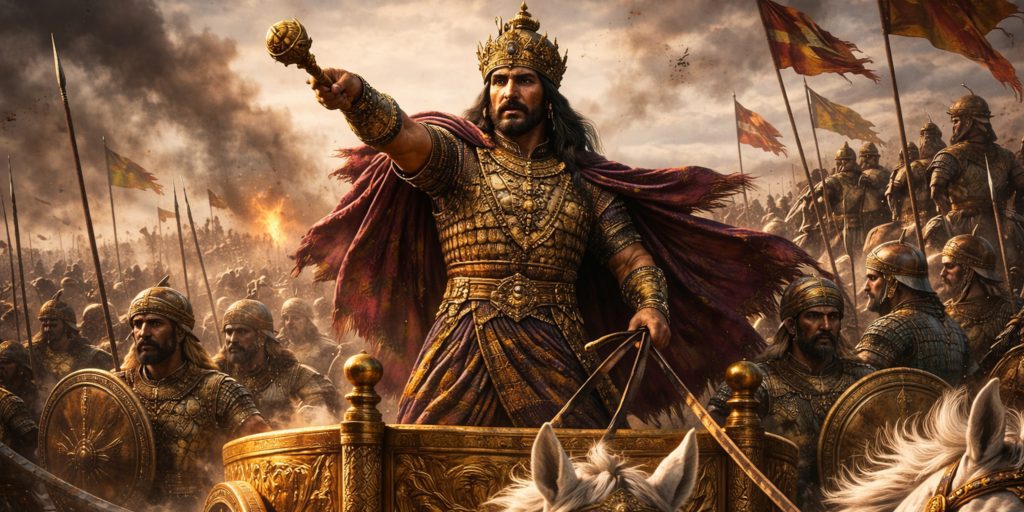
• Darius III, King of Kings of the Persian Empire
• Bessus, satrap of Bactria commanding eastern cavalry
• Mazaeus, satrap of Babylon commanding the Persian right
• Various satraps and noble commanders from across the empire
Darius commanded from the centre behind elite Persian infantry and his royal guard.
Arms and Armour
Ancient armies at Gaugamela represented an extraordinary mixture of weapons and fighting styles from across the known world.
Macedonian Equipment
Infantry
• Sarissa pikes, often over 5 metres long
• Short swords such as the xiphos
• Curved cutting swords known as the kopis or machaira
• Bronze helmets
• Linen or bronze cuirasses
• Large round shields carried by hypaspists
Cavalry
• Long cavalry spears (xyston)
• Kopis swords for close combat
• Bronze helmets and body armour
• Companion cavalry fought as heavy shock troops
The Macedonian system relied heavily on the phalanx holding the enemy while cavalry struck decisive blows.
Persian Equipment
Persian forces were more diverse.
Infantry
• Spears and javelins
• Short swords similar to the akinakes
• Wicker shields
• Scale armour in elite units
Cavalry
• Spears and javelins
• Composite bows
• Curved swords such as the akinakes and sabre like blades
• Light armour suitable for mobile warfare
Special Units
• Scythed chariots designed to break infantry formations
• War elephants from India
The Persian army relied on mobility and ranged weapons rather than tight infantry formations.
The Battlefield
The battlefield lay near modern Tel Gomel in northern Iraq.
Darius ordered the plain levelled to remove obstacles for his chariots. Stones were cleared and uneven ground flattened.
In theory it gave Persian cavalry and chariots ideal conditions.
In practice it also gave Alexander the space to perform one of the most elegant battlefield manoeuvres in history.
Battle Timeline
Night Before the Battle
Darius kept his army awake in anticipation of a night attack. Alexander refused the idea, reportedly stating he would not steal his victory.
One suspects he preferred his soldiers well rested.
Early Morning Deployment
The Persians deployed in an enormous line designed to outflank the Macedonians.
Alexander arranged his army in a flexible formation with reserve units behind the main line to counter encirclement.
The Opening Movements
Alexander began moving his right wing diagonally across the battlefield. The manoeuvre forced Persian cavalry to follow, stretching their formation.
This created a growing gap in the Persian centre.
Persian Chariot Attack
Darius unleashed his scythed chariots toward the Macedonian phalanx.
Macedonian troops simply opened their ranks, allowing chariots to pass through before attacking the drivers.
The terrifying weapons proved largely ineffective.
Alexander’s Decisive Charge
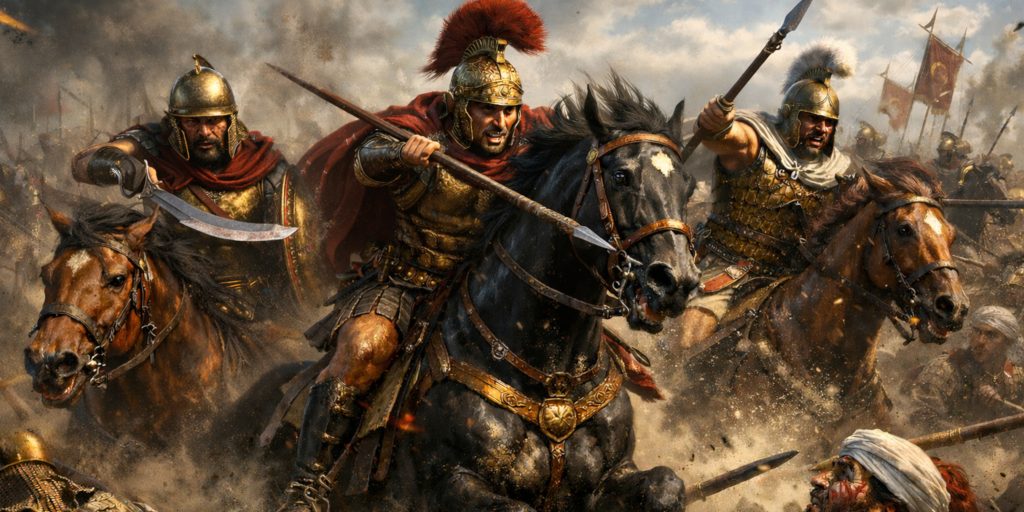
Once a gap appeared in the Persian line, Alexander led the Companion Cavalry in a wedge formation directly toward Darius.
The attack punched through the centre of the Persian army.
Facing the sudden threat, Darius turned his chariot and fled.
Collapse of the Persian Army
With their king fleeing, the Persian army began to break apart.
Meanwhile Parmenion on the Macedonian left faced heavy pressure from Persian cavalry and requested aid. Alexander briefly turned back to stabilise the line before pursuing Darius.
The battle ended with a decisive Macedonian victory.
Archaeology and Location
Unlike some ancient battlefields, Gaugamela has received increasing archaeological attention in recent decades.
The most widely accepted location lies near Tel Gomel in Iraqi Kurdistan.
Archaeological and landscape studies have identified terrain features matching ancient descriptions, including the wide open plains suitable for cavalry manoeuvres.
Researchers have also found settlement remains consistent with references to nearby villages mentioned in ancient sources.
Large scale battlefield artefacts remain rare. That is hardly surprising considering the scale of looting and reuse of metal equipment in antiquity.
Ancient battlefields were rarely left untouched.
Contemporary Accounts
Several ancient historians recorded the battle, though they wrote centuries later using earlier sources.
Arrian gives one of the most famous descriptions:
“Alexander saw the gap in the Persian line and drove straight for Darius.”
Plutarch describes the moment panic spread through the Persian army:
“When the king fled, the whole army dissolved.”
Diodorus Siculus also emphasised the psychological collapse once Darius abandoned the field.
Ancient writers consistently highlight Alexander’s decisive cavalry charge as the turning point.
Aftermath
Gaugamela effectively ended organised Persian resistance.
Within months Alexander captured:
• Babylon
• Susa
• Persepolis
The Persian imperial treasury fell into Macedonian hands, providing enormous wealth to fund further campaigns.
Darius fled east but was eventually murdered by his own satrap Bessus in 330 BC.
Alexander now ruled the largest empire the world had yet seen.
Not bad for a commander still in his twenties.
Legacy of the Battle
Historians often debate which battle represents Alexander’s greatest tactical achievement. Issus demonstrated his brilliance. Hydaspes showed his adaptability.
Gaugamela combined both.
Alexander faced a numerically superior enemy on ground chosen by the opponent and still managed to engineer a decisive breakthrough.
Military academies still study the battle today for its use of manoeuvre, flexible formations and psychological pressure.
It also marked the moment when the Persian Empire, which had dominated the Near East for two centuries, finally collapsed.
One could say Alexander did not merely win a battle.
He rearranged the political map of the ancient world.