Few medieval weapons have acquired a reputation quite like the Ulfberht sword. It is often described as the “Viking super blade”, a phrase that has fuelled documentaries, television programmes and countless online articles. The reality is both more complex and, in many ways, even more interesting.
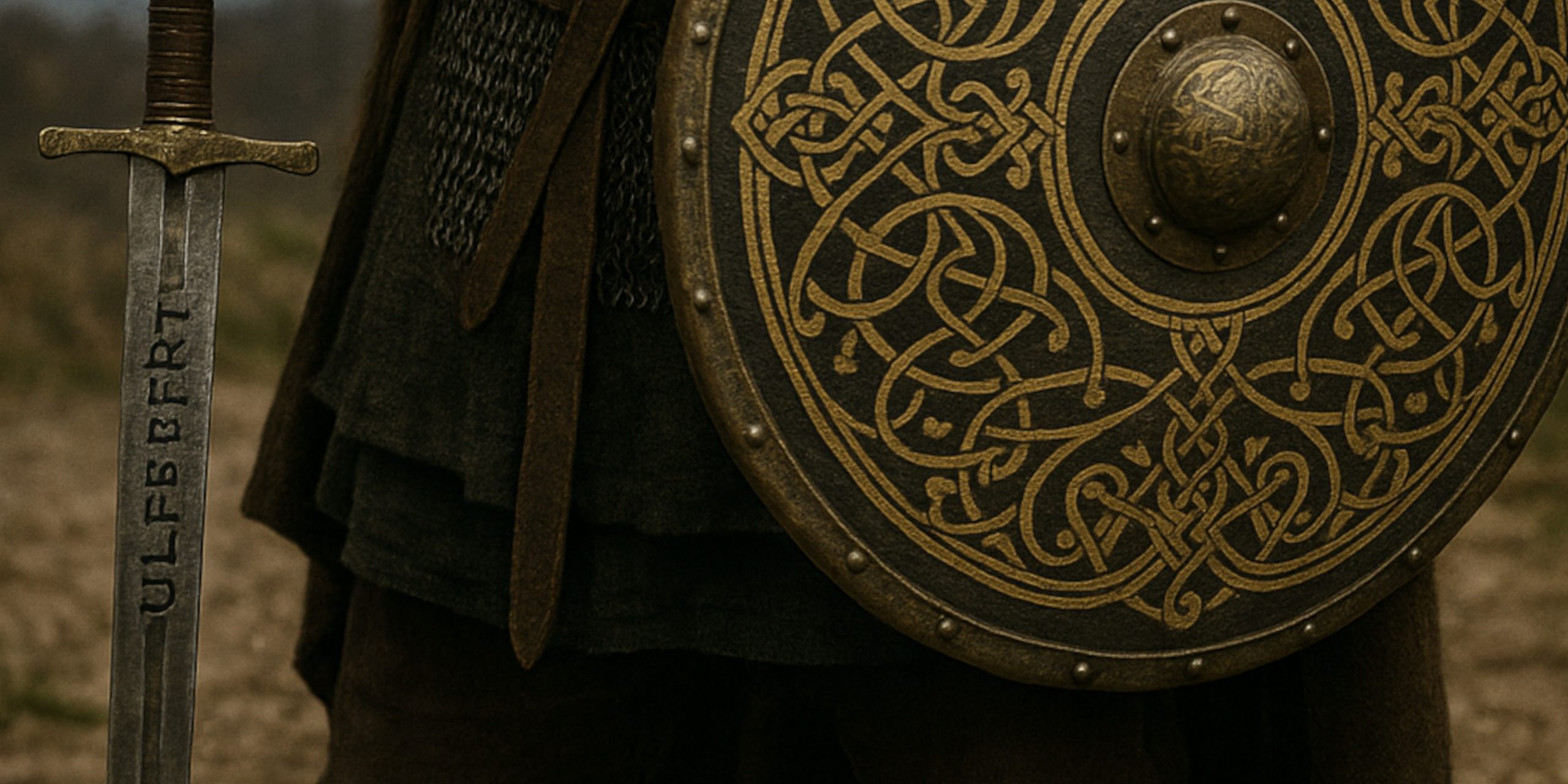
An Ulfberht was not a single sword or even a single design. Instead, it was a group of high status blades produced between the 9th and 11th centuries that carried variations of the famous +VLFBERH+T inscription. Around 170 examples are currently known, although the exact number continues to change as fragmentary finds are reclassified.
For decades historians assumed the inscription represented one master smith. Modern scholarship now leans towards a workshop, family, religious foundation or established Frankish manufacturing tradition rather than a single craftsman. Anne Stalsberg and Alan Williams have both shown that the metallurgy and inscriptions vary considerably, suggesting production over several generations rather than one individual’s lifetime.
What also surprises many people is that not every Ulfberht was exceptional. Some were made from remarkably pure high carbon steel, while others were ordinary weapons carrying copied or misspelled inscriptions. Medieval counterfeiting, it seems, is hardly a modern invention.
Ulfberht Sword Specifications
| Feature | Specification |
|---|---|
| Period | 9th to 11th century |
| Origin | Probably Rhineland, Frankish Empire |
| Length | Approximately 90 to 95 cm |
| Blade Length | Approximately 75 to 80 cm |
| Weight | Around 1.1 to 1.3 kg |
| Blade Type | Double edged |
| Grip | One handed |
| Fuller | Wide central fuller |
| Steel | Variable, from pattern welded steel to high quality crucible steel in some examples |
| Typical Users | Elite Viking warriors, Frankish nobles and wealthy professional fighters |
Although popular culture associates them exclusively with Vikings, the blades were almost certainly forged in Frankish territory before being traded, gifted, looted or smuggled into Scandinavia and Eastern Europe. Carolingian rulers even attempted to ban the export of quality weapons to their enemies, suggesting these swords were considered valuable strategic assets.
History and Evolution
Origins in the Rhineland
The name Ulfberht is Frankish rather than Scandinavian.
Most historians place production somewhere in the Rhine region, an area already famous for sword manufacture during the Carolingian period. The inscription itself was inlaid into the blade using iron or steel rods hammered into prepared grooves before polishing.
A Premium Brand
Rather than being the equivalent of a modern model number, Ulfberht appears to have functioned more like a prestigious maker’s mark.
Production likely lasted over two centuries.
That immediately tells us one important thing.
No single smith could have made every authentic Ulfberht.
Instead, scholars suggest several generations of craftsmen continued using an established workshop name that had developed an excellent reputation.
Viking Expansion
Most surviving examples have actually been discovered in Scandinavia rather than Germany.
This reflects burial customs more than manufacturing.
Pagan Scandinavian elites frequently buried expensive weapons with their owners, whereas Christian Europe generally did not.
As a result, archaeology preserves more Viking examples than Frankish ones.
Genuine and Imitation Blades
Modern metallurgical analysis has transformed our understanding.
Alan Williams demonstrated that some Ulfberht swords contain remarkably clean, high carbon steel with very low slag content.
Others are conventional bloomery steel.
Some even contain obvious spelling mistakes in the famous inscription.
Examples include:
- +VLFBERH+T
- +VLFBERHT+
- Misspelled variants
- Poorly executed copies
This strongly suggests that competing workshops attempted to imitate a prestigious brand once it became famous.
Construction and Metallurgy

One reason Ulfberht swords became legendary is their metallurgy.
Not every blade was extraordinary, but the finest examples possess characteristics that were genuinely unusual for early medieval Europe.
| Feature | Typical Viking Sword | High Quality Ulfberht |
|---|---|---|
| Slag Content | Moderate to high | Very low |
| Carbon Content | Moderate | High |
| Pattern Welding | Common | Sometimes absent |
| Edge Retention | Good | Excellent |
| Manufacturing Difficulty | Moderate | Extremely high |
Some researchers believe the highest quality blades were forged from imported crucible steel originating somewhere in Central Asia or Persia before reaching Frankish workshops through long distance trade networks.
This remains one of the leading scholarly theories, although debate continues over exactly where the steel originated.
Advantages
- Exceptional balance
- Superior edge retention on the finest examples
- Greater resistance to bending
- Excellent cutting performance
- Prestigious status symbol
- Highly respected across northern Europe
- Premium craftsmanship compared with many contemporary swords
Disadvantages
- Extremely expensive
- Beyond the reach of ordinary warriors
- Many surviving examples were copied or imitated
- Genuine high quality examples were relatively rare
- Required considerable skill to manufacture
- Some lower quality Ulfberhts offered little improvement over standard Viking swords
Comparison with Similar Weapons
| Weapon | Date | Advantages | Weaknesses |
|---|---|---|---|
| Ulfberht | 9th to 11th century | Premium steel, prestige, balance | Rare and expensive |
| Standard Viking Sword | 8th to 11th century | Reliable and widespread | Variable quality |
| Ingelrii Sword | 10th to 12th century | High quality inscription blades | Less common than Ulfberht |
| Carolingian Sword | 8th to 10th century | Excellent military weapon | Quality varied by workshop |
The closest comparison is the Ingelrii family of inscribed swords, which emerged slightly later and appears to represent another respected manufacturing tradition.
Archaeology
Approximately 170 Ulfberht swords have been identified across Europe.
The largest concentrations have been found in:
| Country | Significant Finds |
|---|---|
| Norway | Highest concentration |
| Sweden | Numerous warrior burials |
| Finland | Large number of inscribed blades |
| Germany | Probable production region |
| Poland | Multiple discoveries |
| Russia | Volga trade connections |
| Ukraine | Several examples |
| England | Small number of finds |
The distribution demonstrates extensive trade routes linking the Frankish Empire with Scandinavia and Eastern Europe.
Legacy
The Ulfberht has become one of the defining weapons of the Viking Age.
Its reputation stems from three factors:
- Genuine technological innovation in some examples
- Wide geographical distribution
- An enduring mystery surrounding its manufacture
Popular media has occasionally exaggerated claims that the swords were “centuries ahead of their time” or made using impossible technology. The evidence is more measured.
Some Ulfberhts were indeed exceptional.
Others were simply good medieval swords carrying a prestigious name.
That distinction is important because it reflects what archaeology actually shows rather than what modern myth sometimes prefers.
Where to See an Ulfberht Sword
Several museums display genuine examples or closely related Viking Age swords.
| Museum | Country |
|---|---|
| Germanisches Nationalmuseum | Germany |
| Kulturhistorisk Museum, University of Oslo | Norway |
| National Museum of Denmark | Denmark |
| Swedish History Museum | Sweden |
| Finnish National Museum | Finland |
| British Museum (selected Viking swords) | United Kingdom |
Collections rotate regularly, so it is worth checking exhibition schedules before travelling.
Collectors Guide
Owning an authentic Ulfberht is virtually impossible for most collectors.
Many examples are protected archaeological finds that cannot legally enter private ownership.
When genuine specimens do appear, they attract international attention.
Recent Market Values
| Item | Typical Value |
|---|---|
| Fragmentary authentic blade | Tens of thousands of pounds |
| Museum quality authenticated example | Often unavailable through public sale |
| TimeLine Auctions Ulfberht (2025 estimate) | £15,000 to £20,000 |
| Modern functional reproduction | £200 to £1,000+ |
| Museum grade custom reproduction | £2,000 to £6,000+ |
A Christie’s sale of a Viking sword bearing an Ulfberht inscription demonstrated just how desirable these weapons remain among serious collectors.
What Collectors Should Look For
- Clear documented provenance
- Independent authentication
- X ray and metallurgical reports
- Legal export documentation
- Conservation history
- Academic publication where possible
Be extremely cautious of any seller claiming to offer a complete Viking Age Ulfberht with little or no provenance. Genuine examples are exceptionally scarce, and illicit excavation has long been a problem in the medieval arms market.
Frequently Asked Questions
Was every Ulfberht made from advanced steel?
No. Metallurgical analysis shows considerable variation. Some examples contain exceptionally pure high carbon steel, while others are made using more conventional bloomery methods.
Who made the Ulfberht swords?
The exact identity remains unknown. Most scholars believe the inscription refers to a Frankish workshop or manufacturing tradition rather than a single individual.
Were Ulfberht swords used by Vikings?
Yes. Many surviving examples come from Viking graves, although the blades were probably manufactured in Frankish territory before reaching Scandinavia through trade, gift exchange, raiding or smuggling.
Are Ulfberht swords the best Viking swords ever made?
Some certainly rank among the finest surviving Viking Age swords. However, the inscription alone is not proof of superior quality, and several imitation examples are known.
Takeaway
The Ulfberht sword deserves its legendary reputation, though perhaps not for the reasons often repeated online. It was never a magical weapon centuries ahead of its time, nor was every blade a metallurgical masterpiece. What makes the Ulfberht remarkable is that it sits at the intersection of craftsmanship, commerce and reputation. Across two centuries, a Frankish name became synonymous with quality from the Rhine to the Baltic, influential enough that other smiths copied it in the hope of sharing its prestige.
For historians, that enduring mystery is part of the appeal. The best Ulfberht swords reveal extraordinary skill, while the poorer imitations remind us that branding, reputation and forgery are hardly modern inventions. More than a thousand years later, these blades continue to spark debate among archaeologists, metallurgists and collectors alike, which is perhaps the greatest testament to their legacy.