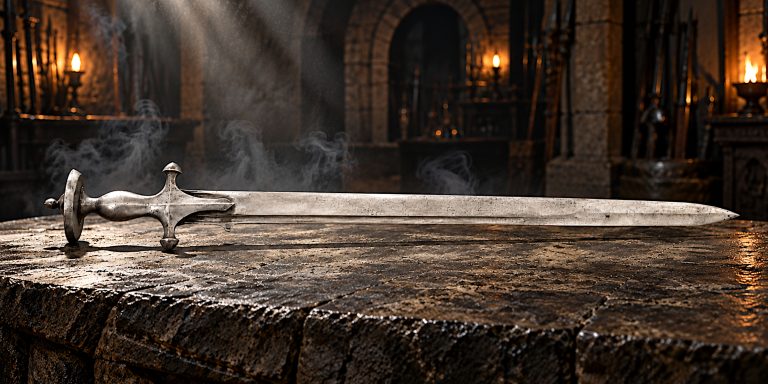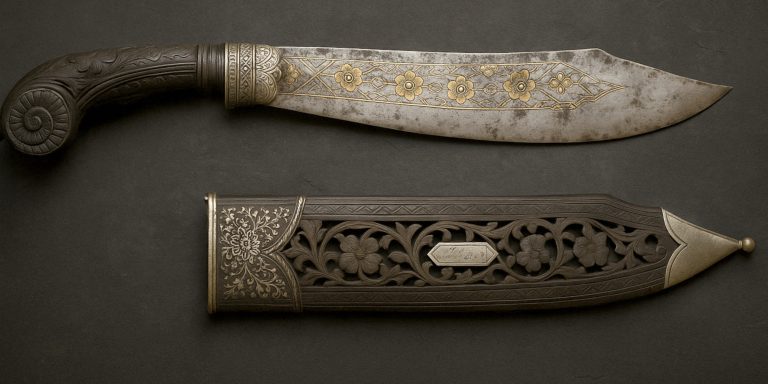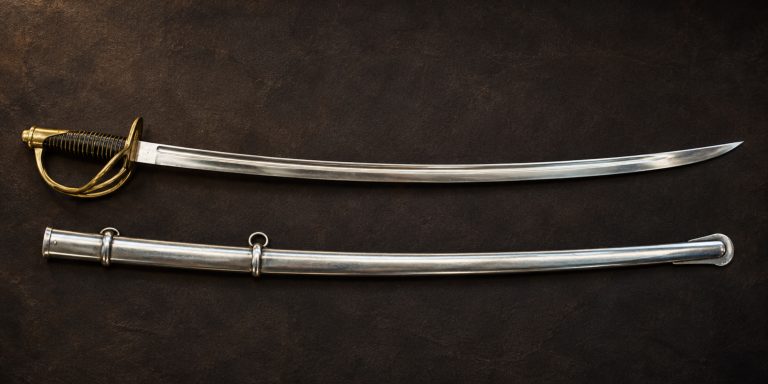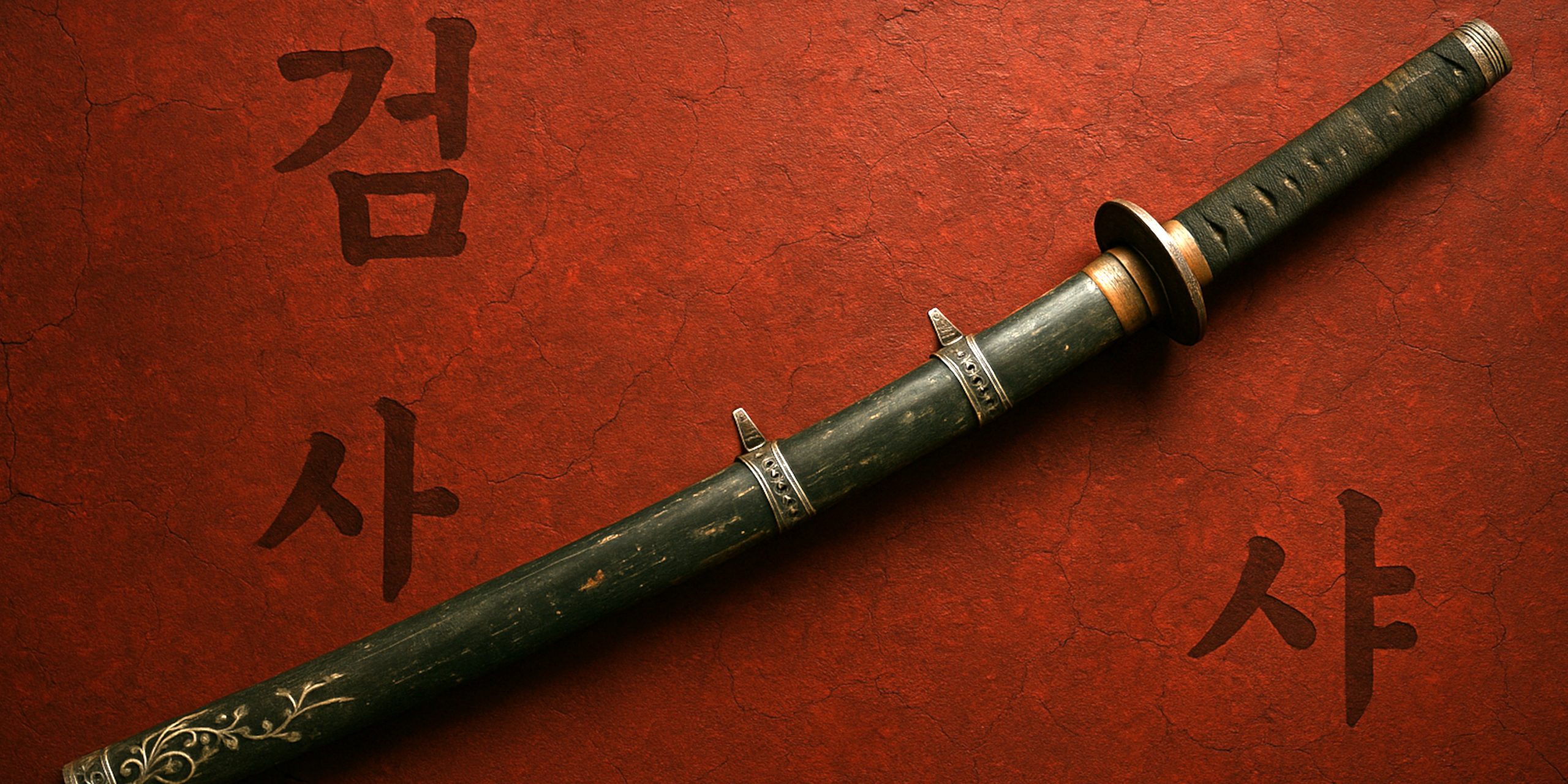
The Byeolun-Geom (별운검), translated as “Star-Cloud Sword”, is one of the more enigmatic blades from late Joseon Korea. Its poetic name reflects the refined aesthetics of Korean sword-making traditions rather than a single uniform design. While not as widely recognised as the Hwando or Ssangdo, the Byeolun-Geom represents the ceremonial and symbolic dimension of Korean weaponry, where craftsmanship, court ritual, and philosophy blended with martial purpose.
Specifications
| Feature | Description |
|---|---|
| Type | Single-edged sword (possible ceremonial and military variants) |
| Origin | Late Joseon Dynasty, Korea |
| Blade Length | Approximately 70–85 cm |
| Overall Length | 90–110 cm |
| Blade Curvature | Shallow curve, similar to Hwando |
| Steel Composition | Pattern-welded or folded steel, occasionally with inlay work |
| Guard (Tsuba) | Typically round or lobed brass guard with minimal ornamentation |
| Handle (Hilt) | Wood core wrapped in ray skin and silk cord |
| Scabbard | Lacquered wood, often inlaid with mother-of-pearl or fine brass fittings |
| Typical Use | Ceremonial, symbolic, or as a gift weapon of distinction |
History and Evolution
The Byeolun-Geom appeared in the later years of the Joseon Dynasty, when swords had become symbols of rank, loyalty, and artistry more than instruments of war. Korean swordsmiths, influenced by both Chinese dao and Japanese katana, created a variety of hybrid forms.
- 17th–18th Century: Decline in battlefield sword use, rise in ceremonial craftsmanship.
- 18th–19th Century: The Byeolun-Geom likely became associated with royal or scholar-official circles. The name “Star-Cloud” suggests celestial symbolism, reflecting Confucian cosmology and aesthetic values.
- Post-Joseon Era: Surviving examples were often preserved as family heirlooms or gifts of state. Many were later exported or collected by Japanese and Western antiquarians during the colonial period.
While the Byeolun-Geom shares some traits with military Hwando, its ornamentation and poetic naming indicate its role as a weapon of prestige rather than a battlefield necessity.
Advantages and Disadvantages
| Aspect | Advantages | Disadvantages |
|---|---|---|
| Craftsmanship | Exquisite decorative work, often featuring inlays and lacquered scabbards. | Fragile compared with combat-grade swords. |
| Balance and Handling | Light and well-balanced for demonstration or dress wear. | Lacks the heft required for heavy combat. |
| Symbolism | Represented cosmic harmony and virtue, prized among scholar-warriors. | Functionally limited to ritual or symbolic use. |
| Collectibility | Rare and visually striking. | Authentic examples are difficult to verify due to imitation pieces. |
Comparison with Similar Weapons
| Weapon | Region | Key Features | How It Differs from Byeolun-Geom |
|---|---|---|---|
| Hwando | Korea | Military side-arm, single-edged, practical battlefield weapon. | The Byeolun-Geom is more decorative and ceremonial. |
| Ssangdo | Korea | Twin swords, used in martial arts and duelling. | The Byeolun-Geom is single-bladed and symbolic. |
| Jingum | Korea (modern) | Martial arts sword modelled after the katana. | The Byeolun-Geom predates it and holds ritual significance. |
| Dao | China | Broad single-edged sword, mass-produced for soldiers. | The Byeolun-Geom is finer and less utilitarian. |
| Katana | Japan | Curved single-edged sword with exceptional sharpness. | The Byeolun-Geom may echo its form but not its martial intent. |
Legacy
Today, the Byeolun-Geom stands as a symbol of the cultural fusion and aesthetic sophistication of late Joseon Korea. It represents a period when the sword ceased to be a weapon of survival and became a medium for artistic expression and philosophical ideals. Korean museums and collectors prize surviving examples for their intricate inlay work and craftsmanship.
Modern martial artists and historians regard it as a reflection of Korea’s shift from warrior culture to scholarly refinement, blending the poetic with the practical.
Where to See
Authentic Byeolun-Geom swords are exceptionally rare, but examples and replicas can occasionally be found in:
- National Museum of Korea (Seoul) – holds several ceremonial swords from the late Joseon period.
- Gyeongbokgung Palace Armoury Displays – showcases ceremonial weapons of the royal guard.
- Private Korean Collections – particularly in Seoul and Busan, often featuring lacquered and inlaid scabbards.
- Overseas Museums – such as the British Museum and Tokyo National Museum, where colonial-era acquisitions include Korean swords labelled generically as “ceremonial Hwando”.
Collector’s Guide
Authenticity Markers
- Folded steel blade with consistent patterning.
- Traditional brass fittings or gilt details featuring floral or cosmic motifs.
- Lacquered wooden scabbard with mother-of-pearl inlay.
- Korean maker’s marks or inscriptions (often poetic rather than functional).
Condition and Provenance
- Documentation from Korean or Japanese provenance archives increases value.
- Unpolished blades with original fittings are preferable to heavily restored pieces.
Typical Auction Prices
| Condition | Provenance | Estimated Price Range (GBP) |
|---|---|---|
| Museum-grade, documented royal gift | Verified Joseon artefact | £15,000–£30,000 |
| High-quality ceremonial replica (19th century) | Private collection | £4,000–£9,000 |
| Undocumented or partial sword | Unverified origin | £1,000–£3,000 |
| Modern replica (decorative) | Contemporary craftsman | £300–£700 |
Buying Tips
- Request metallurgical analysis or expert appraisal before purchase.
- Avoid over-polished examples that have lost surface detail.
- Look for symmetry between the guard, handle, and scabbard inlays.
- Seek provenance linking to known smiths or families active in Seoul or Jeolla during the 19th century.
The Seven Swords Takeawy
The Byeolun-Geom is a sword less about battle and more about beauty, philosophy, and identity. It embodies the late Joseon fascination with the cosmos and the refined artistry of Korean metalwork. While it lacks the battlefield pedigree of earlier blades, its quiet grace and symbolic depth make it one of the most evocative weapons in East Asian history.
Its rarity ensures that each surviving piece tells not only the story of its maker, but also of a culture transitioning from war to wisdom.