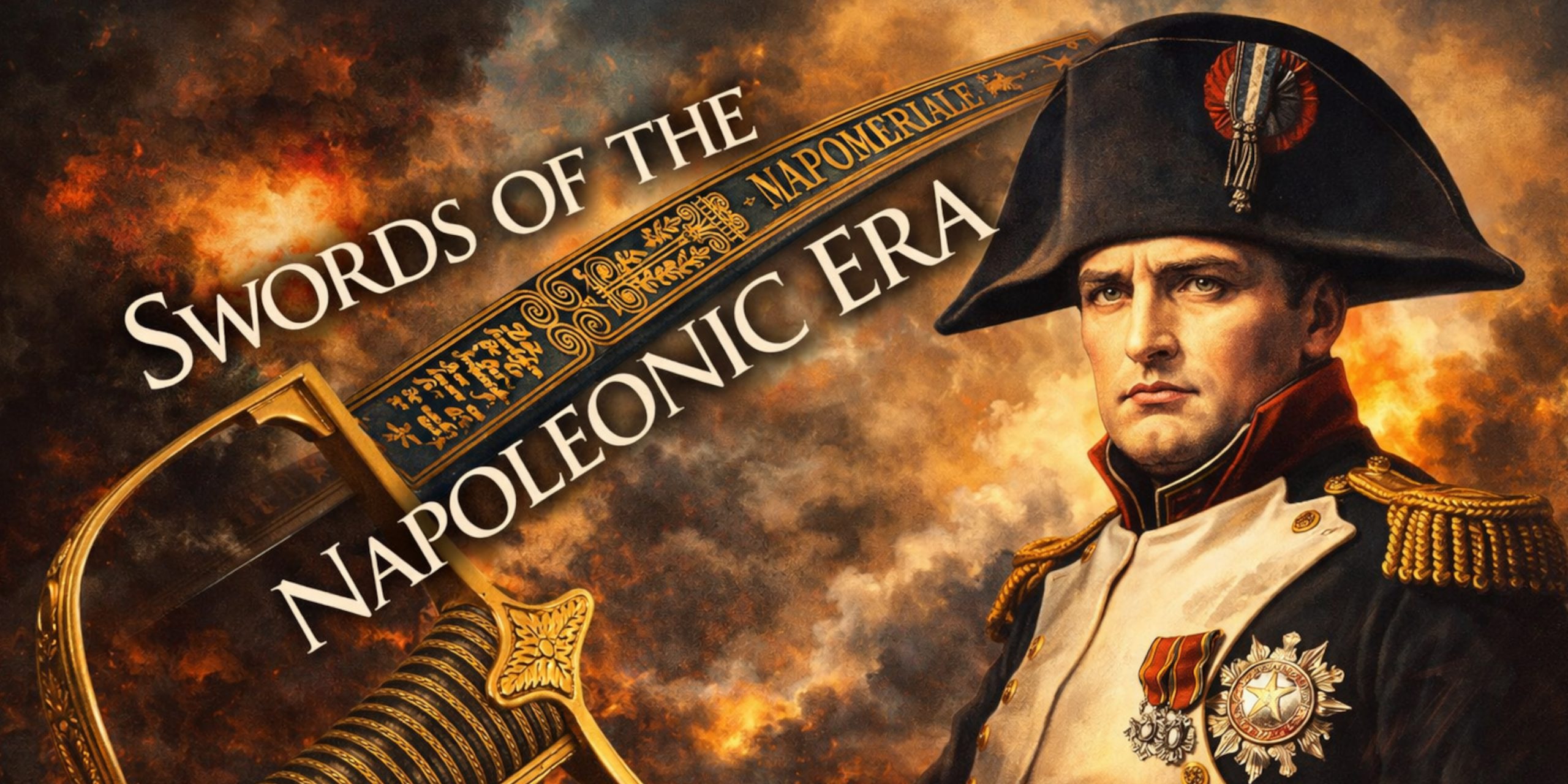
The Napoleonic Wars did not invent the sword, but they represent its final great chapter as a primary battlefield weapon in Europe. Between 1792 and 1815, hundreds of thousands of blades were forged, inspected, carried and blooded across the continent.
The period produced some of the most recognisable sword patterns ever issued, from the heavy British cavalry sabres to the elegant French light cavalry blades and the disciplined geometry of Prussian and Austrian designs. It was an era when industrial standardisation met older craft traditions, when steel was shaped not only by hammer blows but by bureaucratic reform.
As a historian, I find Napoleonic swords fascinating precisely because they stand at a crossroads. They are both modern military equipment and the last heirs of medieval craft culture.
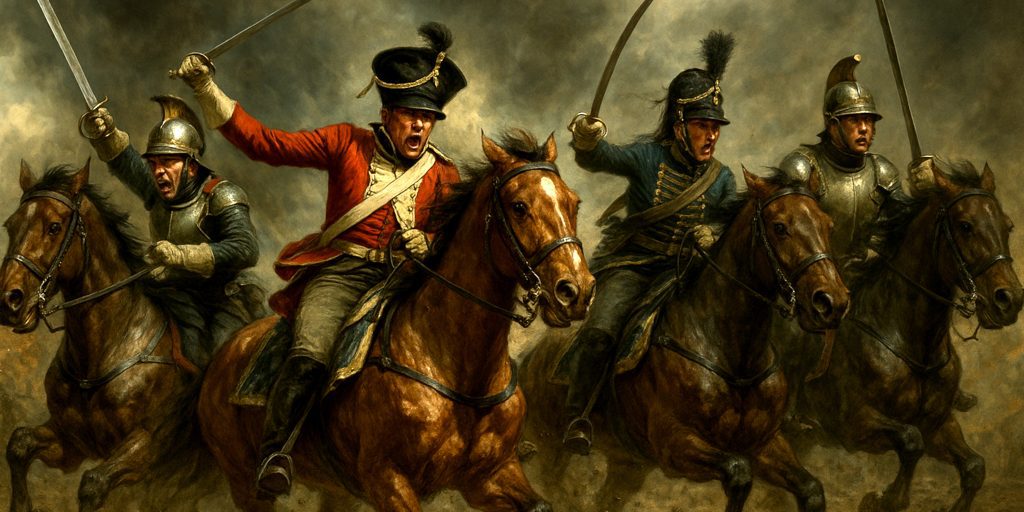
Forging and Steel: How Napoleonic Blades Were Made
By the late eighteenth century, European sword manufacture had moved toward greater uniformity. Armies required consistency, durability and volume. The romantic image of a lone master smith still existed, but increasingly production involved networks of forges, grinders and polishers working under state contracts.
Steel Production
Most European powers relied on refined blister steel or shear steel. Britain benefitted from advances in crucible steel production pioneered in Sheffield, allowing for more homogeneous and reliable blades. Continental producers used a mix of imported steel and domestic sources.
In France, Klingenthal in Alsace became the principal state manufactory. Blades were forged from high carbon steel billets, repeatedly heated and hammer forged to shape. Careful control of carbon content was essential. Too soft and the blade would bend permanently. Too hard and it risked shattering under impact.
Heat treatment involved quenching, often in water or oil, followed by tempering to relieve brittleness. Surviving inspection marks reveal that blades were tested by flexing them significantly to ensure resilience. A good sabre would bend and spring back true.
Blade Geometry and Grinding
After forging, blades were ground to their final profile. The fuller, that familiar groove along the blade, was not decorative. It reduced weight while preserving stiffness. British heavy cavalry blades of 1796, for example, featured broad fullers that lightened what was otherwise an imposing cutting weapon.
Polishing and finishing required great skill. Officers’ blades were often etched or blued and gilt, with patriotic motifs, trophies of arms and royal cyphers. Enlisted men’s weapons were plainer but still required careful finishing to prevent corrosion.
Famous Workshops and Centres of Production
Klingenthal and Châtellerault
Manufacture d’armes de Klingenthal became the beating heart of French blade production from 1730 onwards. During the Napoleonic period, it supplied cavalry, infantry and naval swords on a vast scale. Later, production shifted to Manufacture d’armes de Châtellerault, which reflected France’s broader industrial consolidation.
French blades are typically marked with spine inscriptions identifying inspectors and dates. These marks are invaluable to collectors today.
Solingen
Solingen had been synonymous with sword making for centuries. During the Napoleonic Wars, Solingen workshops supplied blades across Europe, including Britain. Even when hilts were mounted elsewhere, the blade itself often originated in this Rhineland centre.
Birmingham and London
In Britain, sword production was more decentralised. Birmingham handled much of the manufacturing, with London retailers such as Runkel & Co and Osborn & Gunby supplying officers.
The British government’s Board of Ordnance oversaw pattern approval. The result was a fascinating blend of private enterprise and state regulation. Officers purchased their own swords, which explains the variation in quality and decoration.
The Evolution of Sword Patterns
Napoleonic swords were not static. They evolved rapidly in response to battlefield experience.
The 1796 British Cavalry Sabres
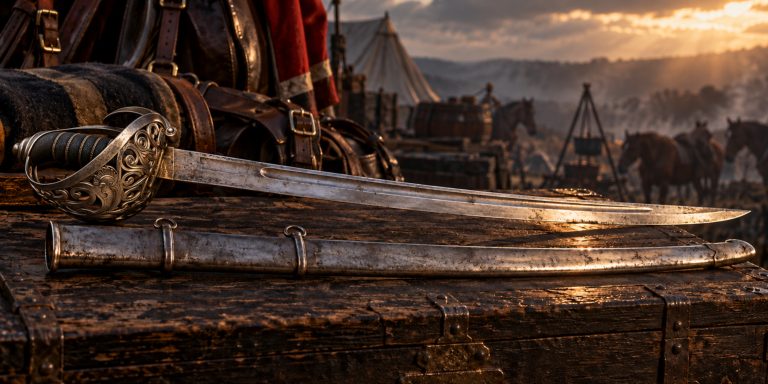
The British 1796 Light Cavalry sabre was inspired by Central European designs. It featured a curved blade optimised for slashing. Many accounts praise its cutting power. Contemporary critics, however, noted that its extreme curve reduced thrusting efficiency.
The 1796 Heavy Cavalry sword, with its straight blade, was intended for powerful downward cuts from horseback. In practice, it proved unwieldy and sometimes poorly balanced. Later reforms in 1821 produced more refined patterns influenced by continental models.
French An XI and An XIII Sabres
French light cavalry sabres of the Year XI pattern were elegant, well balanced and widely admired. They struck a compromise between cut and thrust capability. Napoleon’s cavalry, particularly the hussars and chasseurs à cheval, relied heavily on these curved blades in fast moving engagements.
Heavy cavalry swords, carried by cuirassiers, were straight and optimised for the thrust. In the shock of a mounted charge, a straight blade offered penetration against opposing cavalry and infantry formations.
Infantry and Staff Swords
Infantry officers carried spadroons or lighter sabres. These were often more symbolic than practical, yet in close combat they could still be deadly. As firearms improved, the sword’s battlefield role diminished, but officers continued to carry them as markers of authority and tradition.
Effectiveness and Soldier Experience
A sword’s reputation was shaped as much by the soldier wielding it as by its design.
Cavalry sabres were devastating in pursuit or against broken infantry. In disciplined squares, however, charging horsemen found themselves facing bristling bayonets. The sword could not overcome tactical reality.
British cavalry in the Peninsular War earned a reputation for ferocious cutting attacks. French cuirassiers, armoured and equipped with long straight swords, excelled in close order shock action.
Letters and memoirs suggest that soldiers valued reliability above all. A blade that bent permanently or snapped under stress could mean death. There is a certain grim pragmatism in the sources. Few soldiers wax lyrical about steel quality. They cared whether it worked.
Industrialisation and Standardisation
The Napoleonic era accelerated standardised military production. Patterns were approved, measurements fixed and inspection marks applied.
This did not eliminate variation. Contractors cut corners, steel supplies fluctuated and wartime pressure forced compromises. Still, compared to earlier centuries, the level of uniformity was striking.
It marked the beginning of the modern military procurement system. The sword, paradoxically an ancient weapon, became a product of early industrial bureaucracy.
Cavalry Swords
Napoleonic Cavalry were the glamour troops of the period, and their swords reflected their roles.
Heavy Cavalry

Designed for raw impact, these swords favoured thrusting power and sheer weight.
- British 1796 Heavy Cavalry Sword – A straight, broad-bladed brute that looked more like a cleaver than a gentleman’s weapon. Infamous at Waterloo in 1815 for the carnage it caused.
- French AN XI Heavy Cavalry Sword – Straight-bladed and brutally effective, carried by Napoleon’s cuirassiers in their thunderous charges.
- Austrian 1769 & 1798 Heavy Cavalry Pallasch – Long, straight thrusting swords influenced by earlier Germanic designs, less refined but deadly in massed formations.
Light Cavalry

Speed and cutting ability mattered more than brute strength here.
- British 1796 Light Cavalry Sabre – Perhaps the most iconic sword of the wars, its sweeping curve perfect for slashing attacks. Inspired by Hungarian hussars, beloved by Britain’s light dragoons.
- French AN IV & AN XI Light Cavalry Sabres – Elegant curved sabres, standard issue for chasseurs à cheval and hussars who lived and died by mobility.
- Prussian 1811 Blücher Sabre – A faithful copy of the British 1796, so effective the Prussians adopted it wholesale.
Infantry Swords
Infantry were the workhorses of every army, but swords were mostly the preserve of officers or elite troops. Practicality often trumped flair.
- British 1796 Infantry Officer’s Sword – A straight, slender spadroon-type weapon more suited to duelling and ceremony than surviving a French bayonet charge.
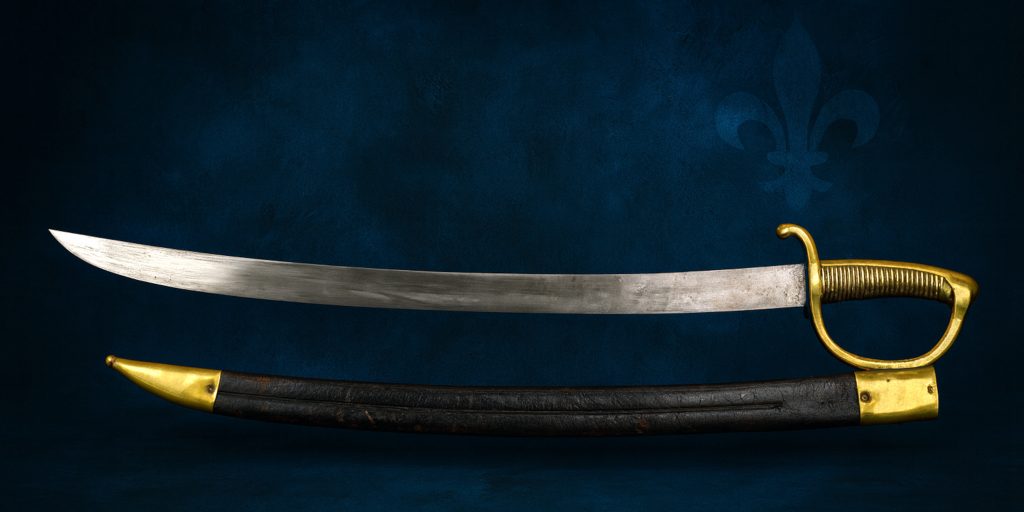
- French Briquet Sabre (AN IX & AN XI) – A chunky short sword issued to grenadiers and voltigeurs. Its weight made it better for hacking brush than for duelling, but it was reliable in close scrapes.
- Austrian M1798 Infantry Officer’s Sword – Straight-bladed and serviceable, worn by officers who had more pressing duties than swordplay.
- Prussian 1808 Infantry Officer’s Sword – Another spadroon-like piece, a symbol of authority as much as a weapon.
Naval Swords
Life at sea demanded short, tough blades for cramped boarding actions and vicious melees on deck.
- British 1804 Royal Navy Cutlass – Sturdy and curved, the quintessential sailor’s weapon. Issued in bulk and swung with enthusiasm during the great fleet battles.
- French Naval Cutlass (Sabre de Bord AN XI) – Similar in form to the British version, used in the brutal chaos of boarding actions.
- Spanish M1802 Naval Cutlass – A heavy-duty blade for Spanish sailors, part tool, part weapon in the long wars at sea.
Artillery and Engineer Swords
Specialist troops had their own blades, often short and practical.
- British 1803 Flank Officer’s Sword – A curved sabre for light infantry and artillery officers, blending style with battlefield utility.
- French AN XI Artillery Sabre – Short, curved, and tough, ideal for artillery crews who needed sidearms for emergencies rather than lengthy duels.
- Prussian M1811 Artillery Sword – A no-nonsense straight blade, influenced by the British 1796 infantry sword.
Specialised and Officer Swords

The Napoleonic officer’s sword walked a fine line between weapon and jewellery. Some were elegant sidearms, others lavishly decorated symbols of rank.
- British 1803 Infantry Officer’s Sabre – A popular choice among light company and Rifle officers, marrying practicality with flair.
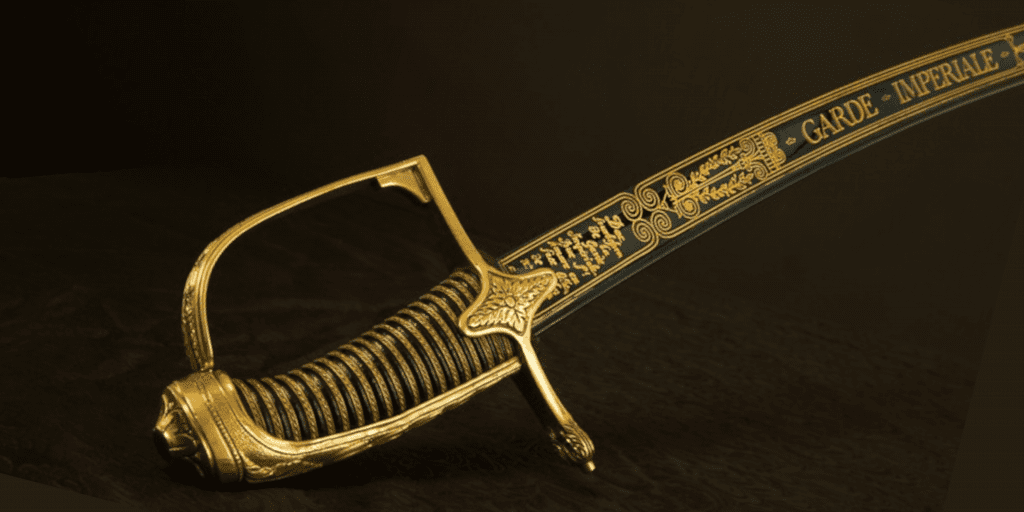
- French Empire Guard Officer’s Sword – Gilt, ornate, and as much a badge of honour as a blade, carried by Napoleon’s elite Guard.
- Spanish M1806 Officer’s Sword – A thrusting sword that served officers throughout the bitter campaigns of the Peninsular War.
Comparison Table: Napoleonic Swords at a Glance
| Sword | Nation | Type | Length (avg) | Weight (avg) | Role |
|---|---|---|---|---|---|
| British 1796 Heavy Cavalry Sword | Britain | Heavy Cavalry | 35 in (89 cm) | 2.5–3 lbs | Shock charges, brutal cuts and thrusts |
| French AN XI Heavy Cavalry Sword | France | Heavy Cavalry | 38 in (96 cm) | 3 lbs | Cuirassier charges, thrust-focused |
| Austrian Pallasch (1769/1798) | Austria | Heavy Cavalry | 37–39 in (94–99 cm) | 3 lbs | Thrusting, massed formations |
| British 1796 Light Cavalry Sabre | Britain | Light Cavalry | 33 in (84 cm) | 2.2 lbs | Slashing, speed and mobility |
| French AN XI Light Cavalry Sabre | France | Light Cavalry | 33 in (84 cm) | 2–2.5 lbs | Hussar and chasseur skirmishes |
| Prussian 1811 Blücher Sabre | Prussia | Light Cavalry | 33 in (84 cm) | 2.2 lbs | Copy of British 1796 sabre |
| French Briquet Sabre | France | Infantry | 24 in (61 cm) | 2 lbs | Grenadiers, close combat |
| British 1796 Infantry Sword | Britain | Infantry Officer | 32 in (81 cm) | 1.8 lbs | Officer sidearm, thrusting |
| British 1804 Cutlass | Britain | Naval | 27 in (69 cm) | 2.5 lbs | Boarding, close-quarters |
| French Naval Cutlass AN XI | France | Naval | 27 in (69 cm) | 2.5 lbs | Boarding actions |
| British 1803 Officer’s Sabre | Britain | Officer | 32 in (81 cm) | 2 lbs | Officer prestige, practical use |
Note: Lengths and weights vary slightly by manufacturer and surviving examples.
Collector’s Guide: Value, Museums, and Market Trends
Today, Napoleonic swords occupy a strong position in the militaria market.
Condition, originality and provenance are paramount. Blades retaining crisp inspection marks from Klingenthal or Solingen command higher prices. Officers’ swords with named etchings or documented service history can reach significant sums.
British 1796 Light Cavalry sabres remain particularly sought after, partly due to their association with the Peninsular War and Waterloo. French An XI sabres also enjoy steady demand, especially when matching scabbards survive.
Collectors must navigate issues of reproduction and restoration. The nineteenth century saw refurbishment of older blades, and modern replicas further complicate matters. Subtle details such as correct grip wire, patina consistency and period scabbard fittings separate authentic pieces from later copies.
Prices vary widely. Common trooper swords in average condition are accessible to serious enthusiasts. Rare officer examples with battlefield provenance can command substantial five figure sums.
From a historian’s perspective, the appeal is understandable. Holding a Napoleonic sabre is to hold an object that may have crossed Spain, Russia or the Low Countries. It carries not just steel but memory.
Auction Prices
- British 1796 Light Cavalry Sabre – Typically £800 to £2,500 depending on condition and provenance. Battle-scarred examples linked to Waterloo can fetch much higher.
- British 1796 Heavy Cavalry Sword – £1,000 to £3,500, with officer’s models or regimentally marked pieces commanding premiums.
- French Briquet Sabre – More common, usually £400 to £1,200. Scarce regimental markings add value.
- French AN XI Heavy Cavalry Sword – £1,500 to £4,000, with cuirassier examples especially desirable.
- Naval Cutlasses (British or French) – £600 to £2,000, though rare variants and engraved officer models may climb higher.
Where to See Them
- National Army Museum (London) – Holds fine examples of British 1796 sabres.
- Musée de l’Armée (Paris) – A treasure trove of French swords, including ornate Guard officer’s weapons.
- Imperial War Museum (London) – Displays Napoleonic cavalry swords alongside uniforms and pistols.
- Royal Armouries (Leeds) – Offers both cavalry and naval swords, including rare experimental models.
Market Insights
Collectors value swords with clear provenance. Regimental engravings, battle honours, or officer ownership all push prices higher. Condition is important, but many collectors enjoy the patina of service wear. Officer’s swords are generally scarcer than enlisted models, and presentation swords with inscriptions sit at the top end of the market.
The Seven Swords Takeaway
By 1815, the sword was already ceding ground to the bayonet and firearm as the decisive infantry weapon. Yet cavalry would continue to carry sabres for decades.
Napoleonic era swords represent the final flowering of the blade as a practical instrument of mass warfare in Europe. They embody craft, industrial ambition and human violence in equal measure.
When I examine one in a museum or private collection, I am struck by its dual nature. It is both a work of skilled metalwork and a tool designed for brutal efficiency. That tension defines the age itself.