One of the most revealing swords from Han China has animals running along its blade. A craftworker picked them out in gold and silver wire against bronze, reducing a landscape to a few fine lines. Sheathed, the whole scene disappeared. Whoever commissioned the sword paid for something that only an unsheathed blade could show.
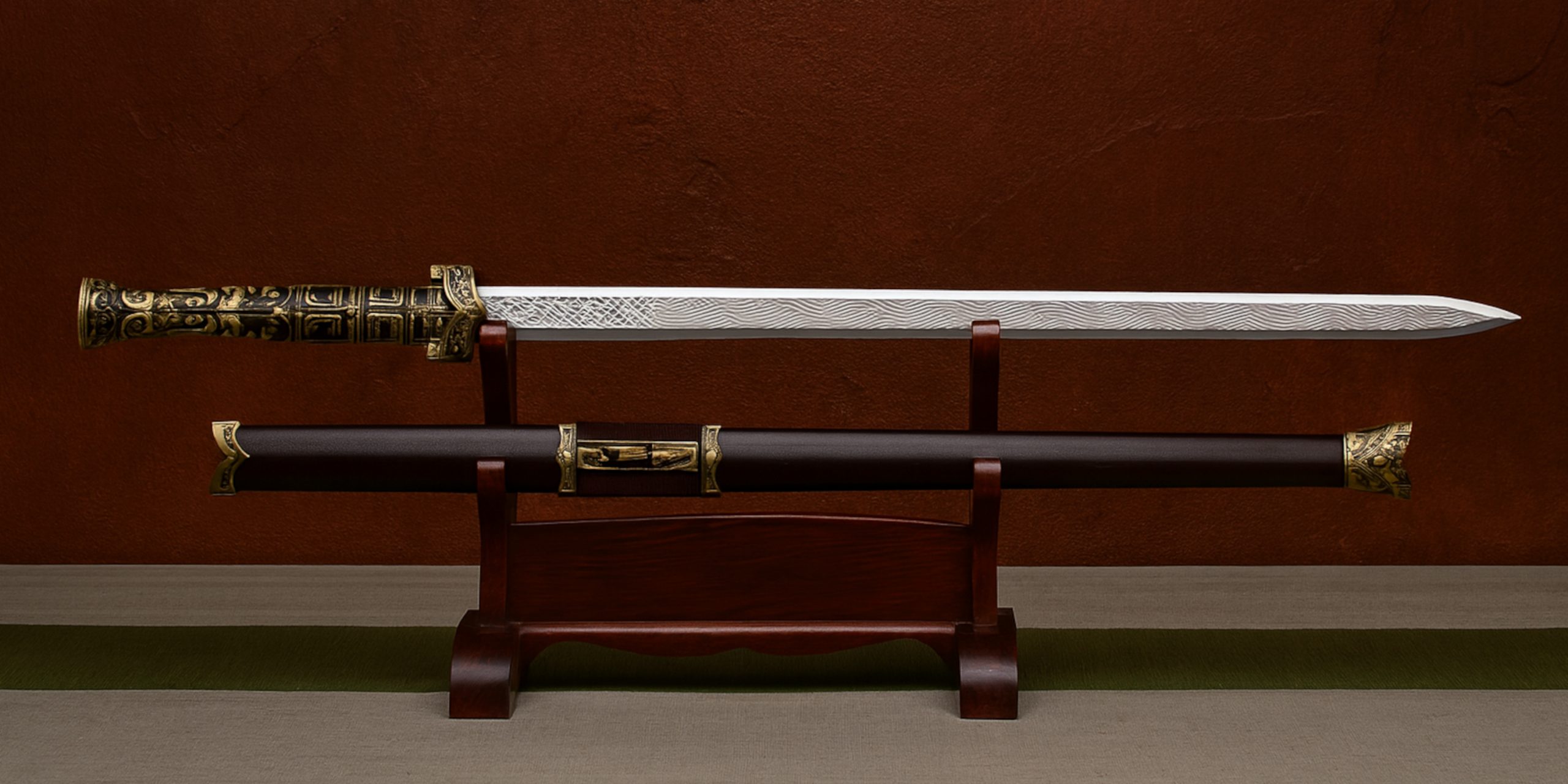
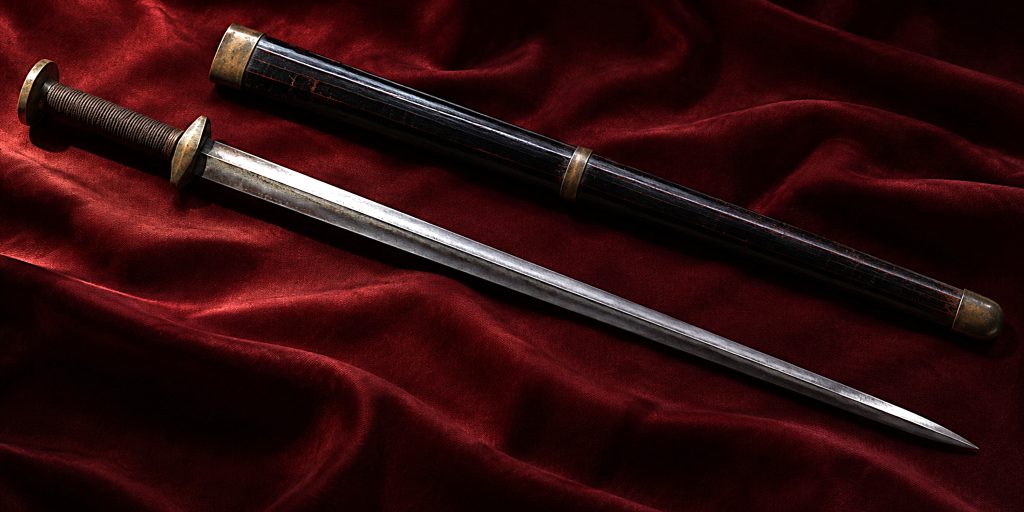
The Han jian was the straight, double-edged sword of China’s Han dynasty (206 BCE to 220 CE). The name covers considerable variety. A bronze blade from an elite collection and an iron sword recovered from a provincial tomb can share the same outline while telling quite different stories about who made them, who wore them and why they survived.
Han jian specifications
| Feature | What survives |
|---|---|
| Blade | Two cutting edges taper towards a central point. A raised ridge can give the blade a faceted profile. |
| Material | Bronze and iron both occur. Steel was available to Han smiths, although identifying a particular blade’s metal and treatment requires examination. |
| Length | The Metropolitan Museum of Art’s inlaid bronze blade measures 51.4 cm. Long iron swords of the late Zhou and Western Han could approach a metre. Blade length and complete sword length are separate measurements. |
| Width and thickness | The Met records its bronze example at 2.9 cm wide and 0.6 cm deep. These figures belong to that object. |
| Hilt | Surviving arrangements include compact guards, disc pommels and grips fitted over a tang. An excavated example from Guizhou pairs an iron blade with a copper-based metal handle. |
| Scabbard | Wood and lacquer could form the sheath. On finer examples a carved jade slide attached the scabbard to the wearer’s belt. |
Weight is the least satisfactory entry in a general specification. An iron sword can lose metal through corrosion, while a missing grip, guard or pommel alters both its weight and the way it sits in the hand. A modern reproduction can be weighed to the gram and still tell us very little about the original.
History and evolution
The outline of the jian was already familiar in the Warring States period. Earlier bronze swords had the paired edges, pointed tip and central ridge that remained recognisable under the Qin and Han. An auction catalogue that dates a sword broadly from the Warring States to the Western Han is acknowledging a real difficulty. A change of dynasty left no convenient date stamp on the hilt.
Under the Western Han, bronze casting and ironworking overlapped. The sword excavated in 1978 at Kele in Hezhang County is particularly instructive. Its maker chose iron for the blade and a copper-based alloy for the handle. On the Met’s bronze blade, meanwhile, the surface served as a ground for precious-metal inlay. Both objects belong to the Western Han. Arranging them on a simple ladder from bronze to iron would miss what each maker was trying to achieve.
Iron also changes the archaeological picture long after burial. A conservation study of six iron sword samples from Tuchengpo Cemetery in Chongqing examined the corrosion products that had formed on them. A heavily altered surface can preserve the outline of a weapon while obscuring its original finish. The more legible decoration on bronze gives it a considerable advantage in a museum photograph.
The Han period also saw the rise of the long, single-edged dao with a ring at the pommel. Examples from high-status tombs show that the two sword traditions overlapped. The dao gained military prominence over time, while the jian retained a place in elite dress and, much later, in martial practice.
Advantages and disadvantages
| Design choice | Advantage | Limitation |
|---|---|---|
| Two edges and a central point | One blade offered both cutting edges and a point suited to thrusting. | Both edges needed finishing and care, and damage to the tip altered the meeting point of the two. |
| Compact guard | The hilt sat neatly beside the body when the sword was worn. | The small guard offered limited cover for the hand. |
| Belt-mounted scabbard | The wearer could carry the sword while leaving both hands free. Its fittings could also display wealth or taste. | A long, rigid scabbard took up space at the hip, especially when sitting. |
Reach varied considerably between individual swords. So did the character of the hilt. Claims about the exceptional lightness or perfect balance of the Han jian are difficult to square with such a varied group of objects.
Han jian compared with similar swords
| Sword | Distinguishing feature | Historical connection |
|---|---|---|
| Warring States bronze jian | Cast, straight, double-edged blade, often with a pronounced ridge | The closest predecessor. Some examples are difficult to date more narrowly without a secure find context. |
| Han ring-pommel dao | A single cutting edge, a back and a conspicuous open ring at the end of the grip | A contemporary alternative. Early examples could be straight, so curvature alone is a poor way to distinguish a dao from a jian. |
| Qing dynasty jian | The straight, double-edged blade continued, with later fashions in guards, grips and scabbard decoration | A useful comparison for the persistence of the form across nearly two millennia. Its fittings belong to a different world. |
The legacy of the Han jian
A sword could communicate quite a lot while its blade stayed hidden. At the belt, a visitor might see polished jade, lacquer and the end of a carefully finished hilt. The carved slide had a practical job holding the scabbard in place, yet it also put a valuable material where other people could see it. To understand the jian as an object of dress, the little fitting matters as much as the blade.
Later generations continued to associate the jian with rank, cultivation and martial accomplishment. The nineteenth-century jian in the Royal Armouries makes a rewarding companion to a Han example. The silhouette is immediately recognisable. The long interval between the two leaves ample room for changes in how swords were mounted, carried and understood.
Where to see a Han jian
- Guizhou Provincial Museum, Guiyang. Look up Iron Sword with cupreous Handle from the Western Han Dynasty. Its recorded findspot at Kele makes this a particularly valuable example for anyone interested in the archaeological history of a sword. Museum record
- Metropolitan Museum of Art, New York. The online photographs of Sword Blade, accession 65.74.1, reward close inspection. Follow the gold and silver animals along the blade, then compare the separate Western Han nephrite scabbard slide. The museum lists the blade as off display. Sword blade · Scabbard slide
- Royal Armouries, UK. For the later history of the form, the collection records a nineteenth-century Chinese jian with its scabbard. Check its current location before planning a visit. Sword and scabbard
Collectors’ guide and auction prices
Start with the auctioneer’s exact description. “Western Han”, “Warring States to Han” and “Han style” make three different claims. The last describes an appearance and leaves the date open. Equally important is what the lot actually contains. A detached jade guard, a fragment of bronze and a pair of complete-looking swords belong in different comparisons.
| Auction lot | Catalogue description | Published sale price |
|---|---|---|
| Waddington’s, 6 October 2022, lot 157 | Two bronze jian attributed to the Warring States period or Western Han. The longer measured 50 cm. | CAD 5,400 for the pair, including buyer’s premium. Lot record |
| Galerie Zacke, lot 208 | Bronze sword fragment with a jade guard, attributed to the Warring States to Han period | €650, reported as sold. Lot record |
Neither sale establishes a going rate for a securely excavated Han iron jian. Both preserve a broader date range, and the Canadian figure covers two objects in one transaction.
Questions worth asking before bidding
- What is the earliest dated photograph, invoice or inventory entry that identifies this particular object? The Waddington’s pair came with certificates dated 1995. Those provide a point in its documented history, distinct from the proposed ancient date.
- Which parts are original to the assembly? Ask specifically about the joint between guard and blade, repaired breaks and any replacement grip. A genuinely old fitting can still be a later addition to a particular sword.
- What supports the attribution? A recorded excavation, a close parallel from a dated tomb and a dealer’s stylistic opinion carry different evidential weight. Ask to see the comparison the catalogue relies on.
- What does the condition report say about active corrosion, coatings and restoration? On an ancient blade, a newly polished surface may have cost the object some of its surviving evidence.
Sources and further reading
- Metropolitan Museum of Art, Western Han sword blade and nephrite scabbard slide.
- Guizhou Provincial Museum, Western Han iron sword excavated at Kele.
- Heritage Science, analysis of iron sword corrosion at Tuchengpo Cemetery.
- Scientific Reports, metallurgical study of the Han ring-pommel dao.
- Royal Armouries, nineteenth-century jian and scabbard.