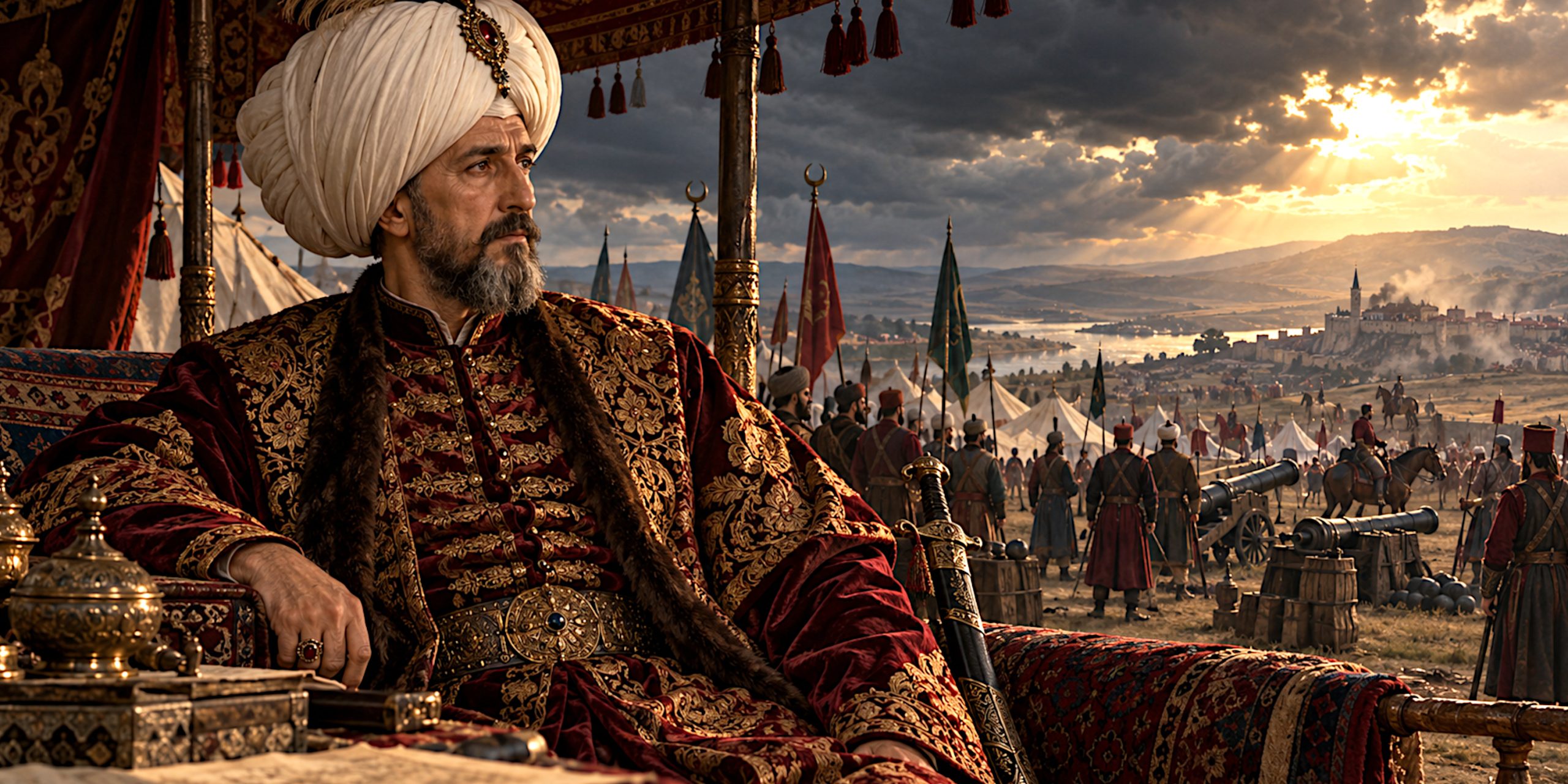
Suleiman the Magnificent ruled the Ottoman Empire from 1520 to 1566, overseeing military expansion, legal reform and extraordinary artistic patronage. His armies broke the Hungarian kingdom at Mohács, his officials governed territories across three continents, and his architects reshaped the skyline of Istanbul.
Yet the familiar portrait of a wise ruler beneath an enormous turban needs some scrutiny. Suleiman ordered the deaths of trusted servants and members of his own family. His empire offered opportunities for advancement while depending on slavery, compulsory recruitment and conquest.
What interests me most is how comfortably these contradictions occupied the same throne. The poet, patron and executioner were all Suleiman. Understanding him requires keeping each in view.
Who Was Suleiman the Magnificent?
| Detail | Information |
|---|---|
| Name | Suleiman I, also written Süleyman |
| Born | Usually dated to 6 November 1494, in Trabzon |
| Parents | Sultan Selim I and Hafsa Sultan |
| Reign | 1520–1566 |
| Dynasty | Ottoman |
| Principal consorts | Hürrem Sultan and Mahidevran |
| Successor | His son Selim II |
| Death | September 1566, during the siege of Szigetvár |
| Burial | His mausoleum beside the Süleymaniye Mosque, Istanbul |
“The Magnificent” reflects European impressions of his wealth and power. In Turkish historical memory he is Kanuni, the Lawgiver, although that title became established after his lifetime.
Neither label is neutral. One directs attention towards imperial spectacle; the other towards orderly government. Both tell us something useful, provided we remember who was doing the remembering. islamansiklopedisi.org.tr
Early Life and Accession
Suleiman grew up within a dynasty in which succession could become a lethal competition. His father, Selim I, secured the throne through a struggle that demonstrated how little protection blood relationship offered.
Provincial governorships gave Suleiman experience before his accession. When Selim died in 1520, he inherited a powerful state, substantial resources and an experienced military establishment.
That inheritance matters. Suleiman did not conjure an empire from personal brilliance. He expanded and adapted institutions built by earlier rulers, relying on administrators, commanders and provincial elites whose work rarely receives equal space in royal biographies.
The sultan supplied authority and direction. Thousands of other people supplied the paperwork, provisions and bridges.
Conquests and Military Campaigns
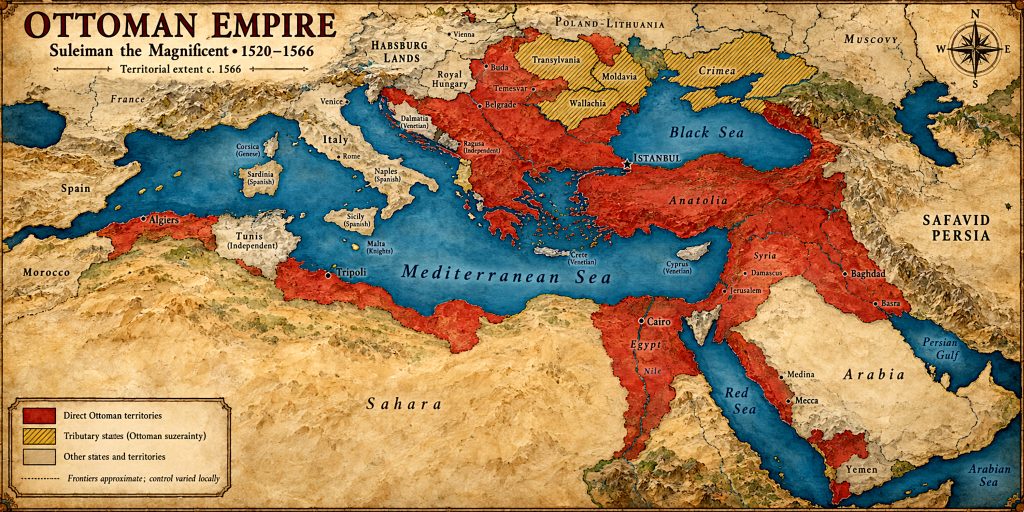
Suleiman’s victories changed the balance of power in Europe and the Middle East. His failures are equally revealing: Ottoman strength was considerable, but distance, weather and determined resistance still imposed limits.
| Date | Campaign or event | Significance |
|---|---|---|
| 1521 | Capture of Belgrade | Opened an important route into Hungary |
| 1522 | Conquest of Rhodes | Removed the Knights Hospitaller from their island stronghold |
| 1526 | Battle of Mohács | Defeat and death of Louis II destabilised the Hungarian monarchy |
| 1529 | Siege of Vienna | Ottoman forces withdrew without taking the city |
| 1534 | Capture of Baghdad | Extended Ottoman authority into Iraq |
| 1538 | Battle of Preveza | Barbarossa strengthened Ottoman naval power |
| 1541 | Occupation of Buda | Established direct Ottoman government in central Hungary |
| 1555 | Peace of Amasya | Settlement with Safavid Persia |
| 1565 | Siege of Malta | Major Ottoman expedition failed |
| 1566 | Siege of Szigetvár | Suleiman died before the fortress fell |
Hungary and Vienna
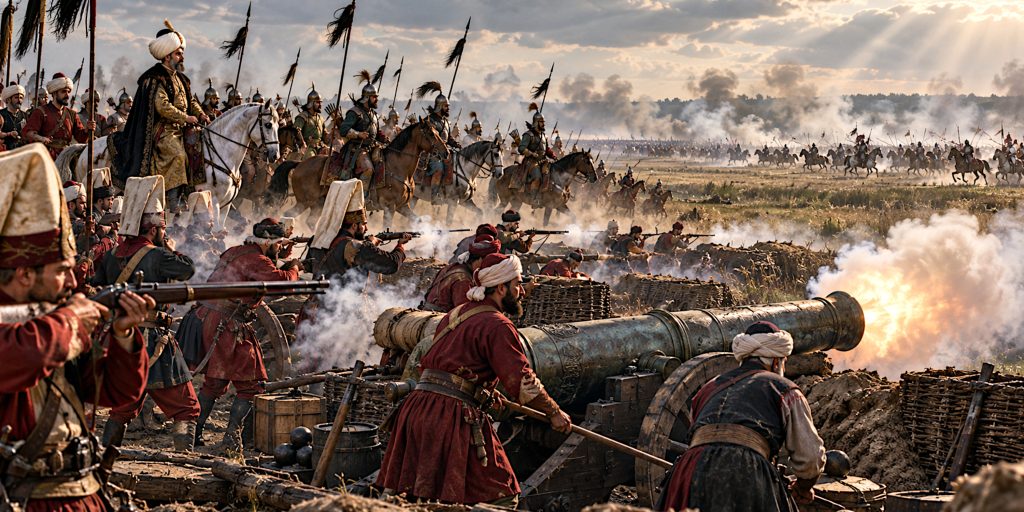
Mohács was a battlefield victory with consequences far beyond the battlefield. Hungarian succession disputes and Habsburg intervention helped turn conquest into a prolonged struggle over central Europe.
Vienna exposed the difficulty of campaigning far from Ottoman supply centres. Rain, transport problems, seasonal pressures and the defenders’ resistance all mattered. Explaining the withdrawal simply as either Ottoman incompetence or Christian heroism leaves rather a lot of mud out of the story.
Persia and the Mediterranean
Against the Safavids, Ottoman operations faced different problems: long distances, difficult terrain and an opponent who could avoid a decisive engagement.
At sea, Suleiman depended on accomplished commanders, particularly Hayreddin Barbarossa. Naval victories during his reign belong in his political record, but they should not become battles he supposedly directed in person.
Malta provides the clearest corrective to any claim of uninterrupted success. Magnificent was an epithet, not a guarantee.
Forces, Commanders and Military Equipment
The Ottoman army combined salaried household troops, provincial cavalry, irregular forces and specialist support units. Its effectiveness depended on coordination rather than a single celebrated corps.
| Formation | Main role | Typical equipment |
|---|---|---|
| Janissaries | Household infantry, siege fighting and garrison service | Matchlock firearms, bows and sidearms |
| Timariot sipahis | Provincial cavalry supported through revenue assignments | Composite bows, lances, sabres and varying armour |
| Household cavalry | Mounted service around the sultan and central army | Bows, lances, sabres and protective equipment |
| Akıncı | Reconnaissance, raiding and disruption | Light cavalry equipment, bows and sabres |
| Artillery corps | Siege bombardment and battlefield support | Cannon, powder and specialist tools |
| Engineers and support personnel | Mining, transport, crossings and supply | Entrenching tools, bridging equipment and draught animals |
Armour varied with wealth and function. Mail, helmets, shields and combinations of mail and plate remained useful, particularly among cavalry. There was no single uniform appearance shared by every Ottoman soldier.
Important figures around Suleiman included:
- Ibrahim Pasha: grand vizier, commander and influential companion.
- Hayreddin Barbarossa: admiral central to Ottoman Mediterranean power.
- Rüstem Pasha: grand vizier and a major figure in court politics.
- Sokollu Mehmed Pasha: senior statesman during the final years.
- Ebussuud Efendi: leading jurist associated with the reign’s legal settlement.
Swords and Surviving Artefacts
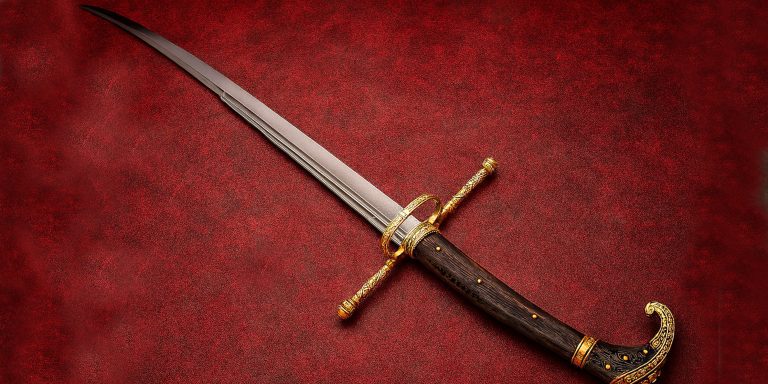
The kilij, a curved Ottoman sabre, is the sword most readily associated with Ottoman military culture. Examples varied considerably; later forms should not be imposed on every sixteenth-century reconstruction.
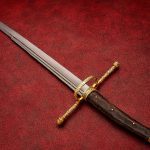
The yataghan offers a particularly valuable connection to Suleiman’s court. This short, guardless weapon has a distinctive double-curved blade.
The Metropolitan Museum of Art holds an example dated to about 1525–1530, attributed to the workshop of Ahmed Tekelü. Its steel blade, gold decoration and precious materials reveal the sophistication of imperial craftsmanship. A closely related sword at Topkapı was made for Suleiman in 1526–1527.
The distinction matters: the Met’s weapon comes from his court workshop, but should not casually be described as his personal sword. Nor should the yataghan’s later popularity among Ottoman troops be projected backwards as universal issue in his army. The Metropolitan Museum of Art
A richly decorated sword could serve several purposes at once: weapon, gift, statement of rank and demonstration that its owner employed exceptionally good craftsmen.
Why Was He Called the Lawgiver?
Suleiman’s legal reputation rests on the organisation and development of kanun, the sultan’s regulations, alongside Islamic law.
This was government through taxation, landholding, administrative rules and judicial interpretation. It involved officials and jurists as well as the ruler himself.
I find this aspect of the reign less theatrical than the campaigns, but no less consequential. A conquest could be announced in a day. Governing the resulting province required decisions about revenue, obligations and disputes for generations.
There is an essential qualification. Greater regularity in government did not mean equality before the law in a modern sense. Ottoman society remained hierarchical, and religious status, dependence and slavery shaped people’s rights and opportunities.
The Lawgiver governed an imperial order. He did not abolish its inequalities.
Hürrem Sultan and the Imperial Family
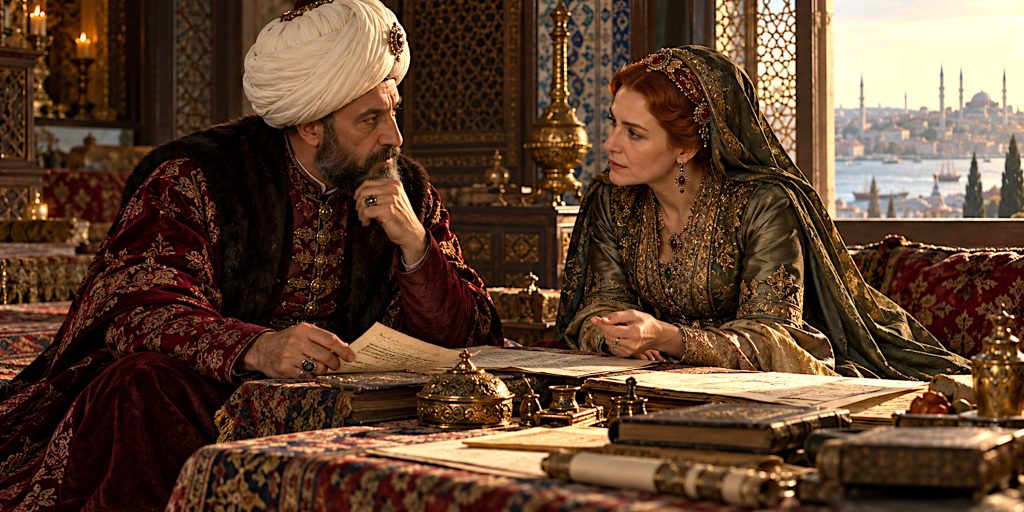
Hürrem, known in European accounts as Roxelana, entered the palace through enslavement and became Suleiman’s wife. Their marriage departed from recent dynastic practice and gave their relationship unusual political visibility.
She exercised influence through patronage, correspondence and her position within the household. Reducing her to a scheming romantic rival misses the institutional importance of the imperial family.
The same caution applies to Mihrimah Sultan, their daughter, whose charitable and architectural patronage helped establish her public standing.
Court accounts often explain political disasters through the influence of supposedly manipulative women. Historians should be careful here. Such stories could shift responsibility away from men who possessed formal authority, including the sultan.
Hürrem mattered. Suleiman still made Suleiman’s decisions.
Executions and the Succession Crisis
The darkest events of the reign resist any comfortable celebration.
Ibrahim Pasha was executed in 1536 after years of exceptional influence. His fate demonstrates how insecure even the highest office could be when authority depended on the ruler’s confidence.
In 1553 Suleiman ordered the execution of his son Mustafa, a prince with substantial support. Accusations of conspiracy surrounded the decision, but the precise balance of genuine fear, political rivalry and court manoeuvring remains disputed.
Later conflict between Selim and Bayezid further narrowed the succession. Bayezid’s defeat, flight to Safavid territory and eventual execution left Selim as the surviving heir.
These events were connected to a system in which succession could threaten both the dynasty and the state. That explains the pressures involved. It does not make the killings inevitable, or remove responsibility from the people who ordered them.
Contemporary Voices: What Busbecq Observed
The Habsburg diplomat Ogier Ghiselin de Busbecq provides a valuable foreign account of Ottoman government and military life during Suleiman’s reign.
On advancement in public service, he wrote:
“It is by merit that men rise in the service”
On campaign endurance, he praised:
“the patience, self-denial and thrift of the Turkish soldier”
These extracts total 23 words and follow the nineteenth-century English translation reproduced by Fordham University. sourcebooks.web.fordham.edu
Busbecq’s admiration deserves attention, but so does his purpose. He used Ottoman examples to criticise shortcomings at home. His account offers observation filtered through diplomatic rivalry and an argument for reform.
Nor did advancement erase coercion. Some successful Ottoman servants began their careers through enslavement or compulsory recruitment. Opportunity within that system should not be confused with freedom to enter or leave it.
Architecture, Poetry and Imperial Culture
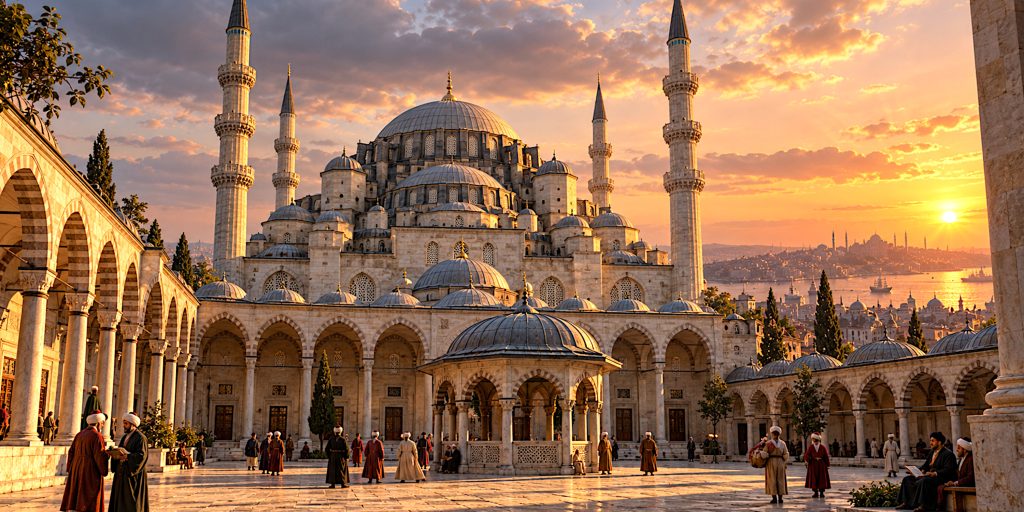
Suleiman’s cultural reputation survives most visibly in Istanbul’s Süleymaniye Mosque complex, designed by Mimar Sinan.
Its importance extended beyond the prayer hall. Educational, charitable and other supporting institutions made such foundations part of everyday urban life. They also gave imperial authority a permanent architectural presence.
Court patronage supported calligraphy, textiles, ceramics, manuscript painting and metalwork. These objects expressed wealth, taste and connections across the wider Islamic world.
Suleiman also wrote poetry under the pen name Muhibbi. That literary identity complicates the remote figure presented by formal portraits. It does not make him harmless. Sensitivity and ruthlessness have never been mutually exclusive qualifications for government.
Death and the Archaeology of Szigetvár
Suleiman died during the siege of Szigetvár in September 1566. His body was subsequently taken to Istanbul.
Near the siege site, a memorial complex developed around the place associated with his death. Research combining historical documents, landscape reconstruction, geophysics and excavation identified the site at Turbék, with investigations between 2015 and 2019 revealing the former complex.
A 2023 study describes its mausoleum, mosque, dervish lodge and defensive moat. These remains illuminate how the Ottomans commemorated their ruler in a contested frontier landscape. Repository of the Academy’s Library
The frequently repeated story that Suleiman’s organs were buried locally requires separate treatment. Identifying a memorial site does not establish the discovery of his heart or other human remains.
Archaeology is already telling an interesting story here. It does not need an extra organ for dramatic effect.
What Was Suleiman’s Legacy?
Suleiman left a formidable empire, an influential legal reputation and a cultural inheritance that remains visible in buildings and objects.
His reign also left devastated communities, prolonged frontier warfare and a dynasty whose security had been purchased through executions.
I would resist both the flawless golden-age portrait and its equally simple opposite. Suleiman was an effective ruler whose achievements were inseparable from the resources and coercive powers of empire.
The most revealing question is therefore not whether he deserved to be called magnificent. It is what his magnificence required, who benefited from it, and who bore the cost.
Sources and Further Reading
- TDV İslâm Ansiklopedisi: Süleyman I
- Fordham University: Busbecq’s Turkish Letters
- The Metropolitan Museum of Art: Yataghan from Suleiman’s court
- Hungarian Academy repository: archaeological research at Turbék