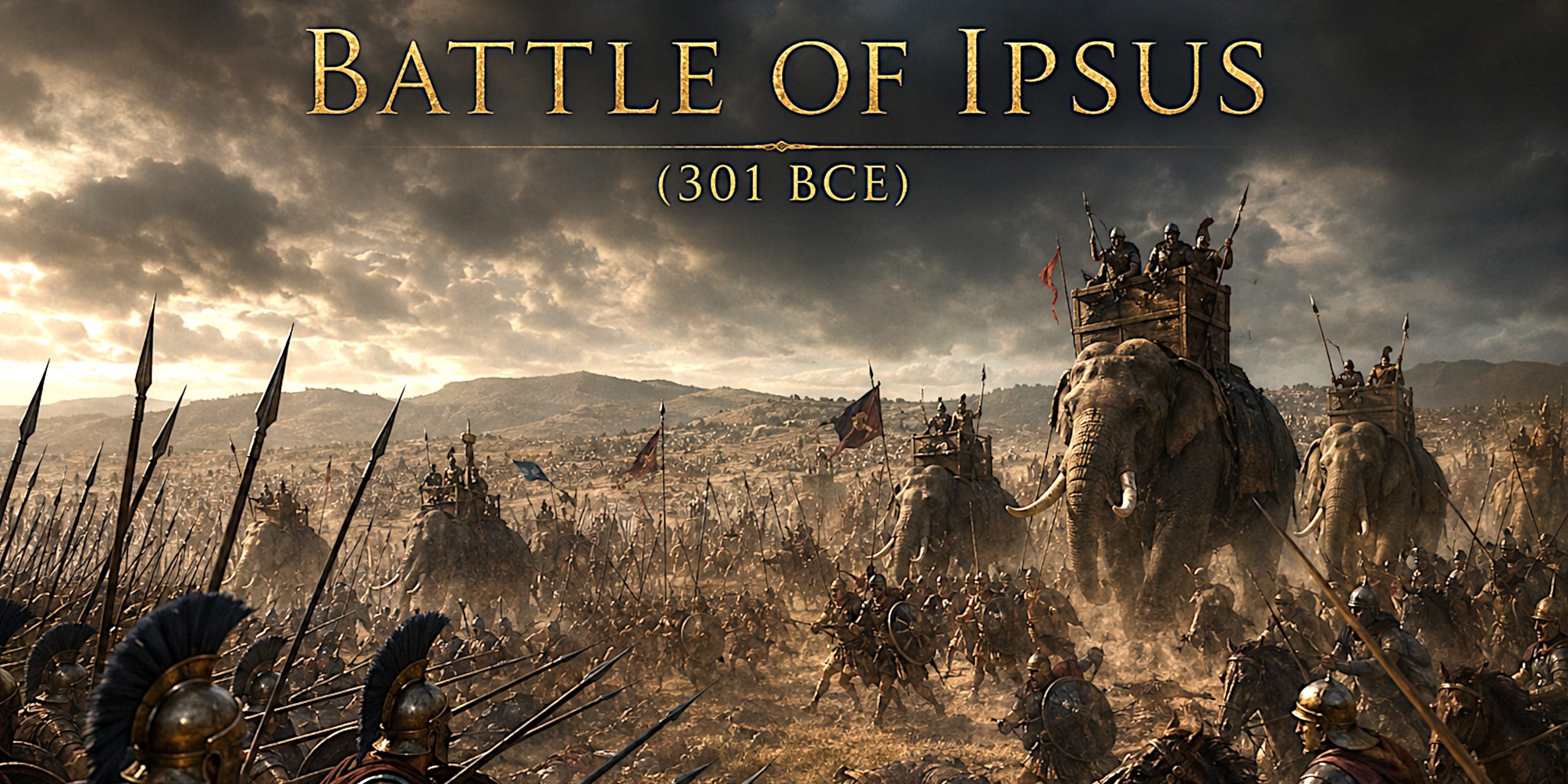
The Battle of Ipsus, fought in 301 BCE, was one of the defining moments of the ancient world. It was not simply another clash between rival kings. It was the battle that finally shattered any realistic hope of restoring the empire built by Alexander the Great.
When Alexander died in Babylon in 323 BCE, he left behind an empire stretching from Greece to India, but no capable adult heir. His generals, remembered as the Diadochi or “Successors”, spent more than twenty years fighting one another in a series of brutal wars. Alliances shifted with remarkable speed. Yesterday’s ally often became tomorrow’s bitter enemy.
Ipsus proved to be the greatest and final confrontation of these struggles. Two ageing veterans of Alexander’s campaigns, Antigonus Monophthalmus and his son Demetrius, faced an alliance led by Seleucus I Nicator and Lysimachus. The outcome determined who would inherit the eastern Mediterranean and Near East for centuries to come.
As a historian, Ipsus has always fascinated me because it demonstrates that battles are rarely won by numbers alone. Planning, logistics, timing and a little opportunism often matter far more. It also reminds us that war elephants, while undeniably impressive, could sometimes achieve more by standing still than by charging dramatically into battle.
Quick Facts
| Detail | Information |
|---|---|
| Date | 301 BCE |
| Location | Near Ipsus, Phrygia (modern Türkiye) |
| Conflict | Fourth War of the Diadochi |
| Victory | Coalition of Seleucus and Lysimachus |
| Defeated Commander | Antigonus I Monophthalmus |
| Result | Death of Antigonus and partition of his empire |
| Historical Significance | Ended any realistic chance of reuniting Alexander’s Empire |
Background
Alexander’s death created a political vacuum unlike anything the Mediterranean had previously witnessed.
Initially, his generals claimed to govern on behalf of the royal family. In reality, each gradually carved out his own kingdom. Over two decades these former comrades fought repeated wars across Greece, Asia Minor, Syria, Egypt and Mesopotamia.
By the opening years of the fourth century BCE, four dominant rulers remained.
- Antigonus Monophthalmus controlled most of Asia Minor, Syria and large areas of the former Persian Empire.
- Demetrius, his energetic son, commanded one of the finest cavalry forces of the age.
- Lysimachus ruled Thrace and had invaded western Asia Minor.
- Seleucus had rebuilt his fortunes after recovering Babylon and expanding eastwards into Persia.
The growing power of Antigonus alarmed the other Successors. Should he defeat Lysimachus before Seleucus arrived, he might recreate something close to Alexander’s original empire.
The coalition therefore had a simple objective.
Destroy Antigonus before he became unstoppable.
Forces
Precise figures remain disputed because ancient historians often exaggerated army sizes. Modern historians generally favour the following estimates.
| Army | Estimated Strength |
| Antigonid Army | 70,000 infantry, 10,000 cavalry, 75 elephants |
| Coalition Army | 64,000 infantry, 15,000 cavalry, about 400 elephants, 120 scythed chariots |
The most striking imbalance lay not in infantry or cavalry but in elephants.
Seleucus had recently returned from the east after negotiations with Chandragupta Maurya. In exchange for territory in the Indus region, he acquired hundreds of Indian war elephants. Their presence would fundamentally alter the battle.
Leaders and Troop Composition
| Commander | Role | Forces Commanded |
| Antigonus I Monophthalmus | Supreme Commander | Macedonian phalanx and overall command |
| Demetrius Poliorcetes | Cavalry Commander | Elite Companion-style cavalry |
| Seleucus I Nicator | Coalition Commander | Elephants, reserve cavalry and centre |
| Lysimachus | Coalition Commander | Main infantry and left wing |
| Cassander | Coalition Ally | Political supporter, limited battlefield presence |
Antigonid Army
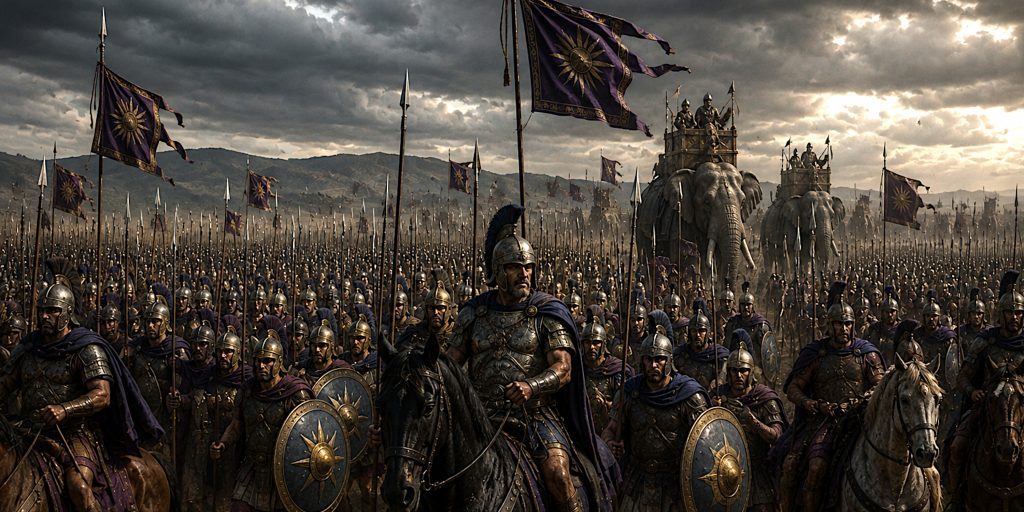
- Veteran Macedonian phalangites
- Heavy cavalry under Demetrius
- Greek mercenary infantry
- Light infantry including peltasts
- Approximately seventy-five war elephants
Coalition Army
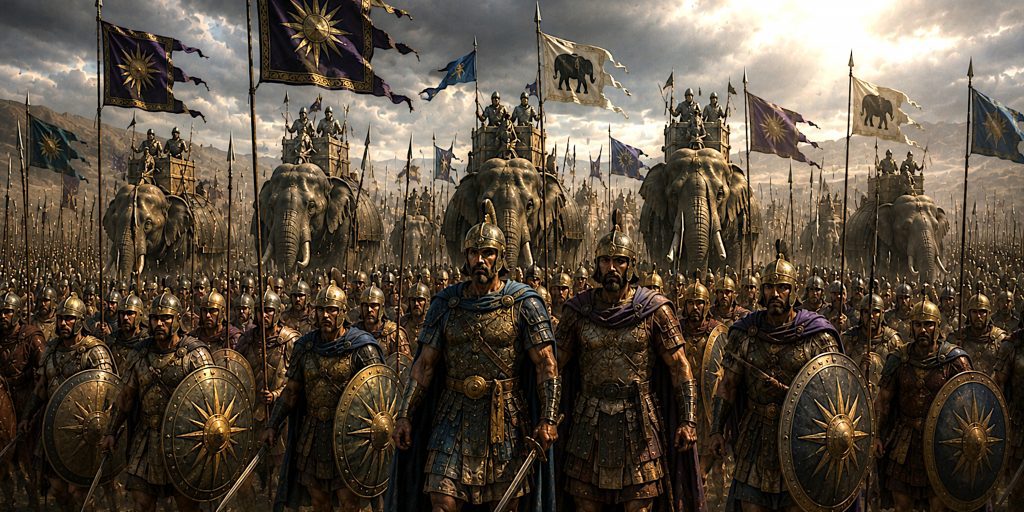
- Macedonian phalanx
- Thracian infantry
- Persian and eastern contingents
- Heavy cavalry
- Horse archers
- Around four hundred Indian war elephants
- Scythed chariots
The coalition army reflected the increasingly international nature of the Hellenistic kingdoms. Soldiers from Greece, Persia, Bactria and Central Asia fought alongside one another under experienced Macedonian commanders.
Battlefield and Terrain
The exact location of ancient Ipsus has never been identified with complete certainty, although historians generally place it within central Phrygia in modern Türkiye.
Most reconstructions suggest a broad, open plain that offered ideal conditions for both cavalry manoeuvres and the dense Macedonian phalanx.
Several features made the battlefield significant.
- Wide open ground favoured heavy cavalry.
- Relatively level terrain suited the long sarissa pike formations.
- Plenty of space allowed Seleucus to deploy his enormous elephant reserve.
- Few natural obstacles restricted large-scale manoeuvres.
Unlike battles fought in mountain passes or river crossings, Ipsus became a contest of movement, timing and battlefield control.
This suited experienced commanders who had spent decades campaigning across Asia.
Yet the openness of the plain also created opportunity. When Demetrius pursued the enemy cavalry too enthusiastically, he left the Antigonid centre dangerously exposed.
That single decision would become one of the most expensive cavalry pursuits in military history.
Battle Timeline
| Time | Event |
|---|---|
| Early Morning | Both armies deploy on the plain near Ipsus. Antigonus commands from the centre while Demetrius takes charge of the right wing cavalry. |
| Mid Morning | The phalanxes advance, supported by light infantry and elephants. Initial fighting is evenly matched. |
| Late Morning | Demetrius launches a powerful cavalry charge against Antiochus, son of Seleucus, driving the coalition cavalry from the field. |
| Shortly Afterwards | Demetrius pursues the fleeing cavalry far beyond the battlefield instead of returning to support his infantry. |
| Midday | Seleucus rapidly moves hundreds of elephants into the gap, forming a living barrier that blocks Demetrius from returning. |
| Early Afternoon | Antigonus’ centre is left isolated. Coalition cavalry attack the exposed flanks while missile troops harass the phalanx. |
| Afternoon | The Antigonid army begins to collapse. Antigonus refuses to retreat and is struck down by volleys of javelins and arrows. |
| End of Battle | Demetrius escapes with part of the cavalry. The coalition wins a decisive victory and divides Antigonus’ empire. |
The Battle
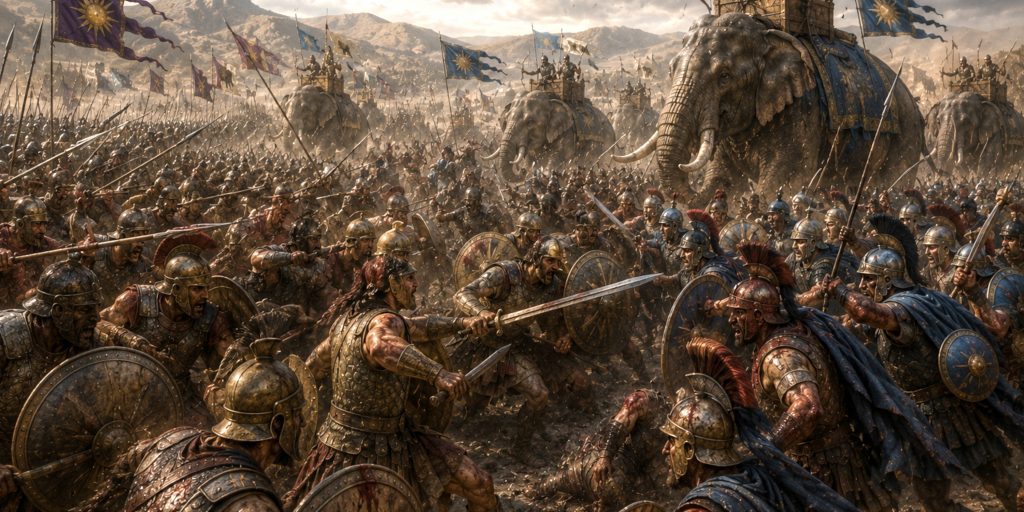
As dawn broke over the plains of Phrygia, two armies faced one another that represented the final generation of Alexander the Great’s companions.
Many of the officers on both sides had marched together across Asia decades earlier. They had crossed the Hellespont, fought at Issus and Gaugamela and watched Alexander build the greatest empire the ancient world had yet seen.
Now they stood ready to destroy one another.
Antigonus, approaching eighty years of age and blind in one eye, took command of the centre. Despite his age, he remained an experienced battlefield commander with immense confidence in his veterans.
On the opposite side, Seleucus and Lysimachus shared command. Both understood that defeating Antigonus required patience rather than reckless aggression.
The battle opened in familiar Macedonian fashion.
Dense formations of phalangites advanced behind forests of sarissas, each pike extending several metres beyond the front ranks. Light infantry screened the advance while cavalry searched for opportunities along both wings.
Initially, neither side gained a decisive advantage.
Demetrius’ Brilliant Charge
The first major success belonged to Demetrius.
Already famous for his aggressive leadership, he led the Antigonid heavy cavalry in a determined assault against Antiochus, who commanded the coalition horse on the opposing wing.
The charge achieved exactly what cavalry commanders hoped for.
The coalition cavalry broke.
Demetrius pursued them with relentless enthusiasm across the open countryside.
It was a spectacular success.
It was also a catastrophic mistake.
Alexander himself had often pursued defeated enemies, but he usually recognised the moment to return and support the main battle. Demetrius allowed excitement to overcome discipline.
While he chased fleeing cavalry, the decisive struggle was unfolding behind him.
Seleucus Changes the Battle
Seleucus immediately recognised the opportunity.
Rather than commit his reserve cavalry, he ordered something far more imaginative.
Hundreds of Indian war elephants moved into the empty ground separating Demetrius from the battlefield.
Instead of charging, they simply occupied the space.
The animals formed an enormous mobile wall.
No cavalry commander willingly rode horses into a dense line of elephants. Horses unfamiliar with elephants frequently panicked long before reaching them.
Demetrius suddenly found himself unable to return.
His finest cavalry force remained intact.
It simply could not reach the battlefield.
This was perhaps the greatest tactical use of elephants in ancient military history.
Rather than using them as shock troops, Seleucus transformed them into a gigantic obstacle that isolated the strongest part of Antigonus’ army.
Collapse of the Antigonid Centre
With Demetrius absent, Antigonus’ infantry became increasingly vulnerable.
Coalition cavalry began working around the exposed flanks while light infantry showered the phalanx with arrows and javelins.
The Macedonian phalanx was devastating when advancing in formation.
It was considerably less effective once attacked from multiple directions.
Its exceptionally long sarissas became awkward when soldiers needed to turn rapidly or defend their rear.
Ancient sources suggest that portions of Antigonus’ army gradually lost cohesion as pressure mounted.
Some units continued fighting stubbornly.
Others began to withdraw.
Once discipline started to break down, recovery became almost impossible.
The Death of Antigonus
Throughout the battle Antigonus reportedly remained convinced that Demetrius would return.
According to the ancient writers, advisers repeatedly urged him to withdraw.
He refused.
Whether through confidence, stubbornness or simple loyalty to his son, Antigonus stayed with his troops until the very end.
Missiles began raining into the increasingly isolated command position.
Eventually one struck the elderly king, killing him on the battlefield.
He was approximately eighty years old.
His death effectively ended organised resistance.
One of Alexander’s last surviving marshals had fallen where so many of his former comrades already had.
Demetrius eventually returned only to discover that the battle had already been lost.
He escaped with several thousand cavalry, preserving his own life but not his father’s kingdom.
It was an extraordinary reversal.
The finest cavalry charge of the battle had achieved complete tactical success, yet contributed directly to strategic defeat.
Arms and Armour
The Battle of Ipsus was fought by armies that still reflected the military system created by Philip II of Macedon and perfected by Alexander the Great. Although the Successor kingdoms had begun recruiting soldiers from across the Near East, the Macedonian style of warfare remained dominant.
The battle was ultimately decided by tactics rather than technology, but the quality of the equipment carried by these veteran soldiers was among the finest of the ancient world.
The Sarissa
The defining weapon of the Macedonian phalanx was the sarissa, an exceptionally long pike measuring between 4.5 and 6 metres.
Constructed from tough cornel wood and fitted with iron spearheads, the sarissa gave infantry tremendous reach.
Advantages included:
- Multiple ranks could present spear points simultaneously.
- Cavalry found it extremely difficult to attack the front of the formation.
- Enemy infantry struggled to close into sword range.
Its weaknesses were equally apparent.
- Difficult to manoeuvre on uneven ground.
- Required strict discipline and close formation.
- Vulnerable if attacked from the flank or rear.
At Ipsus, these disadvantages became increasingly important once Antigonus’ cavalry support disappeared.
The Xiphos
The standard secondary weapon for many Macedonian soldiers was the xiphos.
| Feature | Specification |
|---|---|
| Type | Double-edged straight sword |
| Blade Length | Approximately 45 to 60 cm |
| Material | Iron or early steel |
| Primary Role | Close combat after spear fighting |
The leaf-shaped blade was ideal for both cutting and thrusting.
Although rarely the primary battlefield weapon, the xiphos became invaluable once formations collapsed into close fighting.
The Kopis
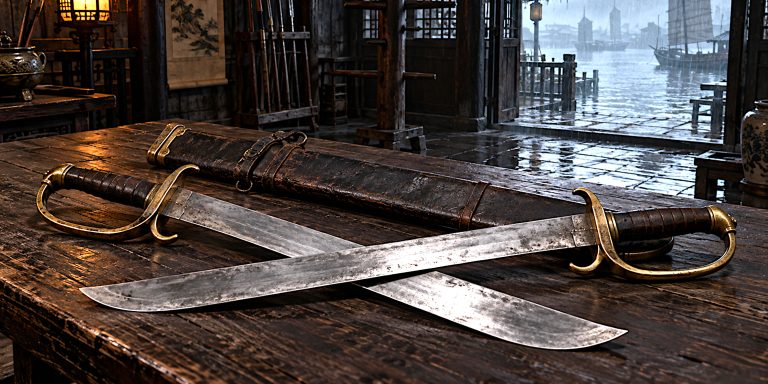
Many officers and cavalrymen preferred the kopis, a forward-curving sword that delivered devastating chopping blows.
Its weight concentrated near the tip gave it exceptional cutting power.
The kopis was especially effective from horseback, where the momentum of a charging rider increased its striking force.
Several Successor kings are depicted carrying swords of this style, reflecting both practicality and prestige.
Cavalry Weapons
The elite cavalry of both armies remained descendants of Alexander’s famous Companion Cavalry.
Typical equipment included:
- Xyston cavalry lance
- Xiphos or kopis sword
- Bronze helmet
- Muscle cuirass or scale armour
- Small cavalry shield, although many fought without one
Demetrius’ cavalry demonstrated exactly why these formations were feared across the ancient world.
Their initial charge completely overwhelmed the opposing horsemen.
Ironically, their success ultimately removed them from the decisive phase of the battle.
Armour
Protection varied according to wealth and rank.
Elite soldiers commonly wore:
- Bronze muscle cuirasses
- Linen armour reinforced with metal scales
- Iron or bronze helmets
- Greaves protecting the lower legs
- Arm guards for some cavalry
Helmets were often of the Phrygian or Boeotian style.
The Boeotian helmet remained particularly popular with cavalry because it offered excellent visibility and hearing without sacrificing too much protection.
Shields
The Macedonian infantry shield differed from the larger hoplite aspis used by earlier Greek armies.
Phalangites generally carried a smaller shield suspended from the shoulder, allowing both hands to control the massive sarissa.
Other troops, particularly mercenaries and peltasts, carried larger round shields better suited to independent fighting.
War Elephants
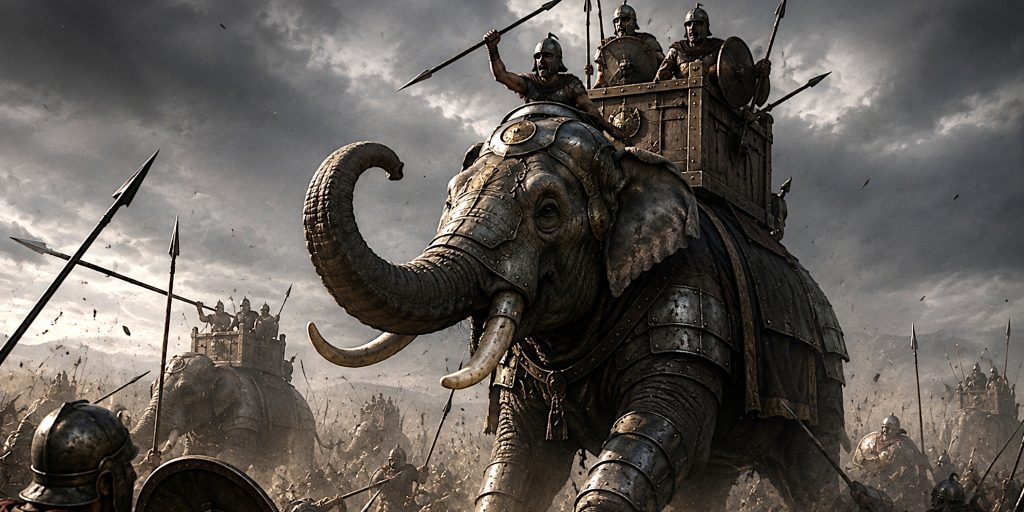
No discussion of Ipsus can ignore the battle’s most famous participants.
Seleucus deployed around four hundred Indian elephants, almost certainly acquired after his treaty with Chandragupta Maurya.
Each elephant carried:
- A trained mahout
- Sometimes one or more fighting soldiers
- Armour on the head in some cases
- Bells, decorative harnesses and protective coverings
The psychological impact of elephants could equal their physical effect.
Their size, smell and noise unsettled horses unfamiliar with them.
At Ipsus, however, they were employed with remarkable restraint.
Instead of launching dramatic charges, Seleucus positioned them to deny movement.
This subtle use of the elephants demonstrated outstanding battlefield awareness and remains one of antiquity’s finest examples of operational thinking.
Ancient Sources
Unlike battles such as Marathon or Cannae, no detailed contemporary account of Ipsus survives. Historians must reconstruct events from later writers, each relying on earlier sources that have since been lost.
Fortunately, several important ancient historians preserve valuable fragments.
Plutarch
Writing in the late first and early second centuries AD, Plutarch describes the crucial moment when Demetrius pursued the fleeing cavalry too far from the battlefield.
His account highlights Seleucus’ decision to deploy the elephants between Demetrius and the main fighting, preventing his return.
“The elephants intercepted his return.”
Although brief, this sentence explains the turning point of the battle.
Diodorus Siculus
Diodorus’ surviving narrative for this period is incomplete, but other sections of his work provide valuable information about the Successor Wars, their commanders and the political tensions leading to Ipsus.
His history remains one of the principal foundations for reconstructing the conflict.
Appian
Appian’s Syrian Wars focuses on Seleucus and his successors.
He describes how the victory transformed Seleucus into the dominant ruler of the eastern Hellenistic world and dramatically expanded his kingdom.
Modern Interpretation
Modern historians compare these surviving texts with military logic, archaeology and geographical evidence.
Although individual details remain debated, there is broad agreement on the essential sequence of events.
- Demetrius won the cavalry engagement.
- He pursued too far.
- Seleucus blocked his return with elephants.
- Antigonus’ centre became isolated.
- Coalition cavalry exploited the opening.
- Antigonus was killed.
- His army collapsed.
Remarkably, historians remain largely united on these fundamental events despite relying on sources written centuries after the battle itself.
Sometimes the ancient authors disagree over numbers, speeches and minor incidents.
On the bigger picture, however, they tell a surprisingly consistent story.
Archaeology and the Search for Ipsus
One of the enduring mysteries surrounding the Battle of Ipsus is that its exact location has never been identified with certainty. Unlike famous battlefields such as Marathon or Gaugamela, no universally accepted archaeological site has emerged. This has forced historians to combine ancient texts, topographical studies and scattered archaeological discoveries to reconstruct what happened.
Most scholars place the battlefield somewhere in the ancient region of Phrygia, close to the town of Ipsus, within modern-day central Türkiye. Several possible locations have been proposed near Afyonkarahisar, although none has produced definitive evidence.
The uncertainty is hardly surprising. Ancient battlefields often leave remarkably little behind. Victorious armies recovered valuable weapons and armour, local populations scavenged abandoned equipment, and centuries of agriculture erased many traces of the fighting.
What Archaeologists Look For
When investigating an ancient battlefield, archaeologists search for patterns rather than spectacular discoveries.
Typical evidence includes:
- Iron spearheads
- Arrowheads and javelin heads
- Sword fragments
- Bronze helmet fittings
- Shield bosses and bronze edging
- Horse equipment
- Coins dating to the period
- Human remains showing combat injuries
Finding a single weapon proves very little.
Finding hundreds of weapons concentrated within the same landscape begins to tell a compelling story.
Why Ipsus Is Difficult to Locate
Several factors complicate the search.
- Ancient place names changed over time.
- Roman roads altered regional geography.
- Farming has disturbed soil for more than two thousand years.
- Ancient historians provided only limited geographical detail.
- Modern settlements cover parts of the likely battlefield.
Unlike sieges, which often leave destroyed walls and occupation layers, open battles can disappear almost completely from the archaeological record.
The Elephant Problem
One intriguing question concerns Seleucus’ famous elephants.
An army deploying around four hundred elephants required enormous logistical support.
Each animal consumed vast quantities of food and water every day.
Historians estimate that such a force would have needed many hundreds of tonnes of fodder during an extended campaign, together with specialist handlers, veterinary knowledge and organised supply lines.
Although elephants leave little direct archaeological evidence after two millennia, their presence demonstrates the remarkable administrative capabilities of the Seleucid army.
The logistics behind Ipsus were almost as impressive as the battle itself.
Modern Research
Modern historians increasingly employ technologies unavailable even a generation ago.
These include:
- Satellite imagery
- Geographic Information Systems (GIS)
- Landscape reconstruction
- Remote sensing
- Metal detector surveys conducted under archaeological supervision
Rather than searching for a single dramatic discovery, researchers build evidence from multiple small finds and geographical clues.
The battlefield of Ipsus may eventually be identified through this cumulative approach.
Casualties
Reliable casualty figures have not survived.
Ancient historians focused far more on the political consequences than precise losses.
Most modern historians conclude:
| Army | Estimated Outcome |
|---|---|
| Antigonid Army | Heavy casualties, widespread surrender and dispersal following Antigonus’ death |
| Coalition Army | Moderate losses while maintaining battlefield cohesion |
The death of Antigonus proved far more significant than numerical casualties.
Ancient armies often remained effective despite substantial losses.
They rarely survived the death of their king.
Immediate Aftermath
The victory transformed the political map of the Hellenistic world almost overnight.
Antigonus’ vast empire was divided among the victors.
Seleucus emerged as the greatest beneficiary.
His kingdom expanded across Syria, Mesopotamia and much of the eastern territories, laying the foundations of the Seleucid Empire.
Lysimachus consolidated his control over western Asia Minor.
Cassander strengthened his position in Macedonia.
Only Demetrius escaped with a significant force.
Although he would later become King of Macedon, he never again possessed the resources necessary to rebuild his father’s empire.
The dream of restoring Alexander’s united kingdom died with Antigonus on the battlefield.
Historical Significance
Few battles have altered the course of history as profoundly as Ipsus.
Its consequences extended far beyond the death of one ruler.
The battle effectively created the political landscape of the eastern Mediterranean for the next three centuries.
Among its lasting consequences were:
- The permanent division of Alexander’s empire.
- The rise of the Seleucid Empire as the dominant eastern kingdom.
- The survival of the Ptolemaic Kingdom in Egypt.
- The emergence of stable Hellenistic monarchies.
- Continued spread of Greek language and culture across the Near East.
These kingdoms would later become Rome’s principal rivals.
Without Ipsus, the political history encountered by the Roman Republic during its eastern expansion might have looked entirely different.
It is one of those rare battles whose consequences echoed for centuries rather than decades.
Legacy
Military historians continue to study Ipsus because it illustrates timeless principles of warfare.
The battle demonstrates the importance of:
- Maintaining battlefield reserves.
- Supporting successful attacks rather than overextending them.
- Coordinating infantry and cavalry.
- Exploiting opportunities as they appear.
- Understanding that mobility can be denied without direct combat.
Seleucus’ use of elephants remains one of antiquity’s greatest tactical innovations.
Rather than treating them as irresistible assault weapons, he employed them as a movable barrier that shaped the battlefield itself.
Modern commanders would recognise the principle immediately.
Control the enemy’s movement, and you often control the battle.
Ipsus also serves as a reminder that even brilliant battlefield commanders can make costly mistakes. Demetrius won his engagement with remarkable skill, yet by pursuing too far he unintentionally abandoned the army that depended upon him.
History has a habit of rewarding restraint just as much as courage.
Frequently Asked Questions
Who won the Battle of Ipsus?
The coalition led by Seleucus I Nicator and Lysimachus defeated Antigonus I Monophthalmus in 301 BC.
Why was the Battle of Ipsus important?
The battle permanently ended any realistic chance of reuniting Alexander the Great’s empire and established the major Hellenistic kingdoms that dominated the eastern Mediterranean for centuries.
How did Seleucus win?
His decisive move was deploying hundreds of war elephants to prevent Demetrius’ victorious cavalry from returning to the battlefield. This isolated Antigonus’ infantry and allowed the coalition to overwhelm the centre.
Was Alexander the Great alive at Ipsus?
No. Alexander died in 323 BCE, twenty-two years before the battle.
Has the battlefield been found?
Not conclusively. Historians have identified several possible locations in central Türkiye, but no archaeological discovery has confirmed the exact site.
Further Reading
For readers wishing to explore the Successor Wars in greater depth, the following works remain among the most authoritative:
- Richard A. Billows, Antigonos the One-Eyed and the Creation of the Hellenistic State
- Robin Waterfield, Dividing the Spoils
- Graham Shipley, The Greek World After Alexander
- Plutarch, Life of Demetrius
- Appian, Syrian Wars
- Diodorus Siculus, Bibliotheca Historica
Ipsus rarely enjoys the same public recognition as Cannae, Marathon or Gaugamela, yet it deserves to stand alongside them. Few battles have so completely redrawn the political map of the ancient world, and fewer still demonstrate so clearly that a single tactical decision can shape the fate of empires.