Released in 1981 and directed by John Boorman, Excalibur is not interested in historical realism or cosy medieval nostalgia. It presents Arthurian legend as something primal, mystical and dreamlike. Kings are born in blood. Knights wear armour that gleams like mirrors. Merlin speaks in riddles. Every forest feels enchanted and every sword carries the weight of destiny.
More than forty years later, the film remains unlike anything else in fantasy cinema. It is gloriously theatrical, occasionally bizarre, surprisingly brutal and endlessly quotable. Modern audiences may notice some rough edges, but they are also likely to discover why so many filmmakers borrowed from it without ever quite matching its atmosphere.
If there is one object that defines Excalibur, it is not Camelot or the Round Table.
It is the sword itself.
Film Information
| Category | Details |
|---|---|
| Director | John Boorman |
| Release | 1981 |
| Genre | Fantasy, Adventure, Drama |
| Running Time | 140 minutes |
| Based On | Thomas Malory’s Le Morte d’Arthur |
| Music | Trevor Jones, featuring Richard Wagner and Carl Orff |
| Cinematography | Alex Thomson |
| Rating | R (US) |
Plot Review
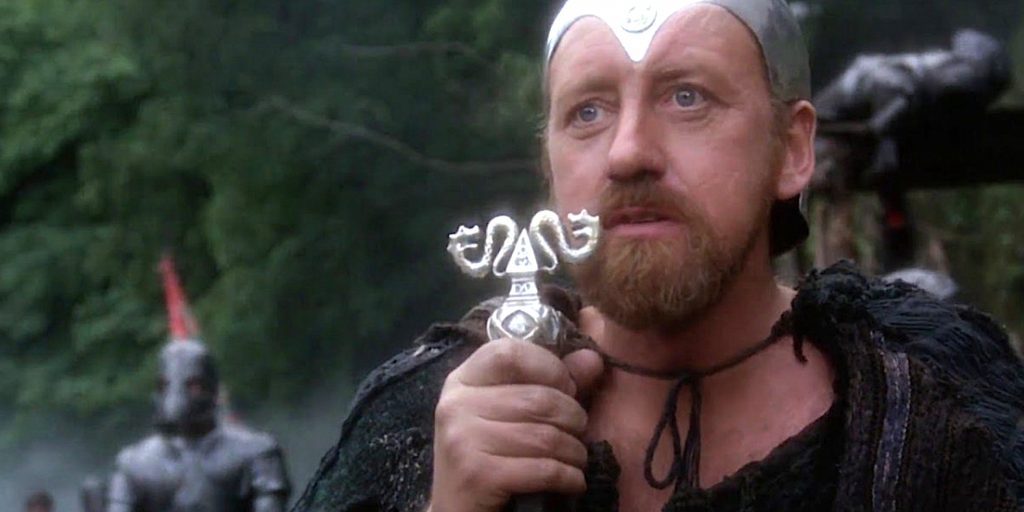
Rather than adapting one specific Arthurian tale, Excalibur compresses almost the entire legend into a single sweeping epic.
It begins with Uther Pendragon’s obsession with Igraine, a desire that plunges Britain into chaos. Merlin arranges the infamous bargain that leads to Arthur’s birth before placing the infant into secrecy until the time is right.
Arthur’s accidental drawing of the Sword from the Stone transforms an overlooked squire into the rightful king.
From there the film races through the formation of Camelot, the rise of the Round Table, Lancelot’s friendship with Arthur, the forbidden romance between Lancelot and Guenevere, the search for the Holy Grail and finally Arthur’s tragic confrontation with Mordred.
This sounds like far too much for one film.
Oddly enough, it works.
Boorman approaches the story more like mythology than conventional drama. Time flows strangely. Characters age almost without warning. Entire wars pass between scenes. The result feels closer to reading medieval legends than watching a modern blockbuster.
A World Built from Steel and Legend
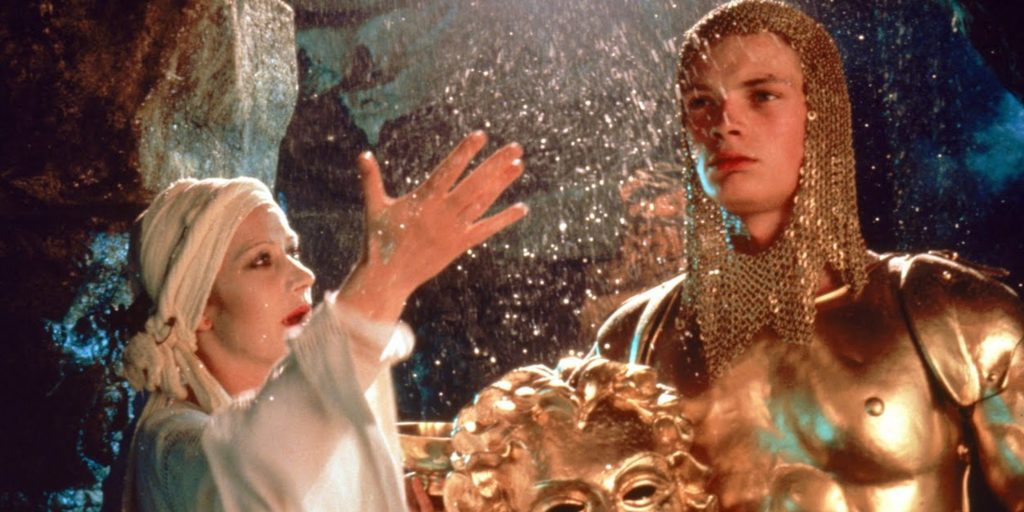
The greatest achievement of Excalibur is its atmosphere.
Everything looks damp, ancient and enchanted.
The forests seem alive.
Mist rolls through every valley.
The armour catches impossible green light that gives the entire film an almost supernatural glow.
Instead of trying to recreate medieval Britain accurately, Boorman creates a world that feels like it exists outside history altogether.
It is fantasy in its purest form.
Even today, very few productions have managed to recreate this mixture of beauty, decay and mystery.
Excalibur: More Than Just a Sword
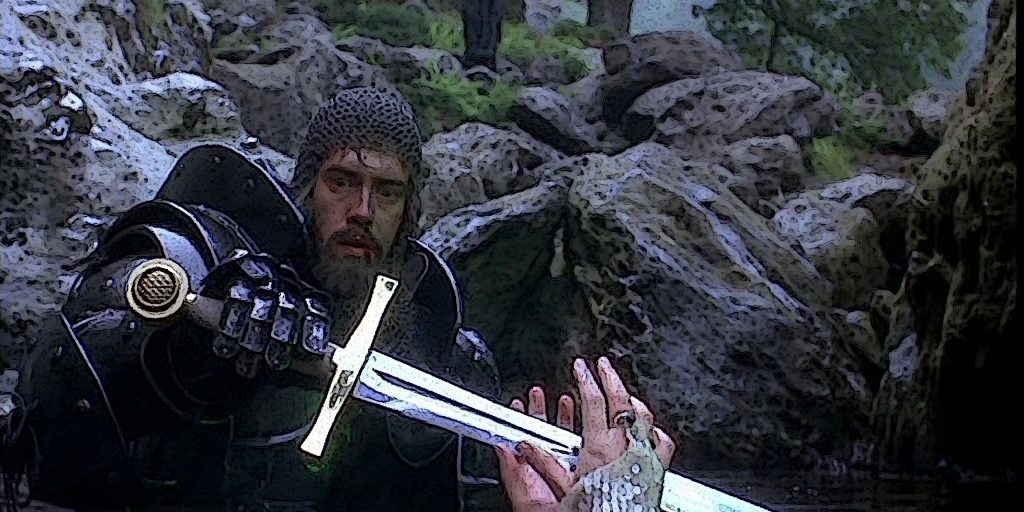
No weapon has carried greater cinematic importance than Excalibur itself.
The sword is not merely a magical object. It represents legitimacy, responsibility, sacrifice and ultimately redemption.
Its polished blade almost appears alive throughout the film, helped enormously by Boorman’s use of reflective armour and carefully controlled lighting.
Every appearance matters.
When Arthur first draws the sword, it signals hope.
When it is handed to him by the Lady of the Lake, it becomes a covenant between king and kingdom.
When Arthur’s pride leads to its destruction, the sword reflects the collapse of Camelot itself.
The final return of Excalibur to the lake remains one of fantasy cinema’s most iconic closing images.
The Other Swords of Camelot
While Excalibur dominates the story, the other weapons quietly reinforce each character’s personality.
Lancelot’s longsword is elegant and disciplined, reflecting his unmatched skill and inner conflict.
Mordred’s blade is darker and more aggressive, its design emphasising corruption and unnatural ambition.
Throughout the film, swords rarely feel like props.
They are extensions of the people holding them.
That simple idea influenced fantasy cinema for decades afterwards.
Peter Jackson’s The Lord of the Rings, Game of Thrones and countless fantasy games owe something to Boorman’s treatment of legendary weapons.
Performances
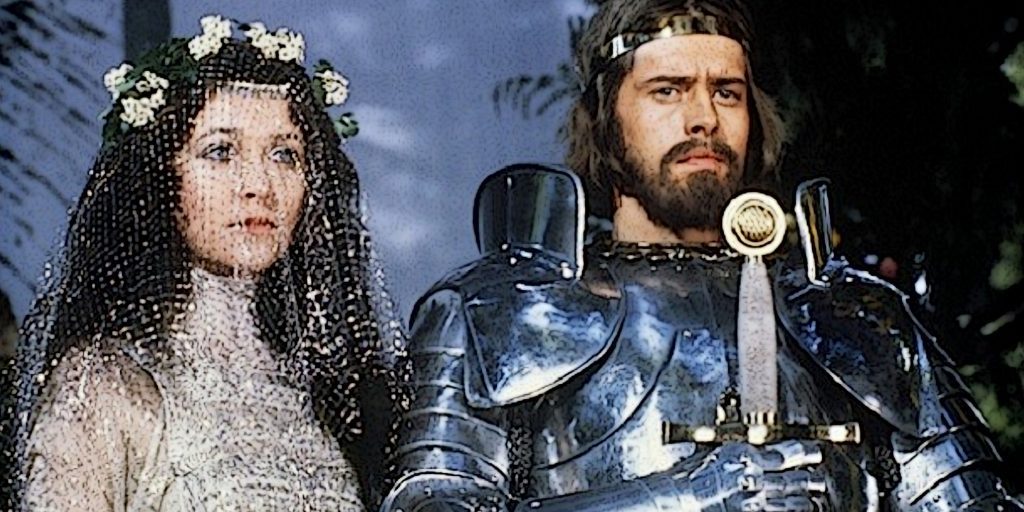
Nigel Terry as Arthur
Nigel Terry delivers one of fantasy cinema’s most underrated performances.
He begins as an uncertain young man and gradually transforms into a weary king carrying impossible responsibility.
His Arthur is never flawless.
He makes mistakes.
He loses control.
He doubts himself.
That humanity gives the legend emotional weight.
Nicol Williamson as Merlin
Nicol Williamson completely steals the film.
His Merlin feels ancient, unpredictable, funny and quietly terrifying.
Rather than playing the character as a kindly old wizard, Williamson creates someone who seems only partially interested in humanity.
Every line feels theatrical without becoming ridiculous.
His performance has become one of the defining interpretations of Merlin.
Helen Mirren as Morgana
Helen Mirren gives Morgana remarkable complexity.
She is seductive, intelligent, manipulative and increasingly consumed by her own ambitions.
Rather than becoming a simple villain, she gradually destroys herself through obsession.
Nicholas Clay as Lancelot
Clay captures both Lancelot’s nobility and overwhelming guilt.
His duel with Arthur remains one of the emotional high points of the film because neither man truly wants to fight.
A Remarkable Supporting Cast
Looking back today feels almost surreal.
Future stars appear throughout Camelot.
The cast includes Patrick Stewart, Liam Neeson, Gabriel Byrne, Ciarán Hinds and Charley Boorman long before they became household names.
It almost feels like British and Irish acting talent accidentally assembled in one castle.
The Sword Fights Still Impress
Fight choreographer William Hobbs approached combat with unusual seriousness.
Instead of flashy choreography, the battles feel heavy.
Every sword strike carries weight.
Armour actually behaves like armour.
Combatants become exhausted.
The duel between Arthur and Lancelot remains especially memorable because it tells an emotional story rather than simply showing technical skill.
Modern fantasy often favours speed.
Excalibur favours consequence.
Music That Makes Everything Feel Legendary
Trevor Jones provides the original score, but the film’s greatest musical weapon is Richard Wagner.
The repeated use of passages from Parsifal and Siegfried elevates ordinary scenes into mythic spectacle.
Meanwhile Carl Orff’s O Fortuna appears during one of cinema’s greatest cavalry charges.
It is impossible to separate those images from that music now.
Together they create one of fantasy cinema’s finest soundtracks.
Themes That Still Feel Relevant
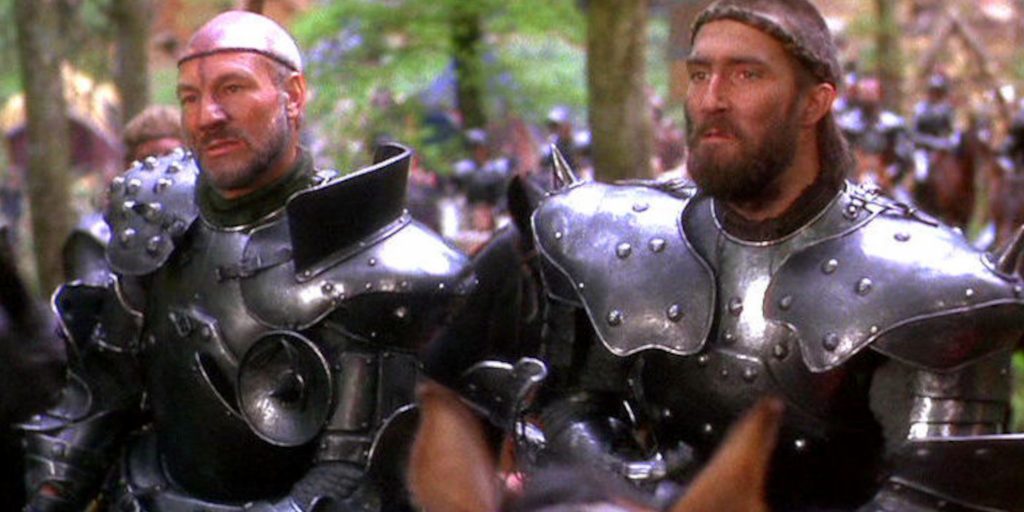
Beneath the armour and magic lies a surprisingly thoughtful story.
The film explores:
- Power and responsibility
- Leadership and sacrifice
- Temptation
- Betrayal
- Redemption
- Faith
- The relationship between ruler and nation
- The destructive nature of pride
The famous line, “The land and the king are one,” becomes the film’s emotional foundation.
Arthur’s failures literally poison the kingdom.
When he heals spiritually, Britain heals with him.
It is wonderfully mythic logic.
Cinematography That Refuses to Age Quietly
Alex Thomson’s cinematography remains extraordinary.
The film constantly embraces dramatic lighting instead of realism.
Green hues dominate forests.
Gold illuminates Camelot.
Dark shadows swallow Morgana’s world.
Every frame feels carefully painted.
Yes, the reflective armour occasionally borders on excessive.
Everyone appears polished enough to advertise medieval metal cleaner.
Oddly enough, that distinctive look has become part of the film’s identity.
What Has Aged Well?
A surprising amount.
The practical effects still possess genuine charm.
The locations remain breathtaking.
The costumes continue to look magnificent.
The performances never lose their conviction.
Most importantly, the film refuses to explain its magic.
It trusts the audience to accept mystery.
That confidence feels refreshing today.
What Shows Its Age?
The pacing can feel unusual for viewers raised on faster editing.
Characters sometimes disappear for lengthy stretches.
Women are not always given the depth modern audiences might expect.
Some dialogue borders on operatic melodrama.
Yet those qualities also contribute to its unique personality.
This is not trying to be modern fantasy.
It is trying to feel like an ancient legend brought to life.
Legacy
It is almost impossible to overstate Excalibur’s influence.
Its fingerprints can be found across fantasy films, television and video games.
Elements echoed later include:
- The Lord of the Rings
- Game of Thrones
- Dragon Age
- Dark Souls
- Elden Ring
- The Witcher
The film helped define how audiences imagine Arthur, Merlin and Camelot.
It also established the visual language for magical swords that countless fantasy stories continue to borrow today.
Memorable Quotes
Some films produce memorable dialogue.
Excalibur produces speeches that sound as though they have been carved into stone.
Among the finest are:
“The land and the king are one.”
“When a man lies, he murders some part of the world.”
“For it is the doom of men that they forget.”
“The sword is power.”
Merlin, unsurprisingly, gets almost all the best lines.
Where to Watch
Availability changes regularly, but Excalibur can usually be rented or purchased digitally through services such as Amazon Prime Video, Apple TV and Google TV.
Physical Blu-ray and 4K editions remain excellent options for viewers who want to appreciate the film’s remarkable cinematography.
Final Verdict
Excalibur is not perfect.
It is strange.
It is unapologetically theatrical.
It occasionally leaps through years of story as though someone misplaced several chapters.
None of that matters.
John Boorman created one of fantasy cinema’s defining achievements. It captures the mystery, tragedy and grandeur of Arthurian legend in a way that few adaptations have managed before or since.
If you prefer grounded medieval realism, this may not be your Camelot.
If you want myth presented with complete conviction, glorious armour, unforgettable music and enough legendary swords to satisfy any fantasy fan, Excalibur remains essential viewing.
Some films entertain.
Excalibur feels like someone telling an ancient story around a fire, except they happened to bring a full orchestra and several hundred suits of polished armour.
Rating
| Category | Score |
|---|---|
| Story | 9.5/10 |
| Performances | 9/10 |
| Visual Style | 10/10 |
| Music | 10/10 |
| Sword Fights | 9/10 |
| Historical Arthurian Atmosphere | 9/10 |
| Rewatch Value | 9.5/10 |
Overall Score: 9.4/10
Frequently Asked Questions
Is Excalibur (1981) historically accurate?
No. It adapts Arthurian legend rather than documented history, drawing heavily from Sir Thomas Malory’s Le Morte d’Arthur and medieval romance traditions.
Was a real sword used for Excalibur?
Several hero and stunt props were produced for filming. Their distinctive gold hilt and green gemstone pommel have become iconic, and surviving examples are highly sought after by collectors.
Why does the armour shine so brightly?
John Boorman deliberately used highly polished armour combined with stylised lighting to give Camelot an ethereal, almost supernatural appearance.
Is Excalibur suitable for children?
Not really. Despite being a fantasy film, it contains graphic violence, nudity and mature themes.
Is Excalibur still worth watching?
Absolutely. It remains one of the finest Arthurian films ever made and one of the most visually distinctive fantasy epics in cinema history.