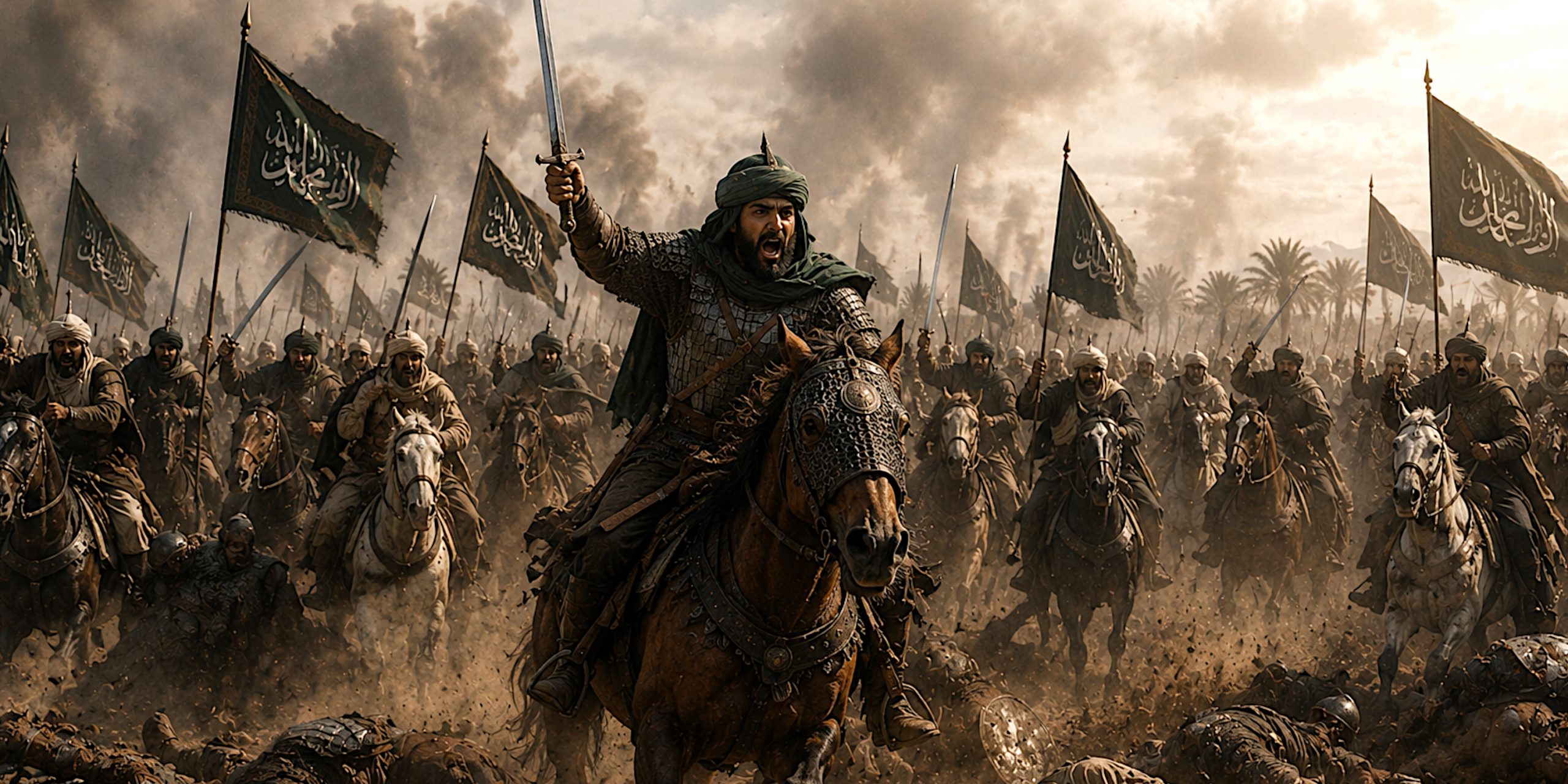
Khalid ibn al-Walid is one of those commanders whose reputation has become so enormous that separating the historical soldier from the legend surrounding him is half the job.
Known in Islamic tradition as Sayf Allah, the “Sword of God”, Khalid was a Qurayshi warrior who initially fought against Muhammad before converting to Islam and becoming one of the most important commanders of the early Muslim state. His career carried him from the fighting around Mecca to the Ridda Wars in Arabia, through campaigns against the Sasanian frontier in Iraq and finally into Byzantine Syria.
His military reputation rests on speed, cavalry manoeuvre, aggressive operational thinking and an extraordinary ability to keep an army functioning across hostile terrain. Yet some of the familiar stories about him come from sources written generations after his death. Modern historians therefore have to perform the slightly frustrating task of admiring the broad achievement while questioning some of the wonderfully convenient details.
What survives is impressive enough without embellishment.
Khalid ibn al-Walid at a Glance
| Detail | Information |
|---|---|
| Full name | Khalid ibn al-Walid ibn al-Mughira al-Makhzumi |
| Arabic | خالد بن الوليد |
| Born | Traditionally c. 592 CE, Mecca |
| Tribe | Quraysh, Banu Makhzum clan |
| Converted to Islam | Usually placed around 627 or 629 CE |
| Allegiance | Early Muslim community, later Rashidun Caliphate |
| Known title | Sayf Allah, “Sword of God” |
| Principal enemies | Rival Arabian tribes, Sasanian-aligned forces, Byzantine forces and their allies |
| Major campaigns | Ridda Wars, conquest of Iraq, conquest of Syria |
| Most famous battle | Yarmouk, 636 CE |
| Died | Traditionally 642 CE |
| Traditional burial place | Homs, Syria |
The exact chronology of his early life and some campaigns remains disputed. This is important. Khalid lived during a period for which the surviving narrative sources were largely compiled considerably later.
Early Life and the Banu Makhzum
Khalid was born into the Banu Makhzum, one of the powerful clans of Quraysh in Mecca. His father, al-Walid ibn al-Mughira, belonged to the Meccan elite.
The Makhzum had strong associations with warfare and cavalry. Khalid therefore emerged from an environment in which weapons, horses, tribal politics and the organisation of armed expeditions were familiar parts of elite life.
We know far less about his childhood than later biographies sometimes suggest. There is a natural temptation with famous generals to imagine them spending infancy studying battlefield formations rather than doing whatever seventh-century children actually did. The evidence does not permit that.
What becomes clearer is his presence as a capable warrior in the conflict between Muhammad and the Quraysh.
Khalid Before Islam
Khalid originally fought against the Muslims.
His most famous appearance during this period came at the Battle of Uhud in 625 CE. Islamic accounts describe him commanding or helping direct Quraysh cavalry.
The battle turned after Muslim archers left a strategically important position. Khalid’s cavalry exploited the opening and attacked the Muslim flank or rear.
The precise reconstruction is difficult, but the episode is revealing because it foreshadows the qualities later associated with him: watching for weakness, retaining mobile troops and reacting rapidly when an enemy formation became vulnerable.
He was not yet the Sword of God. At Uhud, the sword was very definitely pointed in the opposite direction.
Conversion to Islam
Khalid converted several years later, probably around 627 to 629 CE, though the exact dating varies between traditions.
His military abilities were soon put to use.
The critical moment was the Battle of Mu’tah in 629 CE, fought in what is now Jordan between a Muslim expedition and forces associated with the Byzantine frontier.
The Muslim commanders Zayd ibn Haritha, Ja’far ibn Abi Talib and Abd Allah ibn Rawaha were killed. Khalid subsequently assumed command.
Rather than achieving some implausible annihilation of the Byzantine army, Khalid’s real achievement appears to have been extracting the Muslim force from a dangerous situation.
That deserves more respect than it sometimes receives. Commanders are often celebrated for charges and conquests. Getting an army home after its leadership has been killed is arguably a better test of command.
Islamic tradition associates his conduct at Mu’tah with Muhammad giving him the title Sayf Allah, the Sword of God.
The Conquest of Mecca and Later Campaigns
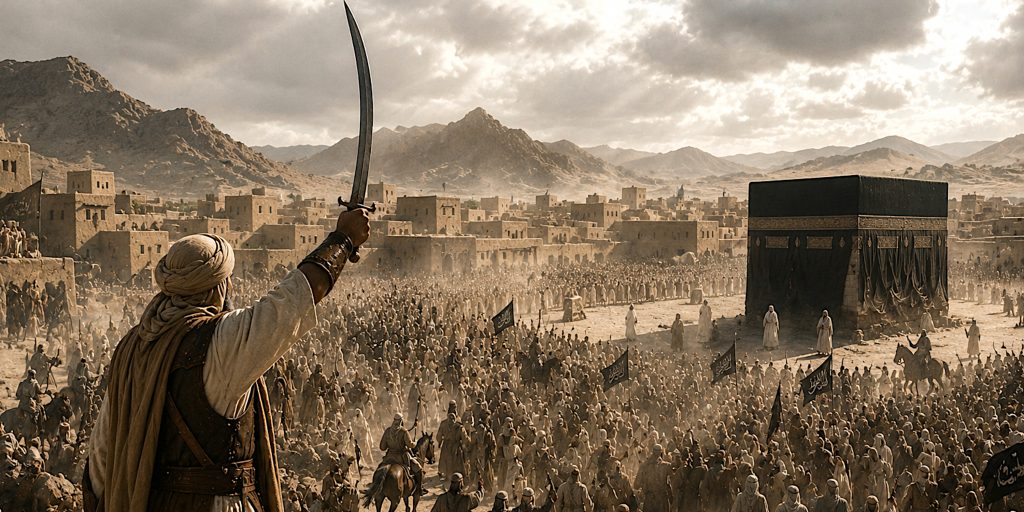
Khalid participated in the Muslim conquest of Mecca in 630.
He subsequently fought at Hunayn and was involved in further expeditions during Muhammad’s lifetime. Traditional accounts also connect him with the destruction of the sanctuary of al-Uzza at Nakhla.
His expedition against the Banu Jadhima is considerably more uncomfortable.
Islamic sources themselves report that members of the tribe were killed after submitting or attempting to indicate their acceptance of Islam. Muhammad is portrayed as disapproving of Khalid’s actions and compensating the victims’ families.
This episode matters because Khalid should not be reduced to a spotless military hero. Even within the tradition that preserved his fame, his career contained controversy.
The Ridda Wars
Muhammad’s death in 632 created an immediate political crisis.
Several Arabian tribes rejected Medina’s authority, refused obligations previously owed to Muhammad or supported competing prophetic and political movements. Caliph Abu Bakr responded with the campaigns conventionally known as the Ridda Wars.
Khalid became one of his most important commanders.
Among his operations were campaigns against Tulayha and, most famously, Musaylima in central Arabia.
Battle of Yamama
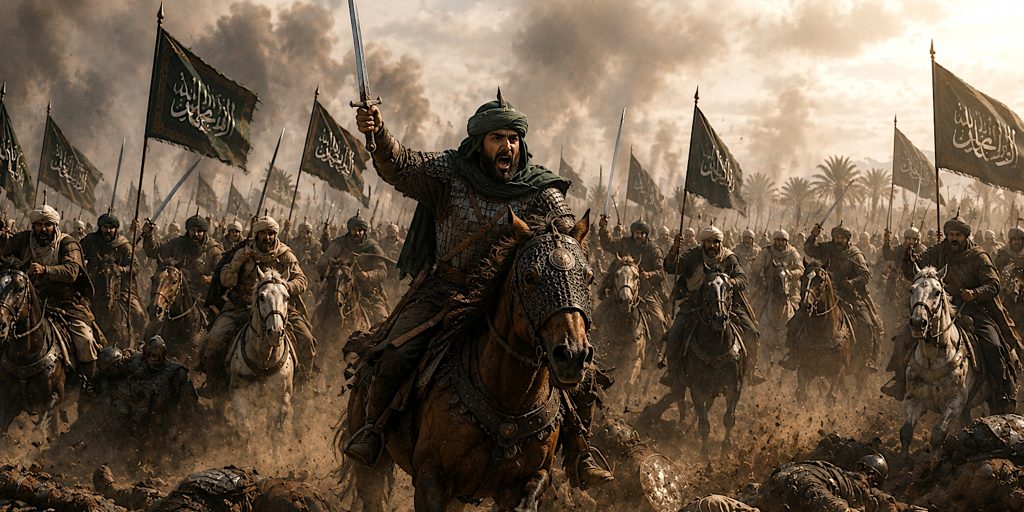
The Battle of Yamama was one of the bloodiest encounters of the Ridda Wars.
Musaylima’s forces resisted fiercely, and Muslim losses were considerable. Fighting eventually concentrated around an enclosed area remembered in Islamic tradition as the Garden of Death.
Musaylima was killed and organised resistance collapsed.
The victory helped Abu Bakr consolidate political authority across Arabia and made possible the expansion beyond the peninsula that followed.
The Malik ibn Nuwayra Controversy
Khalid’s actions during the Ridda Wars were not universally accepted even among the early Muslim elite.
The tribal leader Malik ibn Nuwayra was captured and killed under circumstances that became deeply controversial. Accounts differ considerably over whether Malik had genuinely rebelled, whether his execution was justified and precisely what Khalid ordered.
Khalid subsequently married Malik’s widow, Layla bint al-Minhal.
Umar ibn al-Khattab was reportedly among Khalid’s strongest critics and pressed Abu Bakr to punish or dismiss him. Abu Bakr retained Khalid.
The surviving accounts are too contradictory to produce a comfortable verdict. What they do demonstrate is that Khalid was controversial in his own tradition, not merely in modern reassessments.
Campaign in Iraq
In 633 Khalid moved against territories on the western edge of the Sasanian Empire.
The political landscape was complicated. Arab tribes, local rulers, Sasanian administrators and imperial forces overlapped across Iraq and the desert frontier. Describing every opponent simply as “Persian” gives a misleading picture of the campaign.
Traditional sources credit Khalid with a remarkably rapid sequence of victories.
Major Operations in Iraq
| Battle or operation | Approximate date | Importance |
|---|---|---|
| Chains / Dhat al-Salasil | 633 | Traditionally an early victory in the Iraq campaign |
| River | 633 | Continued Muslim advance |
| Walaja | 633 | Famous in later accounts for enveloping manoeuvres |
| Ullais | 633 | Major victory remembered for exceptionally severe fighting |
| Al-Hira | 633 | Important political and strategic centre secured |
| Ayn al-Tamr | 633 | Extended control towards the desert frontier |
| Firaz | 634 | Traditionally associated with the final phase of Khalid’s Iraqi campaigning |
Some details of these engagements come from considerably later histories and should not be read like modern staff reports.
The Battle of Walaja and the Cannae Comparison
Walaja has become particularly famous because later descriptions depict Khalid concealing cavalry and using them to envelop the enemy.
It is frequently described as a second Cannae, comparing Khalid with Hannibal.
I would be cautious with that comparison.
The tactical account is compelling, but the sources do not give us the sort of contemporary documentation needed to reconstruct the battle with complete confidence. Modern diagrams showing perfectly positioned units and beautifully timed arrows can create a degree of certainty the evidence simply does not possess.
The broader pattern is much more defensible. Khalid repeatedly demonstrated an ability to use mobility, reserves and flanking forces effectively.
That is impressive enough.
The Desert March into Syria
One of the most celebrated episodes of Khalid’s career was his transfer from Iraq to Syria in 634.
Muslim armies were already operating against Byzantine territory when Khalid was ordered west. Rather than simply following the most predictable routes, tradition records his force making an exceptionally difficult crossing through arid country.
The precise route remains debated.
Whatever reconstruction one accepts, the operational principle was characteristically Khalid: move quickly, accept calculated logistical risk and arrive where the enemy would prefer you not to be.
In an age when armies were tied to water, fodder and supply routes, this was a serious undertaking rather than an adventurous stroll across the desert.
The Conquest of Byzantine Syria
Khalid joined commanders including Abu Ubayda ibn al-Jarrah, Amr ibn al-As, Yazid ibn Abi Sufyan and Shurahbil ibn Hasana in the campaign against Byzantine Syria.
The conquest should not be portrayed as Khalid single-handedly defeating the Byzantine Empire. Muslim command was collaborative, changed over time and involved several important commanders.
Khalid nevertheless appears to have been a particularly important operational commander during the decisive phase.
Major actions traditionally associated with him include:
- Bosra
- Ajnadayn
- Damascus
- Fahl
- Homs
- Yarmouk
- Operations around Qinnasrin and northern Syria
Modern scholarship broadly accepts the scale of the transformation while remaining cautious about the exact sequence and tactical details preserved by later Muslim historians. Recent scholarship continues to examine the conquest through Islamic, Byzantine, Syriac and archaeological evidence rather than relying on a single narrative tradition.
Battle of Yarmouk, 636
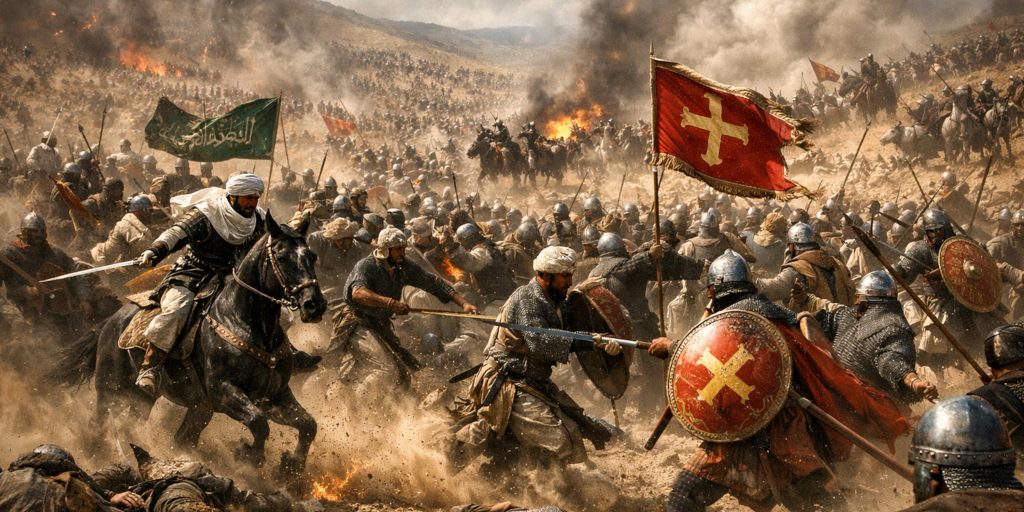
Yarmouk made Khalid immortal.
The battle in August 636 pitted the Muslim armies against a major Byzantine force during Emperor Heraclius’s attempt to restore control in Syria.
Numbers given by medieval sources are often enormous. Modern historians generally favour much smaller forces than the hundreds of thousands sometimes claimed in later traditions.
The command structure on the Muslim side is also more complicated than popular retellings suggest. Abu Ubayda held senior authority, while Khalid appears to have exercised an important battlefield role.
Khalid is particularly associated with the effective use of cavalry reserves.
Rather than committing every mounted soldier immediately, cavalry could reinforce threatened sectors, exploit Byzantine weakness and eventually assist in turning retreat into defeat.
The Byzantine army was comprehensively beaten.
Yarmouk effectively destroyed the empire’s immediate ability to recover Syria. The consequences reached far beyond Khalid’s personal career. Byzantine political power in much of the Levant was broken, while the Rashidun state acquired territory, cities, revenue and strategic depth.
A recent 2026 study has continued the debate over Yarmouk by comparing modern military interpretations with classical Islamic historiography, particularly the treatment of Khalid’s strategy. That continuing argument is useful because the neat tactical reconstructions found online often imply far greater certainty than the evidence warrants.
Khalid’s Military Acumen
Calling Khalid a military genius is easy. Explaining why is more interesting.
Mobility
Speed was perhaps his greatest weapon.
His armies operated across enormous distances between Arabia, Iraq and Syria. Khalid appears to have understood that strategic mobility could compensate for limited manpower.
An enemy concentrating against where you were yesterday is not especially useful if you are somewhere else tomorrow.
Cavalry
Khalid made particularly effective use of mounted troops.
Cavalry provided:
- reconnaissance
- rapid reinforcement
- pursuit
- flanking attacks
- operational mobility
- the ability to exploit a collapsing enemy formation
This did not mean his armies were simply cavalry hordes. Infantry remained essential for holding ground and maintaining the battle line.
Reserves
One of the recurring themes in accounts of Khalid is his willingness to retain mobile forces rather than committing everything at once.
That gave him options after a battle began.
For a commander, options are an underrated luxury.
Psychological Pressure
Rapid marches and successive victories also created psychological effects. Communities and enemy commanders could find themselves confronted by Khalid before they had expected his army to arrive.
Reputation then became part of the weapon.
Adaptability
Khalid fought tribal Arabian forces, Sasanian-associated armies and Byzantine forces.
These opponents operated differently.
His ability to succeed across several military environments suggests that adaptability, rather than one miraculous tactical formula, was central to his success.
Arms and Armour
There is no securely authenticated surviving sword, helmet or suit of armour belonging personally to Khalid.
This needs stressing because later weapons have repeatedly acquired associations with famous early Islamic figures.
We can instead reconstruct the equipment available to an elite Arab warrior of his period from literary, archaeological and comparative evidence.
Sword
Khalid would probably have used a straight, double-edged sword, rather than the strongly curved sabre often shown in later artwork.
This distinction matters.
The pronounced curved Islamic sabres familiar from later medieval and early modern imagery belong largely to subsequent developments in Islamic weaponry. Seventh-century Arabian swords were generally much closer to the straight sword traditions of Late Antiquity.
The generic Arabic term sayf simply means sword and does not specify the later curved form.
Possible blades could have been Arabian, Byzantine, Persian or Indian in origin through trade, tribute and captured equipment.
Spear and Lance
Spears were fundamental weapons of Arabian warfare.
Mounted warriors could employ lances for thrusting while infantry used various forms of spear. For a cavalry commander such as Khalid, the spear or lance was probably at least as militarily important as the sword.
The sword gets the poetry. The spear generally gets the reach.
Bow
Archery was an important element of warfare across Arabia, Persia and the Byzantine frontier.
Both foot and mounted archers operated within the military traditions Khalid encountered.
Elite warriors could wear mail armour, known in Arabic sources as dir’. Mail traditions were well established throughout the Byzantine and Sasanian worlds and were certainly familiar in Arabia.
Captured equipment would have further broadened what was available to successful commanders.
Helmet
Iron helmets based upon Late Antique regional traditions are plausible. Forms influenced by Byzantine and Sasanian equipment would have existed throughout the frontier regions.
Shield
Round shields constructed from hide, wood or combinations of materials were widely used.
The exact equipment of Khalid himself cannot be reconstructed confidently enough to dress a museum mannequin and label it “Khalid’s battle kit”. Any such reconstruction should be presented as representative rather than personal.
Khalid’s Sword
The title “Sword of God” has inevitably encouraged traditions concerning Khalid’s actual sword.
Weapons attributed to early Islamic figures survive in later collections, most famously among the sacred relic traditions preserved at Topkapı Palace in Istanbul.
Topkapı’s Holy Relics collection contains weapons and objects traditionally associated with Muhammad, the early caliphs and companions. The museum itself describes its collection as containing items belonging to prophets, caliphs and companions.
Such provenance should be approached carefully.
An object traditionally attributed to a seventh-century figure is not automatically an archaeologically authenticated personal possession. Many relic traditions developed over centuries and were collected or transferred under later Islamic dynasties.
For Khalid, there is currently no sword whose personal ownership can be demonstrated to modern archaeological standards.
Was Khalid Really Undefeated?
Khalid is routinely described online as a commander who fought “100 battles and never lost”.
That statement needs qualification.
A later tradition attributes to Khalid a remark that scarcely a place on his body remained without the mark of a sword, spear or arrow. Some sources also associate him with participation in roughly a hundred engagements.
But defining a “battle” is difficult. Raids, expeditions, skirmishes, sieges and major field battles are frequently mixed together.
More importantly, our documentation is not complete enough to construct a modern match record for his entire career.
What can reasonably be said is that no major battlefield defeat clearly attributable to Khalid as overall commander dominates the surviving tradition. His record was unquestionably remarkable.
Turning that into a precise 100 wins and zero losses statistic makes seventh-century history look suspiciously like a boxing record.
Dismissal by Umar
One of the most interesting aspects of Khalid’s career is that military success did not make him politically untouchable.
Caliph Umar removed him from supreme command, with Abu Ubayda assuming greater authority.
The reasons are debated.
Traditional explanations include concern about Khalid’s distribution of money, his independence and the possibility that Muslims were attributing victories to Khalid personally rather than to God.
There may also have been older political tensions between Umar and Khalid.
What is striking is that Khalid appears to have accepted the decision and continued serving.
His dismissal therefore should not automatically be interpreted as disgrace. It demonstrates that the early caliphate was attempting to establish political authority over commanders whose reputations had become formidable in their own right.
Death
Khalid died around 642 CE, traditionally at Homs in Syria.
A famous tradition has him lamenting that despite having fought repeatedly and carrying wounds across his body, he ultimately died in bed.
Whether every word of that deathbed speech is authentic is impossible to establish.
The sentiment survived because it suited the man perfectly. After Arabia, Iraq and Syria, the idea that illness rather than an enemy sword finally killed Khalid seemed almost irritatingly ordinary.
What the Sources Actually Tell Us
Khalid presents historians with a familiar early medieval problem.
The events are seventh century. Many of our detailed narratives are considerably later.
Important Islamic historians and compilers include:
- Ibn Ishaq
- al-Waqidi
- Ibn Sa’d
- al-Baladhuri
- al-Tabari
- later biographical and hadith traditions
They did not all work in the same way or preserve equally reliable material.
A 2025 comparative study of early Arab historians’ treatment of Khalid emphasised these methodological differences. Ibn Ishaq constructed sequential narrative traditions, while al-Waqidi supplied unusually extensive military material but relied upon chains of transmission that later scholars frequently considered weak.
This does not mean throwing the sources away. It means using them critically.
For broad events such as the Ridda campaigns, Muslim expansion into Iraq and the conquest of Syria, literary traditions can be compared with non-Muslim chronicles, documentary evidence, inscriptions, coins and archaeology.
The closer we move towards beautifully detailed battlefield speeches and minute tactical manoeuvres, the more cautious I become.
Archaeology and the World Khalid Conquered
No excavation has produced an object that can securely be labelled “Khalid ibn al-Walid’s sword” or “Khalid ibn al-Walid’s armour”.
Archaeology instead helps us understand the world through which his armies moved.
This is arguably more useful.
Material evidence from Syria, Jordan and Iraq increasingly challenges the old idea that the Muslim conquests produced an immediate archaeological rupture everywhere.
Settlement, trade and local communities frequently continued across the transition from Byzantine or Sasanian to Islamic government.
Recent archaeological scholarship published by Cambridge in 2025 has emphasised how the transformation of Syria and Iraq involved new military and administrative settlements alongside considerable regional continuity. In Iraq, garrison centres such as Kufa and Basra became particularly important after the conquests. Syria developed differently, with armies distributed through military districts rather than concentrated into precisely the same settlement model.
Research in northern Palestine and Jordan likewise warns against simply labelling every archaeological change after the conquest as an abrupt “Islamic” replacement of Byzantine society. Pottery, settlement and occupation sequences suggest a considerably more complicated transition.
For me, this is one of the most interesting developments in studying Khalid’s period. The literary sources are naturally obsessed with armies and battles. Archaeology reminds us that most people living through the conquest were not standing at Yarmouk. They were farming, trading, worshipping and trying to work out who was collecting the taxes this year.
Latest Archaeological and Historical Research
As of 2026, there has been no widely accepted archaeological discovery directly attributable to Khalid himself.
That absence should be stated rather than filled with exciting but unverified claims.
Recent work has instead strengthened the wider archaeological context of the seventh-century transition.
The 2025 Cambridge publication The Byzantine and Early Islamic Near East brought renewed attention to settlement archaeology in Syria, Iraq, Palestine and Jordan, including the complicated relationship between political conquest and changes visible in the archaeological record.
Research also continues into the battlefield and strategic interpretation of Yarmouk. The terrain and surviving textual traditions allow broad military analysis, but assigning isolated weapons or archaeological material specifically to Khalid’s battle remains extremely difficult.
A 2026 academic study of Yarmouk demonstrates that Khalid’s role and tactical methods remain active subjects of historical interpretation rather than closed questions.
Meanwhile, archaeological and epigraphic research in northern Arabia continues to improve our understanding of the society from which the early Muslim armies emerged. The precisely dated sixth-century Arabic inscription from Dumat al-Jandal, for example, belongs to the generation before Khalid and helps illuminate the linguistic and cultural landscape of northern Arabia immediately before Islam.
None of this gives us Khalid’s lost helmet. It gives us something historically better: a progressively clearer picture of his world.
Where to See Artefacts and Places Connected with Khalid’s Era
Khalid ibn al-Walid Mosque, Homs
Khalid’s traditional tomb is housed within the Khalid ibn al-Walid Mosque in Homs, Syria.
The present building is much later than Khalid. It therefore should be understood as a monument to his historical and religious memory rather than a surviving seventh-century structure.
The mosque suffered damage during the Syrian conflict and has undergone restoration and rehabilitation work. A restoration project concerning the mosque was included in the programme of the 2025 International Conference on Mosque Architecture.
Topkapı Palace, Istanbul
The Holy Relics collection at Topkapı Palace contains objects traditionally associated with important figures of early Islam.
For anyone interested in how later Islamic societies preserved and understood the material memory of the seventh century, it is an important collection.
The crucial word remains traditionally.
Attribution and modern archaeological provenance are different things.
Museums of Late Antique and Early Islamic Archaeology
Collections in Jordan, Syria, Saudi Arabia, Iraq and major international museums contain seventh-century and Late Antique material relevant to Khalid’s world, including:
- swords and weapon fragments
- arrowheads
- spearheads
- armour
- coins
- inscriptions
- ceramics
- Byzantine military objects
- Sasanian arms and material culture
- early Islamic coins and inscriptions
These are generally far more useful for reconstructing what Khalid’s soldiers actually carried than later ceremonial weapons attributed to famous individuals.
Khalid as a Commander
There is a danger in treating Khalid like a modern general equipped with maps, radios and a permanent logistical headquarters.
His command environment was intensely personal.
Information travelled at the speed of riders. Armies depended upon wells, grazing, pack animals and local knowledge. Tribal relationships mattered. Soldiers had to recognise commanders, standards and shouted orders amid dust, noise and confusion.
Khalid excelled within that world.
His greatest achievement may therefore have been operational rather than purely tactical. He repeatedly got armed men to the right place, maintained cohesion and attacked before opponents could properly respond.
That sounds simple until you attempt it across several hundred miles of seventh-century desert.
Why Khalid Was So Successful
Several factors appear repeatedly across his campaigns:
- exceptional strategic mobility
- strong understanding of Arabian geography
- effective use of cavalry
- willingness to take calculated logistical risks
- rapid exploitation of victories
- experience in tribal warfare
- ability to operate within larger command structures
- aggressive pursuit of weakened opponents
- personal reputation among his soldiers
- adaptability against very different enemies
His opponents also faced serious structural difficulties.
The Byzantine and Sasanian empires had recently exhausted themselves in a devastating war lasting from 602 to 628. Disease, taxation, political instability and regional tensions further complicated imperial defence.
Acknowledging this does not diminish Khalid. Good commanders frequently become famous precisely because they recognise when an opponent is vulnerable.
Historical Reputation
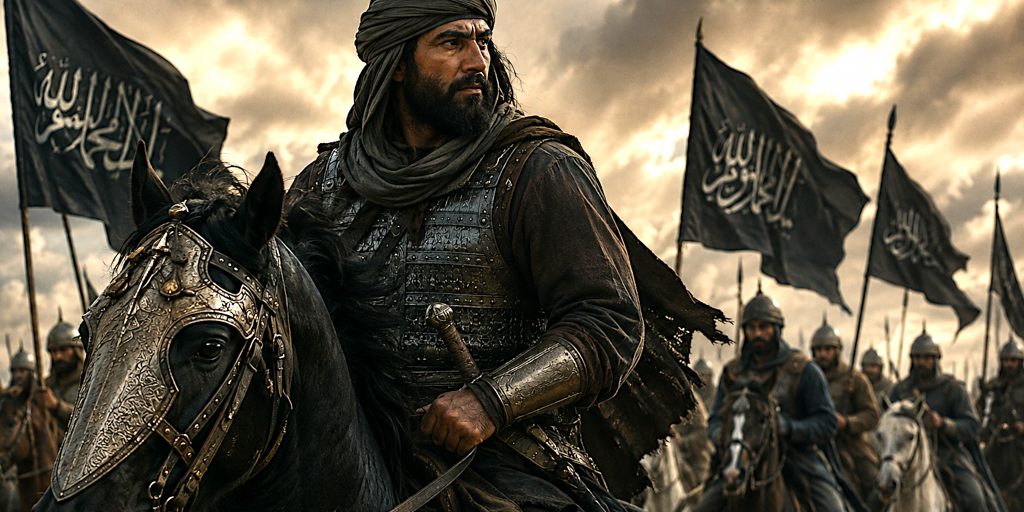
In Islamic memory, Khalid became the archetypal warrior commander.
His reputation travelled far beyond the seventh century. Military writers, historians and popular culture have repeatedly returned to Yarmouk, Walaja and the desert march as examples of decisive command.
Yet the legendary Khalid sometimes obscures the historical one.
The historical Khalid is actually more interesting.
He changed allegiance. He made controversial decisions. He clashed with political authority. He operated alongside other talented commanders. Some victories attributed almost entirely to him were collective achievements. Some spectacular tactical details may have grown in the telling.
And despite all those qualifications, he still emerges as an exceptional military leader.
That is usually a good sign. If a reputation survives after the mythology has been trimmed away, there was probably something substantial underneath it.
Legacy
Khalid ibn al-Walid lived during one of the fastest political transformations of Late Antiquity.
Within a few years, the Muslim state moved from consolidating Arabia to challenging two of the world’s great imperial systems. Khalid participated in the crucial phase of that expansion and became closely associated with its military character.
Yarmouk helped remove Byzantine power from Syria. The campaigns in Iraq opened the struggle against Sasanian authority. The Ridda victories helped preserve the political unity upon which those conquests depended.
Yet his importance extends beyond the battles themselves.
Khalid became an idea about command: mobile, aggressive, fearless and decisive.
The historian has to be slightly troublesome here and point out that legends do not come with footnotes. Some stories about him cannot be verified, some battle reconstructions are much too confident and no authenticated personal sword has conveniently survived for us to place behind museum glass.
Even after those cautions, however, the scale of his career remains extraordinary.
Khalid does not need the mythology of an invincible super-general. The seventh-century commander is impressive enough.
Sources and Further Reading
Fred M. Donner, The Early Islamic Conquests, Princeton University Press.
Walter E. Kaegi, Byzantium and the Early Islamic Conquests, Cambridge University Press.
Hugh Kennedy, The Great Arab Conquests, Weidenfeld & Nicolson.
Al-Baladhuri, The Origins of the Islamic State / Futuh al-Buldan.
Al-Tabari, The History of al-Tabari, relevant volumes concerning the Ridda Wars and early conquests.
Ibn Ishaq, surviving through Ibn Hisham and other transmitters, for the early Islamic biographical tradition.
Fatima Ali Hamad Mohamed Aljneibi, Mohd Roslan Mohd Nor and Faisal Ahmad Faisal Abdul Hamid, “Early Arab Historians’ Approaches to the Biography of Khalid Ibn Al-Walid: A Comparative Critical Study”, Journal of Al-Muqaddimah, 2025.
Alastair Northedge, “Archaeology and New Urban Settlement in Early Islamic Syria and Iraq”, in The Byzantine and Early Islamic Near East, Cambridge University Press, online edition 2025.
Ali Zeyadeh, archaeological case studies from northern Palestine and Jordan, in The Byzantine and Early Islamic Near East, Cambridge University Press, online edition 2025.
Abbas Khalid Abbas, “The Battle of Yarmouk in Western Historical and Military Studies: An Analytical Study of Islamic Military Strategy (636 CE)”, 2026.
Topkapı Palace Museum, Holy Relics collection.