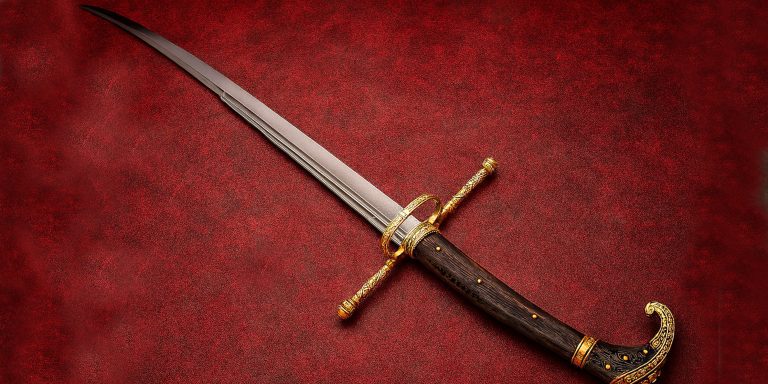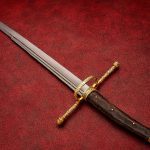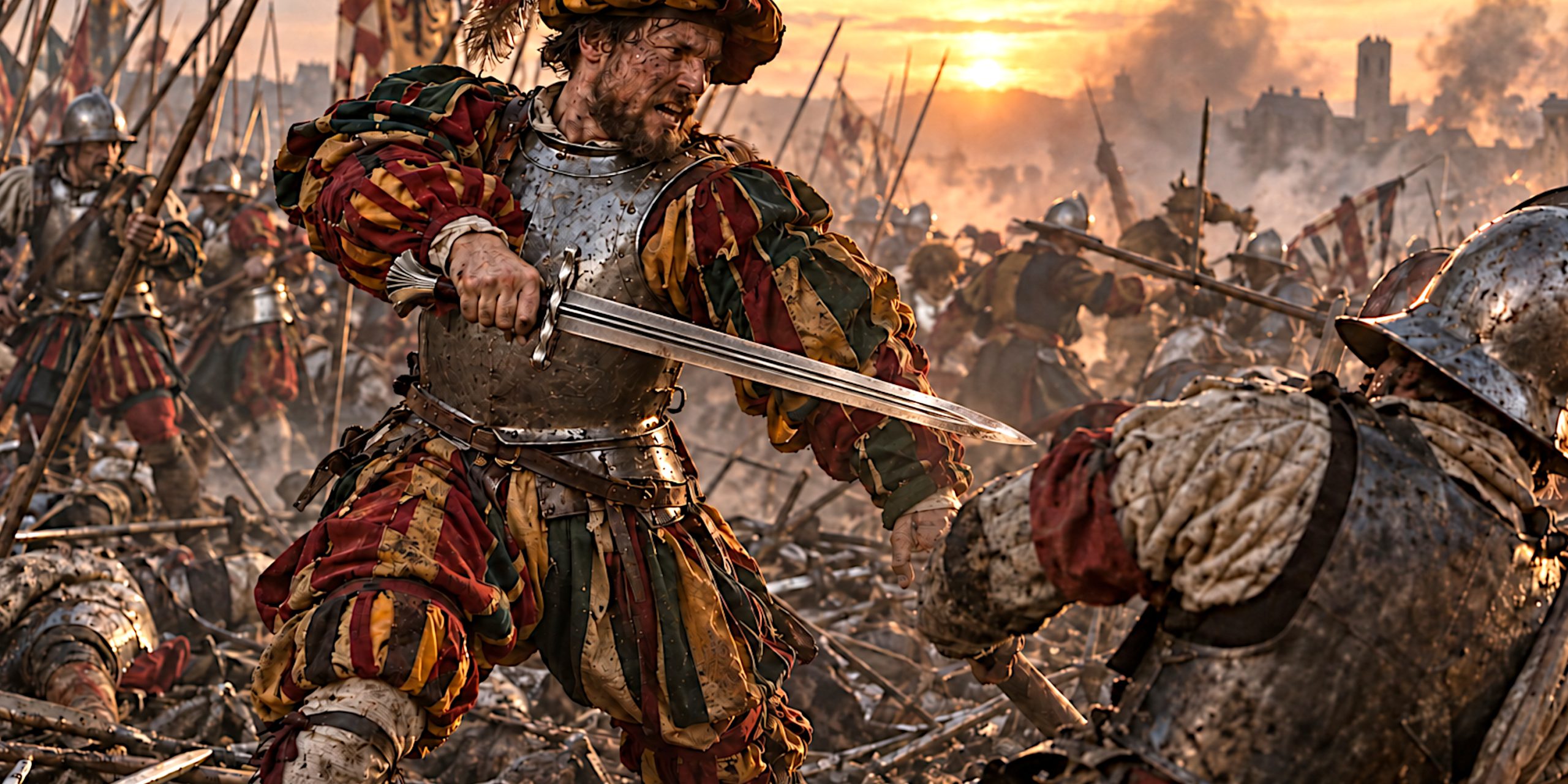
The katzbalger was the unmistakable sidearm of the Landsknecht, the flamboyantly dressed German mercenary infantry who fought across Europe during the late fifteenth and sixteenth centuries. Its broad blade, compact proportions and curling guard made it practical in a press of men, but also turned it into part of the Landsknecht’s visual identity.
This was not simply a shortened medieval sword. The katzbalger developed alongside the pike, halberd and two-handed sword in an age when disciplined infantry formations were reshaping European warfare. A soldier whose main weapon became useless at arm’s length needed a sidearm that could be drawn quickly and used in very little space. The katzbalger answered that requirement with a stout cutting blade and a guard often bent into an S or closed figure of eight.
Surviving swords vary enough to make rigid definitions risky. Some are little longer than large fighting knives, while others approach the proportions of an arming sword. The familiar features are more reliable than any single measurement: a relatively short and broad double-edged blade, a one-handed grip, and the distinctive curved guard associated with Landsknecht dress.
Katzbalger specifications
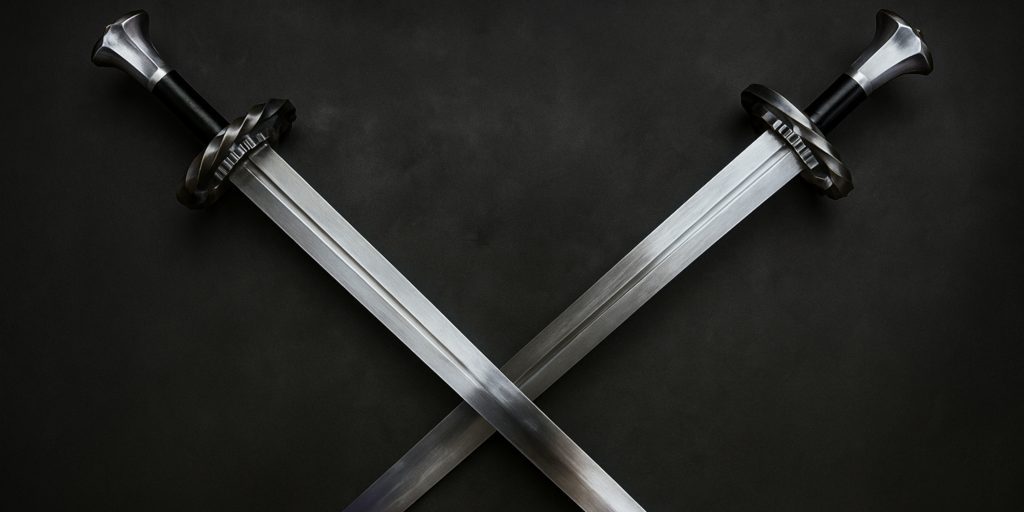
There was no regulated model. Dimensions changed according to date, region, maker and intended owner, so the figures below describe the common range rather than a military standard.
| Feature | Typical form |
|---|---|
| Date | Late fifteenth to later sixteenth century, with related forms continuing beyond it |
| Place of origin | German-speaking lands of the Holy Roman Empire |
| Primary users | Landsknechte and other infantry |
| Overall length | Commonly about 70 to 90 cm, although longer examples exist |
| Blade length | Often about 50 to 70 cm |
| Weight | Frequently around 1 to 1.5 kg, with substantial variation |
| Blade | Broad, straight and double-edged, usually with modest taper |
| Point | Often rounded or only moderately acute, though not universally blunt |
| Guard | S-shaped, C-shaped or formed into a horizontal figure of eight |
| Grip | One-handed, normally with a wooden core covered in leather, textile or cord |
| Pommel | Commonly flared, fan-shaped, faceted or cap-like rather than a large medieval wheel |
| Main function | Infantry sidearm for cutting at close quarters |
A particularly useful surviving reference is the German Landsknecht’s sword at the Metropolitan Museum of Art, dated to about 1520. It measures 81.3 cm overall, with a 68.2 cm blade, and weighs 1.08 kg. That makes it handier and lighter than the rather club-like proportions sometimes assigned to the type in modern summaries.
Identifying features
Look for a combination of features rather than one dramatic curl in the guard:
- A broad blade with nearly parallel edges for much of its length
- A short, one-handed hilt
- A guard whose arms sweep in opposing curves or loop around the grip axis
- A compact pommel, often flaring out from the grip
- Proportions suited to wearing with a pike, halberd or firearm
- Period construction, patina and tool marks that agree with one another
The figure-of-eight guard is iconic, but it does not authenticate a sword by itself. It is also the easiest feature for a modern maker to copy.
The name: cat skin or cat fight?
The origin of the word katzbalger remains disputed. Two explanations appear repeatedly.
One connects Katze, meaning cat, with Balg, meaning an animal skin. According to this reading, the sword was carried in a simple covering or cat-skin sheath rather than a conventional scabbard. The image is memorable, which may explain its survival, but physical and documentary support for a regular cat-skin carrying practice is weak.
The other explanation links the name to balgen, meaning to brawl or tussle. It would then evoke the close, violent confusion of a cat fight. That interpretation fits the weapon’s role rather neatly, perhaps suspiciously neatly. Neither derivation should be presented as settled fact.
The sword was also described more plainly as a Landsknecht sword. That term lacks feline drama, but it is often safer when discussing period images or museum catalogues whose terminology may differ.
History and evolution
A sidearm for the new infantry
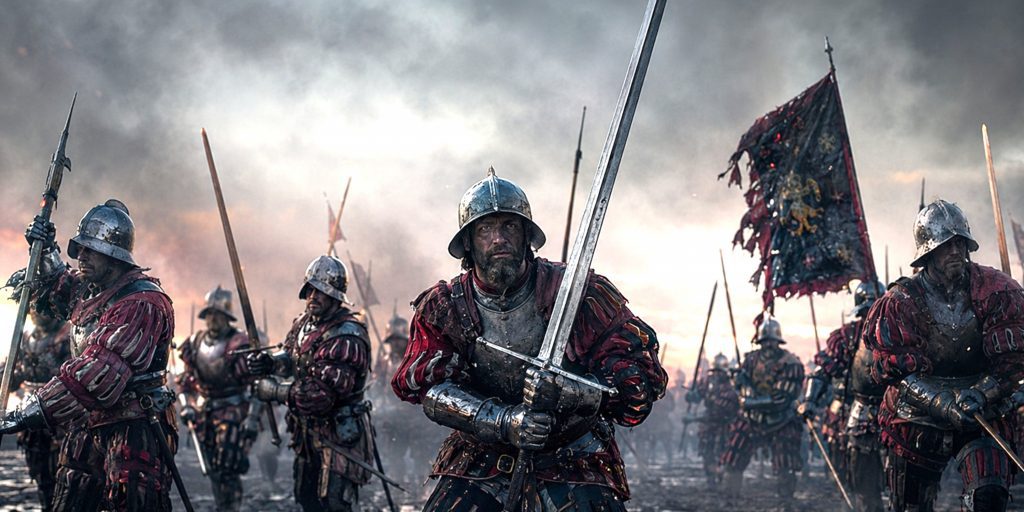
The rise of the Landsknechte from the late fifteenth century created a distinctive military culture. These paid infantrymen fought in dense formations with pikes, halberds, arquebuses and large two-handed swords. Their success depended on cohesion, aggression and the ability to keep a formation working under pressure.
Long polearms were formidable while ranks and distance remained intact. Once opposing formations collided, however, a pike could become awkward or impossible to use. A short sword worn at the hip or across the body gave the soldier a practical second weapon. It also had to avoid tangling with the rest of his equipment during a march.
The katzbalger was used by more than one specialist. It appears in the hands or at the belts of:
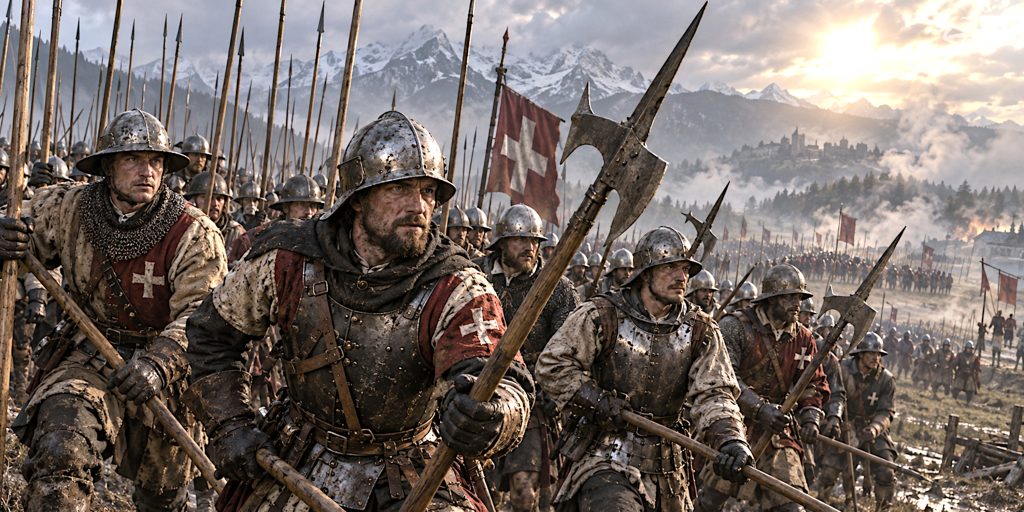
- Pikemen who needed a close-range reserve weapon
- Halberdiers operating in and around the formation
- Arquebusiers vulnerable while reloading
- Doppelsöldner associated with two-handed swords and dangerous front-rank work
- Officers and wealthier soldiers who treated the hilt as a display surface
The early form
Examples associated with the late fifteenth and early sixteenth centuries tend to have broad blades, compact grips and relatively simple guards. The guard could be made from an iron bar curved into an S, sometimes continuing towards a closed figure of eight. This gave more hand protection than a straight medieval cross without producing the bulk of a full basket hilt.
The blade was usually optimised for the cut. Broad surfaces, limited taper and a point that was sometimes rounded all supported powerful chopping and drawing cuts. Yet surviving blades are not identical. Some have useful points and could thrust effectively, especially against an unarmoured target. Calling every katzbalger blunt is as misleading as calling every one a cut-and-thrust sword.
Development during the sixteenth century
As the century progressed, hilts became more elaborate. Guards might gain additional rings or branches, while blades could become longer and narrower. These changes belonged to a wider European movement towards more protective sword hilts and more specialised civilian and military weapons.
The katzbalger therefore has fuzzy boundaries. A late sword with a complex guard may be catalogued as a Landsknecht sword, a military cut-and-thrust sword or a precursor to later basket-hilted forms. Typology is useful, but the objects were made before modern collectors had labels to defend.
Decline
By the later sixteenth century, the classic katzbalger was losing ground to swords with more complete hand protection. Rapiers, side-swords and developing basket hilts offered different balances of reach, thrusting ability and defence. Infantry tactics also continued to change as firearms became more important.
The katzbalger did not vanish on a particular date. Its recognisable form gradually dissolved into other military sword traditions as the Landsknecht’s own cultural moment passed.
How the katzbalger was used
No complete surviving fencing system is devoted solely to the katzbalger, so its use must be reconstructed cautiously from the weapon, contemporary images and broader German fighting traditions.
Its likely strengths included quick cuts from the wrist and elbow, short descending blows, horizontal cuts and close parries with the broad blade or curved guard. The compact blade reduced the risk of striking comrades in a crowded formation. It could also be brought into action after a pike was dropped, broken or abandoned.
The katzbalger should not be imagined as a magical pike-cutting machine. Sword blades were capable of damaging wooden shafts in favourable circumstances, but severing a moving pike cleanly during a battle is far less reliable than popular accounts suggest. Its better-established role was as a secondary weapon once the polearm fight had collapsed into close combat.
The broad blade could deliver serious cuts, while examples with a serviceable point retained some thrusting ability. The guard helped catch or divert cuts, but its large openings did not protect the hand as thoroughly as a later basket.
Advantages and disadvantages
| Advantages | Disadvantages |
|---|---|
| Short enough to use in dense infantry fighting | Less reach than an arming sword, sidesword or rapier |
| Broad blade capable of forceful cuts | Broad, rounded-point examples are relatively poor thrusters |
| Quick to draw after abandoning a polearm | Limited protection against direct thrusts to the hand |
| Curved guard offers more coverage than a plain crossguard | Guard can be bulky when worn with other equipment |
| Strong visual association with Landsknecht identity | Not well suited to defeating substantial plate armour |
| Usually manageable with one hand | Wide variation makes general statements unreliable |
What it did well
- Delivered decisive cuts against unarmoured or lightly protected targets
- Worked in spaces where a pike, halberd or two-handed sword became cumbersome
- Served as a robust reserve weapon rather than delicate specialist equipment
- Offered useful lateral hand protection without an enclosed basket
- Sat comfortably within the aggressive visual culture of Landsknecht service
Where it struggled
- An opponent with a longer sword could control distance more easily
- A rounded point reduced options in the thrust
- The open guard left fingers and knuckles exposed from some angles
- Cutting alone was not a dependable answer to good plate armour
- Short reach demanded commitment, particularly outside a tight formation
Katzbalger compared with similar weapons
| Weapon | Typical difference | Relative strength | Relative weakness |
|---|---|---|---|
| Arming sword | Usually longer, with stronger taper and a straight crossguard | Better all-round reach and thrusting | Less distinctive hand protection and sometimes less convenient in a crush |
| Messer | Single-edged knife construction, often with a side nail or Nagel | Strong cutter with useful hand protection | Usually protects one side of the hand more than the looping katzbalger guard |
| Cinquedea | Very broad Italian blade, often shorter and sharply tapering | Powerful close-range cut and capable point | More strongly associated with urban or civilian wear than pike formations |
| Baselard | Shorter double-edged weapon with an H-shaped hilt | Compact and easy to carry | Less protective guard and generally less cutting authority |
| Sidesword | Longer blade and more developed finger rings or branches | Greater reach, thrusting ability and hand defence | More cumbersome in the tightest fighting |
| Schiavona | Basket-hilted military sword, especially associated with Venetian service | Far better hand protection | Heavier and representative of a later hilt tradition |
| Rapier | Long, narrow blade with complex hilt | Superior reach and thrust control | Less suited to heavy cutting or use as a compact infantry reserve weapon |
The closest comparison is often the arming sword, but the katzbalger’s proportions and guard reflect a more specific infantry context. The messer shares its cutting emphasis, while the sidesword shows where sixteenth-century military hilts were heading.
Legacy
The katzbalger survives as one of the clearest visual symbols of Renaissance mercenary warfare. In prints by artists such as Urs Graf and Daniel Hopfer, the curled guard is almost a badge of profession. It belongs beside slashed clothing, feathers, pikes and enormous two-handed swords in the public image of the Landsknecht.
Its historical importance is broader than costume. The weapon shows how a sword could be shaped by the needs of infantry rather than mounted chivalry. It was compact, practical and closely integrated with a soldier’s primary battlefield equipment. Its evolving guard also forms part of the long movement from the simple medieval cross towards the increasingly complex hand protection of the early modern period.
Today, the katzbalger appears in museum collections, living-history displays, historical fencing experiments and modern reproductions. Unfortunately, fantasy art often enlarges it into a thick, brutal cleaver. Originals are generally more refined. Broad does not mean crude, and short does not mean badly balanced.
Where to see a katzbalger
Display arrangements change, so check with a museum before travelling specifically to see one.
| Collection | Location | What to look for |
|---|---|---|
| The Metropolitan Museum of Art | New York, USA | German Landsknecht’s sword dated about 1520, object 29.158.707 |
| Royal Museum of the Armed Forces and Military History | Brussels, Belgium | Early sixteenth-century Landsknecht display including a katzbalger |
| German Blade Museum | Solingen, Germany | Major collection of European edged weapons, including Landsknecht material |
| Royal Armouries | Leeds, UK | European swords and related sixteenth-century arms; confirm current display status |
| Kunsthistorisches Museum | Vienna, Austria | Important imperial arms and armour collection with high-status sixteenth-century weapons |
Online catalogues are valuable because they provide dimensions and provenance even when an object is in storage. The Metropolitan Museum example is particularly helpful for correcting the inflated measurements repeated on commercial replica pages.
Collector’s guide
Originals, historicist pieces and reproductions
The word katzbalger is used for three very different markets:
- Original period swords: genuine late fifteenth or sixteenth-century weapons, exceptionally scarce and normally handled by specialist arms and armour dealers or major auction houses
- Historicist or composite swords: nineteenth-century revival pieces, later assemblages, or objects made from old and newer components
- Modern reproductions: decorative, sharp, stage-combat or HEMA-oriented swords made for present-day buyers
These categories must never be priced as though they are interchangeable. A sword with an old-looking blade and a newly made figure-of-eight guard is not an original katzbalger.
Indicative auction and retail prices
The market for securely authenticated originals is too thin for a reliable annual price index. The ranges below are broad buying guides, not valuations. Condition, provenance, maker, decoration and legal status can move a sword far outside them.
| Category | Indicative price | Buying context |
|---|---|---|
| Decorative reproduction | £80 to £250 | Usually wall display, often with unsuitable blade geometry for training |
| Better production reproduction | £300 to £800 | Sharps, stage swords and more historically informed models |
| Custom-made reproduction | £900 to £3,000 or more | Hand-forged work with chosen dimensions, finish and scabbard |
| Nineteenth-century historicist example | £1,500 to £6,000 | Value depends heavily on age, quality and whether it is honestly catalogued |
| Composite or heavily restored antique | £2,500 to £10,000 | Requires expert assessment of every component |
| Authenticated sixteenth-century katzbalger | Often £10,000 to £40,000 or more | Rare at public auction; exceptional provenance or decoration can lift the price substantially |
| Museum-quality or highly important example | Potentially above £50,000 | Scarcity makes simple comparisons unreliable |
Auction estimates are not sale prices. Buyer’s premium, VAT, import charges, shipping, insurance and conservation can add a substantial amount to the hammer price. A low estimate may also reflect doubts about age or assembly rather than an overlooked bargain.
What to inspect before buying an antique
- Provenance: Ask for ownership history, old catalogue references and export paperwork. A vague story about a castle attic has no evidential value.
- Hilt construction: Inspect whether the guard, grip and pommel belong together. Fresh welds, modern threads and artificial patina are warning signs.
- Blade fit: A period blade can be mounted in a later reproduction hilt. Check the shoulders, tang, peening and alignment.
- Surface: Honest oxidation and cleaning differ from acid ageing. Be cautious when every component has exactly the same theatrical brown finish.
- Marks: Do not assume a stamped wolf, orb or cross identifies a famous workshop. Marks were copied in period and are widely reproduced today.
- Dimensions: Compare the sword with documented originals, but remember that genuine examples vary.
- Condition: Look for cracks in the guard, active rust, deep edge loss, loose components and shortened blades.
- Documentation: Obtain a written condition report and an explicit statement of date and restoration.
- Independent opinion: For a serious purchase, commission a specialist who is not financially involved in the sale.
Questions to ask an auction house
- Is the catalogue dating guaranteed or merely an opinion?
- Which components are believed to be sixteenth century?
- Has the hilt been dismantled or the tang inspected?
- Are there signs of later welding, re-peening or blade shortening?
- Is the grip covering original, restored or replaced?
- Does the lot have published provenance?
- Can high-resolution photographs of the tang junction, guard and pommel be supplied?
- What buyer’s premium and taxes apply to the final invoice?
- Are export licences or import permits likely to be required?
Buying a reproduction
Decide what the sword is for before comparing prices.
| Intended use | Essential checks |
|---|---|
| Wall display | Secure hilt, truthful materials and safe mounting |
| Living history | Period-appropriate dimensions, scabbard and finish |
| Cutting practice | Proper heat treatment, secure assembly and maker approval for cutting |
| Stage combat | Blunt edge, rounded point and suitability for choreographed contact |
| HEMA training | Flexible safe point, controlled edge thickness and approval from the club or event |
Never assume a blunt reproduction is safe for sparring. Some theatrical swords are too rigid, while decorative swords may fail at the tang. Equally, a sharp sword should not be used for partner drills. The dramatic guard does not make poor steel more trustworthy.
UK legal considerations
UK law controls the sale of knives and swords, particularly sales to people under 18 and the carrying of bladed articles in public. Import rules and prohibited-weapon definitions can also change. A katzbalger is not automatically lawful to carry merely because it is an antique or used for historical interpretation.
Collectors should check current UK government guidance on selling, buying and carrying knives and obtain specialist advice where necessary. Transport a sword securely, out of immediate reach, and only for a legitimate purpose.
Is a katzbalger worth collecting?
For a collector of Renaissance arms, the katzbalger has enormous appeal. It is visually distinctive, tied to a well-documented military culture and available in reproductions at several levels of quality. That popularity also creates a field crowded with loose descriptions, composite antiques and aggressively aged copies.
A good reproduction offers the clearest route for most buyers. An original should be treated as a major purchase requiring specialist authentication, not as an unusually expensive version of the same product. The most convincing swords are supported by construction, condition and provenance together. One curled guard and an exciting auction description are nowhere near enough.
Frequently asked questions
Was the katzbalger a short sword?
Usually, yes, relative to contemporary arming swords and larger infantry weapons. Surviving examples vary, and some have blades long enough to challenge a strict modern definition of a short sword.
Was it used to cut through pikes?
That claim is often repeated but should be treated cautiously. A stout sword could damage a wooden shaft, yet the katzbalger’s better-supported role was as a sidearm for close combat when a soldier’s primary weapon could no longer be used effectively.
Did every katzbalger have a rounded point?
No. Many examples prioritise cutting and have broad or rounded points, but others retain a functional point. The type was never completely uniform.
Why is the guard shaped like a figure of eight?
The opposed curves offer lateral coverage and can help intercept an incoming blade while remaining simpler than a full basket hilt. The form also became a strong visual marker of Landsknecht identity.
How much does an original katzbalger cost?
A securely authenticated sixteenth-century example can reach five figures, with especially important swords rising much higher. Because public sales are rare, any valuation must be based on the individual sword rather than a generic online price.