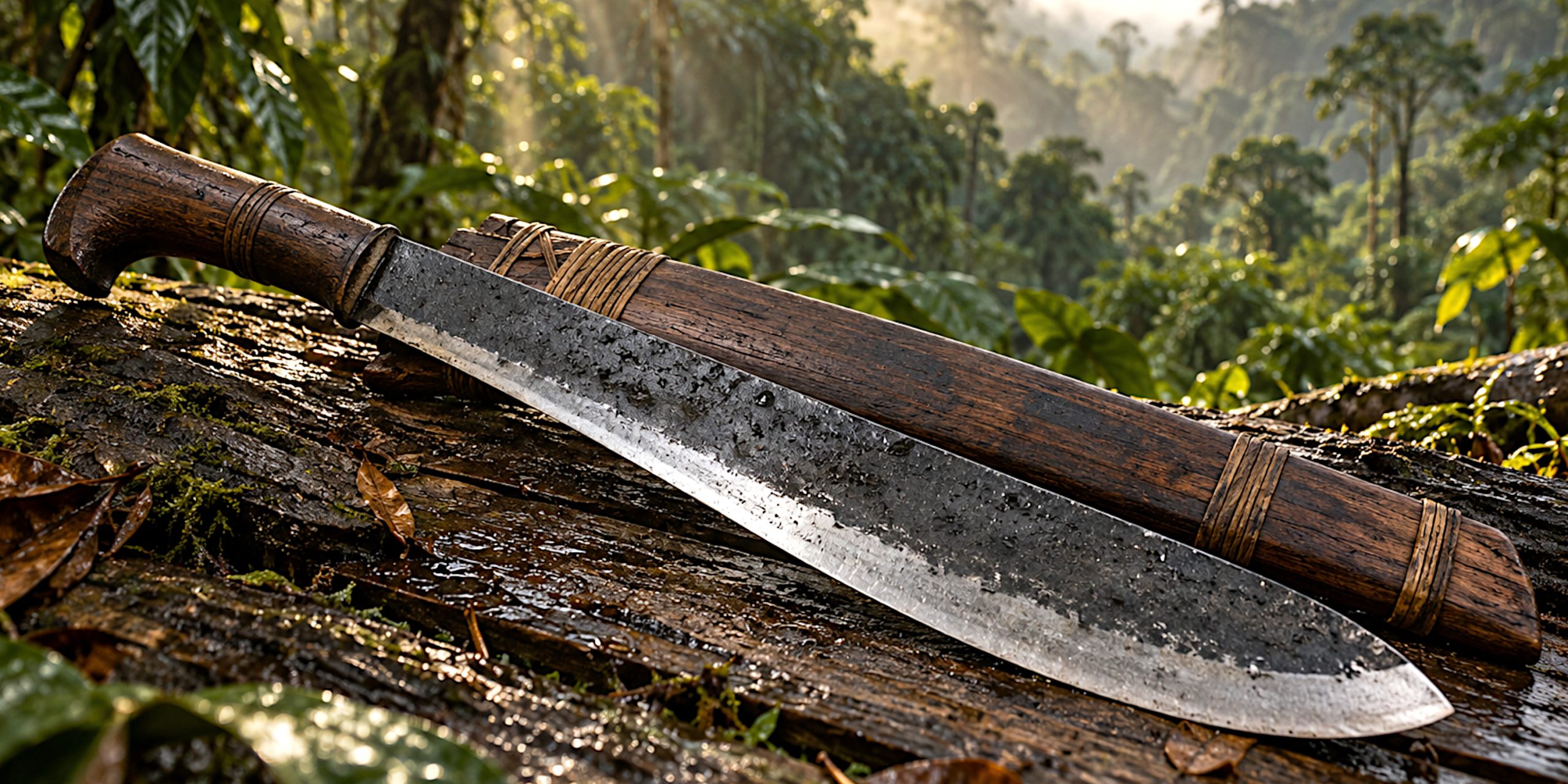
The parang is a single-edged cutting blade associated with the Malay world, particularly Malaysia, Indonesia, Brunei and Borneo. It has served as an agricultural tool, woodland implement and weapon, with designs ranging from plain working knives to elaborately decorated swords.
The name describes a broad family rather than one fixed pattern. A compact chopping parang and a decorated Bornean parang ilang can differ considerably in their blade geometry, fittings and cultural significance. Understanding those differences matters more than finding one supposedly definitive specification.
Much of the parang’s appeal lies in that relationship between practical design and local craftsmanship. Some examples were made to work hard; others also expressed identity, wealth or status. Decoration and usefulness were perfectly capable of sharing the same scabbard.
Specification

There is no universal parang specification. Dimensions, weight and construction should be recorded for the individual blade rather than assumed from its name.
| Feature | Description |
|---|---|
| Classification | Single-edged cutting tool or sword, depending on the form |
| Principal regions | Malay Peninsula, Borneo and parts of the Indonesian archipelago |
| Blade profile | Straight, curved, angular or widening towards the tip |
| Cutting edge | Usually one sharpened edge; bevel geometry varies |
| Blade material | Iron and steel in historical examples; commonly carbon steel in modern working blades |
| Hilt materials | Wood, horn or bone; synthetic materials on some modern versions |
| Hand protection | Often little or none, although some sword forms have guards |
| Scabbard | Frequently wood, sometimes secured or decorated with rattan and metal fittings |
| Main functions | Clearing vegetation, agricultural work, woodworking and, in some contexts, fighting |
A useful measured example is the Metropolitan Museum of Art’s parang ginah, dated to the eighteenth or nineteenth century. Its catalogue records an overall length of 57.2 cm, a blade length of 35.6 cm and a weight of 669 g. These are measurements of that object, not a standard for the whole family. The Metropolitan Museum of Art
Blade balance is often more informative than length alone. A broad blade carrying substantial mass towards the tip behaves differently from a narrower sword blade, even when their overall dimensions are similar.
History and Evolution
The parang developed within regional traditions of metalworking, agriculture and weapon manufacture. Its history cannot be reduced confidently to a single inventor, birthplace or date.
Working blades needed to cope with repeated cutting, humid conditions and locally available materials. Their shapes reflected particular tasks as well as the preferences of smiths and users. A blade suited to cutting woody growth did not necessarily need the same proportions as one intended primarily for fighting.
Historical sword forms also demonstrate that the parang was never exclusively a humble agricultural implement. The British Museum holds an example catalogued as both a parang and a mandau, with an asymmetrical blade, brass inlay, a carved bone handle and an elaborate scabbard assembly. Such features reveal considerable investment in craftsmanship. British Museum
Regional Forms and Related Names
| Name | General characteristics | Important distinction |
|---|---|---|
| Parang chandong or candung | Broad working blade, often with a rounded or sheepsfoot-like tip | Strongly associated with practical cutting tasks |
| Parang ilang or mandau | Bornean sword tradition, often with carved fittings and distinctive blade geometry | Local terminology and community attribution matter |
| Parang latok | Recognisable angular profile in many examples | Should not be treated as an ordinary curved machete |
| Parang nabur | Sword form associated with southern Borneo, often with a substantial guard | Its fittings distinguish it from many working parangs |
| Parang ginah | A named form represented in historical collections | Identification should follow the object’s construction and catalogue evidence |
These names are useful starting points, but spelling and classification vary between publications. Older museum records and auction catalogues sometimes apply broad labels to objects that would benefit from a more specific identification.
Modern parangs continue this development through both local production and commercial bushcraft manufacture. Contemporary makers may use different steels, handle materials and sheath systems while retaining the basic emphasis on effective cutting.
Advantages and Disadvantages
The parang’s strengths depend on the particular design. A heavy working blade should be assessed as a chopping tool; a historical sword form deserves a different comparison.
Advantages
- Effective chopping: Forward blade mass can help a working parang cut woody stems and small branches.
- Versatility: Suitable forms can handle vegetation clearance, rough woodworking and agricultural tasks.
- Manageable size: Compact examples are easier to carry through dense growth than long swords or large axes.
- Repairable construction: Traditional wooden hilts and scabbards can be maintained or replaced by skilled craftspeople.
- Local specialisation: Regional variation allows different designs to suit particular work and environments.
Disadvantages
- Limited hand protection: Many working forms lack a guard, leaving the hand exposed.
- Corrosion: Carbon steel requires care, especially in damp conditions.
- Fatigue: A heavy blade can become tiring during prolonged use and awkward for fine work.
- Variable manufacture: Steel quality, heat treatment and hilt security differ considerably between makers.
- Restricted reach: Short examples provide less reach than longer swords or polearms.
A convex edge can be durable when properly made, but no grind makes a blade indestructible. Edge thickness, heat treatment and the material being cut all affect performance.
Comparison with Similar Weapons
Parangs belong within a wider world of blades used for both work and fighting. Their boundaries overlap, particularly where local names have been translated loosely into English.
| Blade | Principal association | Typical design emphasis | Comparison with the parang |
|---|---|---|---|
| Machete | Widely used internationally | Vegetation clearance; many forms have relatively thin blades | Heavy parangs often favour chopping, but machete designs vary greatly |
| Golok | Particularly Indonesia | Compact utility blade, often stout and broad | Closely related in function; terminology can overlap |
| Bolo | Philippines | Diverse agricultural and fighting blades | Some forms share forward weight and broad cutting profiles |
| Kukri | Nepal | Distinctive forward-curving blade | Shares chopping capabilities but has a different profile and tradition |
| Klewang | Indonesia and neighbouring regions | Usually a single-edged sword, with varied regional forms | Often more explicitly sword-like, although catalogue terminology overlaps |
Claims that all machetes are light, all goloks are short or all parangs are heavy quickly run into exceptions.
The better comparison examines the actual object: blade thickness, balance, edge geometry, grip security and intended use. A modern product label tells only part of that story.
Legacy
The parang remains a living tool rather than merely a historical weapon. Its continued usefulness helps explain why familiar blade shapes survive alongside modern materials and manufacturing methods.
Historical examples also preserve evidence of regional craftsmanship. Hilt carving, scabbard construction, blade decoration and metal fittings can reveal more than an isolated blade silhouette.
For collectors and museums, that makes accurate attribution important. “Dayak sword” is a broad description covering distinct communities and traditions, not a complete identification. Nor should every decorated Bornean blade be described automatically as ceremonial or associated with headhunting.
The strongest interpretation considers the whole object and its documented history. An impressive carving deserves attention, but it cannot supply missing provenance.
Where to See Parangs
Online collection records provide reliable opportunities to study historical examples. Physical display should be checked separately before travelling.
| Museum | Example to study | Access |
|---|---|---|
| British Museum, London | Parang or mandau, museum number As,Bk.84.a, with decorated blade, carved hilt and elaborate scabbard | Online collection record; confirm physical display with the museum |
| Metropolitan Museum of Art, New York | Sword (Parang Ginah), 36.25.1416, dated to the eighteenth or nineteenth century | Online photographs and measurements; currently listed as not on view |
The British Museum example is particularly useful for examining the relationship between blade, hilt and scabbard. The Met’s record offers a clearly measured comparison. Neither holding should be treated as a promise that the object will be in a public gallery on the day of a visit. British Museum
When studying photographs, look beyond the decoration. Blade cross-section, wear around the grip and the fit of the scabbard can be equally revealing.
Collector’s Guide
A good purchase begins with identifying what is being offered: an antique working parang, a historical sword, a later decorative object or a modern functional blade.
“Hand-forged” does not establish age. Traditional methods remain in use, and a newly made blade may display hammer marks, natural materials and a wooden scabbard.
What to Check Before Buying
- Regional attribution: Ask what supports the seller’s identification.
- Blade condition: Examine cracks, deep corrosion, edge losses and evidence of heavy grinding.
- Hilt security: Look for splits, movement, repairs and replacement bindings.
- Matching components: Establish whether blade, hilt and scabbard belong together.
- Provenance: Prefer dated photographs, acquisition records and earlier catalogue entries to an unverified family story.
- Alterations: Replaced fittings and aggressive polishing can affect historical interest and value.
- Materials: Obtain specialist advice where protected animal materials are identified or suspected.
Decoration alone cannot establish that a blade was ceremonial. Equally, a plain example with sound provenance may be more historically useful than an ornate object with an uncertain history.
Recorded Auction Prices
Documented sales provide firmer reference points than broad price bands presented without supporting results.
| Auction | Catalogued object | Estimate or starting price | Recorded result |
|---|---|---|---|
| Skinner, Boston, 2 April 2005, sale 2292, lot 383 | Nineteenth-century Sumatran parang, with watered-steel blade, horn hilt and silver-mounted wooden scabbard | Estimate US$500–700 | Archive displays US$529, with US$450 also shown |
| Artmark, 15 July 2021, lot 111 | Parang ilang attributed to Borneo and dated by the auctioneer to the eighteenth or nineteenth century | Starting price €250 | Listed as sold for €400 |
Skinner’s archived page does not clearly label the relationship between its two displayed figures, so the premium basis should be confirmed before using the result as a direct comparison. Artmark’s listing records €400 as the sale figure; additional charges should be checked against the applicable sale terms. Dates and attributions above follow the auction catalogues. Skinner Auctioneers
These are historical results, not current valuations. Two sales cannot establish a dependable market range for such a varied family of objects.
What Influences Value?
| Factor | Why it matters |
|---|---|
| Reliable provenance | Supports age, attribution and historical context |
| Identifiable regional form | Helps collectors compare genuinely similar objects |
| Original hilt and scabbard | Preserves the object as a complete historical assembly |
| Condition | Cracks, severe corrosion and substantial alteration can reduce appeal |
| Craftsmanship | Carving, inlay and well-executed fittings may attract specialist interest |
| Documented association | A credible link to a person or event can add significance |
Care and Conservation
Keep an antique parang dry and inspect it periodically for active corrosion. Avoid abrasive cleaning, powered polishing or attempts to reveal a blade pattern through amateur chemical treatment.
Steel, wood, horn, bone and rattan require different care. A treatment suitable for the blade may damage the fittings. For an important example, consult a conservator before attempting restoration.
An antique should also be treated as a collection object rather than tested as a working tool. A sound-looking blade can conceal weaknesses in its hilt or tang.