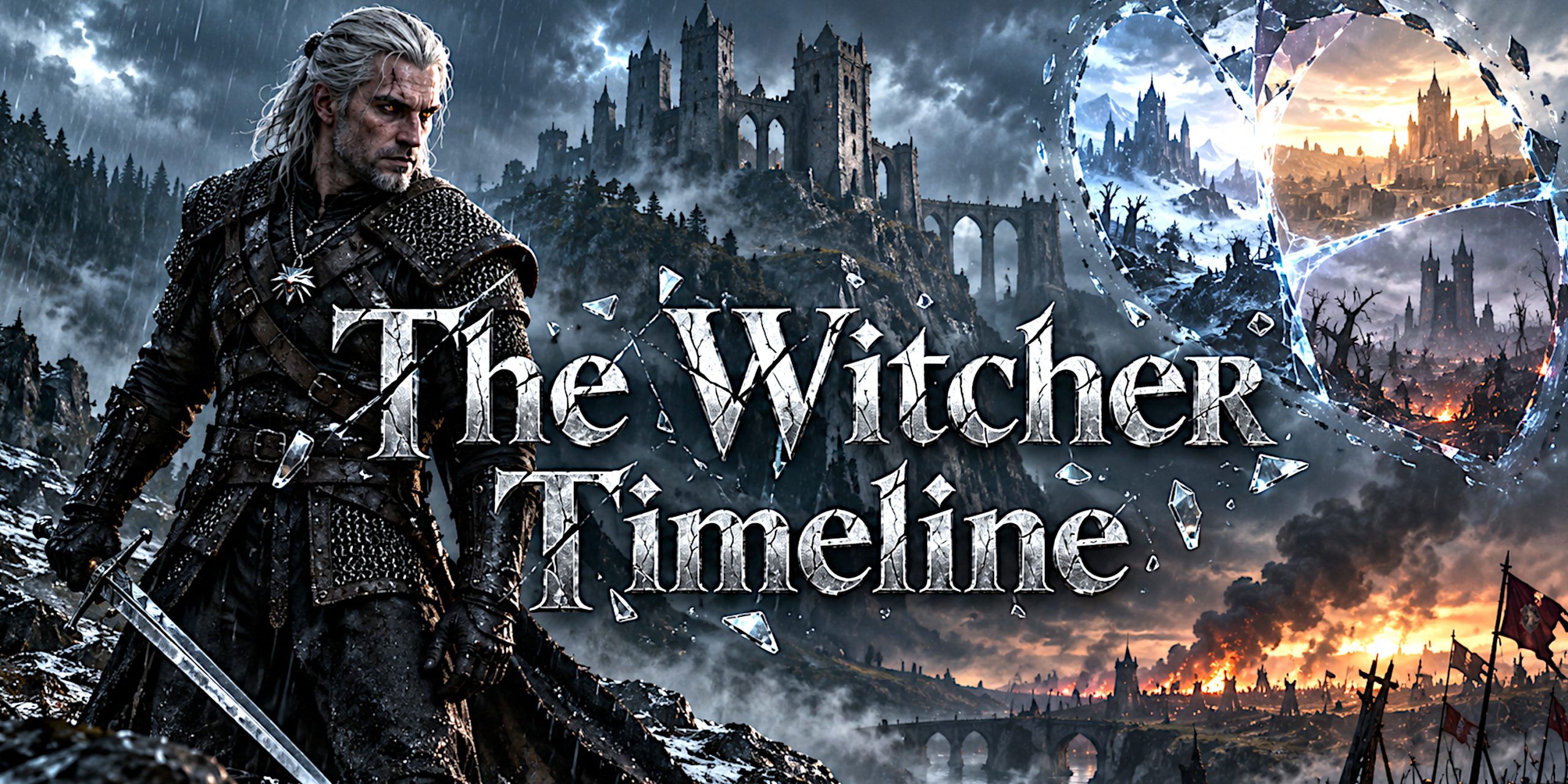
The Witcher timeline becomes much easier to follow once you stop trying to squeeze every version into the same calendar. Andrzej Sapkowski’s books, CD Projekt Red’s games and Netflix’s adaptations share characters and major events, but they do not form one seamless history.
The books tell the original story. The games build their own continuation after the main saga. Netflix retells that material with altered dates, relationships and events. Mixing them produces the sort of headache usually associated with a botched portal.
Here is how the chronology fits together, where it gets messy, and which order makes the most sense for a first encounter.
Spoiler warning: This guide discusses the broad events of the novels, games and Netflix series, including the consequences of Thanedd. It avoids detailing the final resolution of the book saga and the games’ alternative endings.
The Witcher timeline at a glance
These are useful landmarks, rather than a claim that every passing reference agrees. Early dates are particularly slippery, while the games introduce inconsistencies when measuring the years since the books.
| Period or date | Event | Continuity |
|---|---|---|
| Roughly 1,500 years before the main saga | The Conjunction of the Spheres reshapes contact between worlds | Book background, reinterpreted by adaptations |
| Centuries before the saga | Human expansion, the growth of kingdoms and the development of witchers | Broadly shared history, with different details |
| Geralt’s early career | Crossroads of Ravens | Books |
| Before the main five-novel saga | The Last Wish, Sword of Destiny and the principal action of Season of Storms | Books |
| Early to mid-1260s, with dating uncertainties | Cintra falls, Sodden becomes a turning point, and Geralt takes responsibility for Ciri | Books |
| 1267 | The Thanedd coup and renewed war fracture the main characters’ lives | Books |
| 1268 | Brenna, the Peace of Cintra and the closing events of the main saga | Books |
| 1270 | The Witcher | Conventional game chronology |
| 1271 | The Witcher 2: Assassins of Kings | Conventional game chronology |
| 1272 | The Witcher 3: Wild Hunt | Game chronology |
| Usually placed in 1275 | Blood and Wine | Game chronology |
Netflix’s dates belong in a separate table below. Its version of an event should not be used to date the equivalent book chapter.
The Conjunction of the Spheres: where the trouble starts
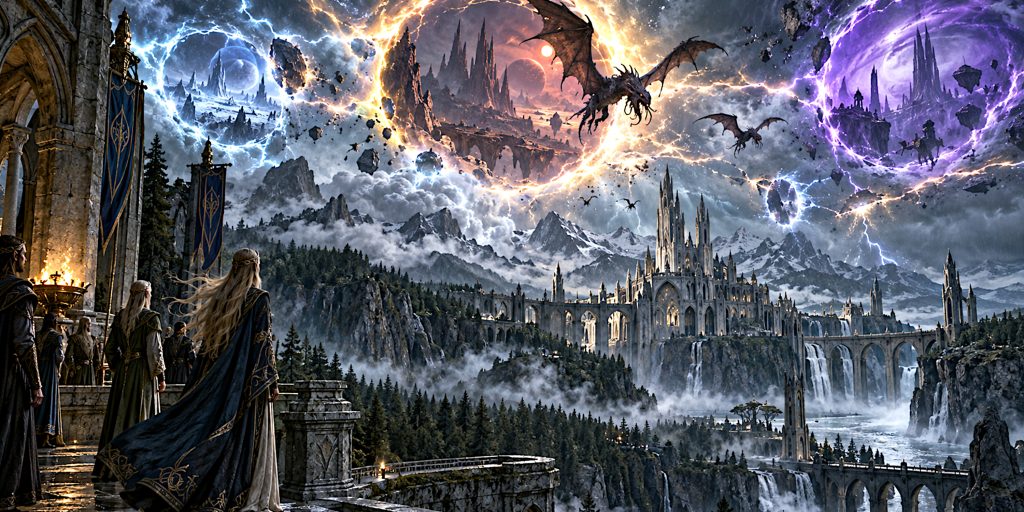
The Conjunction brought previously separate worlds into contact. Creatures became stranded outside their original environments, and the consequences helped shape the monster-haunted world Geralt inherits.
It is usually placed roughly 1,500 years before the main story. That is a useful orientation point, although the ancient history is deliberately less tidy than a modern textbook timeline.
There is also a distinction between the Conjunction and the later arrival and expansion of the human communities that establish the Northern Kingdoms. Treating every movement of humans as one migration flattens a complicated history.
Netflix’s Blood Origin supplies its own account of the catastrophe. It is an explanation within the television continuity, rather than a missing chapter of Sapkowski’s novels.
Human expansion and the creation of witchers
Human kingdoms grow through settlement, conflict and conquest. Elves and dwarves face displacement, violence and restrictions that remain central to the politics of Geralt’s era.
I find this background more revealing than another royal family tree. The Continent’s prejudices are not decorative scenery. They determine who can work, who gets protection and who becomes a convenient target when a ruler needs someone to blame.
Witchers emerge as specialists trained and mutated to survive encounters with monsters. Their creation involves magical experimentation, alchemy and lethal trials. Their usefulness rarely translates into public affection.
Avoid assigning the same founding date to every version of the setting. Netflix’s official chronology gives specific dates for its witcher origins, but those dates should stay attached to that adaptation.
Geralt’s early adventures and the short stories
Crossroads of Ravens follows a young Geralt at the beginning of his career. It belongs before the familiar adventures of the established monster hunter, although that does not automatically make it the best first book.
The Last Wish introduces much of the series’ emotional and moral vocabulary through stories involving Renfri, a striga, a djinn and Geralt’s complicated approach to choosing between bad options.
Sword of Destiny develops his relationships further and makes Ciri essential to the story. These collections are foundational. Skipping them to reach the supposedly proper novels means losing much of the reason those novels matter.
Neither collection behaves like a diary with every entry neatly dated. The Last Wish uses a framing narrative, and the stories look back across earlier adventures. Reading order and chronological order are different things here.
Season of Storms also takes place mainly during Geralt’s earlier career. Its later framing material is a good reason to leave it until after the main saga on a first read.
Source: The publisher’s Witcher book guide.
Cintra, Sodden and Ciri’s training
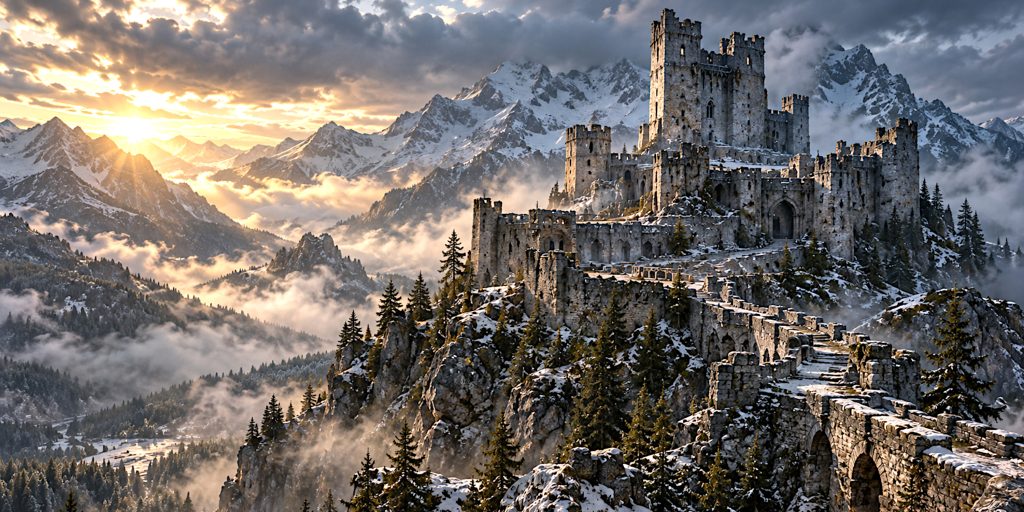
The fall of Cintra destroys Ciri’s security and turns her royal ancestry into a danger. Nilfgaard’s advance and the fighting at Sodden reshape the balance between the empire and the Northern Kingdoms.
Geralt and Ciri’s relationship then becomes the centre of the saga. At Kaer Morhen she begins learning from the witchers; her magical education brings Yennefer into a parental role that no list of political alliances can adequately describe.
Blood of Elves follows this transition from short-story encounters into a sustained narrative. Monarchs, spies and mages increasingly recognise that Ciri’s ancestry could serve their ambitions.
The Elder Blood descends through the line associated with Lara Dorren and the human mage Cregennan of Lod. It helps explain Ciri’s unusual abilities and why so many powerful people pursue her. Their interest is rarely accompanied by much concern for her preferences.
Thanedd and the war years, 1267 to 1268
The coup on Thanedd in The Time of Contempt is a major chronological landmark. Rival interests within the magical establishment break into open conflict, and Geralt, Yennefer and Ciri are separated.
The later novels follow overlapping journeys through the resulting war. Geralt gathers companions while trying to reach Ciri. Yennefer faces dangers of her own. Ciri’s experiences become increasingly brutal, including her time with the Rats and her encounters with Leo Bonhart.
Baptism of Fire, The Tower of the Swallow and The Lady of the Lake do not always present events in a straight line. Testimony, recollection and later perspectives are part of how the story is told.
The Battle of Brenna and the Peace of Cintra belong to 1268. They settle major military questions, but political settlements and personal safety are very different achievements on this continent.
The saga’s ending also resists a completely literal reading. I would leave room for that ambiguity before treating the next game’s opening as the definitive explanation of what Sapkowski intended.
Where the Witcher games fit
CD Projekt Red’s main trilogy continues from the books in its own continuity. It assumes much of the literary history, then develops new events and outcomes.
| Game | Usual setting | Place in the story |
|---|---|---|
| Thronebreaker: The Witcher Tales | 1267 to 1268 | Queen Meve’s campaign overlaps the war depicted in the later novels |
| The Witcher | 1270 | Geralt returns with amnesia and becomes involved in events around Temeria |
| The Witcher 2: Assassins of Kings | 1271 | Royal assassinations destabilise the North |
| The Witcher 3: Wild Hunt | 1272 | Geralt searches for Ciri during another Nilfgaardian invasion |
| Hearts of Stone | During Geralt’s Wild Hunt-era adventures | A largely separate contract draws him into Gaunter O’Dimm’s affairs |
| Blood and Wine | Usually 1275 | Geralt travels to Toussaint for an adventure that serves well as an epilogue |
The early games’ references to elapsed time do not always match the books’ dates. The sequence is more dependable than attempts to make every stated interval fit.
Hearts of Stone can be played at different points during The Witcher 3. Blood and Wine works best after the main campaign for narrative closure, even though gameplay access does not force that order.
The Witcher IV introduces Ciri as the protagonist of a new game saga. An exact in-world year should only be added when confirmed, rather than calculated from trailer appearances.
Source: CD Projekt Red’s Witcher IV announcement.
The Netflix Witcher timeline explained
Season 1 follows Geralt, Yennefer and Ciri across different periods before their stories converge. Scenes placed next to each other can be decades apart. The characters’ slow ageing does very little to help.
Netflix’s published timeline supplies these adaptation-specific landmarks:
| Netflix date | Event |
|---|---|
| 1165 | The sacking of Kaer Morhen, depicted in Nightmare of the Wolf |
| 1192 | Yennefer is born |
| 1206 | Yennefer enters Aretuza |
| 1231 | Geralt’s confrontation with Renfri at Blaviken |
| 1240 | Geralt meets Jaskier |
| 1249 | Geralt invokes the Law of Surprise after saving Duny |
| 1250 | Ciri is born |
| 1256 | Geralt and Yennefer’s encounter involving the djinn |
| 1263 | Cintra falls |
| Around 1264 | Sodden and Geralt’s meeting with Ciri |
| Around 1265 to 1266 | The principal events covered by Season 2 |
Those dates explain the television edit. They also demonstrate why importing Netflix character ages into a book chronology causes problems.
Source: Netflix’s official Witcher timeline.
Where the Netflix prequels and later seasons belong
Blood Origin is set roughly 1,200 years before the main television series. Nightmare of the Wolf follows Vesemir before Geralt’s adult adventures, while Sirens of the Deep belongs within Geralt’s earlier monster-hunting years.
Season 3 moves towards the catastrophe at Thanedd. Season 4 follows the separated central characters afterwards: Geralt travels with new companions, Yennefer confronts the struggle over magic, and Ciri lives among the Rats under the name Falka.
Season 4 also introduces a storytelling frame around a century later. That future perspective does not mean Geralt’s main adventure has suddenly jumped forward a hundred years.
For a first watch, keep the main seasons in order. The prequels are optional additions, and chronological placement alone is not a good reason to interrupt a developing storyline.
The Rats: A Witcher Tale takes place before the gang meets Ciri at the end of Season 3. However, its presentation is designed for viewers who have completed Season 4, so that is the better place to watch it.
The best Witcher book reading order
For a first read, I would follow the story’s introductions and revelations rather than chase the earliest possible date.
| Reading position | Book |
|---|---|
| First | The Last Wish |
| Second | Sword of Destiny |
| Third | Blood of Elves |
| Fourth | The Time of Contempt |
| Fifth | Baptism of Fire |
| Sixth | The Tower of the Swallow |
| Seventh | The Lady of the Lake |
| Afterwards | Season of Storms |
| Afterwards | Crossroads of Ravens |
The last two are supplementary novels rather than the next chapters of the five-book saga. Crossroads of Ravens can be approached as an early-career adventure, but returning to young Geralt after knowing the older one gives it a different appeal.
Common Witcher timeline questions
Are the games set after the Netflix series?
The games follow the book saga within CD Projekt Red’s continuity. Netflix adapts parts of that earlier material, but its series is not a direct prequel to the games.
Is Blood Origin part of the book timeline?
It belongs to Netflix’s continuity. Its account of ancient events should not be treated as the original novels’ confirmed history.
Why does Geralt barely age in Season 1?
Witchers age slowly, so his appearance is an unreliable guide to the passing decades. Yennefer’s appearance is similarly unhelpful because of magic.
Does Ciri’s time travel make the timeline meaningless?
No. Her movement between worlds and times complicates her personal journey, but the wars, family relationships and most characters’ experiences still have an order. Keeping track of where Ciri is can require more care than keeping track of the year.
Can I start with The Witcher 3?
Yes. It gives enough context to follow its central adventure. Earlier books and games add emotional weight, but beginning with Wild Hunt is perfectly workable. Accept that some returning characters have history you have not personally witnessed yet.