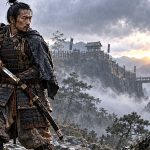
Kingdom should not work quite as well as it does. Court politics, dynastic succession, famine, class conflict and sprinting zombies sound like ingredients selected by someone spinning a particularly chaotic television wheel. Somehow, writer Kim Eun-hee turns them into one of Netflix’s sharpest historical dramas.
Set in a fictionalised Joseon Korea shortly after the Japanese invasions of the late sixteenth century, the series follows Crown Prince Lee Chang as he investigates reports that his father, the king, has died. The royal court insists that the monarch is merely unwell. This would be more reassuring if people entering his chambers were not being eaten.
What follows is a beautifully filmed political thriller in which the undead are terrifying, but rarely the most dangerous creatures on screen.
Spoiler warning: This article discusses characters, themes and some plot developments from both seasons and Kingdom: Ashin of the North.
Kingdom at a Glance
| Detail | Information |
|---|---|
| Original title | Kingdom |
| Creator and writer | Kim Eun-hee |
| Directors | Kim Seong-hun and Park In-je |
| Country | South Korea |
| Original language | Korean |
| Genre | Historical drama, political thriller, action and horror |
| Setting | Fictionalised Joseon Korea |
| First released | 25 January 2019 |
| Seasons | Two |
| Main episodes | Twelve |
| Special episode | Kingdom: Ashin of the North |
| Main cast | Ju Ji-hoon, Ryu Seung-ryong, Bae Doona, Kim Sang-ho and Kim Sung-kyu |
| Streaming service | Netflix |
Netflix currently lists two seasons of the main series. The feature-length special Kingdom: Ashin of the North was released in July 2021.
What Is Kingdom About?

Rumours are circulating through Hanyang that the king is dead. Crown Prince Lee Chang, already politically vulnerable because he was born to a concubine, is denied access to his father by the powerful Haewon Cho clan.
Lee Chang leaves the capital with his bodyguard Mu-yeong to find the physician who last treated the king. Their investigation leads south to the Jiyulheon clinic, where they encounter disease, mass death and evidence that the royal court is hiding something considerably worse than an awkward succession crisis.
The dead are returning to life.
Yet Kingdom is never content to become a straightforward outbreak story. Lee Chang must fight the infected while also defending his claim to the throne from Chief State Councillor Cho Hak-ju. The plague spreads through a country already weakened by war, hunger and political exploitation. Every disaster is made worse by someone wealthy refusing to surrender an advantage.
There are zombies, certainly. There are also tax policies, food shortages and factional disputes. I promise this combination is far more exciting than it sounds.
The Historical Setting Behind the Series

The story takes place several years after the Japanese invasions of Korea, known collectively as the Imjin War of 1592 to 1598. The conflict devastated large areas of the Korean peninsula, disrupted agriculture and exposed weaknesses in the Joseon state.
Kingdom does not recreate a specific documented outbreak or succession crisis. Its characters and principal events are fictional. However, the political and social conditions surrounding them are rooted in recognisable features of the period.
Joseon society was strongly hierarchical. Political influence was concentrated among aristocratic yangban families, while ordinary farmers carried much of the economic burden. Court factions competed for appointments and royal favour, sometimes with lethal consequences.
The series uses that structure brilliantly. Access to food, shelter and medical treatment depends heavily on rank. Noble officials close gates to protect themselves. Hungry villagers are treated as disposable. The infection may be supernatural, but the unequal response to it feels grimly believable.
Power, Hunger and the Real Monsters
The undead provide the immediate threat, but hunger sits at the centre of the first season.
The outbreak begins among people who are starving. Its spread is accelerated by desperation, secrecy and the willingness of powerful figures to sacrifice poorer communities. Writer Kim Eun-hee has described hunger as a central theme of the opening season, with the infected reflecting people brutalised by poverty and mistreatment.
Season two shifts towards blood, both in the literal horror of the epidemic and in the political obsession with lineage. The royal court is prepared to deceive, murder and manipulate childbirth to secure the correct bloodline. That makes the title rather clever. The kingdom being fought over is a political state, but it is also a social order built around inherited privilege.
Cho Hak-ju understands this system perfectly. He is frightening because he does not behave like a theatrical villain. His decisions are cold, strategic and usually framed as necessary. He can regard thousands of deaths as an administrative inconvenience, which is a talent governments have historically found alarmingly easy to cultivate.
Crown Prince Lee Chang
Ju Ji-hoon gives Lee Chang a development arc that feels earned rather than conveniently heroic.
At the beginning, the prince is politically isolated and accustomed to privilege. He may care about the country, but caring from inside a palace is relatively comfortable. Once he travels beyond the capital, he is confronted by the consequences of court policy.
Lee Chang gradually learns that royal authority carries obligations as well as benefits. He listens to physicians, soldiers and ordinary survivors. He makes mistakes, loses people and begins to understand why legitimacy cannot rest entirely on ancestry.
Crucially, he never becomes an invincible action hero. He is capable with a sword, but survival frequently depends on cooperation. In a genre fond of lone warriors performing impossible feats, seeing a prince occasionally require practical assistance is almost refreshing.
Seo-bi and the Search for a Cure
Bae Doona’s Seo-bi is one of the series’ most important characters. She is a physician’s assistant who attempts to understand the outbreak through observation rather than superstition or political convenience.
Seo-bi studies the infected, tracks changes in their behaviour and investigates the resurrection plant linked to the disease. Her work supplies the story with an investigative thread that runs alongside Lee Chang’s political struggle.
She is compassionate without being naïve. Her determination to treat the sick places her in repeated danger, but the series does not reduce her to a passive symbol of goodness. She makes deductions, challenges authority and becomes essential to any hope of controlling the epidemic.
Bae Doona plays her with a restrained intensity that suits the character. Seo-bi often looks as if she is the only person in the room who has read the instructions, only to discover that someone powerful has set them on fire.
The Main Cast and Characters
| Character | Actor | Role in the story |
|---|---|---|
| Crown Prince Lee Chang | Ju Ji-hoon | The royal heir investigating the plague and the conspiracy surrounding his father |
| Cho Hak-ju | Ryu Seung-ryong | Chief State Councillor and leader of the powerful Haewon Cho clan |
| Seo-bi | Bae Doona | A physician’s assistant studying the infection |
| Mu-yeong | Kim Sang-ho | Lee Chang’s loyal personal guard |
| Yeong-shin | Kim Sung-kyu | A skilled fighter with a complicated past |
| Queen Consort Cho | Kim Hye-jun | The young queen whose pregnancy becomes central to the succession struggle |
| Lord Ahn Hyeon | Huh Joon-ho | A respected former governor and veteran of the Japanese invasions |
| Min Chi-rok | Park Byung-eun | Head of the Royal Commandery |
| Ashin | Jun Ji-hyun, also credited as Gianna Jun | A woman from the northern frontier connected to the resurrection plant |
The ensemble is consistently strong. Even secondary characters tend to possess understandable motives, personal loyalties or enough survival instinct to cause serious trouble.
Swords, Firearms and Joseon Warfare
One of the pleasures of Kingdom is watching a zombie story unfold in a military culture very different from the modern or vaguely medieval Western settings commonly used by the genre.
Characters fight with a mixture of swords, polearms, bows and gunpowder weapons. These are not decorative historical props. Each weapon presents a different answer to the physical problem of stopping a fast-moving infected attacker.
Swords
Joseon soldiers and officials could carry several forms of single-edged sword. The blades seen in the series broadly reflect the Korean preference for practical military cutting weapons, though individual props should not be treated as museum-grade reconstructions.
The hwando was a relatively short, single-edged sword worn by soldiers and officials. Its compact size made it more manageable than an oversized battlefield blade, particularly in confined spaces. That proves useful when the confined space contains several dozen infected people with poor boundaries.
Longer military swords and sabres also appear. The choreography generally favours direct cuts, defensive movement and rapid changes of position. It is stylised for television, but it avoids turning every fight into weightless acrobatics.
Bows
Archery held considerable military and cultural importance in Joseon Korea. The traditional Korean composite bow was small, powerful and suited to use on foot or horseback.
Archers in Kingdom can engage the infected at distance, although arrows have obvious limitations. Ammunition runs out, accurate headshots are difficult under pressure and massed attackers can cover ground very quickly.
Matchlock Firearms
Gunpowder weapons became increasingly important during and after the Japanese invasions. Matchlock muskets offered considerable stopping power, but their slow loading process created an obvious problem against attackers who did not pause politely between volleys.
The series makes good use of coordinated ranks and defensive firing positions. A firearm is formidable when soldiers have preparation, discipline and space. In a panicked corridor, it becomes an unusually complicated club.
Polearms and Improvised Weapons
Spears and longer polearms allow fighters to maintain distance, hold narrow approaches and attack from behind barriers. Their tactical value is clear during sieges and street fighting.
Common people also use agricultural tools, clubs and whatever else can be lifted without immediately falling apart. This gives the action a grounded quality. Not everyone conveniently owns an ancestral blade with perfect balance.
How Good Is the Action?
The action works because it usually has a clear tactical shape.
Survivors defend walls, bridges, gates, rooftops and narrow streets. They use terrain to control the infected, then lose control when a gate fails or someone makes a politically motivated decision of magnificent stupidity.
The zombies are fast, violent and frighteningly physical. They climb over one another, crash through structures and overwhelm formations through sheer momentum. Large groups resemble a flood more than a collection of individual monsters.
The series also understands restraint. It spends enough time establishing a location before destroying its sense of safety. Quiet palace corridors, mountain roads and frozen lakes acquire their own tension because the audience learns to expect disaster from almost any direction.
Fight scenes are not flawless. Named characters occasionally survive odds that would mulch an entire regiment, and some last-second escapes depend on generous timing. Still, the choreography has weight and geographical clarity. You can usually understand where people are, what they are trying to defend and why the plan has just gone horribly wrong.
Why the Zombies Feel Different
The infected follow a developing set of rules rather than the familiar conventions of Western zombie fiction.
Their behaviour appears connected to temperature, daylight, parasites and the properties of the resurrection plant. As Seo-bi learns more, earlier assumptions are revised. This prevents the threat from becoming predictable.
The visual design is excellent. The infected move with violent, unnatural energy, while their damaged bodies and distorted posture retain traces of the people they once were. They are grotesque without becoming visually interchangeable.
The plague also has a specific social meaning. Hunger, exploitation and resentment are embedded in its origins. The infected are victims before they become monsters, which lends the horror a layer of tragedy beneath all the enthusiastic biting.
Production Design and Costume
Kingdom looks expensive, but more importantly, it looks considered.
Palaces, provincial administrative buildings, defensive walls and rural settlements create a convincing sense of scale. The contrast between courtly splendour and impoverished villages reinforces the social divisions driving the story.
Costume communicates rank almost instantly. Officials wear formal robes and distinctive hats associated with Joseon administration, while soldiers, physicians, villagers and aristocrats are visually separated through colour, fabric and silhouette.
The hats have become one of the series’ most discussed features, partly because Joseon officials possessed a remarkable ability to make bureaucratic headwear look intimidating. The gat, a broad-brimmed hat associated with elite men, is particularly memorable. It should not be dismissed as a fashionable curiosity, as dress codes carried real social and political meaning.
The production takes artistic liberties, as historical drama always does. Clothing remains suspiciously camera-ready during a national catastrophe, and combat equipment is selected partly for visual impact. Even so, the setting feels inhabited rather than assembled.
Season One Review
The first season is lean, tense and exceptionally well paced.
Its six episodes move between political conspiracy, medical investigation and outbreak horror without allowing any strand to overwhelm the others. Information is revealed gradually, encouraging the viewer to reconsider both the plague and the royal court.
The major weakness is the ending. Season one stops at what feels less like a conclusion and more like someone has removed the next episode from the queue. Fortunately, season two continues the story directly.
As an opening season, it remains difficult to fault. It introduces a complicated political structure without drowning the audience in exposition and gives the outbreak an emotional and social foundation.
Season Two Review
Season two expands the conflict while delivering answers to several of the first season’s central mysteries.
The political struggle becomes more ruthless, the action grows larger and Lee Chang is forced to decide what kind of ruler he intends to be. Several characters receive emotionally satisfying conclusions, although the speed of events leaves less space for the careful suspense that distinguished the opening episodes.
The season occasionally strains credibility during its largest action sequences. It also introduces new information about the infection at a rapid pace. Yet the escalation largely works because it grows from choices already made by the characters.
Most importantly, season two reaches a genuine point of resolution while opening another chapter. That balance is rather valuable now, given the subsequent wait.
Kingdom: Ashin of the North
Released in 2021, Kingdom: Ashin of the North is a feature-length special exploring Ashin’s childhood and her connection to the resurrection plant.
The story moves away from the southern provinces and towards Joseon’s northern frontier. Relations between Joseon authorities, border communities and Jurchen groups create an atmosphere of suspicion and exploitation.
Ashin’s story is bleaker and more self-contained than the main series. It replaces much of Lee Chang’s reluctant idealism with grief, betrayal and revenge. The pacing is deliberate, particularly during its first half, but the emotional payoff is brutal.
The special also changes how we interpret the plague. What initially appeared to be a dangerous natural discovery becomes entangled with deliberate human action. As usual in Kingdom, somebody finds a terrible force and immediately considers its political applications.
Is Kingdom Historically Accurate?
Kingdom is best understood as historical fantasy informed by real institutions, material culture and social tensions.
Accurate or broadly credible elements include:
- The rigid hierarchy of Joseon society
- Competition among court factions
- The political importance of royal succession
- Social and agricultural disruption following the Japanese invasions
- Period clothing inspired by Joseon styles
- The use of bows, swords, polearms and matchlock firearms
- Regional administration through governors, magistrates and military commanders
Elements altered or invented for drama include:
- The royal family and principal political conspiracy
- The resurrection plant and parasitic infection
- Specific battles and outbreaks
- Compressed travel times
- Some weapon combinations and fighting techniques
- The scale and appearance of certain military formations
The series does not offer a documentary reconstruction of seventeenth-century Korea. It does something more interesting for a drama: it creates a fictional crisis that exposes the pressures within a historical society.
What Kingdom Does Best
The show’s greatest strength is its refusal to separate politics from horror.
A weaker series would pause the court intrigue whenever the zombies arrived. Kingdom makes the two threats inseparable. The outbreak spreads because officials conceal information. Defensive plans fail because aristocrats value status above competence. Hunger turns a local disaster into a national one.
Its other major strengths include:
- Excellent location work and production design
- Distinctive costume and weaponry
- Clear, forceful action choreography
- Strong performances across the ensemble
- A plague governed by evolving biological rules
- Political themes that emerge from the story rather than speeches
- Short seasons with very little wasted time
Where Kingdom Falls Short
The series earns its reputation, but it is not completely flawless.
Some viewers may find the opening political material dense, particularly if they are unfamiliar with Joseon offices and naming conventions. The story expects attention and does not always stop to remind you which magnificently dressed official belongs to which murderous faction.
Other limitations include:
- Abrupt season endings
- Occasional protection for major characters during chaotic battles
- Supporting figures who disappear before reaching their full potential
- A few revelations delivered through heavy exposition
- An unresolved continuation after Ashin of the North
These are irritations rather than fatal weaknesses. The largest frustration is simply that the existing story promises more than Netflix has so far delivered.
Will There Be a Kingdom Season Three?
As of September 2026, Netflix has not officially announced a third season of Kingdom.
The second-season finale and Ashin of the North clearly establish material for a continuation. Kim Eun-hee has also discussed further ideas for the story in past interviews. Interest from the creators and an official production order, however, are not the same thing.
Ignore supposed release dates attached to unofficial trailers or social media posts. Until Netflix or the production team confirms a renewal, season three remains possible but unconfirmed.
That is a frustrating position for viewers. We have a new threat, unfinished character arcs and enough resurrection plants to cause a fairly serious gardening dispute.
Is Kingdom Worth Watching?
Yes. Kingdom is one of the strongest historical horror series available on streaming.
Its zombies are frightening, its political villains are worse and its treatment of class gives the spectacle real substance. The action is exciting without becoming incoherent, while the historical setting offers weapons, tactics and visual traditions rarely seen in mainstream horror.
I would recommend it to viewers who enjoy:
- Historical political dramas
- Zombie horror with clear internal rules
- Siege battles and tactical action
- Korean period drama
- Stories about succession and court intrigue
- Series that trust the audience to keep up
Anyone seeking a relaxed background watch may struggle. Kingdom rewards attention, especially during its early political scenes. Look away for ten minutes and someone may have changed the succession, opened a gate and accidentally released several hundred corpses.
Seven Swords Verdict
Kingdom takes the familiar zombie outbreak and places it inside a society already wounded by war, inequality and political ambition. The result is tense, visually distinctive and far more thoughtful than its wonderfully excessive premise suggests.
Ju Ji-hoon gives the story a convincing moral centre, Bae Doona brings intelligence and humanity to its medical mystery, and Ryu Seung-ryong makes political calculation feel as threatening as any infected horde.
The lack of a confirmed third season leaves the larger story unfinished. Even so, the two existing seasons form a compelling arc, while Ashin of the North adds a darker account of how the catastrophe began.
Rating: 9 out of 10
Beautiful hats, vicious politics and extremely fast corpses. History television has offered considerably worse evenings.
Frequently Asked Questions
Is Kingdom based on a true story?
No. The characters, royal conspiracy and zombie epidemic are fictional. The series draws upon the society, clothing, weapons and political conditions of Joseon Korea following the Japanese invasions.
How many seasons of Kingdom are there?
There are two seasons containing six episodes each. A separate feature-length special, Kingdom: Ashin of the North, was released in 2021. Netflix currently lists the main series as having two seasons.
Should I watch Ashin of the North before Kingdom?
No. Watch seasons one and two first, followed by Ashin of the North. The special explains part of the plague’s origin and assumes familiarity with the main story.
Is Kingdom very violent?
Yes. It contains graphic zombie attacks, battlefield violence, executions and disturbing images of infected bodies. It is firmly aimed at mature viewers.
Has Kingdom season three been confirmed?
No. As of September 2026, Netflix has not officially confirmed a third season or announced a release date.
What swords are used in Kingdom?
The series shows Korean-style single-edged military swords broadly associated with the Joseon period, including weapons resembling the hwando. It also features bows, spears, polearms and matchlock firearms.
Where can I watch Kingdom?
Both seasons are available on Netflix, along with Kingdom: Ashin of the North. Availability can vary by country.