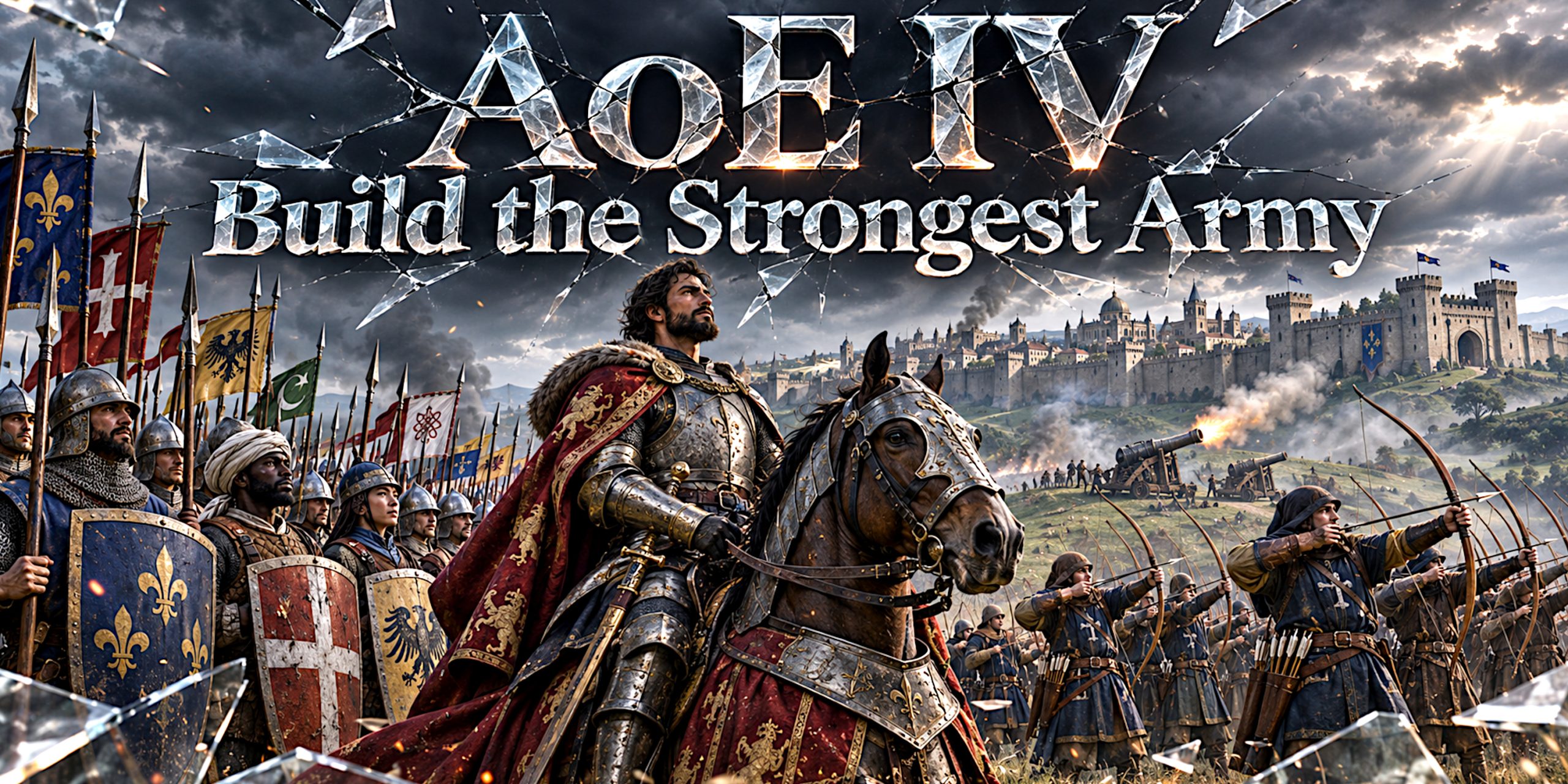
An army of your civilisation’s fanciest unit looks brilliant right up to the moment it meets the unit designed to kill it. Age of Empires IV rewards a force that can cover its own weaknesses, reach the fight at the right time and keep replacing losses.
These are strong compositions to build towards, rather than fixed recipes. Scout first. If your opponent changes units, change yours. That small act of paying attention wins an unreasonable number of games. The game’s core counters make the point clearly: archers beat spearmen, spearmen beat cavalry, and cavalry beats archers.
The best AoE IV armies at a glance
| Civilisation | Army to build towards | Best window | Main problem to watch |
|---|---|---|---|
| English | Longbowmen, spearmen, then men-at-arms | Feudal pressure into Castle Age | Armoured infantry and siege |
| French | Royal Knights, archers, then Arbalétriers | Feudal raids into Castle Age | Braced spearmen and a costly gold bill |
| Holy Roman Empire | Men-at-arms, a few Landsknechte, ranged support | Castle Age infantry push | Crossbows and exposed Landsknechte |
| Ottomans | Janissaries, a frontline, and Great Bombards | Established late-game push | Losing expensive siege to a flank |
| Mongols | Mobile cavalry with Mangudai support | Raids and open-field fights | Fighting into static defences |
The civilisations have different economic and military strengths, and balance updates can alter the finer details. Think of the table as a guide to how each army works, not a promise that it wins every matchup.
English: Longbowmen and spearmen with a proper frontline
Build: Longbowmen and spearmen in Feudal Age. Add men-at-arms as the match develops, with siege when you need to break buildings.
The English composition is wonderfully straightforward. Longbowmen punish light infantry from a distance; spearmen stand between them and charging cavalry. English men-at-arms give you a tougher front once opponents begin fielding units that can absorb arrows. The English also have dependable farms, which helps sustain production during a long fight.
How to use it: Take ground gradually. Keep the longbowmen firing, place spearmen where cavalry must pass, and make the enemy come to you when possible. If armoured units begin walking through your arrows, add the appropriate armour counter rather than ordering another twenty longbowmen out of sheer loyalty.
Watch for: Siege that can hit your tightly packed ranged units, and opponents who force you to defend several places at once.
French: Royal Knights backed by ranged fire
Build: Royal Knights and archers early. Add Arbalétriers when armoured enemies become a serious part of the opposing army.
A Royal Knight arriving in Feudal Age can threaten villagers, pull defenders out of position and force a reaction before the opponent would like to give one. Archers help clear the spearmen built to stop your knights. Later, Arbalétriers give the French a stronger answer to heavily armoured units.
How to use it: Raid resources, withdraw damaged knights, and attack where the spearmen are absent. In a larger battle, let your ranged units work on the opposing frontline while knights look for exposed archers or siege.
Watch for: Repeatedly charging into braced spearmen. Knights are expensive, and a heroic death does very little for your food and gold economy.
Holy Roman Empire: Armoured infantry with a sharp edge
Build: Men-at-arms as the core, a smaller group of Landsknechte for damage, plus units that answer the opponent’s ranged troops.
The Holy Roman Empire is built for powerful infantry armies. Its Landsknechte deal area damage, making them dangerous when they reach a crowded fight. Their lighter protection means they need sturdier troops around them; sending a whole army of them across open ground is an exciting way to fund your opponent’s victory.
How to use it: Let the armoured frontline absorb the first contact, then bring Landsknechte into the melee where their sweeping attacks matter. Support the push with the counters you actually need, especially when the enemy fields crossbows or massed ranged units.
Watch for: Spending so much on infantry that you cannot answer a mobile opponent or protect the troops doing your damage.
Ottomans: Janissaries and Great Bombards behind a screen
Build: Janissaries and Great Bombards, protected by enough frontline troops to prevent cavalry or infantry from reaching the guns.
This is the terrifying army people picture when they hear “strongest”. Great Bombards can batter fortified positions, while Janissaries add distinctive firepower. The Ottoman military system supports sustained production, but the finished army still takes resources and time to assemble.
How to use it: Advance as one force. Keep vision on the sides of your army and leave room for your frontline to intercept attackers. A Great Bombard that survives several volleys earns its cost; one abandoned at the front becomes a very expensive piece of scenery.
Watch for: Flanks, anti-siege attacks and the temptation to keep producing siege when what you urgently need is protection for it.
Mongols: A cavalry army that chooses its fights
Build: A mobile cavalry core with Mangudai support, adjusted to the enemy’s unit mix.
Mongol strength lies in mobility. Mangudai suit raids and moving engagements, where they can cause trouble without standing still for a fair fight. That last part is crucial. A Mongol army at its best makes the opponent respond to threats across the map, then strikes where the response arrives late.
How to use it: Scout constantly, attack exposed workers or reinforcements, and retreat before a prepared counter force traps you. Bring suitable units when you have to take a direct battle. Mobility gives you the choice of where to fight, but it cannot make a bad matchup disappear.
Watch for: Chasing units into defensive positions or trying to win a prolonged, crowded fight with an army built to move.
How to make any composition stronger
The best army on paper can still lose because it arrives late, lacks upgrades or cannot replace its casualties. Before committing to a big fight, check these four things:
- What has the enemy built? A scout is cheaper than discovering their entire army is crossbows after your knights arrive.
- What protects your damage dealers? Ranged troops and siege need space and a frontline.
- Can your economy sustain losses? Add production buildings and keep their rally points useful as your economy grows.
- What is the fight for? Raiding villagers, holding a sacred site and breaking a keep call for different armies.
If you are learning, start with English longbowmen and spearmen. Their jobs are easy to recognise, and mistakes are easier to diagnose. If you enjoy raids, try French knights. If you want the spectacle of a late-game siege, the Ottomans will happily provide it, along with a strong incentive to guard your cannons.
The strongest AoE IV army is the one you can afford, control and adapt when the opponent finally shows their hand.