Seven swords sounds like the title of a legend that ought to be extremely old.
You can almost picture it already. Seven blades forged by a supernatural smith. Seven chosen warriors. Seven kingdoms. Possibly a prophecy, because these things rarely travel alone.
The historical reality is much less tidy.
There is no single ancient “Seven Swords” tradition stretching across Europe and Asia. Instead, the phrase sits at the meeting point of several very different traditions: the symbolic importance of the number seven, the cultural power of the sword, genuine historical artefacts such as Japan’s Seven-Branched Sword, medieval legends surrounding Wayland the Smith, tarot symbolism, Chinese wuxia fiction and modern film and television.
Some of these traditions are ancient.
Some are medieval.
Some are modern.
And a few are modern inventions dressed so convincingly in medieval clothing that they have acquired an afterlife of their own.
That, for me, is where the subject becomes really interesting.
Why Seven Became Such a Powerful Number
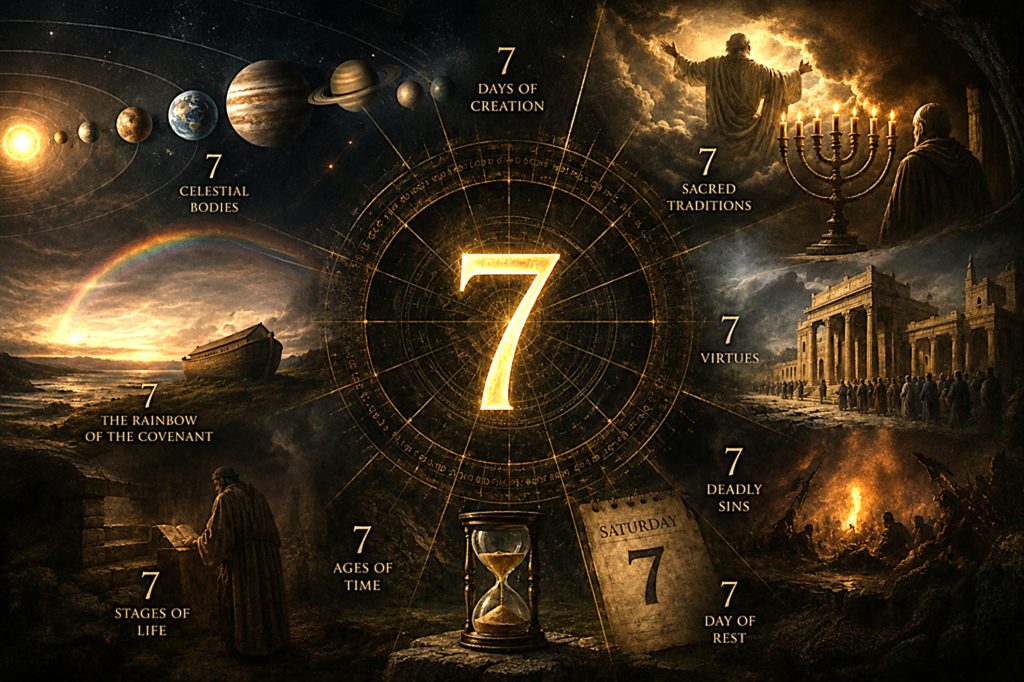
Seven appears repeatedly across religion, astronomy, folklore and storytelling.
The ancient world recognised seven classical celestial bodies visible to the naked eye: the Sun, Moon, Mercury, Venus, Mars, Jupiter and Saturn. These became deeply connected with systems of timekeeping and the seven-day week.
Within Judaeo-Christian traditions, seven appears constantly. Genesis presents creation through a seven-day structure, while later Christian thought developed groups such as the Seven Virtues, Seven Deadly Sins and Seven Sacraments.
The number also appears repeatedly in folklore and popular storytelling.
Seven is particularly useful to writers because it feels complete without becoming unwieldy.
Three characters form a trio.
Twelve begin to resemble a committee.
Seven still feels mythical.
That practical storytelling advantage should perhaps not be underestimated.
| Context | Association with Seven |
|---|---|
| Ancient astronomy | Seven classical celestial bodies |
| Timekeeping | Seven-day week |
| Biblical tradition | Creation and numerous symbolic groups |
| Christianity | Seven virtues, sins and sacraments |
| Folklore | Luck, completion and supernatural importance |
| Modern storytelling | A memorable number for groups, quests and artefacts |
The important caution is that seven does not possess one universal meaning.
Different cultures have attached different associations to it at different times.
The same is true of swords.
What the Sword Symbolises
Historically, swords were first and foremost weapons.
That rather obvious point is worth making because modern discussions can become so concerned with symbolism that the unfortunate business of hitting people with them disappears entirely.
But swords undoubtedly acquired meanings beyond combat.
They could represent:
- Royal authority
- Justice
- Military status
- Personal honour
- Protection
- Inheritance
- Religious authority
- Social rank
- Violence and death
- Legitimate political power
Ceremonial swords survived long after swords had ceased to be dominant battlefield weapons because their symbolic value remained useful.
A sword could be raised during a coronation, carried before a ruler or presented as a diplomatic gift.
It could equally well be used to kill somebody.
That contradiction made the sword unusually powerful as a symbol.
Authority and rebellion.
Justice and violence.
Honour and treachery.
The weapon can support almost any story depending upon who happens to be holding it.
The Seven-Branched Sword: A Genuine Ancient Artefact
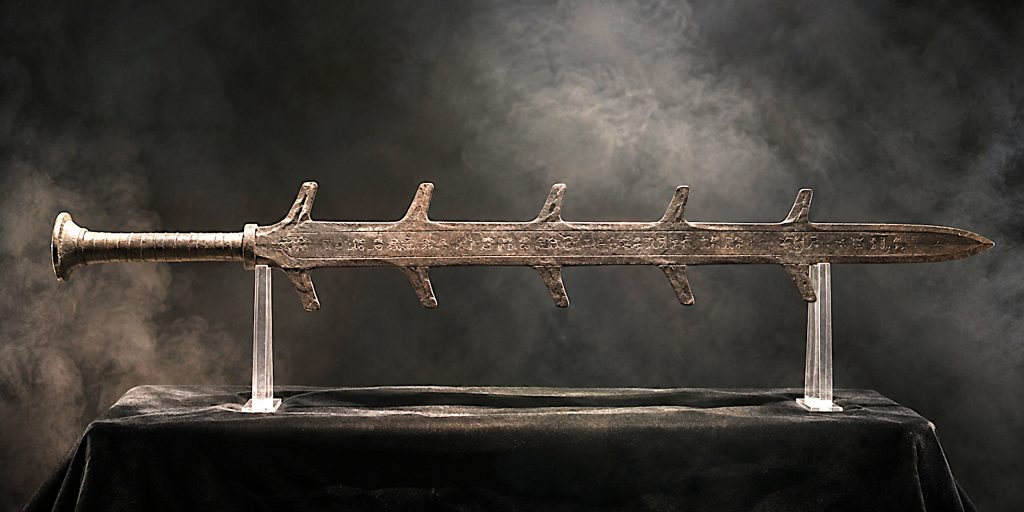
One of the most important historical objects connected with the idea of seven swords is not seven swords at all.
It is one.
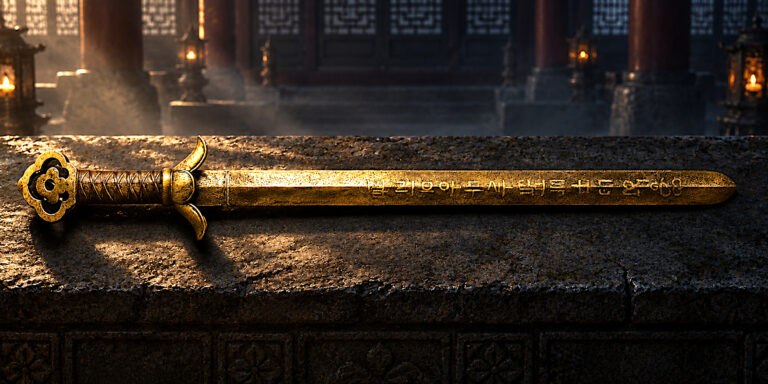
The Seven-Branched Sword, known in Japanese as the Shichishitō, is an extraordinary ancient iron weapon preserved at Isonokami Jingū in Nara Prefecture.
It has a central blade with three projections extending from each side. Together with the continuation of the main blade, these create its distinctive seven-part appearance.
It looks like something designed for fantasy television.
It is considerably older.
How Old Is the Seven-Branched Sword?
The sword is generally associated with the 4th century AD, although its precise dating remains the subject of scholarly discussion.
Its inscriptions are particularly important.
They have been connected with relations between Baekje, one of the Three Kingdoms of Korea, and the developing Yamato polity in Japan.
The blade therefore provides rare physical evidence of political and cultural interaction between the Korean peninsula and Japanese archipelago during this period.
This makes the sword historically significant well beyond its unusual appearance.
Was the Seven-Branched Sword Korean or Japanese?
The weapon is preserved in Japan, but its origins are closely associated with Baekje.
Its inscription is usually interpreted as referring to the presentation of the sword to a ruler in Wa, the name used in early sources for communities associated with ancient Japan.
The exact political implications remain debated.
Was the sword a diplomatic gift between allies?
Did the inscription imply hierarchy?
Which ruler was being addressed as superior?
These questions have produced long-running disagreement.
Ancient diplomacy has the unfortunate habit of remaining politically interesting long after the diplomats themselves have become archaeology.
The safest interpretation is that the sword represents a prestigious object connected with relations between Baekje and Yamato Japan.
Was the Seven-Branched Sword Used in Battle?
Almost certainly not as a conventional fighting weapon.
The six lateral projections would make the sword extremely awkward in practical combat.
They add weight, alter balance and create several excellent opportunities for the weapon to become caught on clothing, armour or anything else within reach.
The form therefore strongly suggests a ceremonial, diplomatic or prestige object.
Its inscription reinforces this interpretation.
| Seven-Branched Sword | Detail |
| Japanese name | Shichishitō |
| Probable date | 4th century AD |
| Material | Iron |
| Form | Main blade with six lateral projections |
| Association | Baekje and Yamato Japan |
| Present location | Isonokami Jingū |
| Likely purpose | Ceremonial or diplomatic |
| Combat use | Highly unlikely |
| Number of actual swords | One |
The Shichishitō matters enormously to this subject because it is genuine.
What it does not provide is evidence for a widespread ancient tradition involving seven separate legendary swords.
Does the Seven-Branched Sword Explain Later Seven Swords Legends?
There is no convincing evidence that it does.
The Shichishitō should not be presented as the origin of Chinese wuxia traditions, tarot symbolism or fictional collections of magical swords simply because the number happens to match.
That would be a very attractive theory with very little evidence behind it.
History produces enough problems without volunteering for additional ones.
Instead, the Seven-Branched Sword demonstrates that the symbolic meeting of “seven” and “sword” genuinely existed in ancient East Asia, but within a specific political and ceremonial context.
The Seven of Swords in Tarot
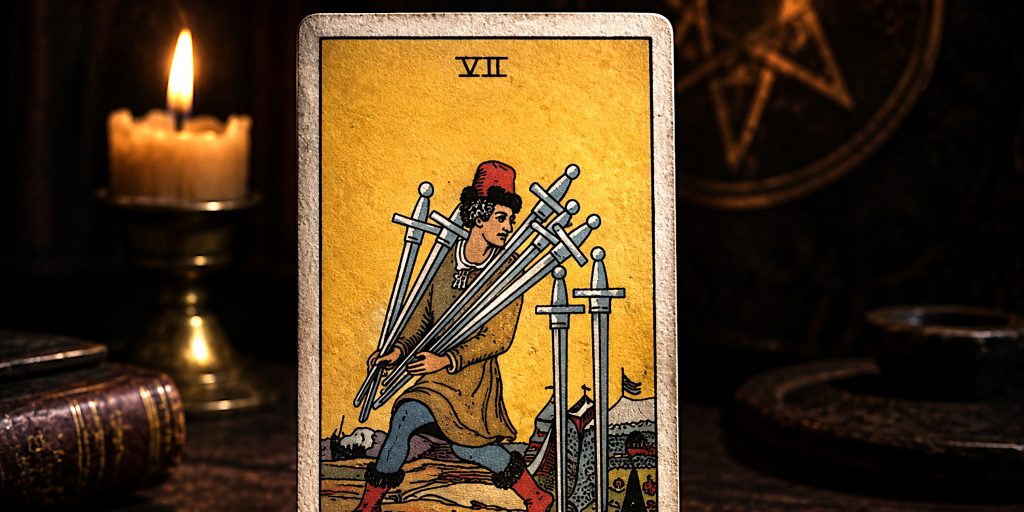
The most familiar Western symbolic use of seven swords is probably the Seven of Swords tarot card.
It belongs to the Minor Arcana.
Modern interpretations frequently associate it with:
- Strategy
- Deception
- Cunning
- Secrecy
- Avoidance
- Independence
- Escaping difficult circumstances
- Acting indirectly
These meanings, however, developed over time.
Tarot did not begin as an ancient occult system.
The earliest tarot decks appeared in Renaissance Italy as playing cards. Their systematic use for divination developed later.
This is worth remembering whenever someone claims that modern tarot symbolism represents an unchanged body of ancient mystical knowledge.
Tarot’s actual history is interesting enough.
The Rider-Waite-Smith Seven of Swords
The image most people now associate with the Seven of Swords comes from the Rider-Waite-Smith deck, first published in 1909.
Pamela Colman Smith’s illustration depicts a figure carrying five swords while apparently slipping away from an encampment.
Two swords remain behind.
He looks over his shoulder as he leaves.
It is a wonderfully suspicious scene.
Is he stealing the swords?
Recovering them?
Sabotaging an enemy?
Escaping?
Has he succeeded, or has he simply forgotten two?
The ambiguity gives the card much of its power.
It portrays intelligence being used indirectly rather than through open confrontation.
That can suggest cleverness.
It can also suggest dishonesty.
The distinction is deliberately uncomfortable.
Earlier Meanings of the Seven of Swords
The card’s interpretation did not begin simply as “the thief card”.
The Hermetic Order of the Golden Dawn associated it with the idea of unstable effort.
Arthur Edward Waite subsequently offered several possible meanings in The Pictorial Key to the Tarot, including attempts, plans, hopes and confidence, alongside less positive associations.
Modern interpretations often lean more heavily towards deception because Pamela Colman Smith’s image is so memorable.
Personally, I prefer the ambiguity.
The card is more interesting when it asks whether intelligence has become dishonesty.
That is a much better problem than simply being told there is a villain in the room.
Why Are There Seven Swords on the Tarot Card?
There is no hidden group of seven legendary blades behind the card.
The explanation is structural.
Tarot’s Minor Arcana contains numbered cards within four suits.
Seven is one stage in that numerical sequence.
Swords became associated in later occult systems with intellect, conflict, decisions and mental struggle.
The image eventually transformed that abstract structure into a miniature narrative.
Five swords carried away.
Two left behind.
Someone has done something questionable.
We have arrived slightly too late.
Seven Swords of Mount Heaven
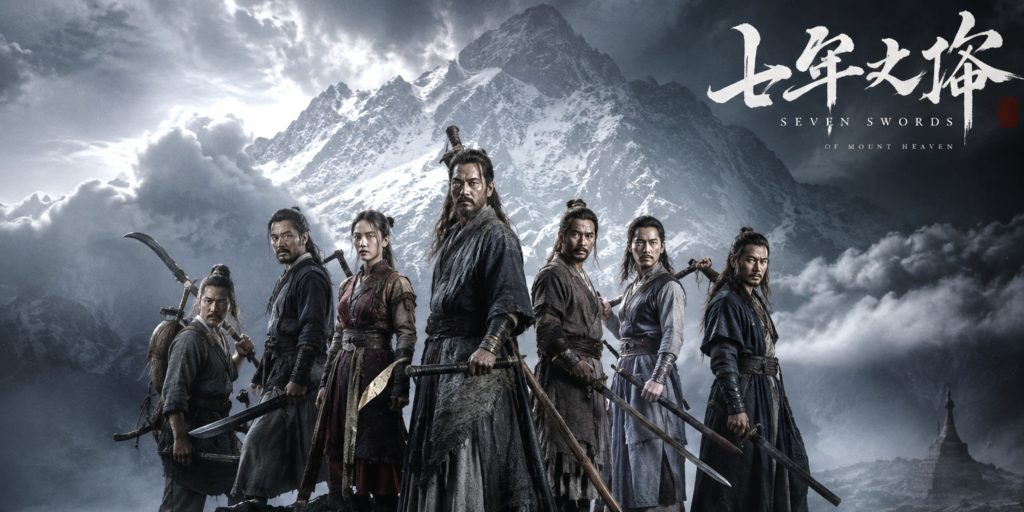
The clearest literary tradition built explicitly around seven swords comes from Chinese wuxia fiction.
Liang Yusheng’s Qijian Xia Tianshan, usually translated as Seven Swords of Mount Heaven, was serialised in Hong Kong during the 1950s.
Liang became one of the major figures in the development of modern wuxia literature.
The genre combines martial arts, historical settings, political conflict, romance, loyalty and codes of personal conduct.
Its heroes inhabit the jianghu, a semi-fictional social world populated by martial artists, wanderers, rebels and unconventional figures living partly beyond normal political authority.
In this tradition, swords can become extensions of personality.
Liang Yusheng and the New Wuxia Tradition
Liang Yusheng helped shape what is often called the New School of wuxia fiction.
His novels blended recognisable historical settings with fictional martial arts worlds.
Seven Swords of Mount Heaven forms part of his wider Tianshan cycle and is set against the tensions surrounding the early Qing period.
The swords therefore exist within a specifically Chinese literary tradition.
They should not be treated as simply an Asian equivalent of Excalibur or a transplanted European fellowship story.
Wuxia developed its own moral and narrative conventions.
Questions of righteousness, loyalty, political legitimacy and resistance frequently matter as much as martial skill.
Seven Swords on Film
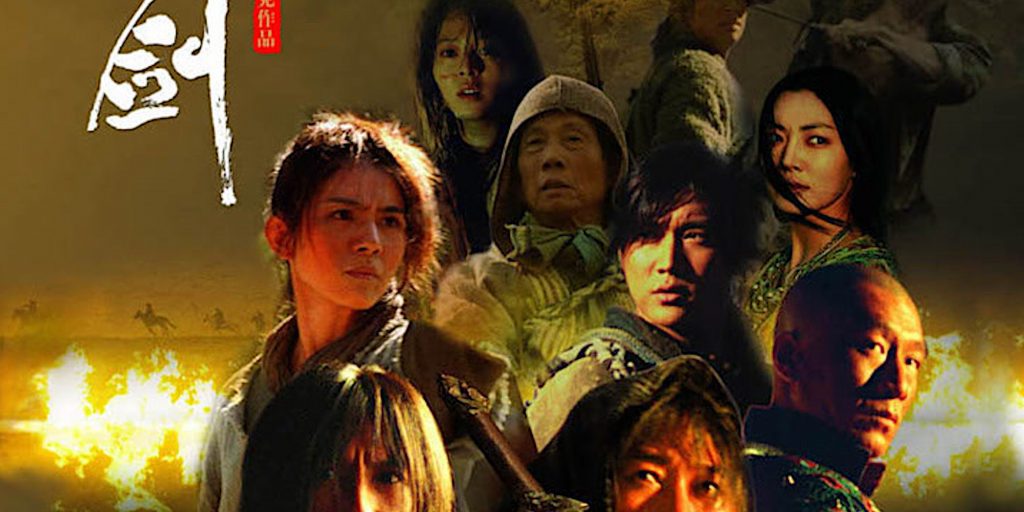
The idea reached a much wider international audience through Tsui Hark’s Seven Swords in 2005.
The film draws inspiration from Liang Yusheng’s novel but significantly reworks its material.
Seven martial artists become associated with seven distinctive swords created by the master smith Shadow-Glow.
The concept is perfectly suited to cinema.
Seven warriors.
Seven weapons.
Seven fighting styles.
The props department presumably had opinions.
The different swords help define individual characters and influence the choreography.
Weapon design becomes part of character design.
Are the Seven Swords in the Film Historically Accurate?
Not in any straightforward sense.
The weapons are intentionally stylised.
They draw upon martial arts cinema and fantasy design rather than attempting to reproduce ordinary Qing-period military swords.
That does not make them meaningless.
Historically, swords could communicate wealth, status, regional tradition and personal identity.
Cinema simply exaggerates those qualities.
The result is less archaeology and more visual mythology.
It works very well.
Seven Swords and Seven Samurai
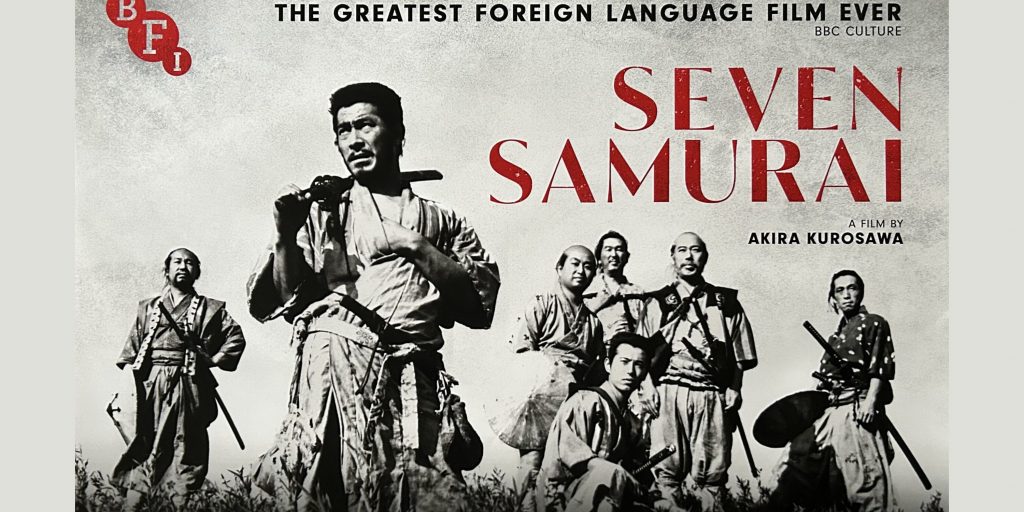
Akira Kurosawa’s Seven Samurai, released in 1954, inevitably enters the discussion.
But there is an important distinction.
There are seven warriors.
There is no canonical set of seven magical swords.
The film follows a group of rōnin recruited to defend a farming community against bandits.
Its influence on later cinema is enormous.
The basic narrative structure became one of the most reusable patterns in modern action storytelling:
A threatened community gathers a small group of highly distinctive warriors to confront a stronger enemy.
That structure later appeared in works such as The Magnificent Seven.
The similarity with later Seven Swords stories is therefore thematic rather than mythological.
Seven simply works very well as the size of an heroic ensemble.
Is There a Japanese Legend of Seven Samurai Swords?
No widely recognised traditional Japanese legend corresponds to a canonical group called the Seven Swords of the Samurai.
Japan certainly possesses famous named swords, celebrated smiths and legendary weapons.
Masamune and Muramasa became surrounded by stories.
The Kusanagi-no-Tsurugi, one of Japan’s Imperial Regalia, belongs to a much older mythological tradition.
Individual swords accumulated reputations, pedigrees and supernatural associations.
But there is no standard historical collection of seven samurai swords forming a recognised traditional set.
Modern online lists sometimes assemble famous Japanese blades retrospectively.
That is categorisation, not medieval tradition.
The Seven Swords of Wayland in Robin of Sherwood
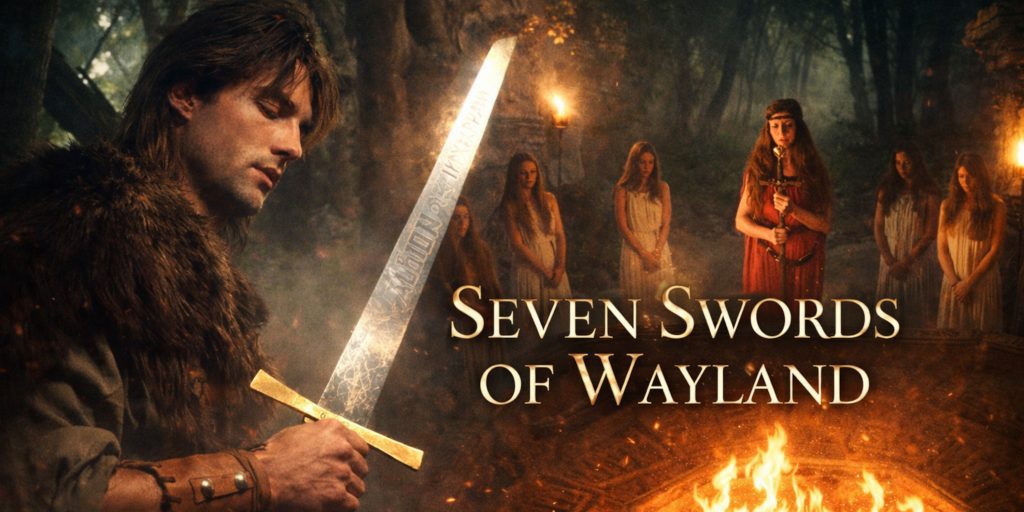
British television created another memorable group of seven weapons.
The Seven Swords of Wayland appear in Robin of Sherwood, most prominently in the 1984 two-part story The Swords of Wayland.
Within the series, they are powerful ancient weapons associated with the legendary smith Wayland.
They feel completely at home in medieval mythology.
There is one small difficulty.
The Seven Swords of Wayland were created for the television series.
There is no known medieval tradition describing a canonical set of seven magical swords forged by Wayland.
Wayland himself, however, is very real as a legendary figure.
That distinction is important.
The Real Legend of Wayland the Smith
Wayland, also known as Weland, Völundr or Wieland, is one of the great smith figures of early Germanic tradition.
His story survives in several medieval sources.
The Old Norse poem Völundarkviða preserves one of the fullest versions of his legend.
He also appears in Anglo-Saxon material.
The Old English poem Deor refers to Weland, while another reference appears in Waldere.
Perhaps most strikingly, the famous Franks Casket, probably produced in the early 8th century, includes imagery generally interpreted as depicting an episode from Wayland’s legend.
This places him firmly within the imaginative world of early medieval northern Europe.
Was Wayland Really Associated with Legendary Swords?
Yes, although not with a canonical group of seven.
Wayland’s reputation as a supernatural or semi-supernatural smith naturally led later traditions to associate him with extraordinary weapons.
The famous sword Mimung is connected with Wayland in later Germanic heroic tradition.
Other weapon traditions vary by source and period.
The important point is that medieval audiences already knew Wayland as an exceptional craftsman.
That made him an ideal figure for later storytellers seeking an ancient origin for fictional magical weapons.
How Robin of Sherwood Created a Convincing Medieval Myth
One of the strengths of Robin of Sherwood was its ability to blend medieval England with folklore, pagan imagery and supernatural fantasy.
Herne the Hunter is the most obvious example.
The Seven Swords of Wayland use the same technique.
Take a genuine early medieval legendary smith.
Give him seven magical weapons.
Place them within an atmosphere of ruined abbeys, cults, prophecy and ancient ritual.
The result feels centuries old.
It is actually twentieth-century television.
This does not make the concept poor history.
It makes it excellent myth-making.
Were There Really Seven Swords Forged by Wayland?
No surviving medieval tradition describes seven magical swords corresponding to those in Robin of Sherwood.
| Element | Historical Status |
| Wayland/Weland the Smith | Genuine Germanic legendary figure |
| Anglo-Saxon references to Weland | Genuine |
| Wayland as an extraordinary smith | Established medieval tradition |
| Legendary weapons associated with Wayland | Genuine within later traditions |
| Seven Swords of Wayland | Created for Robin of Sherwood |
| Historical set of seven swords | No known medieval tradition |
The distinction is a useful one.
Modern fiction frequently borrows genuine mythology and adds new material so successfully that the additions eventually begin to look traditional themselves.
Give something an ancient name and enough atmospheric lighting and the internet will eventually return it to the Middle Ages.
Wayland, I suspect, would appreciate the workmanship.
Seven Swords in Arthurian Legend
Arthurian literature presents another common source of confusion.
There are many famous swords associated with Arthurian stories.
Excalibur is the obvious example.
Depending upon the text, Arthur himself can be associated with more than one sword, while various knights possess named weapons of their own.
But there is no standard medieval tradition of Seven Swords of Arthur or seven canonical swords belonging to seven knights.
Arthurian literature developed over centuries across Britain, France and continental Europe.
Characters, stories and objects changed constantly.
Trying to organise all of those weapons into a neat collection of seven is a modern instinct.
Medieval writers were far less concerned with database management.
Seven Swords in Christian Imagery
There is another genuine historical use of multiple swords that is completely different in meaning.
Christian art sometimes depicts the Seven Sorrows of the Virgin Mary through seven swords piercing Mary’s heart.
The imagery ultimately relates to the prophecy of Simeon in the Gospel of Luke, in which Mary is told that a sword will pierce her own soul.
Later devotional tradition identified Seven Sorrows:
- The prophecy of Simeon
- The flight into Egypt
- The loss of Jesus in Jerusalem
- Mary meeting Jesus on the road to Calvary
- The Crucifixion
- The removal of Jesus from the Cross
- The burial of Jesus
Artists could represent these seven sorrows as seven swords piercing Mary’s heart.
Here swords represent grief rather than heroism, treachery or martial power.
That contrast is useful.
The same basic image can carry completely different meanings.
Seven Swords as a Modern Fantasy Motif
Modern fantasy writers and game designers naturally gravitate towards groups of legendary weapons.
There is a simple narrative reason.
If a character discovers an ancient sword, that is an interesting object.
If they discover it is one of seven, the world suddenly becomes larger.
Where are the other six?
Who owns them?
Were they created together?
What happens if they are reunited?
One object becomes a quest structure.
Seven is particularly effective because audiences already expect the number to matter.
Centuries of religious symbolism, folklore and storytelling have trained us to treat it as significant.
What Can Seven Swords Symbolise?
There is no universal meaning.
Different traditions use the idea very differently.
| Tradition | Meaning |
| Seven-Branched Sword | Ceremony, diplomacy and political prestige |
| Seven of Swords tarot | Strategy, secrecy and deception |
| Seven Swords of Mount Heaven | Martial fellowship and resistance |
| Seven Swords film | Individual identity and heroic ensemble |
| Seven Swords of Wayland | Modern supernatural mythology |
| Seven Sorrows of Mary | Grief and suffering |
| Fantasy fiction | Destiny, quests and legendary artefacts |
| Seven Samurai | Collective heroism rather than magical swords |
That variation is exactly why the subject is interesting.
Seven does not impose one meaning.
Neither does the sword.
Together they create a symbolic framework that different cultures and storytellers repeatedly reshape.
Myth, History and Modern Invention
The most important distinction throughout this subject is between things that are genuinely old and things that merely look old.
| Tradition | Historical Position |
| Seven-Branched Sword | Genuine ancient artefact |
| Wayland the Smith | Genuine medieval legendary figure |
| Seven Swords of Wayland | Modern invention for television |
| Seven of Swords tarot | Genuine tarot tradition, later given occult meanings |
| Seven Sorrows represented by swords | Established Christian devotional imagery |
| Seven Swords of Mount Heaven | Twentieth-century Chinese wuxia literature |
| Seven Swords film | Modern cinematic adaptation |
| Seven Samurai | Modern film using seven warriors |
| Seven Arthurian swords | No canonical medieval tradition |
| Seven legendary samurai swords | No recognised traditional collection |
This distinction matters because fictional mythology is often built from real historical material.
The better the invention, the harder the seam becomes to see.
Why Fake Medieval Traditions Can Feel Real
The Seven Swords of Wayland are a particularly good example.
Wayland is genuinely ancient.
Magical swords genuinely appear in medieval literature.
Robin Hood is genuinely medieval.
Combine those ingredients and a fictional set of seven weapons can feel almost inevitable.
The same process happens constantly in modern fantasy.
Writers borrow fragments of authentic folklore, rearrange them and create new myths.
A few decades later, readers sometimes assume the resulting story was there all along.
That tells us something important about mythology itself.
Myths are rarely preserved unchanged.
They are retold.
Expanded.
Reinterpreted.
Occasionally invented wholesale and then introduced to an unsuspecting audience wearing a very convincing cloak.
The Curious Contradiction of Seven Swords
What I find most appealing about this subject is that the same image can mean almost opposite things.
In the Seven of Swords tarot card, swords suggest secrecy and questionable strategy.
In Chinese wuxia, they can represent fellowship and resistance.
In Christian imagery, they represent suffering.
The Shichishitō appears to have represented diplomacy and prestige.
In Robin of Sherwood, they become supernatural artefacts connected with destiny and ancient power.
Nothing about seven swords possesses a fixed universal meaning.
Symbols simply do not work that way.
They change with context.
Did Seven Legendary Swords Ever Really Exist?
Not as a single historical collection connecting these traditions.
There was no universal ancient order of seven swords.
No shared Indo-European or Asian tradition ties all of these examples together.
The Shichishitō is a real ancient object, but it is one sword.
Wayland is a genuine medieval legendary smith, but his seven swords are a modern television invention.
Tarot contains a genuine Seven of Swords card, but it has nothing to do with Japanese or Chinese sword traditions.
Liang Yusheng’s Seven Swords belong to twentieth-century wuxia literature.
The resemblance lies in recurring symbolism rather than shared ancestry.
That answer is not quite as exciting as discovering a secret order of seven immortal swordsmen.
It does have the considerable advantage of being supported by evidence.
Why Seven Swords Keeps Returning
Seven feels complete.
Swords feel personal.
That combination is unusually powerful.
Historically, swords could be named, inherited, displayed and associated with particular individuals.
That gives them a narrative personality that many other weapons struggle to match.
Spears were enormously important in real warfare.
Logistics were more important still.
Neither has inspired quite the same quantity of mystical television.
Popular culture prefers the named sword.
So, quite often, did medieval literature.
Seven Swords and the Difference Between History and Myth
The most interesting conclusion is not that all Seven Swords traditions descend from one ancient source.
They do not.
What matters is that the number seven and the sword have independently accumulated enormous symbolic power.
Different cultures and periods repeatedly brought them together for different reasons.
A ceremonial sword could represent diplomatic authority.
Seven swords on a tarot card could suggest cunning.
Seven martial artists could embody resistance.
Seven fictional swords forged by Wayland could make twentieth-century television feel authentically medieval.
Those traditions are not connected by one hidden legend.
They are connected by the human tendency to reuse powerful symbols.
For me, that is much more interesting.
A false universal myth would flatten all of these traditions into one story.
The real history gives us several.
And, rather fittingly, they refuse to behave themselves.