Updated for the current Early Access build, September 2026
An army in Manor Lords is not assembled from a convenient barracks menu. It grows out of the settlement itself. Militiamen are householders taken away from workshops and fields, their weapons must exist in regional storage, and professional troops must be paid from the lord’s Treasury. A badly planned war can therefore be lost months before the enemy appears, usually when somebody decides that thirty-six spears are less urgent than another cartload of roof tiles.
That economic connection is the heart of the military system. The best army is not necessarily the one with the highest theoretical damage. It is the force your town can equip, feed, pay and spare from civilian work.
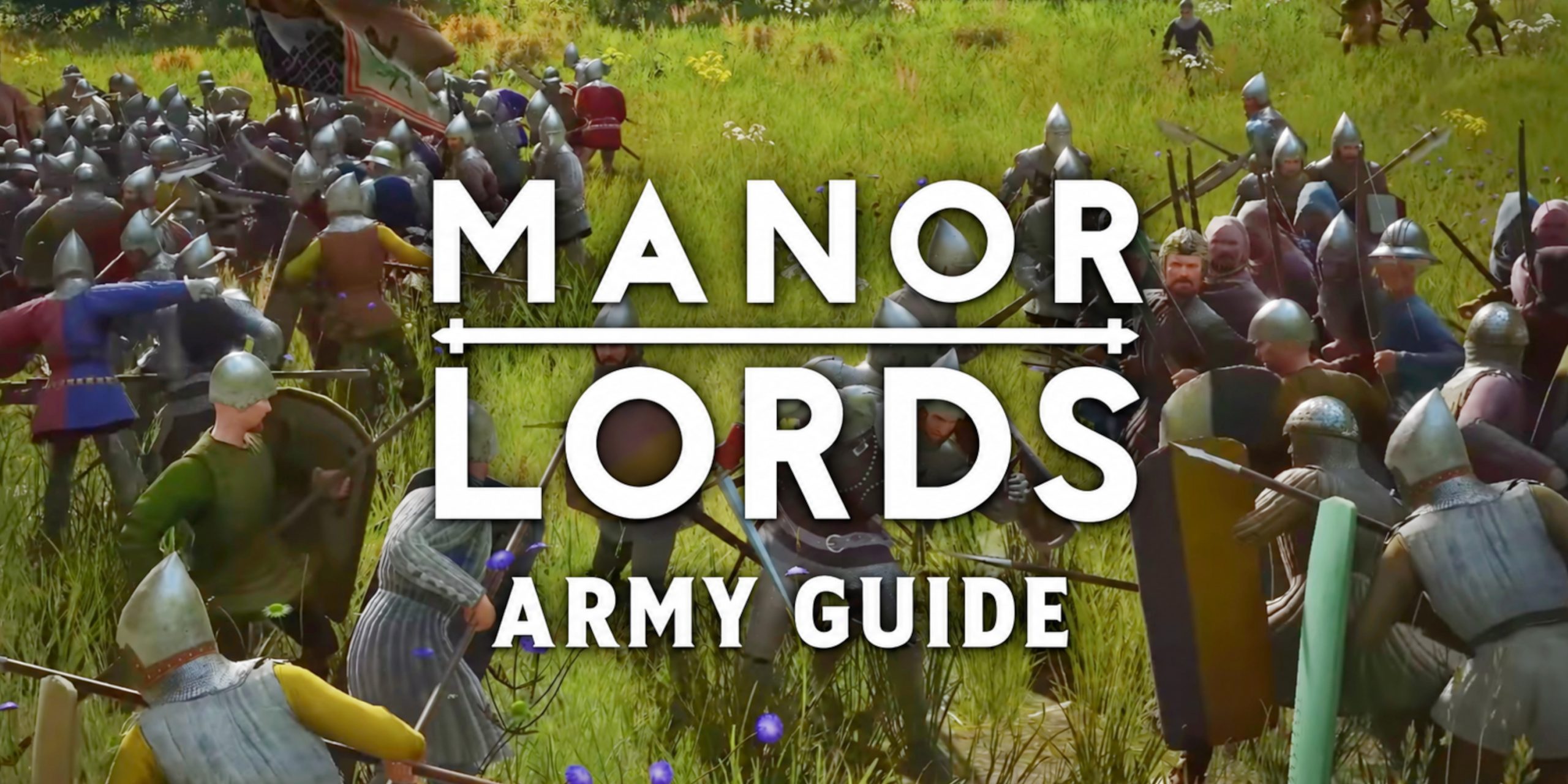
This guide explains every current troop category, how recruitment and equipment work, which formations are strongest, and how to use terrain, fatigue, morale and flanking to win battles without emptying the village.
“Manor Lords is not a Total War competitor. It’s a citybuilder with battles.”
Greg Styczeń, Slavic Magic, before the Early Access launch
That is worth remembering. The battles are excellent, but the army remains an expression of the town behind it.
Manor Lords army system at a glance
The current game divides soldiers into three broad groups:
| Troop type | How it is obtained | How it is paid for | Best use |
|---|---|---|---|
| Militia | Raised from male villagers and supplied from regional stores | Weapons, shields and optional armour use regional production or imports | Main battle line and locally sustained defence |
| Retinue | Unlocked by constructing a Manor, then expanded manually | Recruits and armour are bought with Treasury funds | Elite shock troops, flanking and hard fighting |
| Mercenaries | Hired as available companies | Monthly Treasury payment | Emergency reinforcement and temporary campaigns |
Militia units can contain up to 36 men, provided that the region has enough eligible villagers and the required equipment. A retinue begins as a small professional bodyguard and can be enlarged. Mercenary companies arrive ready to fight, but they remain only while the wages continue.
The intended global army limit includes militia and retinue units, while mercenary companies sit outside that cap. As Manor Lords remains in Early Access, limits and balance values can change between patches. Check the in-game tooltips when exact figures matter.
How to recruit militia
Open the Army panel and create a militia unit. The unit will begin filling as suitable men and the necessary equipment become available in that region. Raising the unit does not create soldiers from thin air. It assigns existing villagers to military duty.
This has two immediate consequences:
- A small settlement may own enough weapons but lack the manpower to fill its ranks.
- A large settlement may have plenty of men but leave half of them staring hopefully at an empty weapons rack.
Militia come from households, so rallying them interrupts civilian labour. Farmers, foresters, smiths and traders may all leave their jobs. A prolonged mobilisation during sowing or harvest can damage the following year more severely than a few battlefield casualties. Medieval administration often involved choosing which disaster was least immediate, and the game captures that rather well.
Create planned militia formations early, even before every item has been produced. This makes the equipment target visible and prevents a last-minute scramble when raiders are already crossing the border.
Every militia unit and its equipment
Spear Militia
Required equipment: spears and large shields
Role: defensive line, charge resistance and formation anchor
Spear Militia are the safest foundation for an early army. Their large shields offer strong frontal protection, while their impaling ability punishes an enemy charge if the formation is stationary and facing the attack. They are particularly useful for holding a road, slope or narrow approach.
They do modest damage and should not be expected to cut through armoured opposition quickly. Their task is to remain in place while another unit works around the flank. Put them on Stand Your Ground when the collision arrives, but do not leave them there if an opportunity to advance appears. A wall that never moves eventually becomes scenery.
Militia Footmen
Required equipment: sidearms and small shields
Role: flexible frontline infantry and sustained melee
Footmen provide a useful balance of protection and attack. They lack the spear unit’s exceptional frontal shield value, but their sidearms make them more assertive once formations are locked together. They are easier to manoeuvre than a deeply packed spear line and make a dependable second unit after spearmen.
Use them to support the centre, exploit a wavering enemy or protect archers from a flank attack. If the settlement can only support two militia formations, spear and foot militia make a sensible, forgiving pair.
Polearm Militia
Required equipment: polearms
Role: aggressive melee, anti-armour work and flanking
Polearm troops exchange shields for offensive power. They carry a charge bonus and anti-armour capability, which makes them useful against better-protected targets. The price is vulnerability to arrows and frontal pressure.
Do not ask them to receive the enemy’s main attack in open ground. Hold them behind the line or on a wing, then send them into an engaged enemy from the side or rear. Rear attacks inflict double damage under the current directional combat system, so good positioning is worth considerably more than another bout of frantic clicking.
Archer Militia
Required equipment: warbows
Role: ranged pressure, morale damage and pursuit support
Archers are support troops. They perform best with a clear line of sight, dry weather and infantry between them and the enemy. Rain lowers their effectiveness, friendly bodies can obstruct their fire, and an exposed archer unit tends to discover that bows are poor shields.
Place archers on a rise or flank, spread the formation where practical and move them when the firing angle becomes crowded. Their friendly-fire control should be chosen according to the situation. Cautious fire preserves your own men, while a permissive order may keep arrows moving during a desperate engagement.
Archers should soften a target, punish exposed movement and chase routing troops with fire. They are not usually the unit around which the entire army should be built.
How militia armour works
Weapons and shields are compulsory for forming the relevant unit. Helmets and body armour are optional, but they materially improve survivability.
Militiamen will draw equipment according to the level of their home burgage plot:
| Burgage level | Armour sought by the household |
|---|---|
| Any eligible plot | Helmet, if available |
| Level 2 | Gambeson, if available |
| Level 3 | Mail armour, if available |
This means town development changes battlefield quality. Upgrading burgage plots does more than improve prosperity and unlock production. It creates households able to field better-protected soldiers, assuming the armour is actually present.
Do not wait until war begins to produce armour. Keep a reserve in storage and use production limits so artisans do not consume every iron slab or flood the market with equipment you no longer require. Helmets are a practical first step because they can improve soldiers drawn from plots of any level. Gambesons then offer a useful middle stage before the expense of mail.
Imported equipment can cover an urgent shortage, but a town that depends entirely on imports is vulnerable to poor trade flow and thin regional wealth. Domestic production takes longer to establish yet gives far greater control.
How to produce weapons and armour
A military industry needs raw materials, transport and specialised households. Iron ore must reach the settlement, be processed into iron slabs and then reach the relevant producer. Planks are needed for several wooden components and artisan goods.
The principal production chain is:
- Mine or import iron ore.
- Smelt it into iron slabs at a Bloomery.
- Supply the appropriate artisan workshops with slabs and planks.
- Store the completed weapons and armour where households can collect them.
Blacksmith and joiner specialisations cover the core militia equipment, while armour production requires the relevant armourer capacity and settlement progression. The exact workshop unlocks and development bonuses have been revised during Early Access, so use current in-game descriptions before committing a scarce development choice.
Transport is the easily missed part. A workshop with materials trapped at the far end of town is technically supplied in much the same sense that a besieged castle is technically surrounded by food. Staff storehouses, restrict their accepted goods where useful, and place military industry close enough to its inputs that workers spend time making equipment rather than touring the county.
How to recruit and upgrade a retinue
Constructing a Manor creates a retinue, your professional household troops. The initial force contains five soldiers. Further men are recruited individually from the retinue customisation screen with Treasury funds, up to the current capacity.
A basic retinue can hold 12 men. Adding a Garrison Tower module to the Manor increases that capacity by a further 12. Additional settled regions and Manors can provide further regional retinues, subject to the current army rules.
Retinue soldiers are expensive but formidable. Their individual armour can be upgraded through the customisation screen, with locally produced armour costing less than imported equipment. Fully upgraded retainers possess vastly better armour and shield protection than ordinary militia.
Use them where quality has the greatest effect:
- Breaking a tired or wavering formation
- Attacking armoured enemies
- Guarding an exposed wing
- Delivering a decisive flank or rear attack
- Defending a newer region that cannot yet equip a full militia
Avoid wasting them in a long, isolated frontal grind. Elite armour reduces losses, but it does not repeal geometry. A surrounded retinue will still suffer, and replacing trained men drains the same Treasury needed for expansion, taxation and mercenary wages.
Retinue weapon distribution can vary between individual soldiers, which slightly changes the formation’s combined values. Polearm-equipped retainers contribute more charge and anti-armour capability. Cosmetic weapon selection should not be confused with complete tactical re-equipment.
When mercenaries are worth hiring
Mercenaries are purchased from the Army interface with Treasury funds and arrive already rallied. Companies may include brigands, infantry, spearmen or archers in different combinations. Availability refreshes and rivals may hire companies before you do.
They are best treated as rented capacity rather than a permanent army. Hire them when:
- A raid is imminent and local equipment will not be ready
- A territorial claim will trigger a battle
- Your militia must remain home to protect production
- You need a specific role, such as another spear line or ranged support
- Capturing a bandit camp can repay much of the expense
The monthly fee continues until the company is properly disbanded. Do not hire early merely because the button is inviting. Rally them close enough to participate, finish the operation and release them once the risk has passed. Treasury has a habit of disappearing with great dignity when professional soldiers are involved.
For bandit camps, speed matters. A modest mercenary company can help seize the camp before a rival reaches it, generating Treasury or regional wealth and Influence. For major battles, mercenaries are most valuable when they complete an army rather than replace one.
The best Manor Lords army composition
There is no universal perfect army, because terrain, weather, enemy equipment and local production all matter. A strong general-purpose field force is built around roles:
| Formation | Battlefield task |
|---|---|
| Two Spear Militia | Hold the centre and receive charges |
| One or two Militia Footmen | Reinforce the line and exploit weak points |
| One Polearm Militia | Flank and attack armour |
| One Archer Militia | Apply ranged pressure from a protected position |
| Retinue | Act as the mobile reserve and decisive assault unit |
If the unit cap or economy forces a choice, favour a reliable infantry line before adding more archers. For early bandit fighting, one reasonably filled spear formation supported by a retinue can succeed if it arrives rested and maintains formation. For an enemy lord’s army, depth and redundancy become much more important.
Mercenaries should plug gaps in this structure. A company containing spearmen can strengthen the centre, while mercenary archers allow a town without bow production to add ranged support for a single campaign.
How fatigue, morale and effectiveness decide battles
The visible body count tells only part of the story. Units also track fatigue, morale and effectiveness.
Fatigue falls when troops run and fight. Every lost point reduces effectiveness, while heavy armour and shields increase the fatigue burden. Exhausted soldiers cannot run. March close to the battlefield, stop, and allow the formation to recover before contact.
Morale represents willingness to remain in combat. It falls under pressure and eventually causes a unit to flee. Militia receive a morale benefit in their home region, making local defence rather more attractive than a grand tour of hostile provinces.
Effectiveness modifies attack and defence. Moving or fighting downhill helps; climbing and becoming surrounded hurt. Rain reduces archer effectiveness. These rules make ground selection genuinely important.
Do not run the entire army across the map unless delay is more dangerous than exhaustion. A tired, disordered force arriving piecemeal is an offering rather than an army.
Formations, stances and battlefield commands
Drag with the right mouse button to set formation width and depth. A wider line threatens flanks and reduces the danger of being wrapped around, while a deeper block is easier to control and can concentrate pressure. Match the frontage to the ground rather than using one shape for every unit.
The principal stances are:
- Balanced: No special modifier and the sensible default while manoeuvring.
- Stand Your Ground: Greatly improves defence but reduces attack speed. Ideal for spear units receiving an assault.
- Push Forward: Applies aggressive pressure once the enemy is fixed or beginning to fail.
- Give Ground: Withdraws gradually and can draw an opponent out of position.
- Missile Alert: Improves protection against arrows at the cost of melee defence.
Shields reduce damage from the front, while attacks from behind cause double damage. Facing therefore matters at least as much as raw numbers. Pin the enemy with a defensive formation, move a second unit beyond its flank, then attack from the side or rear. Keep enough distance between the manoeuvring unit and the melee to prevent it being dragged into the front.
Retinue and mercenary troops can spread out, becoming harder to hit with arrows and moving somewhat faster, though at the cost of melee performance. Use the order while crossing exposed ground, then restore a fighting formation before contact.
A practical recruitment plan from village to field army
Early settlement
Secure food, fuel and timber first. Create a Spear Militia target and begin acquiring spears and large shields. Build the Manor when the settlement can bear the cost, then use the small retinue against bandits with careful positioning.
Growing town
Add Footmen as the second dependable melee formation. Establish domestic iron processing and weapon production. Accumulate helmets, then gambesons as level 2 households become common. Keep enough workers at home that mobilisation does not halt every critical industry.
Established region
Expand and armour the retinue, add a Garrison Tower, and develop Polearm Militia for offensive work. Add archers once a stable infantry screen exists. Build a Treasury reserve before making territorial claims.
Campaign army
Rally militia late enough to protect the economy but early enough to assemble. Hire mercenaries shortly before they are required. March mostly at walking pace, scout the ground, rest before battle and force the enemy to attack uphill or into prepared spears whenever possible.
Common army mistakes
Rallying during harvest
Militia are workers. Pulling them from farms at the wrong moment can turn a successful defence into a winter food shortage.
Producing weapons without shields
A spear alone does not equip Spear Militia, and a sidearm alone does not equip Footmen. Track the complete equipment pair.
Running everywhere
Speed feels urgent, but exhausted troops lose effectiveness. Walk until the tactical situation demands a sprint.
Fighting uphill
Elevation affects effectiveness. Make the enemy climb whenever the map allows it.
Letting polearms lead the line
Their offensive value is tempting, but their lack of shields makes them a poor anvil. Give that honour to spearmen, who at least brought the correct furniture.
Treating retinue as immortal
They are heavily protected, not divinely sponsored. Use them to decide a battle, not to begin every engagement alone.
Forgetting mercenary wages
Companies charge monthly until dismissed. Confirm that every formation belonging to the company has been disbanded after the campaign.
Which unit is best in Manor Lords?
The upgraded retinue is the strongest individual melee formation because of its armour, shields and professional quality. It is not automatically the best investment in every situation. Its small numbers and Treasury cost mean that it works best alongside militia rather than in place of them.
For general value, Spear Militia are arguably the most important unit. They can hold a line, counter charges and protect more vulnerable formations. Polearm Militia deliver better aggressive and anti-armour performance, Footmen offer flexibility, and archers add pressure without replacing the need for infantry.
The best army is therefore combined rather than uniform. Spearmen fix the enemy. Footmen sustain the contest. Polearms and retinue deliver the decisive movement. Archers make the approach unpleasant. Mercenaries fill whatever the town cannot provide in time.
That arrangement also feels historically convincing. Medieval forces were rarely collections of identical ideal soldiers. They were compromises between obligation, wealth, local production and immediate danger. Manor Lords understands that an army is partly a battlefield instrument and partly an accounting problem wearing helmets.
Frequently asked questions
How many men are in a militia unit?
A militia formation can contain up to 36 men. It may rally with fewer if the region lacks eligible villagers or sufficient equipment.
Does armour need to be supplied before militia can rally?
No. The required weapon and shield determine whether the troop can form. Helmets, gambesons and mail are optional improvements drawn from storage by eligible households.
How do I get more retinue soldiers?
Build a Manor to unlock the initial retinue, then recruit additional soldiers through its customisation panel using Treasury funds. A Garrison Tower increases the regional retinue capacity.
Should I import weapons?
Importing is useful for emergencies or for a region without suitable resources. A domestic chain is generally more reliable and allows locally sourced retinue armour to cost less, but it demands workers, construction and time.
Why is my militia not filling up?
Check the region’s population, the required equipment pair and whether those goods are actually available in storage. A production order is not the same thing as a finished spear in a storehouse.
Can mercenaries exceed the normal unit limit?
The intended cap covers militia and retinue. Mercenary companies are separate, provided that a company is available and the Treasury can support its monthly cost.
Is Manor Lords mainly a battle game?
No. The developer describes it as a city-builder with battles. Military preparation matters because it draws directly upon population, production, trade and personal wealth.
Sources and further reading
- Manor Lords Official Wiki: Warfare
- Manor Lords Official Wiki: Beginner’s Guide
- Manor Lords Official Wiki: Development and Treasury
- Manor Lords official news on Steam