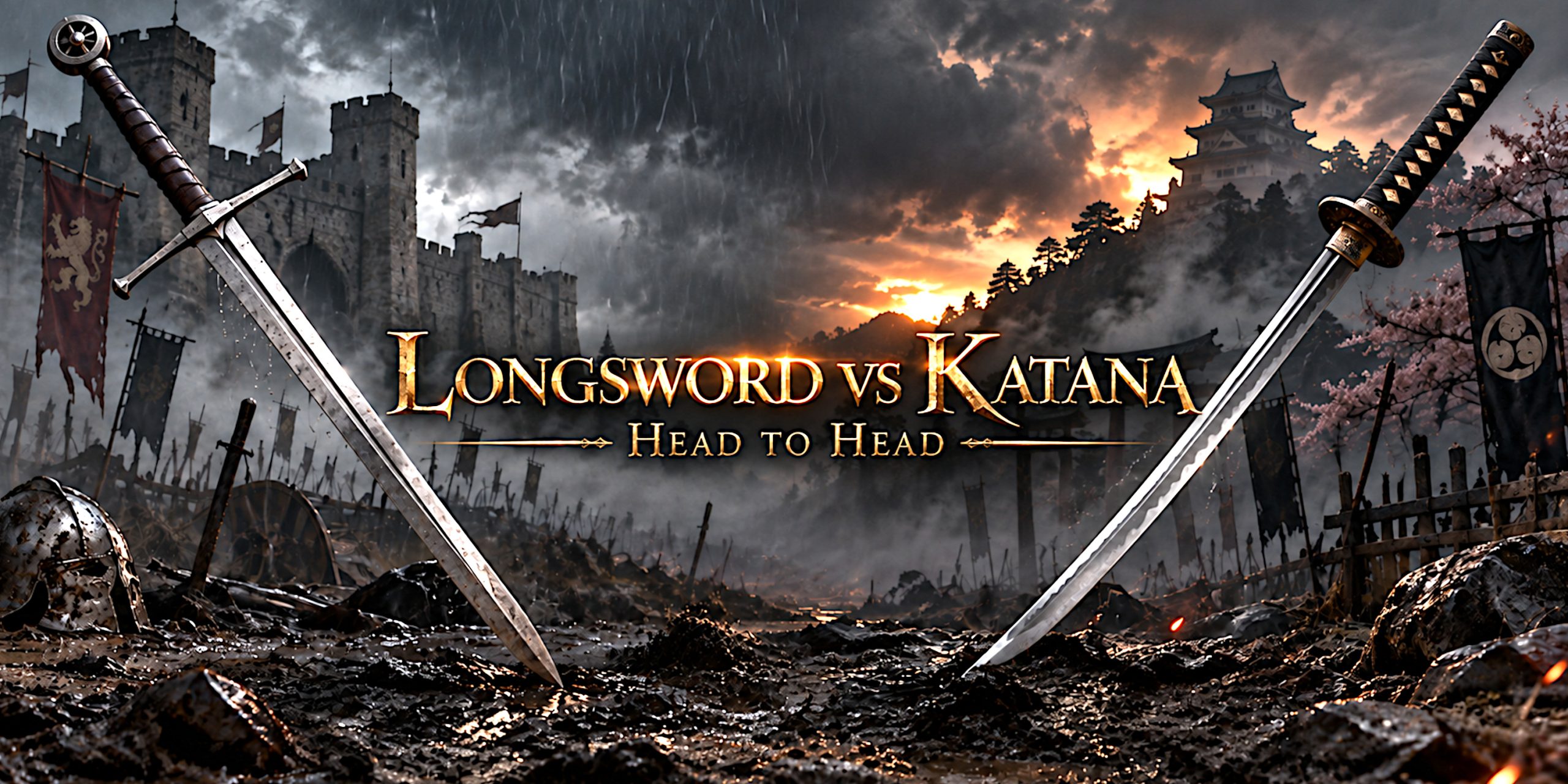
The European longsword and Japanese katana are routinely pushed into imaginary contests. Usually this involves two heroic warriors, several questionable assumptions and somebody insisting that folded steel can cut through a tank.
A more useful comparison begins with the surviving weapons themselves. Length, blade geometry, guard design, fighting manuals and armour all tell us what these swords were built to do.
This contest uses seven categories. Each winner receives one point. The comparison is between representative late medieval longswords and fighting katanas from the Muromachi and early Edo periods, rather than unusually large ceremonial weapons or modern replicas.
Longsword vs Katana at a Glance
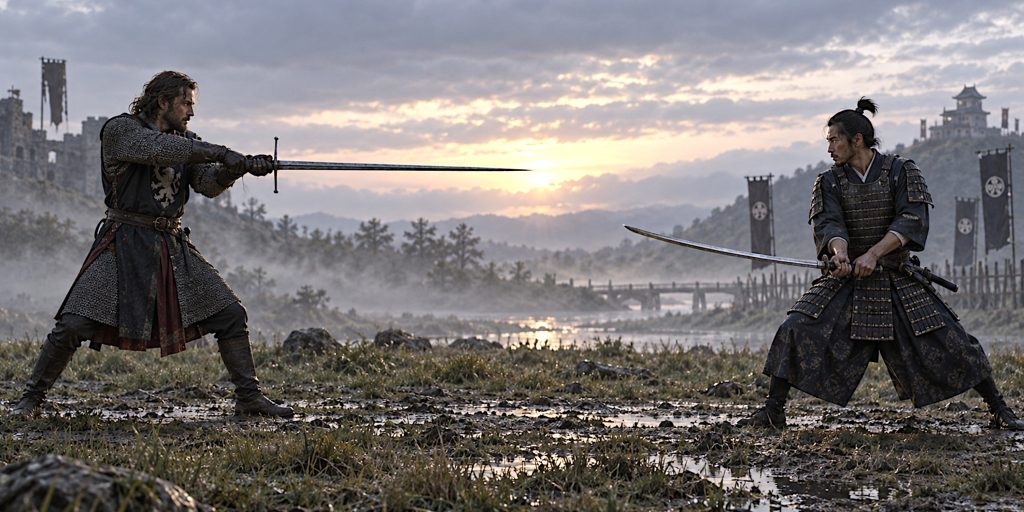
Historic swords vary considerably, so the figures below are representative ranges rather than rigid specifications.
| Measurement | European longsword | Japanese katana |
|---|---|---|
| Typical overall length | 110 to 130 cm | 95 to 110 cm |
| Typical blade length | 85 to 100 cm | 60 to 75 cm |
| Typical weight | 1.1 to 1.8 kg | 1.0 to 1.4 kg |
| Edges | Two | One |
| Blade shape | Straight | Curved |
| Primary grip | Two-handed | Two-handed |
| Guard | Long crossguard | Compact tsuba |
| Main cutting action | Cut, slice and thrust | Draw-cut and slice |
| Armour techniques | Half-swording, thrusting and striking | Targeting gaps, thrusting and close combat |
One surviving fourteenth-century hand-and-a-half sword in the Royal Armouries measures 112.4 cm and weighs 1.775 kg. Another European sword dated to around 1350 to 1400 has a 96.5 cm blade and weighs 1.71 kg. These were substantial weapons, but hardly the iron crowbars sometimes imagined.
The Metropolitan Museum of Art defines a katana as a curved sword with a blade longer than 60 cm, mounted in the uchigatana style and worn edge upwards. Many surviving examples have blades around 65 to 75 cm long.
The important measurement is not weight alone. Balance, blade taper, grip length and rotational inertia determine how quickly a sword moves and recovers. A heavier sword can still feel lively if its mass is distributed intelligently. Medieval smiths were rather good at their occupation, which may come as disappointing news to the makers of fantasy swords.
How the Scoring Works
Each sword receives one point for winning a category:
- Reach
- Cutting performance
- Thrusting ability
- Hand protection and defence
- Use against armour
- Speed of deployment
- Tactical versatility
The comparison assumes fighters of broadly equal size and skill. It does not attempt to decide whether a medieval German fencing master could defeat a Japanese swordsman. Training, judgement, terrain and sheer luck matter more than enthusiastic arguments about metallurgy.
Round One: Reach
The longsword usually has the longer blade.
A typical European longsword blade measures approximately 85 to 100 cm. Many katanas fall between 60 and 75 cm. Individual examples certainly fall outside those ranges, but the overall pattern remains clear.
An additional 15 or 20 cm of blade gives the longsword fighter an earlier opportunity to threaten with the point. Its long grip also permits changes in leverage without sacrificing that reach.
This matters because a sword fight is largely an argument about distance. The person who can strike while remaining just outside the opponent’s effective measure holds a serious advantage.
A katana’s curvature slightly reduces its straight-line reach compared with a straight blade of the same physical length. Its draw and cutting mechanics compensate in other areas, but geometry remains geometry.
Round winner: European longsword
Score: Longsword 1 | Katana 0
Round Two: Cutting Performance
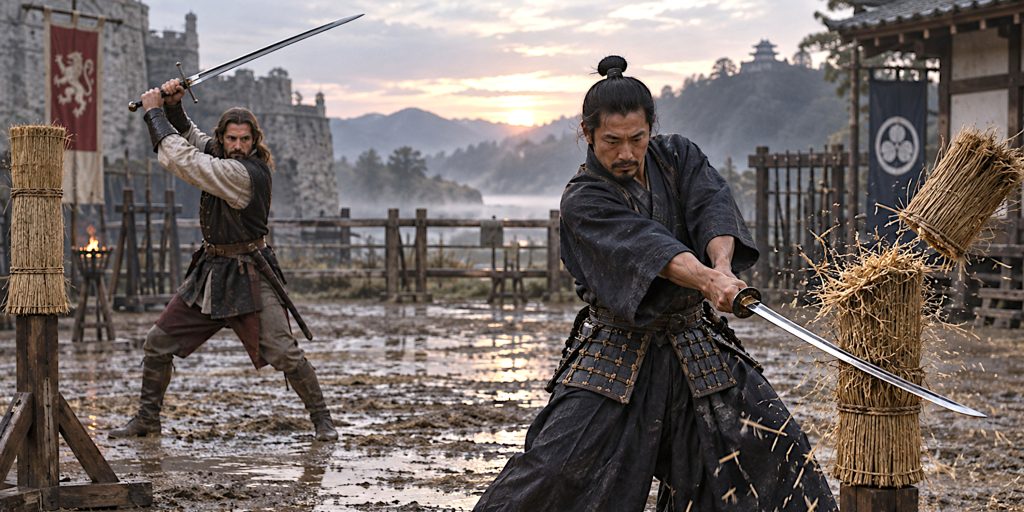
Both swords are formidable cutting weapons, but their designs approach the task differently.
The katana combines:
- A curved cutting edge
- A relatively rigid spine
- A broad blade profile
- Differential hardening on many traditional examples
- A two-handed grip capable of producing controlled slicing cuts
The curve encourages the edge to travel across the target during impact. This makes the katana particularly effective against unarmoured or lightly protected opponents.
The longsword is no blunt instrument. Broad-bladed examples associated with the fourteenth century could deliver extremely powerful cuts. Later forms often became narrower and more sharply pointed as armour developed.
However, when the category is limited to efficient cutting against soft targets, the katana’s specialised geometry earns it the point. This is a narrow victory rather than an exhibition of supernatural sharpness. A katana cannot slice through another sword, a breastplate and the nearest horse simply because someone on the internet has spoken confidently about folded steel.
Round winner: Japanese katana
Score: Longsword 1 | Katana 1
Round Three: Thrusting Ability
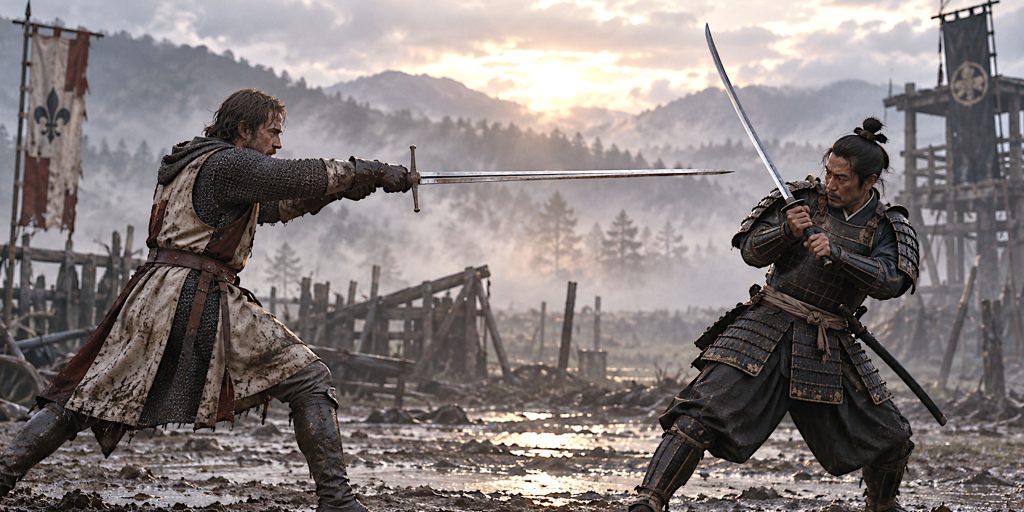
The straight, double-edged longsword is generally the stronger thrusting weapon.
Many fifteenth-century European blades have pronounced points and substantial distal taper. These features made them suitable for driving into openings around the visor, armpit, groin and joints of plate armour.
The longsword’s straight alignment places the point naturally in front of the hands. Its long crossguard and grip help the fighter control the weapon during winding, binding and close thrusting actions.
A katana can thrust perfectly well. Japanese swordsmanship includes direct thrusts such as tsuki, and the kissaki is a carefully formed working point rather than a decorative flourish. Its curved blade, however, is principally configured around cutting.
The longsword also offers two edges. When blades make contact, the swordsman can turn immediately into a cut or thrust from either side without first realigning a single cutting edge.
Round winner: European longsword
Score: Longsword 2 | Katana 1
Round Four: Hand Protection and Defensive Control
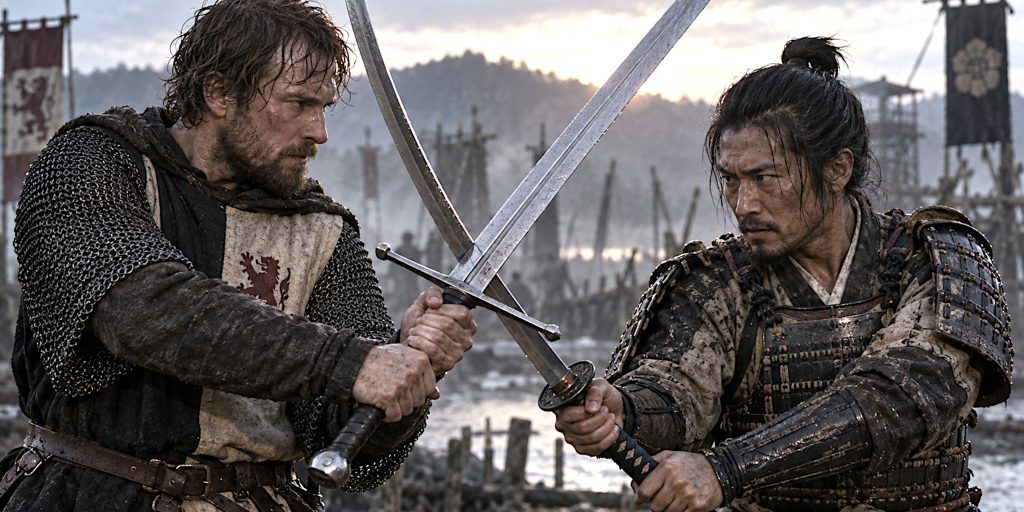
The longsword’s crossguard is considerably wider than the katana’s tsuba.
A typical crossguard can protect the hands from descending cuts and help intercept or control the opposing blade. Certain techniques deliberately use the guard to trap, displace or strike an opponent.
The compact tsuba protects the hand from sliding onto the blade and offers some defence against an opposing weapon. It is effective within its intended fighting system, but it does not provide the same lateral coverage as a European crossguard.
The longsword’s long grip and straight blade also support sophisticated binding actions. European fencing masters taught combatants to feel pressure through blade contact, then cut, thrust, grapple or disengage according to the opponent’s response.
Fiore dei Liberi, writing in the early fifteenth century, gave his sword a suitably modest introduction:
“I am the sword, deadly against all weapons.”
Fiore’s Fior di Battaglia shows cuts, thrusts, pommel strikes, throws, disarms and close-quarter actions. Medieval fencing was rarely content to remain a polite exchange of blade taps.
Round winner: European longsword
Score: Longsword 3 | Katana 1
Round Five: Fighting Armoured Opponents
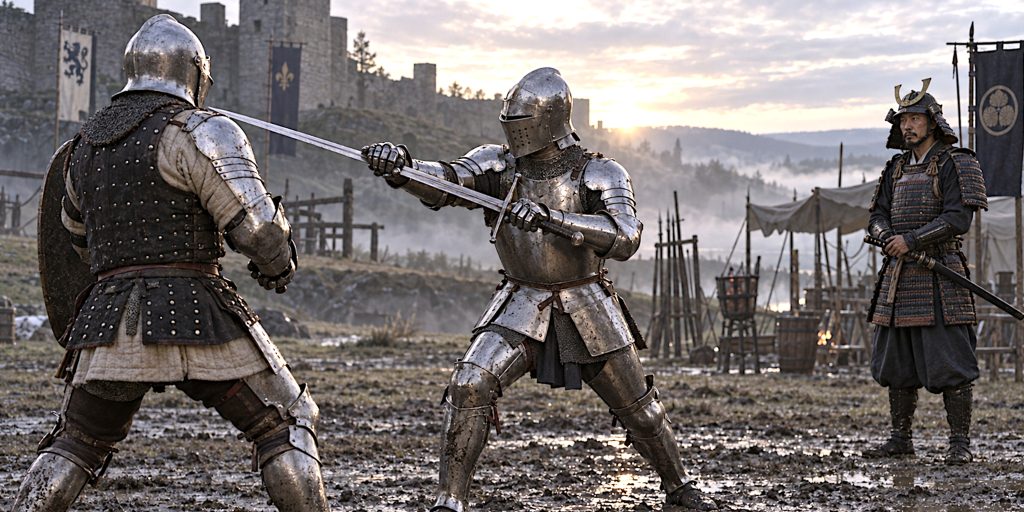
Neither weapon was expected to cut cleanly through good plate armour. Steel plate tends to object.
European longsword systems developed particularly detailed methods for armoured combat. These included:
- Half-swording: gripping the middle of the blade to guide the point accurately into armour gaps
- Mordhau: reversing the sword and striking with the guard or pommel
- Winding: controlling the opponent’s blade while presenting the point
- Grappling: using the sword alongside throws, locks and takedowns
- Targeted thrusting: attacking the visor, armpit, palm, groin and rear of the knee
The longsword’s straight point, crossguard and long pommel all became functional components in this kind of fighting.
Japanese warriors also faced armoured opponents. Katana techniques could target gaps in armour, particularly once combat reached close range. Earlier battlefield warfare, however, placed considerable importance on bows, spears, glaives and later firearms. The sword was one weapon within a larger military system, not a universal answer to every problem.
Against heavy armour, the longsword offers the more adaptable set of documented sword-specific techniques.
Round winner: European longsword
Score: Longsword 4 | Katana 1
Round Six: Speed of Deployment
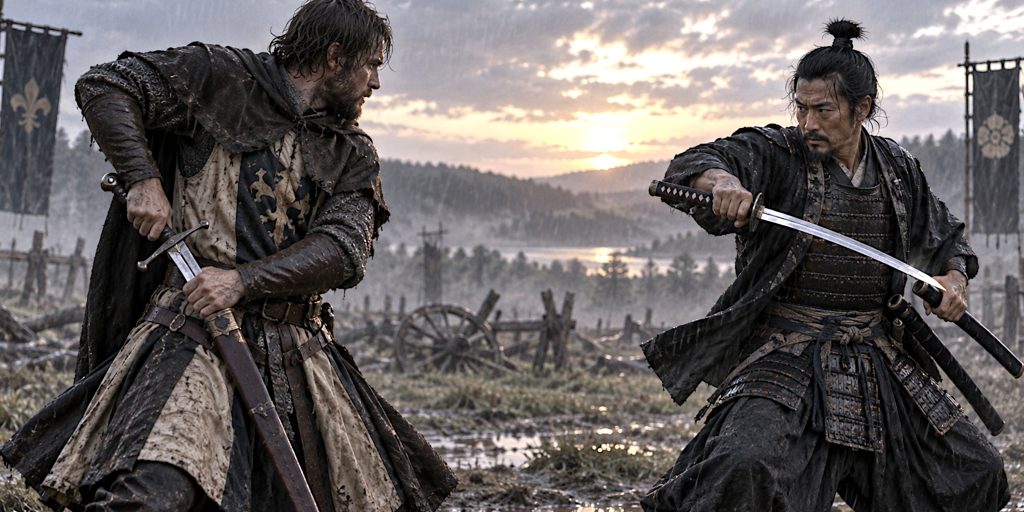
This category belongs to the katana.
The katana was normally worn thrust through the sash with its edge facing upwards. This permitted the draw and opening cut to become part of one continuous action. Schools of iai developed this principle into a sophisticated discipline.
The longsword was commonly carried in a scabbard at the hip, although its greater overall length could make it slower or more awkward to draw in a confined space. On campaign it might also be carried over the shoulder or transported according to circumstance. Contrary to a stubborn modern myth, very long swords were not routinely drawn from scabbards strapped across the back. Human arms have limits, even when dramatic music is playing.
Miyamoto Musashi emphasised the importance of purposeful action rather than theatrical movement:
“The primary thing when you take a sword in your hands is your intention to cut the enemy.”
A katana already in its scabbard could therefore become dangerous extraordinarily quickly. In an encounter beginning with both swords sheathed, that advantage matters.
Round winner: Japanese katana
Score: Longsword 4 | Katana 2
Round Seven: Tactical Versatility
The deciding category goes to the longsword.
Its combination of two edges, a strong point, long crossguard and extended grip allowed it to perform several distinct roles:
- Powerful two-handed cutting
- Long-range thrusting
- Rapid attacks with either edge
- Half-swording against armour
- Pommel and crossguard strikes
- Blade binding and winding
- Hooks, locks and takedowns
- One-handed use when necessary
The katana was versatile within Japanese swordsmanship. It could cut, thrust, parry, bind and support grappling at close range. Its scabbard could also play a role in controlling distance or disrupting an opponent.
Nevertheless, the longsword’s hilt and double-edged blade provide a wider mechanical toolkit. It was, depending on the situation, sword, short spear, lever, hook and improvised war hammer. Rather rude treatment for an expensive possession, but armour left little room for sentimentality.
Round winner: European longsword
Final score: Longsword 5 | Katana 2
Final Results
| Category | Winner | Deciding advantage |
|---|---|---|
| Reach | Longsword | Longer blade and greater threat distance |
| Cutting performance | Katana | Curved, single-edged cutting geometry |
| Thrusting ability | Longsword | Straight blade and specialised point |
| Hand protection | Longsword | Wider crossguard and stronger binding options |
| Armoured combat | Longsword | Half-swording and hilt-strike techniques |
| Speed of deployment | Katana | Efficient edge-up draw |
| Tactical versatility | Longsword | Two edges, long grip and multi-purpose hilt |
Overall Winner: European Longsword
European longsword 5 | Japanese katana 2
The longsword wins this comparison through reach, thrusting capability, hand protection and adaptability against armour. It is the broader tactical instrument.
The katana claims two meaningful victories. It is an exceptionally efficient cutting sword and can be brought into action rapidly from the scabbard. Its lower final score does not make it an inferior weapon within its own historical setting. It means that the chosen test rewards versatility across a wide range of combat problems.
Would the Longsword Always Win a Duel?
No.
A katana in the hands of an experienced swordsman could kill a longsword fighter with one well-timed cut. The reverse is equally true. The statistical advantages of a weapon matter, but they do not operate independently of the person holding it.
A real encounter would depend on:
- The skill and physical condition of each fighter
- Whether the swords began sheathed
- Clothing and armour
- Available space
- Ground conditions
- Prior knowledge of the opponent’s methods
- Initiative, timing and nerve
In an open space with both weapons drawn, the longsword’s additional reach would be difficult to ignore. In a sudden close-range encounter beginning from the scabbard, the katana’s rapid draw could change matters immediately.
History refuses to behave like a character-selection screen.
What the Historical Masters Actually Taught
The surviving traditions agree on one important point. The sword alone does not win.
European fencing books discuss timing, distance, initiative and control of the opponent’s blade. Japanese texts likewise place judgement, rhythm and intent above admiration for the weapon itself.
Fiore’s system moves freely between swordsmanship and wrestling. Musashi warned against becoming dependent on a particular weapon or technique. Both traditions treated combat as a problem to be solved, not a demonstration of national superiority.
That is the sensible conclusion here. The katana was superbly adapted to Japanese methods of carrying, drawing and cutting. The longsword was built for a European environment in which fighters might encounter anything from ordinary clothing to mail and complete plate armour.
The longsword wins the scorecard. The katana retains its dignity. The internet may now lower its voice.
Sources and Further Reading
- Royal Armouries: Fourteenth-century hand-and-a-half sword
- Royal Armouries: Early fifteenth-century hand-and-a-half sword
- Royal Armouries: European sword dated around 1350 to 1400
- Metropolitan Museum of Art: Blade and mounting for a katana
- Wiktenauer: Fiore dei Liberi’s sword in two hands
- Internet Archive: Miyamoto Musashi, The Book of Five Rings