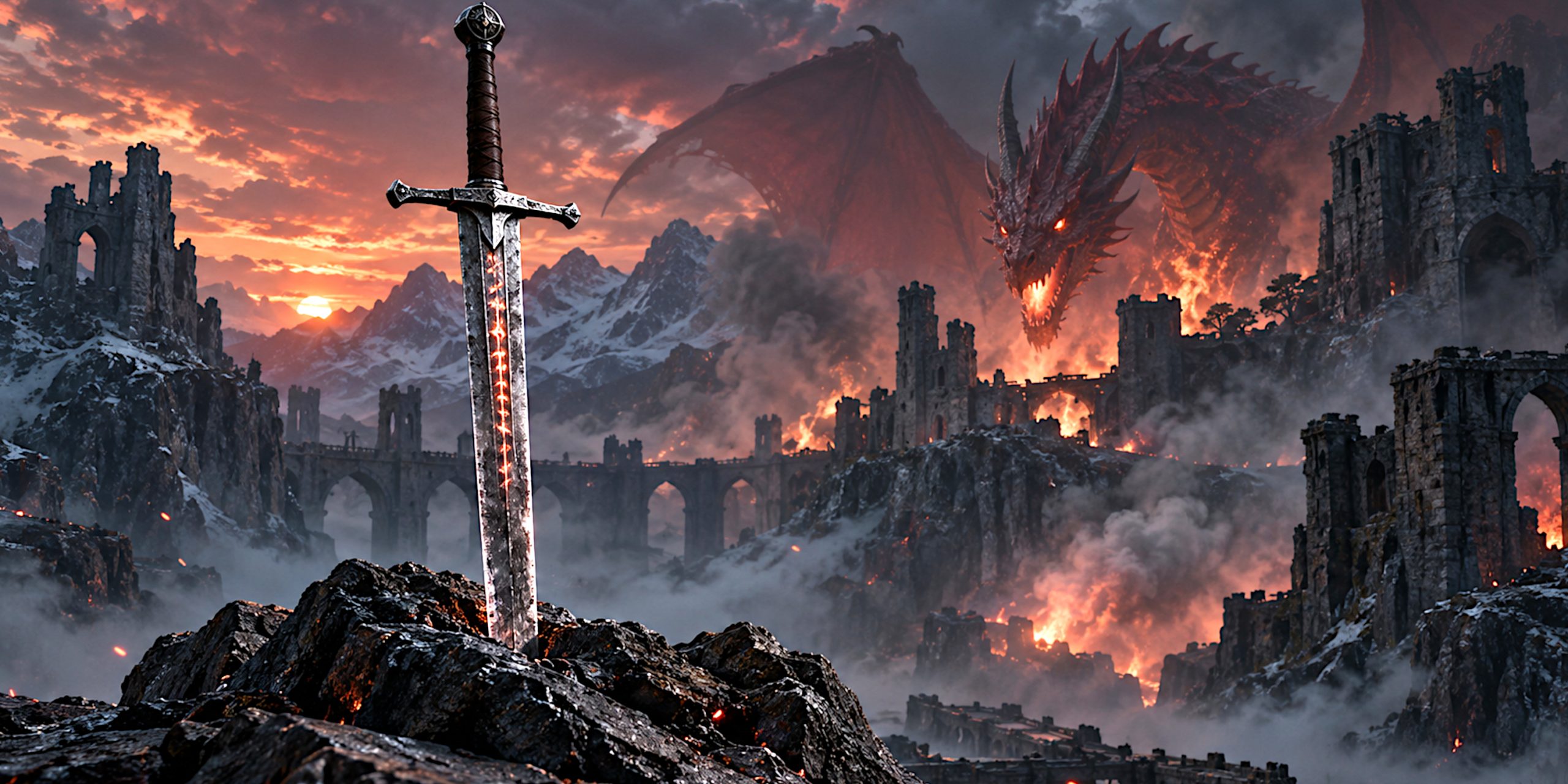
The Dragon Slayer is one of the most wonderfully direct magic weapons in Dungeons & Dragons. There is no misleading name, concealed curse or lengthy instruction manual written by an archmage with poor handwriting. It is a sword. It slays dragons.
Within fifth-edition D&D, the Dragon Slayer is a rare magic weapon that becomes considerably more dangerous when used against creatures of the Dragon type. Against ordinary enemies it remains a useful enchanted sword. Against a dragon, it starts earning its name.
That specialisation makes it less universally powerful than some famous D&D weapons, but far more memorable when the campaign finally produces wings, scales and an alarming amount of fire.
Dragon Slayer Sword Statistics
The familiar fifth-edition version appears as a rare magic weapon. Its basic rules are pleasingly short.
| Property | Rule |
|---|---|
| Weapon type | Any sword |
| Rarity | Rare |
| Magical bonus | Plus 1 to attack and damage rolls |
| Special damage | An additional 3d6 damage against a Dragon |
| Damage type | Matches the sword’s normal damage type |
| Attunement | Not required in the 2014 fifth-edition rules |
| Eligible forms | Longsword, greatsword, shortsword, rapier, scimitar or another sword approved by the DM |
When the wielder hits a creature belonging to the Dragon type, the target suffers an additional 3d6 damage. This damage is added on every successful hit rather than being limited to once per turn.
That detail matters. A fighter with Extra Attack can trigger the additional damage several times during the same turn. Add Action Surge and the supposedly ancient, majestic dragon may suddenly discover that legendary dignity provides no bonus to Armour Class.
Players using the revised fifth-edition rules should check the wording in the version of the Dungeon Master’s Guide being used at their table, particularly when combining material from the 2014 and 2024 rules.
What Counts as a Dragon?
The Dragon Slayer does not work only against traditional chromatic and metallic dragons. Its ability applies to any creature whose stat block identifies it as a Dragon.
Depending on the sourcebooks allowed in the campaign, valid targets can include:
- Chromatic dragons
- Metallic dragons
- Gem dragons
- Dragon turtles
- Faerie dragons
- Pseudodragons
- Wyverns
- Drakes and other creatures classified as Dragons
- Dragon-like monsters specifically given the Dragon creature type
The creature’s name is not enough by itself. A dragonborn, for example, is not automatically a Dragon for rules purposes. Its creature type determines whether the bonus damage applies.
This creates the faintly ridiculous possibility of a legendary dragon-killing blade functioning against a tiny faerie dragon. Mechanically, the sword is satisfied. Morally, the wielder may have some explaining to do.
Is the Dragon Slayer Always a Longsword?
No. The magic item can be attached to any sword unless a particular adventure or Dungeon Master specifies otherwise.
A Dragon Slayer might therefore be:
- A longsword carried by a traditional knight
- A greatsword forged for a heavily armoured dragon hunter
- A rapier created by an elven duellist
- A scimitar belonging to a desert order
- A shortsword designed for a rogue or lightly equipped scout
This flexibility is one of the weapon’s best qualities. The Dungeon Master can place a Dragon Slayer in the campaign without forcing the party to adopt a weapon nobody normally uses.
A greatsword version provides excellent raw damage for Strength-based fighters, barbarians and paladins. A rapier allows a Dexterity-focused character to benefit. A shortsword can be used in two-weapon fighting, although the additional damage only applies when the Dragon Slayer itself lands the hit.
How Much Damage Does a Dragon Slayer Inflict?
Against a normal creature, the sword behaves like a plus 1 magic weapon. Against a Dragon, every successful attack adds 3d6 damage.
A longsword wielded in one hand would normally deal:
1d8 slashing damage, plus the wielder’s ability modifier, plus 1
Against a Dragon, it instead deals:
1d8 slashing damage, plus the wielder’s ability modifier, plus 1, plus 3d6 slashing damage
The extra 3d6 produces an average of 10.5 additional damage per hit. That is substantial on its own and increasingly unpleasant when used by a character who can make several attacks.
Critical hits make the weapon even more dangerous because the additional damage dice are normally doubled along with the weapon’s other damage dice. A critical hit from a Dragon Slayer greatsword can therefore involve a satisfying fistful of dice. This is one of those rare moments when arriving at the table with an excessive dice collection appears entirely reasonable.
Which Classes Use the Dragon Slayer Best?
Any character proficient with the sword’s chosen form can use it, but martial characters make the most of its repeated bonus damage.
Fighter
The fighter is probably the most efficient Dragon Slayer wielder. Extra Attack increases the number of opportunities to trigger the additional 3d6, while Action Surge can produce a devastating burst of attacks.
A fighter does not need complicated preparation. They simply need to reach the dragon, which is admittedly the part dragons tend to object to.
Paladin
Paladins combine the sword’s extra damage with Divine Smite. A critical hit can become spectacularly expensive for the target, particularly if the paladin has been saving spell slots for precisely this moment.
The weapon also suits the class thematically. A sacred warrior hunting an ancient wyrm needs very little additional explanation.
Barbarian
A barbarian benefits from the reliable magical bonus and can use Reckless Attack to improve the chance of landing each hit. Resistance to common physical damage also helps the wielder survive long enough to keep swinging.
A greatsword version is the obvious pairing, although “obvious” has never troubled barbarians very much.
Ranger
A dragon-hunting ranger can combine the weapon with class features and spells that improve accuracy or add damage. Dexterity-based rangers may prefer a rapier or shortsword version.
The main limitation is proximity. Rangers are often safer at range, while a Dragon Slayer demands the sort of personal commitment that places a character directly beneath the claws.
Rogue
A rogue can use a finesse version such as a rapier or shortsword. Sneak Attack and the Dragon Slayer’s bonus damage can produce a formidable single strike.
The rogue gains less from the sword than a fighter making several attacks, but one critical hit can still make the dragon reconsider its threat assessment.
Advantages and Disadvantages
| Advantages | Disadvantages |
|---|---|
| Adds 3d6 damage on every hit against Dragons | Special ability is highly situational |
| Provides a permanent plus 1 magical bonus | Offers no defensive protection |
| Does not require attunement under the 2014 rules | Melee versions are difficult to use against flying dragons |
| Can be created as almost any sword | Less impressive in campaigns without many Dragon-type enemies |
| Scales well with Extra Attack | A plus 1 bonus may feel modest at higher levels |
The absence of an attunement requirement is particularly useful. Characters are usually limited to three attuned magic items, so a weapon that provides a strong specialised ability without occupying a slot is valuable.
Its weakness is equally clear. A campaign full of fiends, undead or aberrations leaves the weapon functioning as an ordinary plus 1 sword. Still useful, certainly, but hardly the legendary implement promised by the name.
Dragon Slayer Versus Dragonlance
The Dragon Slayer is sometimes confused with a dragonlance, but the two weapons are distinct.
| Feature | Dragon Slayer | Dragonlance |
|---|---|---|
| Typical form | Any sword | Lance or pike |
| Rarity | Rare | Varies by version |
| General bonus | Plus 1 to attack and damage | Depends on the item’s rules |
| Anti-dragon effect | Additional damage against Dragons | Usually heavier specialised damage or tactical effects |
| Setting association | Suitable for most D&D settings | Strongly associated with Dragonlance |
| Best user | Any suitable sword wielder | Mounted warriors or dedicated dragon hunters |
A Dragon Slayer is easier to place in a general fantasy campaign. A dragonlance carries more setting-specific history and is often designed around organised warfare against dragons rather than individual adventuring.
Dragon Slayer Versus Other Magic Swords
The Dragon Slayer occupies an interesting middle position among D&D weapons. It is stronger than a basic plus 1 sword in the right encounter, but lacks the broad utility of weapons with effects that work against every opponent.
| Weapon | Main strength | Main limitation |
|---|---|---|
| Dragon Slayer | Heavy repeated damage against Dragons | Highly specialised |
| Flame Tongue | Additional fire damage against most targets | Fire resistance is common |
| Frost Brand | Cold damage and defensive benefits | Usually much rarer |
| Giant Slayer | Extra damage and control against giants | Depends on facing Giant-type creatures |
| Vorpal Sword | Exceptional critical-hit effect | Legendary rarity |
| Holy Avenger | Powerful offence and protection | Restricted to paladins |
The closest comparison is the Giant Slayer. Both are purpose-built weapons aimed at a particular creature type. The Dragon Slayer concentrates on additional damage, while versions of the Giant Slayer may also knock their intended targets prone.
Building Lore Around the Sword
The standard item provides mechanics rather than a fixed history. That gives the Dungeon Master plenty of room to create something more interesting than “you find a sword in the chest”.
A Dragon Slayer might have been:
- Forged from ore taken from beneath a dragon’s first lair
- Quenched in the blood of an ancient wyrm
- Created by a kingdom that no longer exists
- Carried by a hero whose victory was considerably exaggerated
- Broken during an unsuccessful hunt and later reforged
- Blessed by a deity opposed to draconic tyranny
- Made from the fang, claw or scale of a slain dragon
- Stolen from a dragon’s own treasure hoard
The sword need not hate all dragons. It could have been made by a metallic dragon to destroy a particular rival, or forged as part of an alliance between mortals and dragons.
That distinction can create a better story. A weapon designed to kill “dragons” in general is useful. A weapon made to kill one named dragon carries history, grudges and probably several inconvenient heirs.
Should the Sword Be Sentient?
A standard Dragon Slayer is not sentient, but making one intelligent can turn a functional magic item into a recurring character.
Possible personalities include:
- A stern knight who considers every retreat dishonourable
- An enthusiastic weapon with an alarmingly broad definition of dragon
- The trapped spirit of its original wielder
- A repentant dragon whose soul was bound into the blade
- A calculating intelligence interested only in one ancient target
- A boastful sword whose account of past victories cannot be independently verified
Sentience works best when it creates decisions rather than constantly punishing the wielder. A sword that demands the immediate death of every dragon can become exhausting. One that questions the party’s motives or recognises forgotten draconic heraldry is far more useful.
How a Dungeon Master Can Introduce a Dragon Slayer
The weapon is most satisfying when the players understand why they need it. Dropping it into random treasure immediately before a dragon battle works mechanically, but feels suspiciously like the universe has begun arranging the party’s inventory.
Better introductions include:
- A quest to recover the blade from a ruined fortress
- A rival dragon hunter who already carries it
- A sword held in a dragon’s hoard as a captured trophy
- A broken weapon whose pieces lie in separate locations
- An ancestral blade that awakens when a dragon returns
- A weapon offered by a patron whose motives are doubtful
- A ceremonial sword mistakenly believed to be powerless
The Dragon Slayer can also serve as a warning. Finding one in an otherwise peaceful settlement tells the players that somebody once expected dragons, and may expect them again.
Balancing the Dragon Slayer in a Campaign
The weapon’s power depends almost entirely on encounter design. In a campaign containing one dragon, it is a specialised reward with a single glorious opportunity. In a dragon-heavy adventure, it can become one of the party’s most damaging items.
Dungeon Masters should consider:
- How frequently Dragon-type creatures appear
- Whether the wielder can reliably reach flying enemies
- How many attacks the character makes
- Whether critical-hit optimisation is common in the group
- Whether the sword applies to allied or neutral dragons
- How the existence of the weapon affects negotiations
The final point deserves attention. Carrying a weapon called Dragon Slayer into a diplomatic meeting with a gold dragon is not necessarily hostile, but it has the social delicacy of bringing a loaded crossbow to a job interview.
The sword does not need to be weakened simply because it performs well against its intended prey. Specialised magic items should feel powerful in the encounters built for them. The better counterbalance is to make reaching, identifying or confronting the dragon a meaningful challenge.
Can Players Craft a Dragon Slayer?
Crafting rules depend on the edition, campaign and optional systems being used. As a rare magic item, a Dragon Slayer should normally require more than money and spare time.
Suitable ingredients might include:
- A dragon’s fang or claw
- Scales from the intended dragon species
- Metal exposed to a dragon’s breath
- Blood willingly given by a dragon
- An existing magical sword
- Instructions preserved by an extinct order
- A forge heated by elemental or draconic fire
The most interesting ingredient is often something that cannot be acquired through combat alone. Perhaps the blade requires the blessing of one dragon before it can be used against another. That immediately turns the crafting process into an adventure rather than magical shopping with extra paperwork.
Is the Dragon Slayer Worth Using?
Against Dragons, absolutely. The extra 3d6 damage on every hit can transform a capable martial character into a major threat, especially when combined with Extra Attack, critical hits and class abilities.
Against everything else, it remains a reliable plus 1 magic sword. That is respectable, although less exciting once the party begins finding very rare or legendary weapons.
Its real strength lies in timing. The Dragon Slayer is at its best when introduced as part of a developing story, linked to a specific enemy and given enough history to matter. Players should remember where they found it, whose hands once carried it and which dragon has good reason to fear its return.
Mechanically, it is simple. Narratively, it can carry an entire campaign. Few D&D weapons make their purpose quite so clear, and fewer still encourage the party to look at an ancient red dragon and think, perhaps unwisely, that the odds have improved.