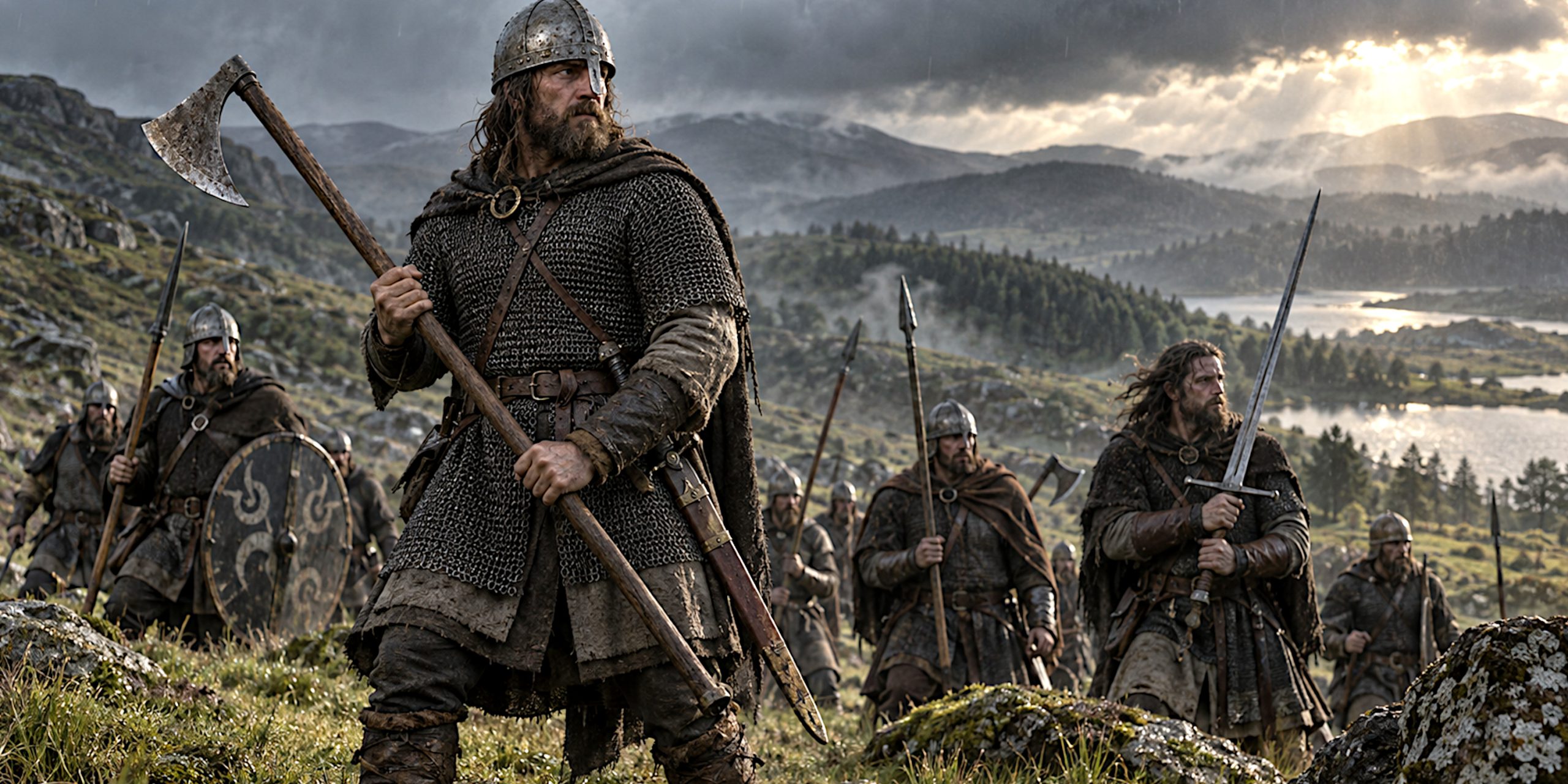
For roughly three centuries, the gallowglass stood among the most respected and feared soldiers in Ireland. These heavily armed infantrymen emerged from the Norse-Gaelic world of western Scotland and the Hebrides, but became deeply embedded in Irish military and political life.
Between about 1300 and 1600, gallowglass companies served Gaelic kings, Anglo-Irish magnates and ambitious regional lords. They fought with long axes, spears and formidable swords, often protected by mail or padded armour. Their role was to provide a solid infantry core around which lighter kern and cavalry could operate.
The image of an enormous, mail-clad warrior swinging a two-handed axe is not entirely wrong. It is simply too neat. Gallowglass equipment varied, their loyalties could be complicated and their military role changed considerably as gunpowder weapons became more common.
They were mercenaries, hereditary retainers, settlers and, in some cases, territorial lords. Ireland did not merely hire the gallowglass. It absorbed them.
Irish Gallowglass at a Glance
| Feature | Details |
|---|---|
| Historical period | Late Medieval and Renaissance era, c. 1300 to 1600 |
| Irish name | Gallóglaigh, singular gallóglach |
| Probable meaning | Foreign warriors or foreign fighting men |
| Origins | Western Scotland, Argyll and the Hebrides |
| Principal role | Professional heavy infantry |
| Main weapons | Sparth axe, spear, two-handed sword and arming sword |
| Armour | Mail shirts, padded garments, helmets and later defensive jacks |
| Notable families | MacSweeney, MacDonnell, MacSheehy, MacCabe and MacRory |
| Employers | Gaelic Irish kings, Anglo-Irish magnates and the English Crown |
| Period of decline | Late sixteenth and early seventeenth centuries |
Who Were the Gallowglass?
The English word gallowglass derives from the Irish gallóglach. The plural form is gallóglaigh. It is usually interpreted as a combination of gall, meaning foreigner, and óglach, meaning warrior or fighting man.
This foreignness was relative. The earliest gallowglass came largely from the Norse-Gaelic communities of the Hebrides and western Highlands. These regions had been shaped by centuries of interaction between Gaelic and Scandinavian populations.
The North Channel did not form the sort of hard national border suggested by a modern political map. It connected communities in Ulster, Argyll and the Isles. Lords, clergy, traders, poets and soldiers moved between them with considerable regularity.
By 1300, warriors from this maritime world were entering Irish service in growing numbers. Some were recruited for individual campaigns. Others settled permanently and received land in return for continued military service.
Within a few generations, prominent gallowglass families had become part of Gaelic Ireland’s ruling structure. They retained connections with Scotland, but their interests, marriages and lands were increasingly Irish.
Calling them Scottish mercenaries is therefore only partly correct. It describes where many originated, but not what they became.
When Did the Gallowglass Arrive in Ireland?
The traditional date for the first major arrival is 1259. According to later historical accounts, Aodh Ó Conchobhair of Connacht received a contingent of Hebridean warriors connected with his marriage to a daughter of Dubhghall mac Ruaidhrí, a ruler in the Isles.
The precise details remain uncertain. Irish annalistic chronology can also differ from modern dating, so the event should not be treated with false precision.
What can be said with greater confidence is that the gallowglass presence expanded during the fourteenth century. This makes c. 1300 a sensible starting point for examining their established role in Irish warfare.
Their arrival occurred after the Anglo-Norman invasion had transformed the political map. Gaelic dynasties were attempting to defend or recover territory, while Anglo-Irish families competed among themselves and adopted many Gaelic customs.
Ireland contained no single united army. It was a country of competing lordships, shifting alliances and recurring succession disputes. A professional company of heavily equipped infantry could alter the balance between neighbouring rulers.
Why Irish Lords Needed Them
Gaelic armies already possessed experienced warriors. Light infantry, commonly described as kern in English-language sources, could move rapidly through woods, hills and wetlands. They excelled at skirmishing, raiding and ambushes.
Mounted nobles and their retainers supplied mobility. They could reconnoitre, pursue a defeated enemy or withdraw before a stronger force arrived. The last of these was particularly important in a political culture where survival preserved both the dynasty and the possibility of revenge.
What many rulers needed was dependable heavy infantry capable of holding a position or sustaining close combat.
Gallowglass troops offered:
- Greater protection than most light infantry
- Professional or hereditary military experience
- Cohesion based on family and company loyalties
- Considerable striking power at close range
- The ability to defend narrow routes and river crossings
- A solid force around which lighter troops could rally
- Personal protection for a lord and his standard
Their presence could discourage an enemy from pressing an attack. If battle did come, they formed a hard centre while kern used missiles and cavalry operated around the flanks.
They were not invincible. Heavily equipped infantry could be outmanoeuvred, overwhelmed by missiles or disrupted by firearms. Nevertheless, a ruler with several reliable gallowglass companies possessed a military advantage that his neighbours could not politely ignore.
How Gallowglass Companies Were Organised
Gallowglass service was organised through a mixture of payment, landholding, kinship and hereditary obligation.
A company was sometimes called a “battle” in English administrative records. Its size was not consistent, but Tudor sources occasionally reckoned a battle at approximately 60 to 100 fighting men.
Each warrior could be accompanied by attendants. These boys or servants carried provisions, spare weapons and other equipment. Consequently, a force listed as 80 gallowglass represented a considerably larger body of people on the march.
At the head of the company stood a captain or constable. In important families, the position could become hereditary. A captain was responsible not only for battlefield command but also for negotiating service, maintaining followers and protecting the family’s political interests.
Payment might include:
- Coin
- Cattle
- Food and lodging
- Grants of land
- Rights over local communities
- Hereditary military offices
The system of maintaining professional soldiers was known as buannacht. The obligation to provide quarters and supplies could be imposed upon local households.
From the lord’s perspective, this maintained a permanent military force. From the perspective of the household providing the beef, ale and bedding, it probably felt rather less efficient.
The Major Gallowglass Families
Several families became particularly prominent in Ireland. Their histories show how imported fighting companies developed into landed dynasties.
The MacSweeneys
The MacSweeneys, from the Gaelic Mac Suibhne, were among the earliest and most influential gallowglass families.
Their ancestors were associated with Argyll and the Hebrides. After losing or abandoning territories in Scotland, different branches established themselves in Donegal. These included:
- Mac Suibhne Fánad
- Mac Suibhne na dTuath
- Mac Suibhne Boghaineach
They served the O’Donnells and other northern rulers, while also becoming territorial lords in their own right. Their castles and burial monuments demonstrate that the family’s status extended far beyond paid military employment.
The MacDonnells
The MacDonnells belonged to a powerful wider kindred whose territories and interests extended across the Hebrides, Kintyre and Antrim.
Scottish soldiers continued to arrive in Ulster under MacDonnell leadership during the sixteenth century. Their ability to move men across the sea repeatedly alarmed Tudor officials.
The Crown attempted to sever these connections, but the geography favoured the MacDonnells. A stretch of water could be crossed more easily than many Irish roads could be travelled.
The MacSheehys
The MacSheehys, or Mac Síthigh, became closely associated with Munster. They served powerful families including the FitzGerald earls of Desmond.
Their history demonstrates that gallowglass were not employed exclusively by Gaelic Irish dynasties. Anglo-Irish magnates who had adopted Irish customs also maintained hereditary fighting companies.
The MacCabes
The MacCabes established themselves in Ulster, Breifne and parts of the northern Midlands. They served the O’Reillys and other regional rulers as constables and professional soldiers.
Different branches acquired lands and local influence. Like the MacSweeneys, they eventually belonged as much to Ireland’s political landscape as to the Scottish world from which their ancestors had come.
The MacRorys and MacDougalls
Other Norse-Gaelic kindreds, including the MacRorys and MacDougalls, contributed to the movement of warriors between Scotland and Ireland. Not every branch established a permanent Irish lordship, but they belonged to the same interconnected military culture.
Arms and Armour
Gallowglass equipment changed between 1300 and 1600. A fourteenth-century warrior wearing mail and carrying a broad axe did not look identical to a sixteenth-century soldier serving alongside pikemen and arquebusiers.
Surviving weapons, grave sculpture, contemporary artwork and written descriptions provide a broad picture. None offers a universal gallowglass uniform.
The Sparth Axe
The weapon most closely associated with the gallowglass was the long-handled sparth axe.
Its design probably developed from Scandinavian and Norse-Gaelic axe traditions. Surviving and illustrated examples vary, but common features include:
- A long wooden haft
- A broad iron cutting edge
- A relatively thin blade
- Projecting points on some axe heads
- Sufficient room for a two-handed grip
The sparth delivered powerful cutting blows. It could split wooden shields, strike around defensive equipment and cause serious injuries through mail or padded armour. Even when the edge failed to penetrate metal protection, the impact could break bones or incapacitate the target.
The weapon also had disadvantages. A committed swing required space. If the wielder missed or became trapped in a close press, recovery could be difficult. Skill, formation and timing mattered rather more than simply owning the largest axe in the neighbourhood.
Two-Handed Great Swords
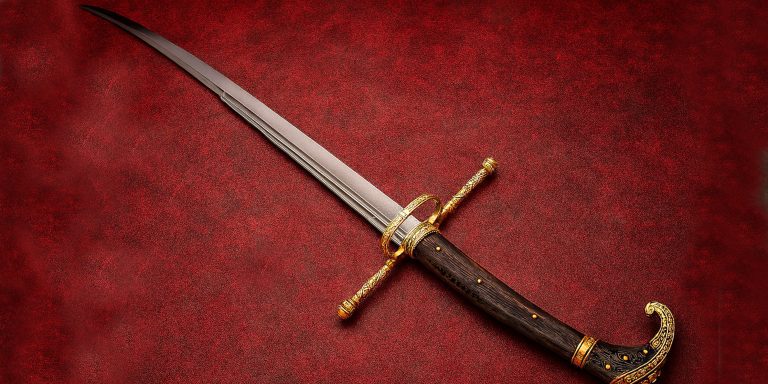
Large two-handed swords were also used by gallowglass warriors. These are often called claymores, although the terminology needs restraint.
The Gaelic expression claidheamh mòr means “great sword”. Modern writers frequently use claymore for almost any large Scottish sword, including weapons from different periods with substantially different hilts.
Sword types associated with the gallowglass world included:
- Two-handed Highland great swords
- Long swords with extended grips
- Hand-and-a-half swords
- Swords with guards angled towards the blade
- Swords with quatrefoil terminals
- Broad-bladed cutting swords
A two-handed sword offered greater reach than an arming sword and could deliver both cuts and thrusts. It was generally more agile than a sparth axe, though it lacked the concentrated impact of the axe head.
West Highland grave slabs frequently depict long swords with distinctive pommels and guards. These carvings are important evidence for the elite military culture from which the gallowglass emerged.
One-Handed Arming Swords
Not every gallowglass carried a two-handed weapon. The one-handed arming sword remained a practical sidearm throughout the period.
These swords generally possessed:
- A straight, double-edged blade
- A simple crossguard
- A one-handed grip
- A wheel, disc or related pommel
- A blade capable of cutting and thrusting
An arming sword could be carried with a shield or kept as a secondary weapon. It was useful in confined ground where a long axe or great sword became awkward.
Irish Ring-Pommel Swords
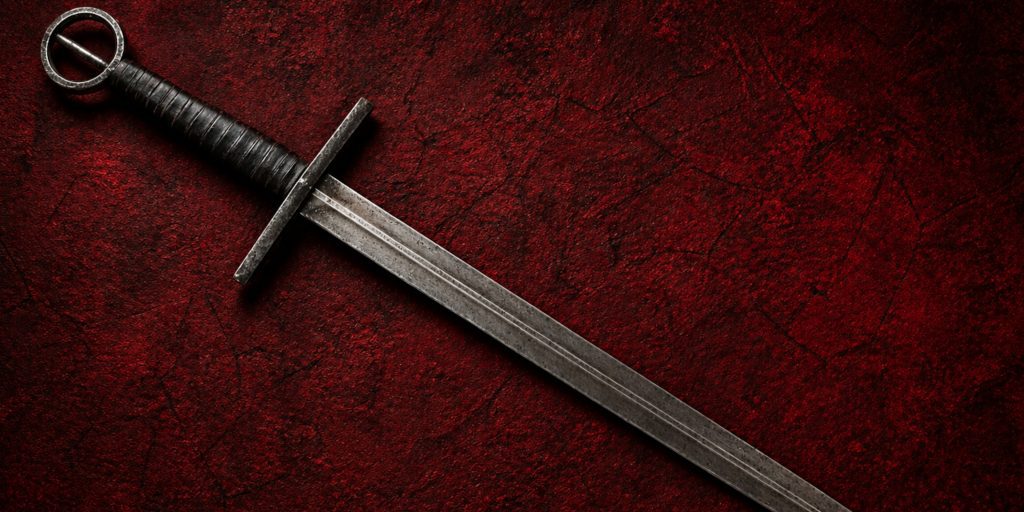
The ring-pommel sword became one of the most recognisable weapons of later medieval and Renaissance Ireland.
Instead of a solid pommel, the hilt ended in an open iron ring. Surviving examples vary considerably, suggesting that the design was a regional tradition rather than a single regulated type.
Ring-pommel swords were usually one-handed weapons, although some had grips long enough for occasional two-handed use. Their association with Irish warriors is supported by archaeological finds and contemporary imagery.
A ring pommel did not necessarily identify its owner as a gallowglass. Kern, nobles and other fighting men could also carry such swords.
Spears and Javelins
Spears were among the most common weapons in Irish warfare. They were cheaper than swords, easier to produce in quantity and effective in both open battle and restricted terrain.
A gallowglass might carry a thrusting spear before drawing an axe or sword. Attendants and lighter troops also carried javelins or darts.
English descriptions do not always distinguish clearly between spears, pikes and throwing weapons. Modern certainty should therefore stop where the evidence does.
Bows and Firearms
The bow was more commonly associated with lighter troops than with the classic gallowglass role. Nevertheless, gallowglass companies did not operate in isolation and could be supported by archers.
By the sixteenth century, Irish armies increasingly included handguns and arquebuses. Some professional gallowglass families adapted to these developments, although the traditional image remained that of an axe-bearing heavy infantryman.
Mail Armour
Mail was central to early gallowglass equipment. A wealthy warrior might wear a mail shirt or hauberk over a padded garment.
Mail offered good protection against slashing attacks and glancing blows. Its flexible construction allowed greater freedom of movement than rigid plate armour.
Its disadvantages included:
- Considerable weight
- High cost
- Constant maintenance
- Vulnerability to concentrated thrusts
- Limited protection against heavy impact
- A tendency to react poorly to persistent Irish rain
Some mail shirts extended towards the knees, while others were shorter. Sleeves could cover much of the arm, though surviving visual evidence does not support a single standard form.
Padded Jacks and Brigandines
During the fifteenth and sixteenth centuries, padded defensive garments became increasingly important. A thick jack could be worn alone or beneath mail.
Brigandines, made from small metal plates riveted inside a fabric covering, were also available within the broader military world of Britain and Ireland. Direct evidence for their use by particular gallowglass companies is less abundant, but such armour was well suited to professional infantry.
Later gallowglass should not be imagined as rejecting every new form of protection on grounds of tradition. Soldiers tend to take a lively interest in equipment that prevents holes appearing in them.
Helmets
Helmets varied widely according to period and wealth. Possible forms included:
- Conical iron helmets
- Bascinets
- Open-faced sallets
- Iron caps
- Morions
- Other imported English or continental designs
Some artwork shows bare-headed warriors, but this may reflect artistic convention, poverty or a particular moment rather than normal battlefield practice.
Shields
Large two-handed weapons prevented the simultaneous use of a shield. Gallowglass armed with swords or spears may nevertheless have carried small shields, particularly in earlier periods.
The round Gaelic shield remained present in Irish warfare, but it was more often associated with lighter warriors. Equipment choices depended upon the individual’s principal weapon and tactical role.
Did the Gallowglass Fight Barefoot?
Contemporary images and descriptions sometimes show Irish soldiers with bare legs and feet. This has encouraged the popular image of the barefoot gallowglass striding into battle regardless of weather, terrain or common sense.
Some Gaelic troops almost certainly fought barefoot or wore simple shoes. Bare feet could offer practical advantages in wetlands where heavy footwear became waterlogged.
It was not a universal gallowglass practice. These warriors served across three centuries and came from different levels of wealth. Captains, landed retainers and newly recruited soldiers would not all have dressed alike.
Artistic depictions also emphasised perceived Irish difference. Bare feet could function as a visual symbol of supposedly uncivilised or exotic behaviour. Such images remain valuable, but they need to be read critically.
How the Gallowglass Fought
The gallowglass fought primarily as heavy infantry. Their role was to stand, protect and strike while lighter troops used mobility and missile weapons.
A typical Gaelic force might include:
| Troop type | Principal role |
|---|---|
| Gallowglass | Heavy infantry and close combat |
| Kern | Skirmishing, raiding and missile attacks |
| Horsemen | Reconnaissance, pursuit and rapid movement |
| Household retainers | Protection of the lord and standard |
| Archers or shot | Ranged support |
| Pikemen | Increasingly important during the sixteenth century |
In battle, kern could harass an enemy with darts, arrows or firearms before withdrawing. Gallowglass then provided a defended position or delivered a close assault. Horsemen operated on the flanks and pursued enemies whose formation had broken.
Gallowglass were particularly useful in:
- Woods
- Narrow passes
- River crossings
- Broken or enclosed countryside
- Defensive positions
- Ambushes
- Fighting retreats
Their heavy weapons were dangerous when the enemy could be forced into close combat. They were less comfortable crossing exposed ground under sustained archery or gunfire.
Discipline was essential. A large axe was effective only when its wielder had enough room to use it without removing an ally’s ear. Gallowglass companies depended upon familiarity, spacing and mutual confidence.
Gallowglass in Major Irish Conflicts
The Battle of Knockdoe
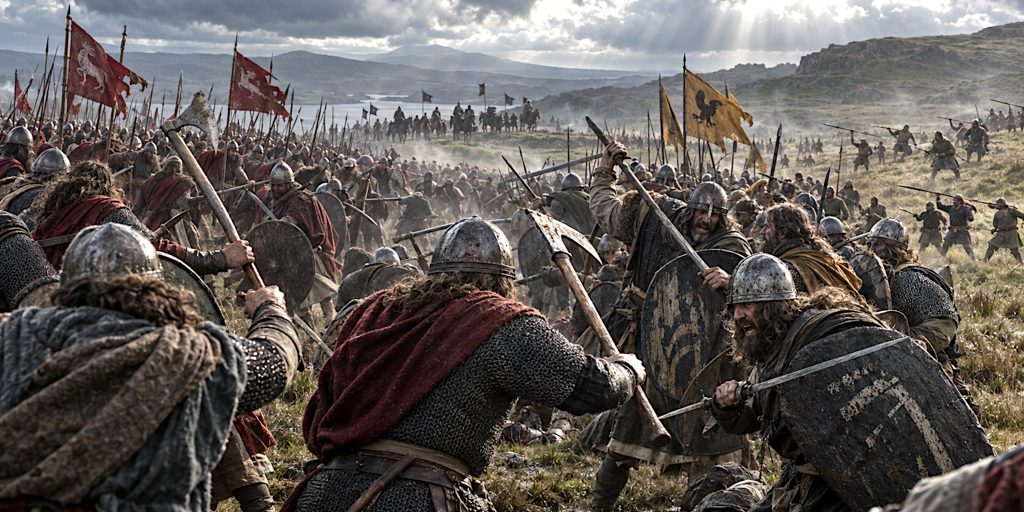
The Battle of Knockdoe in 1504 was one of the largest engagements fought in Ireland during the period.
Gearóid Mór FitzGerald, Earl of Kildare and Lord Deputy of Ireland, led a coalition against Ulick Fionn Burke of Clanricarde. Both armies included Gaelic troops, and gallowglass fought on each side.
The battle appears to have involved severe close combat and heavy casualties among the professional infantry. Its importance lies partly in showing that gallowglass were not simply defenders of Gaelic Ireland against England. They served competing Irish and Anglo-Irish powers according to established political relationships.
The Wars of Shane O’Neill
During the mid-sixteenth century, Shane O’Neill attempted to dominate Ulster and challenge both rival Gaelic families and the Tudor government.
Gallowglass formed an important part of the forces involved. Scottish connections were particularly significant because the MacDonnells could bring fighting men into north-eastern Ireland.
Shane alternately fought, negotiated with and attempted to manipulate these groups. His eventual killing by the MacDonnells in 1567 was an especially emphatic failure of diplomacy.
The Desmond Rebellions
The gallowglass also participated in the Desmond Rebellions of the later sixteenth century. MacSheehy companies had longstanding connections with the FitzGerald earls of Desmond and served within the military networks of Munster.
The conflict exposed the limitations of traditional forces against sustained Tudor campaigning, garrisons and scorched-earth methods. It also devastated the communities required to supply armies.
The Nine Years’ War
During the Nine Years’ War from 1594 to 1603, Hugh O’Neill and his allies fielded an army that combined Gaelic traditions with newer European practices.
Gallowglass remained in service, but they fought alongside:
- Arquebusiers and musketeers
- Pikemen
- More disciplined missile troops
- Horsemen trained for reconnaissance and raiding
- Units influenced by Scottish and continental warfare
O’Neill understood that axes and personal courage alone could not defeat a modern royal army. His success depended upon firearms, prepared positions, flexible tactics and control of difficult terrain.
Traditional gallowglass continued to provide close-combat strength, but they were no longer the sole professional foundation of the army.
Contemporary Descriptions of the Gallowglass
Written descriptions of gallowglass warriors survive mainly from English and Anglo-Irish observers. They offer useful details, but were shaped by political hostility and cultural prejudice.
Richard Stanihurst, writing in the sixteenth century, described the gallowglass as:
“Grim of countenance, tall of stature, big of limb, burly of body, well and strongly timbered.”
The passage captures the physical impression these soldiers made upon observers. It also reads rather like an advertisement placed by a captain hoping to improve recruitment.
Stanihurst associated the gallowglass with mail armour and heavy weapons. His description helps distinguish them from lighter Irish troops, although it cannot be assumed that every company matched his picture.
John Dymmok, writing in the late sixteenth century, similarly differentiated between heavily armed gallowglass and more mobile kern. English military officials clearly recognised that the two performed separate battlefield functions.
Edmund Spenser discussed the maintenance of Irish soldiers through compulsory quartering. In A View of the Present State of Ireland, one speaker complains that troops lived upon the population:
“The soldier is then maintained by the country.”
The remark points towards the social cost of buannacht. Maintaining professional soldiers placed pressure upon farming communities already vulnerable to raids, confiscation and crop destruction.
Spenser must be treated cautiously. He was not a neutral ethnographer but a colonial official who advocated brutal policies against Irish resistance. His observations may be useful, while his assumptions and political conclusions remain deeply compromised.
Irish annals provide a different kind of testimony. They record battles, deaths and dynastic changes, often identifying distinguished gallowglass captains. Their concern was generally ancestry and political significance rather than a convenient catalogue of weapons.
Archaeology and Material Evidence
The archaeology of the gallowglass is intriguing but difficult. Weapons can survive, yet identifying the person who carried them is much harder.
An axe found in Ireland may have belonged to a gallowglass, a kern, a household retainer or someone whose intentions were entirely agricultural. Corrosion is wonderfully impartial about such distinctions.
Surviving Axe Heads
Large iron axe heads recovered from Irish sites and waterways resemble the weapons shown in late medieval and Renaissance depictions.
Some have broad blades and projecting points consistent with combat use. Others are harder to distinguish from working axes. Dating, metallurgical study and archaeological context are essential before linking a find directly with gallowglass warfare.
River finds may represent accidental loss, deliberate deposition or material discarded after battle. Without a controlled excavation, certainty remains elusive.
Archaeological Swords
Late medieval Irish sword finds include:
- Straight double-edged blades
- Ring-pommel swords
- Long swords
- Imported continental blades
- Locally mounted weapons
- Swords influenced by Scottish hilt designs
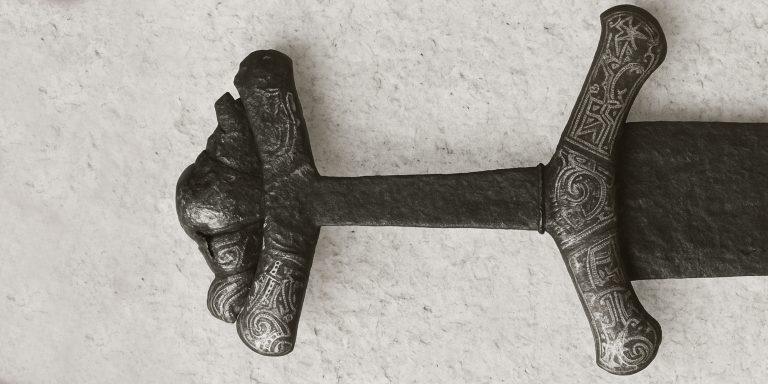
The National Museum of Ireland holds an iron sword identified as a type used by Irish warriors and Scottish gallowglass mercenaries. Its form reflects the movement of weapons and styles across the Irish Sea.
Imported blades could be fitted with locally made guards and pommels. A sword was therefore not necessarily wholly Irish, Scottish or continental. It might combine all three traditions.
Grave Slabs and Warrior Effigies
Carved grave slabs provide some of the strongest visual evidence for the gallowglass military world.
West Highland sculpture depicts warriors with:
- Long swords
- Axes
- Mail armour
- Decorated scabbards
- Belts and harnesses
- Helmets or armoured headgear
These monuments were commissioned for important men and families. They portray status and identity rather than the daily appearance of every soldier.
Related grave sculpture in Ireland demonstrates the movement of artistic styles alongside military families. The monuments help trace the shared Gaelic culture linking western Scotland and northern Ireland.
Castles and Lordship
The archaeological legacy of the gallowglass extends beyond weapons. Families who settled in Ireland constructed, occupied or controlled castles and tower houses.
Sites associated with the MacSweeneys in Donegal include Doe Castle and other strongholds connected with their regional lordships. These were not simply military bases. They were centres of administration, hospitality, storage and dynastic authority.
Their existence demonstrates how far certain gallowglass families had travelled socially. The descendants of foreign warriors had become castle-owning lords.
Albrecht Dürer’s Irish Soldiers
Albrecht Dürer produced a drawing of Irish soldiers in 1521 after encountering men from Ireland in the Low Countries.
The figures wear distinctive clothing and carry long weapons. The drawing is frequently used in modern reconstructions of kern and gallowglass equipment.
It should not be treated as an exact identification chart. Dürer did not label every figure by military role, and he may have emphasised features he considered unusual. Nevertheless, the work is valuable contemporary evidence for the appearance of Irish soldiers during the Renaissance.
Gallowglass Society and Culture
The gallowglass belonged to a professional military culture, but they were not separated from the society around them.
Captains patronised poets, maintained genealogies and formed marriage alliances. Their reputations depended upon courage, generosity and loyalty as well as victory in battle.
Gaelic praise poetry celebrated warriors and their ancestors. Such poems were not impartial biographies. They presented the subject as the latest magnificent branch of an ancient and generally flawless family tree. Medieval patrons rarely paid poets to mention poor judgement or overdue debts.
Military service could also carry social costs. Companies required food, livestock and accommodation. Their presence could strain relations with local communities, especially when payment was late or authority was weak.
Gallowglass loyalty was often directed towards a captain and kindred rather than an abstract state. Service contracts and political relationships could change. A family might support one lord, reconcile with another or accept royal employment when circumstances demanded it.
Did Gallowglass Serve the English Crown?
Gallowglass are often presented solely as opponents of English rule. In reality, some served the Crown or Crown-aligned magnates.
Tudor officials recognised their military value even while condemning the wider Gaelic system that supported them. Government commanders occasionally hired Irish or Scottish troops, negotiated with their captains or attempted to redirect their loyalties.
Service was shaped by:
- Family interest
- Territorial security
- Payment
- Hostages
- Marriage alliances
- Personal rivalries
- Prospects of royal recognition
This does not mean political identity was irrelevant. Gaelic resistance, English expansion and religious conflict became increasingly important during the sixteenth century. It does mean that individual decisions cannot always be forced into a simple Irish-against-English framework.
At Knockdoe, gallowglass fought gallowglass. Elsewhere, they served Anglo-Irish lords whose families had lived in Ireland for centuries. The political map was untidy because the politics were untidy.
The Gallowglass and Gunpowder Warfare
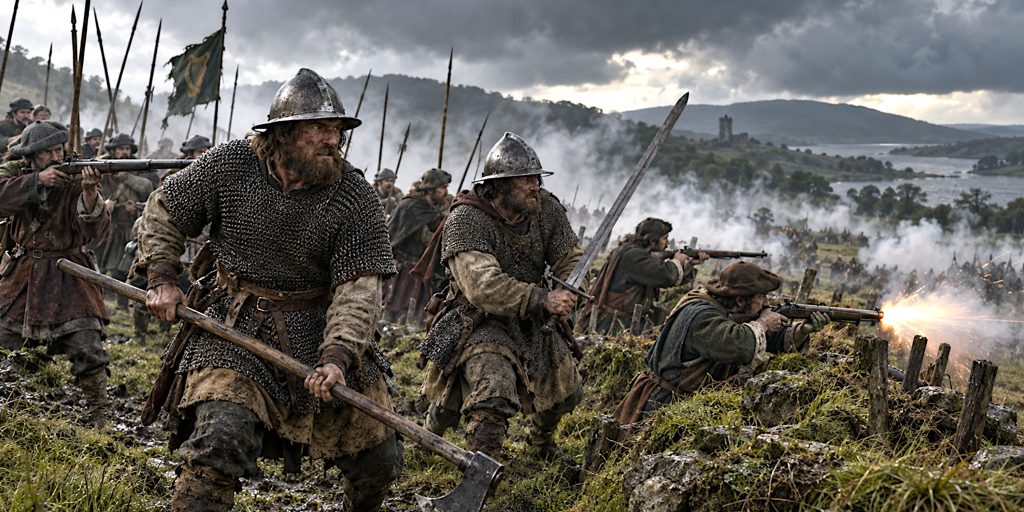
The growing use of firearms did not make gallowglass obsolete overnight. Early handguns were slow to reload, vulnerable in wet weather and dependent upon supporting troops.
Heavy infantry could still defend gunmen from cavalry and close with an enemy whose formation had been disrupted. The gallowglass therefore remained useful during much of the sixteenth century.
The broader military system was changing, however. Successful armies increasingly combined:
- Pike formations
- Arquebusiers and musketeers
- Field fortifications
- Cavalry
- Artillery
- Centralised supply
- Formal training
The gallowglass tradition was based upon hereditary companies maintained by regional lordships. Such forces could fight effectively, but they were expensive and politically independent.
The Tudor state could replace losses, establish garrisons and draw upon wider financial resources. Gaelic lords often struggled to sustain armies during prolonged campaigns, particularly when crops and cattle were deliberately destroyed.
The problem was not that the axe suddenly ceased to hurt. It was that the political and logistical system behind it was being dismantled.
Why the Gallowglass Declined
The decline of the gallowglass accelerated during the late sixteenth century and became decisive after 1600.
Several factors contributed:
- The increasing effectiveness of firearms
- Greater use of pike-and-shot formations
- Tudor military expansion
- The destruction of local food supplies
- The establishment of permanent royal garrisons
- The weakening of Gaelic lordship
- Confiscation and plantation
- The defeat of Hugh O’Neill and his allies
The Nine Years’ War ended in 1603. The Flight of the Earls followed in 1607, removing several leading Gaelic nobles. The Plantation of Ulster further transformed the political and territorial order.
Without the lords, lands and customary obligations that supported them, hereditary gallowglass companies could not continue in their traditional form.
Some descendants entered foreign armies or joined later Irish military formations. Others became landholders, tenants or members of local society. Their surnames survived long after their original military function had disappeared.
Common Myths About the Gallowglass
All Gallowglass Were Scottish Mercenaries
Their earliest origins lay largely in western Scotland and the Hebrides. Many families subsequently settled in Ireland, acquired land and became part of Irish society.
Every Gallowglass Carried a Huge Axe
The sparth axe was characteristic, but gallowglass also used spears, arming swords, ring-pommel swords and two-handed great swords.
Their Two-Handed Sword Was Always a Claymore
Claymore is often used too broadly. The gallowglass employed several types of long sword, including Highland great swords, hand-and-a-half weapons and locally influenced forms.
They Were Berserkers
There is no good evidence that gallowglass fought as uncontrolled berserkers. Their military value rested upon experience, formation and reliability.
They Refused to Use Firearms
Gallowglass served in armies that increasingly used guns, pikes and modern field defences. Some companies adapted, while others retained their traditional close-combat role.
They Disappeared Because Guns Could Pierce Mail
Firearms contributed to their decline, but political conquest and the destruction of the Gaelic lordship system were equally important.
The Legacy of the Irish Gallowglass
The gallowglass left a lasting mark upon Irish warfare, family history and regional identity.
Their arrival strengthened the armies of Gaelic and Gaelicised lords. Their companies provided a professional infantry tradition that remained important from the fourteenth century until the end of the Tudor conquest.
They also reveal how closely Ireland and western Scotland were connected. The North Channel formed part of a shared Gaelic world in which soldiers, poets, nobles and craftsmen moved between territories.
The most interesting part of their history is the speed with which they ceased to be foreigners. Families such as the MacSweeneys, MacSheehys and MacCabes arrived through military service but acquired land, office and local identities. Their members became patrons, constables and lords.
The popular gallowglass remains the towering warrior with his mail shirt and sparth axe. That image survives because it contains a core of truth. Yet the complete picture is richer: a professional soldier bound to his company, a migrant who might become a landholder and a medieval warrior forced to adapt to the gunpowder battlefields of the Renaissance.
Frequently Asked Questions
What does gallowglass mean?
The word comes from the Irish gallóglach, generally translated as “foreign warrior”. The plural is gallóglaigh.
What period did the gallowglass belong to?
Their earliest documented arrival occurred during the thirteenth century. Their established history in Ireland belongs mainly to the Late Medieval and Renaissance era, approximately 1300 to 1600.
Were gallowglass Irish or Scottish?
The earliest families came largely from the Hebrides and western Scotland. Many settled permanently in Ireland and became integrated into Gaelic Irish society.
What weapons did gallowglass use?
Their principal weapons included the sparth axe, spear, two-handed great sword, hand-and-a-half sword and one-handed arming sword. Some later warriors carried Irish ring-pommel swords.
Did every gallowglass use a claymore?
No. Claymore is a modern umbrella term often applied too freely. Gallowglass used several types of large sword, as well as ordinary arming swords, spears and axes.
What armour did they wear?
Mail shirts were common among earlier and wealthier warriors. They also wore padded garments, iron helmets and, in later periods, defensive jacks or other forms of armour.
Did gallowglass fight barefoot?
Some Irish soldiers were depicted barefoot, but the practice was not universal. Clothing and footwear varied according to period, status and circumstances.
Who employed the gallowglass?
They served Gaelic kings, Anglo-Irish magnates, regional lords and occasionally the English Crown. Their loyalties were shaped by hereditary service, landholding and political alliances.
When did the gallowglass disappear?
Their traditional role declined around 1600 as the Tudor conquest destroyed the political and economic system that maintained hereditary military companies.
Selected Sources and Further Reading
- Annals of the Four Masters, University College Cork
- Annals of the Four Masters, Royal Irish Academy
- National Museum of Ireland medieval iron sword
- Richard Stanihurst, Description of Ireland
- Edmund Spenser, A View of the Present State of Ireland
- John Dymmok, A Treatise of Ireland
- John Marsden, Galloglas: Hebridean and West Highland Mercenary Warrior Kindreds in Medieval Ireland
- Seán Duffy, editor, The World of the Galloglass
- Fergus Cannan, Galloglass 1250–1600: Gaelic Mercenary Warrior