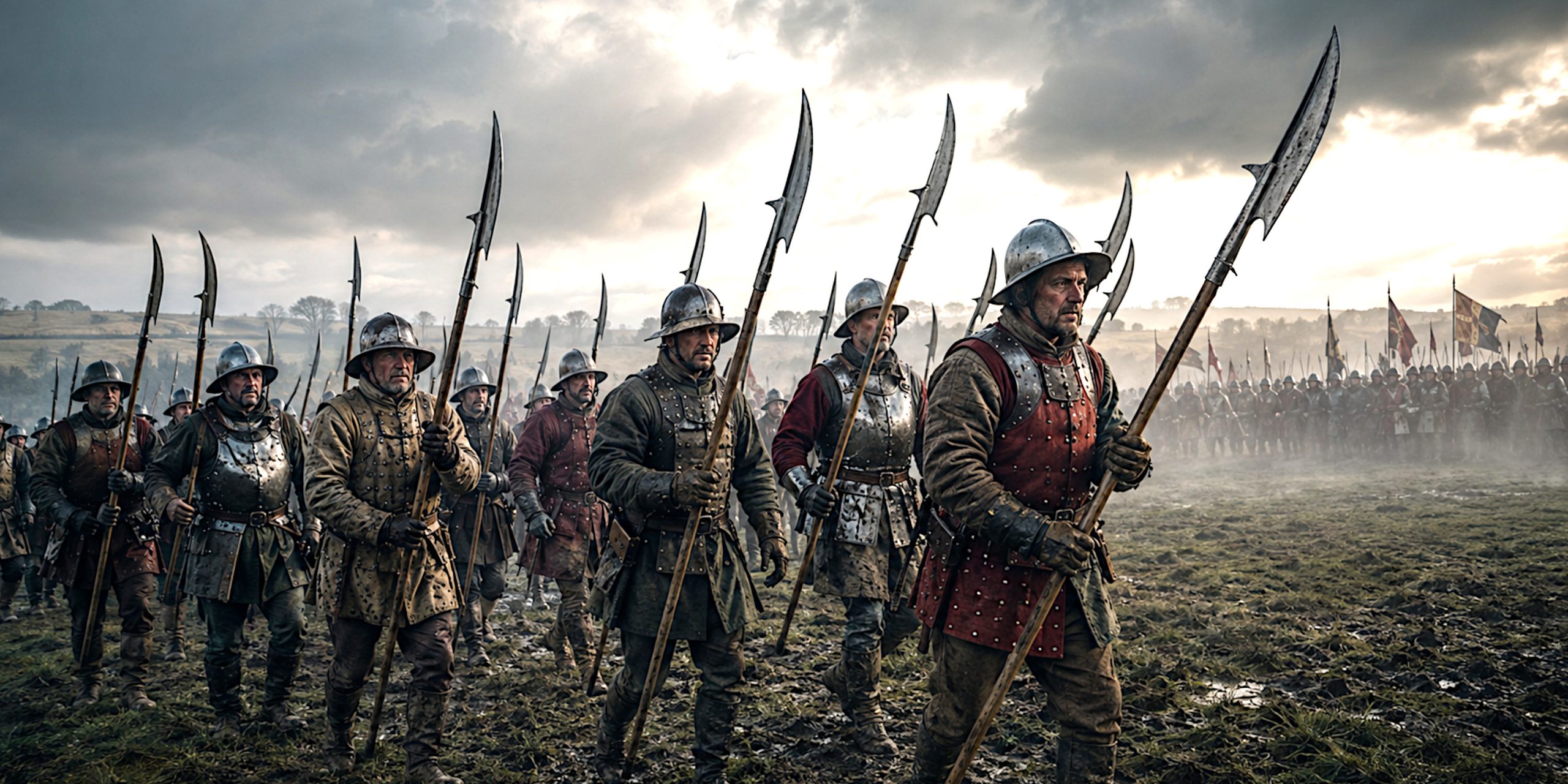
The billman was one of the most characteristic infantry soldiers of late medieval and Tudor England. Armed with a hooked polearm capable of cutting, thrusting and dragging an opponent off balance, billmen supplied the close-combat strength behind England’s better-known archers.
Their history is less tidy than the familiar image suggests. The bill did not suddenly appear as the regulation weapon of a clearly defined troop type. It developed from agricultural cutting tools, entered military inventories gradually and existed in numerous forms. Even the word “billman” can be misleading when applied too freely to fifteenth-century soldiers. Men might be recorded simply as archers, footmen or soldiers, regardless of the weapon placed in their hands.
By the early Tudor period, however, there is no mistaking the bill’s importance. It appeared in arsenals, military regulations, shipboard stores and county musters. At Flodden in 1513, English troops armed with bills helped destroy a Scottish army equipped with long continental pikes. It was a particularly English answer to a familiar military problem: how does an infantryman stop an armoured opponent who would very much like to kill him?
The answer, with admirable directness, was to hook, stab or batter him until he stopped trying.
Billmen at a Glance
| Feature | Typical detail |
|---|---|
| Period of greatest use | Late fifteenth to later sixteenth century |
| Principal regions | England and Wales, with related weapons used elsewhere in Europe |
| Primary weapon | Military bill, forest bill, black bill or related hooked staff weapon |
| Secondary weapons | Arming sword, short sword, hanger, dagger or large knife |
| Armour | Jack, brigandine, mail, sallet, skull-cap, breastplate or munition armour |
| Battlefield role | Close-order infantry, support for archers and shot, defence against cavalry, assault work |
| Typical overall length | Approximately 1.8 to 2.4 metres, depending on type |
| Principal attacks | Thrusting, chopping, hooking, pulling and striking |
| Social background | Retainers, militia, household troops, urban levies and locally raised soldiers |
| Famous engagement | Battle of Flodden, 1513 |
| Decline | Later sixteenth and early seventeenth centuries |
Measurements varied considerably. Surviving weapons include compact fighting bills and longer examples that approach the dimensions of other European polearms. There was no single universal pattern issued across England for the whole of the period.
What Was a Billman?
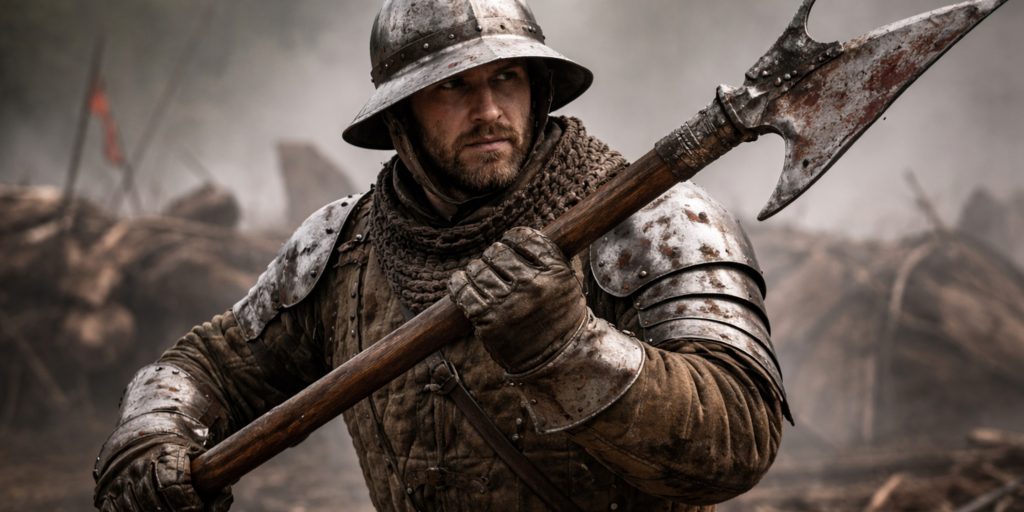
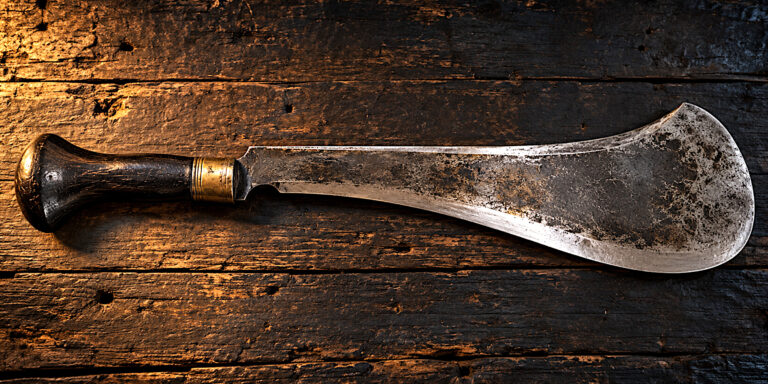
A billman was an infantryman whose principal weapon was a military bill. In its mature form, the bill combined several offensive elements on one pole:
- A forward cutting edge
- A curved hook
- An upper thrusting point
- One or more rear-facing spikes
- A socket attaching the iron head to a wooden haft
The weapon could therefore stab like a short spear, cut with considerable force, catch limbs or equipment and drag an opponent out of position. Its various spikes might also concentrate the force of a blow against armour.
That does not mean every medieval object described as a bill possessed all these features. Some heads were comparatively simple, while others were elaborate constructions bristling with points. Surviving examples are frustratingly diverse, which is precisely why neat modern classifications should be handled carefully.
The conventional pairing of “bill and bow” reflects their complementary functions. Archers disrupted and weakened an enemy at range. Billmen protected them in close combat and provided a body of infantry capable of finishing a fight once formations met.
When Did Billmen Appear?
The bill’s ancestry lay in hooked agricultural tools used for pruning branches, cutting hedges and clearing woodland. Similar implements existed in many parts of Europe, so it would be unwise to imagine that one inspired English farmer fitted his billhook to a long pole and transformed warfare before breakfast.
Military adaptation was gradual. Agricultural blades could certainly be used in violence, but purpose-made war bills developed stronger sockets, thrusting points and additional spikes. The mature weapon was not simply a garden tool carried to war.
Recent study of English military supply records has complicated the usual story. Bills are recorded in the 1450s, but they appear in substantially larger quantities only from the mid-1470s and particularly during the 1480s. Bows and spears remained central to English equipment earlier in the fifteenth century. By the end of the century, bills, pikes and other staff weapons were being supplied in increasing numbers. Research published by the Royal Historical Society indicates that this material change happened before the terminology used to describe soldiers fully caught up with it.
This matters. A man listed as an “archer” in a late fifteenth-century record was not necessarily carrying a bow on the day of battle. Administrative language has always had a talent for surviving after reality has moved on.
Billmen in the Wars of the Roses
Billmen are now firmly associated with the Wars of the Roses, although the surviving records do not always describe armies in the clear categories used by modern reconstructions.
English armies of the period drew upon several overlapping sources:
- Noble and royal household retainers
- Indentured companies
- Town contingents
- County levies
- Garrison soldiers
- Veterans of campaigns in France
- Men raised through local influence and obligation
Some were well-equipped professionals or experienced retainers. Others were temporary soldiers serving for a campaign. Their armour and weaponry reflected wealth, local supply and the resources of the lord who recruited them.
Bills probably became increasingly important during the later stages of the conflict. English armies were accustomed to fighting on foot, even when many of their leaders belonged to the mounted social elite. Once arrows had been exchanged and opposing lines closed, men carrying bills, spears, poleaxes and other staff weapons entered a savage pushing and cutting contest.
Battles such as Barnet, Tewkesbury and Bosworth involved dense close-quarter fighting in which visibility, cohesion and local leadership mattered enormously. A bill was well suited to these conditions. It was shorter and more manoeuvrable than the longest pikes, yet offered greater reach than a sword.
It is still difficult to calculate precise ratios of archers to billmen. Retinues were not assembled according to a single national template, and surviving accounts are incomplete. Claims that every Wars of the Roses army contained a fixed proportion of bows and bills give medieval administration rather more credit than it deserves.
Recruitment and Organisation
Most billmen were not members of a permanent regiment in the modern sense. They were raised for a particular expedition, emergency or period of service.
A magnate might summon retainers through written indentures and local connections. Commissioners could muster men from counties or towns. Equipment might belong to the individual, his employer, a civic armoury or the Crown.
Under the Tudors, the government became increasingly concerned with inspecting military capacity. Muster certificates recorded the number of available men and the weapons or armour they possessed. Bills were attractive militia weapons because they were relatively economical, durable and easier to use at a basic level than the longbow.
Ease of entry should not be confused with complete simplicity. A recruit could learn to deliver a heavy downward blow quite quickly. Fighting effectively in formation, recovering the weapon, controlling its hook and avoiding the man beside him required practice. One imagines that the final lesson was particularly appreciated by the man beside him.
A company could contain several types of soldier:
| Troop type | Principal function |
|---|---|
| Archers | Missile attack and disruption |
| Billmen | Close combat and protection of missile troops |
| Men-at-arms | Heavily armoured fighting and command |
| Pikemen | Formation defence and resistance to cavalry |
| Handgunners or arquebusiers | Gunpowder missile fire |
| Halberdiers | Close combat, guard and ceremonial duties |
The balance changed across the sixteenth century as firearms and pikes became increasingly prominent.
How Billmen Fought
The bill was a weapon of reach, leverage and multiple threats. A trained user could move between thrusts, cuts and hooking actions without changing weapons.
Thrusting
The upper point allowed the billman to attack the face, throat, armpit or gaps in armour. Thrusting also helped keep an opponent beyond sword range.
Cutting
The main blade delivered powerful chopping blows. These could injure an unarmoured limb, damage lighter armour or drive an opponent backwards through sheer impact.
Hooking
The curved blade might catch an arm, leg, shoulder, shield edge, weapon shaft or piece of armour. The billman could then pull the opponent off balance or expose him to another soldier’s attack.
The popular image of billmen routinely hooking knights from horseback is plausible but overused. Horses, riders and harness presented possible targets, yet pulling a large armoured man from a moving horse was neither tidy nor safe. The weapon’s hook was just as useful against infantry.
Striking with the rear spike
Rear projections could deliver concentrated blows and were useful when the principal edge was badly positioned. Some bills were effectively multi-directional weapons.
Fighting in ranks
Billmen probably worked in relatively close formations, supporting one another rather than performing elegant individual techniques. The front ranks could thrust and cut while those behind added pressure or struck over shoulders where space allowed.
Once formations interpenetrated, the weapon’s length became less convenient. This is why swords and daggers remained important. A billman deprived of room needed something he could draw quickly.
Arms and Armour
The billman’s equipment changed between the later fifteenth and later sixteenth centuries. Wealthier retainers might wear substantial protection, while locally raised troops could arrive with little more than a helmet and padded coat.
The Military Bill
The mature English bill usually possessed a broad, forward-facing blade with a curved hook, an upper spike and often a smaller spike projecting from the back. The head was fixed to a wooden haft, commonly ash or another tough timber.
Several names appear in later sources:
- Black bill: A compact, heavy military bill intended for battle
- Brown bill: A term used for certain English bills, although the precise historical distinction remains debated
- Forest bill: A lighter hooked staff weapon associated with woodland work and fighting
- Welsh hook: A related form praised by the English fencing writer George Silver
- Italian bill: The English name for the more elaborate Italian roncone
“Black” may have referred to the finish, construction or established military type rather than colour alone. Attempts to create a rigid modern taxonomy tend to go beyond the surviving evidence.
Swords Used by Billmen
A sword was a secondary weapon rather than the defining equipment of a billman. Directly connecting a particular surviving sword to an ordinary billman is rarely possible, but several types were available during the bill’s period of use.
| Sword type | Period | Likely use |
|---|---|---|
| Arming sword | Fifteenth century | General sidearm with a straight, double-edged blade |
| Bastard sword | Fifteenth and early sixteenth centuries | Larger sidearm, more likely among experienced or wealthier soldiers |
| Falchion | Fifteenth century | Single-edged cutting sword, present but less common than popular imagery suggests |
| Short sword | Fifteenth and sixteenth centuries | Practical close-range reserve weapon |
| Hanger | Sixteenth century | Short, often single-edged military or utility sword |
| Early basket-hilted sword | Sixteenth century | Increasing hand protection for soldiers and seamen |
| Rapier or military side sword | Later sixteenth century | Carried by some soldiers, officers and wealthier individuals |
The ordinary late medieval billman was most plausibly equipped with a short arming sword, hanger, substantial dagger or large fighting knife. A fashionable civilian rapier was less useful inside a compressed infantry struggle, though military side swords with developed guards became increasingly common during the Tudor period.
The wreck of the Mary Rose, lost in 1545, produced swords, daggers, bills and pikes. These objects belonged to the same shipboard fighting environment, although they cannot all be assigned to specific individuals. The Mary Rose Trust records evidence for about 100 bill hafts and describes an inventory listing 150 bills.
Daggers and Knives
Common secondary weapons included:
- Bollock daggers
- Baselards
- Rondel daggers
- Utility knives
- Broad-bladed fighting knives
A dagger could be used after a formation collapsed into grappling distance. Against an armoured opponent, it could be directed into the visor, throat, armpit or other vulnerable opening.
Body Armour
A reasonably equipped billman might wear:
- A padded jack
- A brigandine
- A jack of plates
- Mail at the neck or shoulders
- An iron breastplate
- Munition-quality corselet
- Splints or plate defences for the arms
- Gauntlets, particularly for the forward hand
The forward hand was dangerously exposed on any polearm. Gloves or gauntlets were therefore sensible, though by no means universal.
Helmets
Helmets associated with billmen included:
- Sallets
- Kettles hats
- Skull-caps
- Open burgonets
- Morions
- Cabassets
Late fifteenth-century soldiers are commonly shown in sallets, sometimes with additional throat protection. During the sixteenth century, open burgonets and morions became increasingly visible among infantry.
Strengths of the Billman
The bill was successful because it offered several battlefield functions without requiring an exceptionally complex mechanism.
Versatility
A bill could thrust, cut, hook and pull. This gave its user more attacking choices than a simple spear.
Reach
The weapon allowed a billman to threaten a swordsman before entering the shorter weapon’s effective distance.
Effect against armour
The bill was not a magical plate-cutting device. Its blade was unlikely to cleave good plate armour apart. Its point and spikes could attack openings, while the force of a blow might injure, stun or unbalance an armoured opponent.
Formation utility
Billmen could protect archers and handgunners from sudden attacks. They could also participate in assaults, defensive stands and close infantry engagements.
Relative affordability
A bill required less metal than a full sword and could be produced in quantities for arsenals. Its relationship to familiar working tools may also have made its basic handling less alien to rural recruits.
Weaknesses and Limitations
The bill’s strengths depended heavily upon distance and formation.
Limited against longer pikes
A billman approaching an intact pike formation faced several ranks of points extending beyond his own weapon. He needed terrain, missile support, broken enemy cohesion or an opportunity to get inside the pikes.
Vulnerability to missile fire
Using a two-handed polearm usually prevented the carrying of a large shield. Armour therefore mattered, particularly when facing arrows or firearms.
Awkward in compressed fighting
Hooks and spikes could become entangled with other weapons, clothing or equipment. Once opponents pressed chest to chest, the bill became difficult to employ.
Demands on spacing
A formation of billmen needed enough room to move their weapons without striking comrades. Uneven ground, hedges and narrow streets could interfere with organised use.
Firearms changed the balance
As arquebuses and muskets became more effective and numerous, armies devoted more of their manpower to shot and to pikemen capable of protecting those shooters. The bill remained useful, but its tactical place narrowed.
Billmen at the Battle of Flodden
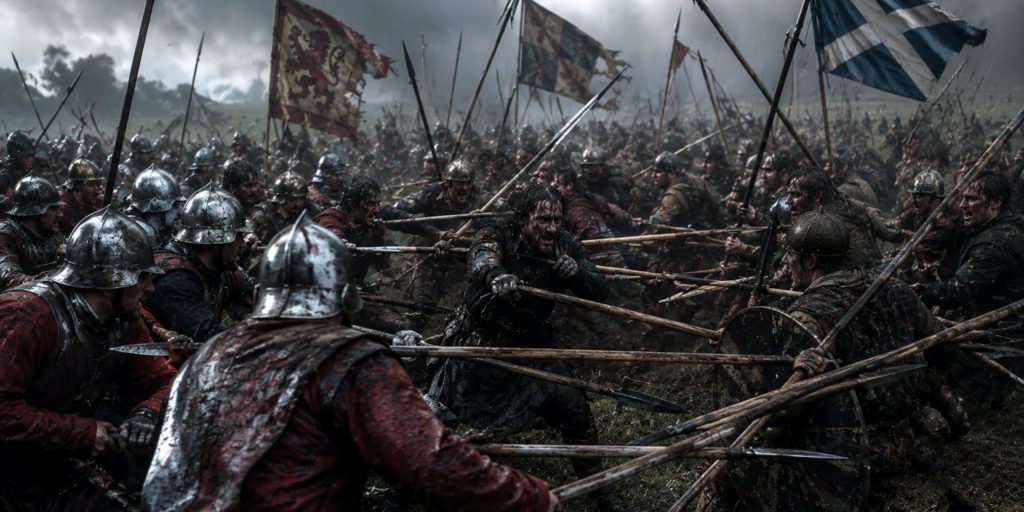
The Battle of Flodden on 9 September 1513 supplied the billman’s most famous victory.
James IV of Scotland invaded northern England while Henry VIII was campaigning in France. The Scottish army had adopted long pikes and methods influenced by continental practice. These weapons could be formidable when used by disciplined troops in good order.
The English army under Thomas Howard, Earl of Surrey, included substantial numbers of archers and billmen. During the battle, Scottish formations descended from their position across difficult and wet ground. Their order deteriorated, and some pike groups became compressed or separated.
Once English billmen passed the points of the Scottish pikes, the Scots’ longer weapons became difficult to recover and redirect. The fighting was extremely close and exceptionally bloody. James IV died near his standard, along with a remarkable portion of the Scottish political and military elite.
Thomas Ruthall, Bishop of Durham, reported that:
“The bills disappointed the Scots of their long spears, on which they relied.”
He also described the Scots as such strong men that some did not fall until struck by several bills. This is valuable evidence, though it should not be turned into a simplistic claim that bills were inherently superior to pikes. The Scottish pike formations had been disrupted by movement, terrain and the circumstances of the advance. An orderly pike block on suitable ground was an altogether less inviting proposition.
Flodden demonstrated what billmen could do once they entered their preferred fighting distance. It did not render the pike obsolete. English armies themselves increasingly adopted pikes afterwards, which is history’s polite way of spoiling an otherwise satisfying theory.
Billmen in Tudor Warfare
During the sixteenth century, billmen remained a substantial part of England’s military system.
They served in:
- Anglo-Scottish campaigns
- Expeditions to France
- Garrison forces
- County militias
- Urban contingents
- Royal ships
- Rebellion suppression
- Household guards
Bills were particularly useful aboard ships. A compact polearm could help defend a deck, repel boarding parties or attack men crossing between vessels. The Mary Rose carried a considerable stock of them alongside bows, pikes, swords and daggers. The museum’s weaponry catalogue identifies bills as anti-boarding weapons and notes their association with longbows and other close-combat arms.
Later Tudor musters show bills continuing beside pikes, bows and firearms. Their persistence was partly practical. England possessed large stocks of them, local armouries understood them, and men could be equipped without the expense and training demands associated with firearms.
Contemporary Views of the Bill
The fencing writer George Silver discussed several forms of bill in Paradoxes of Defence, published in 1599. He wrote:
“The Welch hooke or Forrest bill, hath advantage against all manner of weapons whatsoever.”
This was the judgement of a combative English traditionalist rather than a neutral weapons tester. Silver deeply disliked fashionable Italian fencing and had no shortage of confidence in native arms.
Yet he also distinguished between fighting as an individual and fighting within a massed battle. In crowded combat, he considered the black bill, halberd, battleaxe and two-handed sword especially dangerous because of their weight and force. His comments reveal that contemporaries recognised important differences between bills rather than treating every hooked polearm as the same object. Silver’s original text is preserved through Early English Books Online.
The contemporary reporting from Flodden is even more useful because it describes bills in battle rather than in fencing theory. The sources consistently emphasise the breakdown of the Scottish spear formations and the lethal close fighting that followed.
Billmen Compared with Other Infantry
| Troop type | Main advantage | Main weakness against billmen |
|---|---|---|
| Pikeman | Greater reach and strong formation defence | Vulnerable if the formation was broken or opponents passed the pike points |
| Halberdier | Similar combination of cut, thrust and hook | Differences were often matters of regional form rather than clear superiority |
| Spearman | Simple, quick and comparatively light weapon | Fewer specialised hooking and cutting options |
| Swordsman with shield | Better protection and manoeuvrability at close range | Shorter reach |
| Two-handed swordsman | Powerful cutting and space-clearing attacks | Less capacity to hook and control an opponent |
| Archer | Strong ranged attack | Vulnerable if caught without close-combat support |
| Arquebusier | Armour-piercing missile fire | Slow reload and vulnerable at close range |
The bill and halberd occupied broadly similar tactical territory. Both combined a thrusting point with cutting and hooking elements. The distinction lies mainly in construction and regional tradition. The halberd typically incorporated a recognisable axe blade and beak, while the English bill retained the curved profile inherited from hooked cutting tools.
Archaeology and Surviving Evidence
Archaeology provides strong evidence for the presence and construction of bills, but it is much less capable of identifying precisely how an individual wound was inflicted.
The Mary Rose
The Mary Rose offers the clearest archaeological group of Tudor bills. The ship’s documented stores included 150 bills and 150 pikes. Archaeologists identified the remains of roughly 100 bill hafts, although only a smaller number retained evidence of their iron heads.
Many were found close to longbows and arrow chests in the sterncastle. This supports the close association between bows and bills within Tudor military equipment. It may also reflect shipboard storage arrangements rather than a complete tactical plan frozen at the instant of sinking.
The anaerobic seabed preserved wooden components that would normally decay. Such hafts are particularly valuable because museum collections tend to preserve iron heads while losing the poles that determined the weapon’s true reach and handling.
Battlefield archaeology
Battlefields associated with the Wars of the Roses have produced arrowheads, buckles, coins, fragments of armour and human remains. Towton is especially significant. A mass grave discovered in 1996 contained men with severe sharp-force, penetrating and blunt-force injuries. The associated research became one of the most important studies of medieval battlefield trauma in England.
Some injuries are consistent with heavy edged weapons or polearms. It is rarely possible, however, to state that a particular wound was made by a bill rather than a poleaxe, sword, halberd or another weapon with a comparable edge or point. Bone records the geometry and force of an injury, not the name a quartermaster gave the weapon.
The Towton remains reveal repeated blows to the head and face, including injuries delivered after victims had become vulnerable. They provide a grim corrective to decorative manuscript images of orderly ranks and colourful banners. Close combat was violent, confused and often continued after any formal tactical purpose had ended.
River and urban finds
Individual billheads and related agricultural blades have been recovered from rivers, settlements and later armouries. Context is crucial. A hooked iron blade may be a military weapon, a working tool or an object capable of serving as both.
Purpose-made military bills are more readily identified when they possess reinforced sockets, upper points and combat-oriented rear spikes. Simpler finds are harder to classify confidently.
Did Billmen Wear Uniforms?
Late medieval billmen did not wear standardised uniforms in the modern sense. Retainers might display a lord’s livery colours, badges or coats. Soldiers could also wear crosses or other field signs to distinguish allies during battle.
Clothing varied considerably:
- Woollen doublets and hose
- Livery jackets
- Padded jacks
- Cloaks and coats
- Leather footwear
- Helmets and armour obtained from different sources
Tudor governments gradually became more systematic about the appearance and equipment of contingents, particularly for royal expeditions. Even then, a body of billmen was unlikely to possess perfectly matching armour. Rows of identical polished soldiers belong more comfortably to cinema and miniature cabinets than to an English muster field.
Training and Skill
No complete English manual devoted solely to battlefield bill fighting survives from the billman’s principal period. Later fencing texts, particularly those connected with George Silver, preserve principles for staff weapons and hooks.
Training would have included:
- Maintaining guard and distance
- Delivering controlled thrusts
- Cutting without overextending
- Recovering the weapon after a missed blow
- Hooking limbs or weapons
- Working beside other soldiers
- Advancing and withdrawing in order
- Transitioning to sword or dagger
- Responding to cavalry
- Protecting archers or firearms troops
Experience mattered. The difference between a frightened levy carrying a bill and a seasoned retainer who understood formation fighting would have been considerable. A versatile weapon rewards competence, but it also provides more ways for an incompetent user to create a local emergency.
The Decline of the Billman
Billmen did not disappear immediately when firearms became common. Sixteenth-century armies were mixed forces, and older weapons remained useful alongside new ones.
The principal challenge came from the growing pike-and-shot system. Musketeers and arquebusiers supplied firepower, while long pikes protected them against cavalry and infantry attack. Bills lacked the pike’s defensive reach and could not match the firearm’s distant killing power.
English military reformers increasingly criticised reliance on traditional bows and bills when continental armies were developing disciplined formations of pikes and shot. Yet replacement was slow because:
- Bills were already widely available
- They were relatively inexpensive
- Militia systems changed unevenly
- Firearms required powder, ammunition and maintenance
- Bills remained useful in sieges, ships and confined ground
- Local authorities were reluctant to discard serviceable equipment
By the early seventeenth century, the bill had largely ceased to be a principal battlefield weapon. Related polearms survived among guards, watchmen and ceremonial units. Its hook also continued its quieter agricultural career, apparently relieved to return to hedges.
Myths and Misconceptions
Every Wars of the Roses infantryman was either an archer or billman
English armies included men-at-arms, spearmen, gunners, pioneers and soldiers carrying several kinds of staff weapon. The bow-and-bill division is useful, but too simple when treated as an absolute rule.
Bills easily cut through plate armour
A heavy blow could injure through armour, damage weak components or attack unprotected areas. Good plate was specifically designed to resist edged weapons. Billmen generally exploited openings, leverage and impact rather than slicing breastplates apart.
The bill was merely a farm tool
The ancestry is agricultural, but developed military bills were purpose-made weapons. Their spikes, reinforced construction and sockets went well beyond ordinary hedge cutting.
Billmen always pulled cavalrymen from their horses
They could hook riders, reins, armour or horses, but doing so against moving cavalry was dangerous. The bill’s hooking function was equally relevant against infantry.
Flodden proved bills were better than pikes
Flodden proved that billmen were extremely dangerous after a pike formation lost order. It did not prove that a shorter weapon could casually defeat disciplined pikes under every condition.
Legacy
The billman represents an important stage in the development of English infantry between the longbow armies of the Hundred Years’ War and the pike-and-shot forces of the early modern period.
His reputation rests partly upon Flodden, but the weapon’s wider importance lies in its practicality. The bill was affordable, adaptable and brutally effective at close range. It allowed England to field substantial bodies of infantry capable of defending missile troops and confronting armoured opponents.
The bill also reminds us that military development is rarely a clean procession from primitive to advanced. Agricultural forms, aristocratic weapons, imported pikes and new firearms existed side by side. Soldiers used what governments could supply, what local communities already owned and what experience suggested might keep them alive.
I find the billman more revealing than the fully armoured knight. The knight shows us the expensive summit of medieval warfare. The billman shows us how wars were actually filled out, fought and won: by men standing in wet fields with heavy tools on long wooden poles, trying to maintain formation while the world around them became violently disorganised.
Frequently Asked Questions
What was the main weapon of a billman?
The principal weapon was the military bill, a hooked polearm with a cutting edge, thrusting point and sometimes one or more rear spikes.
Were billmen peasants?
Some came from rural communities, but billmen also included household retainers, townsmen, militia members and experienced campaign soldiers. “Peasant” is too broad to describe their social position accurately.
How long was an English bill?
Many fighting bills were mounted on hafts producing an overall length of roughly 1.8 to 2.4 metres. Both shorter and longer forms existed.
Could a bill penetrate plate armour?
Its spikes might penetrate thinner or weaker areas, but the weapon was not guaranteed to pierce good plate. It was effective for attacking gaps, delivering concussive force and pulling an opponent off balance.
What sword did a billman carry?
Late medieval billmen could carry an arming sword, short sword or occasionally a larger bastard sword. Tudor soldiers also used hangers and swords with more developed hand guards. Daggers and large knives were common alternatives.
What was the difference between a bill and a halberd?
A halberd normally combined a spear point, axe blade and rear beak. A bill retained a more pronounced curved hook derived from agricultural cutting tools. Their battlefield functions overlapped considerably.
Why were English billmen effective at Flodden?
The Scottish pike formations lost cohesion while advancing over difficult ground. English billmen were then able to pass the pike points and use their shorter, more manoeuvrable weapons at close range.
When did billmen disappear?
Their importance declined during the later sixteenth century as pike-and-shot formations became dominant. Bills remained in arsenals and militia stores into the seventeenth century.