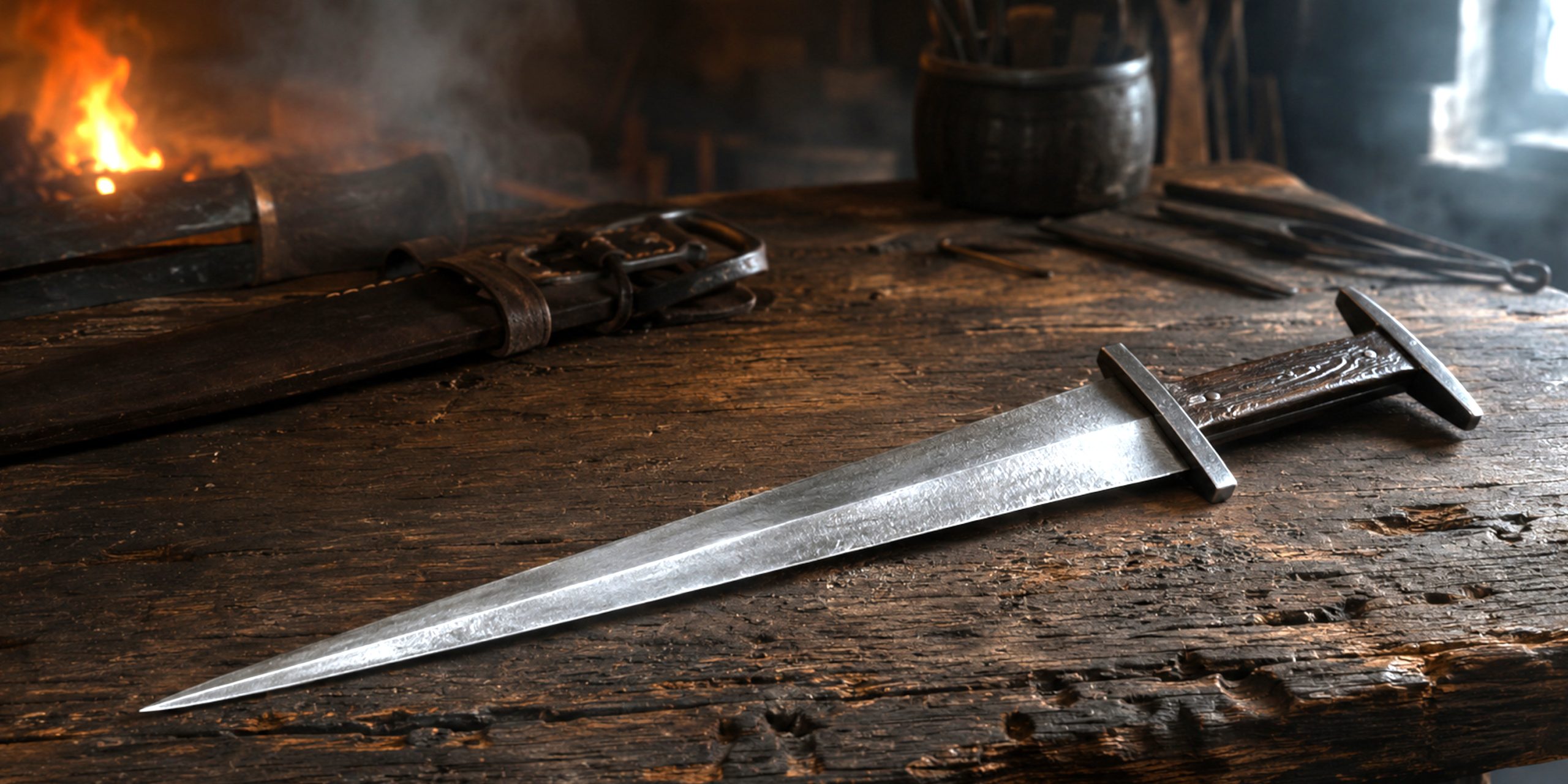
The baselard was a medieval European dagger distinguished by its broad, capital I-shaped hilt. Popular from the late thirteenth century into the fifteenth, it occupied the uncertain ground between dagger and short sword. Some examples were compact civilian sidearms. Others carried blades long enough to make the word “dagger” feel rather modest.
Although closely associated with Switzerland and probably named after Basel, the weapon was never exclusively Swiss. Baselards appeared across Germany, northern Italy, France, England and parts of Central Europe. They were carried by soldiers, merchants, craftsmen and fashionable young men who apparently believed that no outfit was complete without a substantial blade hanging from the belt.
The baselard’s appeal was straightforward. It was recognisable, practical and easier to carry than a sword. Its unusual hilt also gave it a visual identity strong enough to survive in sculpture, manuscript art and archaeological finds.
Baselard Specifications
There was no single regulation pattern. Medieval baselards varied considerably in blade length, construction and quality.
| Feature | Typical form |
|---|---|
| Date | Late thirteenth to late fifteenth century |
| Later development | Swiss daggers of the sixteenth century |
| Place of origin | Probably southern Germany, northern Italy or the Swiss region |
| Overall length | Approximately 30 to 60 cm |
| Blade length | Commonly 20 to 45 cm |
| Weight | Often between 300 and 700 g |
| Blade form | Straight, tapering and usually double-edged |
| Blade section | Diamond, flattened diamond or reinforced with fullers |
| Hilt | Capital I or H-shaped profile |
| Grip material | Wood, horn, bone or ivory |
| Scabbard | Wood covered with leather, sometimes with metal mounts |
| Primary use | Thrusting, cutting and personal defence |
| Users | Soldiers and civilians across several social classes |
Surviving pieces demonstrate the scale of the variation. A fifteenth-century Swiss example at the Metropolitan Museum of Art is 46.7 cm long, with a 31.3 cm blade, and weighs only 340 g. It is a substantial weapon, but far from cumbersome.
The basic identifying feature is not the blade. It is the hilt.
A baselard typically has:
- An upper bar forming the pommel
- A lower bar serving as a simple guard
- A narrow central grip
- A full profile resembling a capital letter I
- Grip scales riveted to a broad iron tang
- A straight blade aligned closely with the centre of the hand
The hilt bars could be straight, slightly curved or divided into projecting arms. On excavated examples, the organic grip material has often disappeared, leaving the iron structure looking rather skeletal.
Where Did the Baselard Come From?
The name is usually connected with the Swiss city of Basel. Medieval spellings include baselard, basilard, basler and related forms. The Metropolitan Museum of Art notes that the name suggests an origin in Basel, while the Royal Armouries places the earliest development more broadly in southern Germany or northern Italy.
That distinction matters. A name can indicate a centre of manufacture, a trading connection or simply the place with which outsiders associated the weapon. It does not prove that the first baselard was forged inside Basel’s walls.
The most cautious conclusion is that the baselard emerged around the Alpine cultural and commercial zone during the late thirteenth century. This region connected Swiss towns, southern German territories and northern Italian centres through trade, warfare and mercenary service. Weapons travelled easily along the same routes as cloth, coin and bad political ideas.
From there, the form spread rapidly across Europe.
History and Evolution
Origins in the Late Thirteenth Century
The baselard developed at a time when daggers were becoming increasingly prominent in European dress and warfare. Earlier medieval knives and daggers often had simple crossguards or relatively plain grips. The baselard’s strongly flared hilt was more distinctive and provided a degree of hand security without requiring a conventional sword guard.
Early examples appear to have been practical weapons with:
- Broad iron tangs
- Riveted grip scales
- Straight double-edged blades
- Modest decoration
- Pronounced upper and lower hilt bars
Some were probably descended from earlier forms of war knife and antenna-hilted dagger. The family tree is not tidy, largely because medieval craftsmen did not trouble themselves with the categories later collectors would devise for them.
Fourteenth-Century Expansion
The fourteenth century was the baselard’s great period of expansion. It appeared in military equipment, civilian dress and contemporary art across much of Europe.
In Italy, the weapon became especially visible in paintings and civic imagery. In England, it was carried as a civilian sidearm as well as a military dagger. Its popularity coincided with the wider social acceptance of wearing bladed weapons in towns.
The baselard could be worn:
- Vertically from the belt
- Suspended at an angle
- Alongside a sword
- As the principal sidearm of a civilian
- With a decorated or plain leather-covered scabbard
Larger examples blurred the boundary between dagger and short sword. This was less confusing to medieval owners than it is to modern cataloguers. If a weapon could be carried conveniently and used effectively, its precise filing category was someone else’s problem.
Civilian Use
The baselard was particularly well suited to civilian life. It was shorter than a sword, visually fashionable and intimidating enough to discourage casual aggression. Unfortunately, it was equally capable of escalating arguments that might otherwise have ended with insults and spilled ale.
Town authorities periodically attempted to restrict the wearing of long knives and daggers. Such regulations show that these weapons were common enough to cause concern. The baselard was therefore not merely a battlefield tool. It formed part of the armed culture of medieval European towns.
Decoration reflected the owner’s wealth. A working man might carry a plain wooden-hilted weapon, while a prosperous merchant or nobleman could commission elaborate materials and fittings.
Military Use
On campaign, the baselard served as a secondary weapon. A soldier might reach for it when:
- His sword was lost or broken
- Fighting became too close for a longer weapon
- He needed to attack gaps in armour
- He was grappling with an opponent
- A wounded enemy had to be subdued
Its point could threaten the armpit, throat, groin, visor and other vulnerable areas. A broad cutting blade also remained useful against unarmoured limbs and lightly protected opponents.
The baselard should not be imagined as a specialised armour-piercing tool comparable with the most rigid rondel daggers. Its battlefield performance depended heavily on the blade. Some were stout thrusting weapons, while others retained better cutting capacity.
Fifteenth-Century Changes
During the fifteenth century, baselards became increasingly varied. Some retained the severe I-shaped profile, while others developed more curved or decorative hilt forms.
In Switzerland, related daggers became symbols of civic and military identity. Wealthier examples could carry engraved fittings, decorated scabbards and accessory knives.
At the same time, the rondel dagger became strongly associated with armoured men-at-arms, while the bollock dagger remained popular across northern Europe. The baselard faced plenty of competition.
The Swiss and Holbein Dagger
By the sixteenth century, the medieval baselard had contributed to the development of the Swiss dagger. This later weapon generally had:
- A shorter or leaf-shaped blade
- A curved I-shaped hilt
- More elaborate metal fittings
- Richly decorated scabbards
- Accessory knives and bodkins on expensive examples
The term “Holbein dagger” is now applied to decorated Swiss daggers whose scabbard designs were influenced by patterns associated with Hans Holbein the Younger. It is best treated as a later related form, not simply another name for every medieval baselard.
A particularly elaborate Swiss dagger set dated to about 1570 survives at the Metropolitan Museum of Art. It includes a sheath, bodkin and small utility knife, with decoration relating to William Tell. By this stage, the weapon had become an expression of status and Swiss identity as much as an emergency means of settling a disagreement.
How Was the Baselard Used?
No surviving fencing system is devoted exclusively to the baselard. Its use must be reconstructed from the weapon’s form, contemporary images and broader evidence for medieval dagger combat.
Likely techniques included:
- Direct thrusts to the torso
- Downward attacks to the neck and shoulders
- Cuts against the face, arms and hands
- Reverse-grip thrusts during grappling
- Close attacks into gaps in armour
- Pommel or hilt strikes
- Use of the free hand to seize the opponent
The broad lower hilt bar helped prevent the hand from sliding onto the blade during a forceful thrust. The upper bar secured the rear of the hand and could assist retention.
The hilt was less protective than the crossguard of a sword. Baselard combat would therefore have depended upon timing, movement and control of the opponent’s weapon arm. Trying to fence with one as though it were a miniature longsword would be a quick route to an educational injury.
Advantages of the Baselard
- Compact but substantial: Larger examples delivered more reach and cutting power than an ordinary knife.
- Useful point: Double-edged tapering blades were capable of effective thrusts.
- Secure grip: The flared upper and lower hilt bars helped contain the hand.
- Easy to carry: It could be worn daily without the inconvenience of a full-length sword.
- Versatile role: The weapon suited civilian defence, military service and close combat.
- Simple construction: Many hilts could be produced from an integral iron framework with riveted scales.
- Social flexibility: Baselards ranged from plain working weapons to elaborately decorated status pieces.
- Strong visual identity: The I-shaped hilt made the weapon immediately recognisable.
Disadvantages of the Baselard
- Limited hand protection: The lower hilt bar was not as effective as a developed crossguard.
- Variable armour performance: Broad cutting blades lacked the concentrated rigidity of specialised rondel daggers.
- Awkward extremes: Very long examples were less convenient than daggers but still lacked the reach of swords.
- Grip comfort: Strongly flared hilts could restrict hand movement, particularly when worn with thick gloves.
- Exposed organic fittings: Wood, horn and ivory scales could split, loosen or decay.
- Close-combat dependence: Against a sword or staff weapon, the baselard’s short reach was a serious handicap.
- No standard design: Quality depended entirely upon the individual blade and maker.
Baselard Compared with Similar Weapons
| Weapon | Typical hilt | Main strength | Main weakness | Difference from the baselard |
|---|---|---|---|---|
| Baselard | Capital I-shaped | Combination of thrusting, cutting and portability | Limited hand protection | Distinctive flared pommel and guard formed as one visual unit |
| Rondel dagger | Circular guard and pommel | Powerful, controlled thrusting | Often poor at cutting | More specialised for armoured combat |
| Bollock dagger | Two-lobed guard | Comfortable grip and civilian utility | Modest hand protection | Usually narrower and less geometrically rigid in appearance |
| Quillon dagger | Small sword-like crossguard | Familiar handling and better lateral protection | Guard can catch on clothing | Resembles a reduced sword more closely |
| Cinquedea | Very broad blade and short hilt | Strong cutting ability and impressive decoration | Heavy and conspicuous | Later Italian weapon with a much broader blade |
| Seax | Usually little or no guard | Strong cutting and utility work | Weak hand protection during thrusts | Primarily single-edged and derived from an older knife tradition |
| Swiss dagger | Curved I-shaped hilt | Status, civic identity and elegant construction | Often more decorative than purely practical | Later development associated strongly with Switzerland |
| Short sword | Conventional guard and pommel | Greater reach and defensive capacity | Harder to carry discreetly | Generally longer and handled more like a sword |
The rondel dagger was usually the better specialised weapon for penetrating weak points in armour. The baselard was the more adaptable civilian sidearm. Compared with the bollock dagger, it offered a firmer visual and structural division between grip, guard and pommel.
Archaeological Evidence
Baselards survive in museum collections, excavated assemblages and river finds. Waterlogged urban sites can preserve wooden hilt components that would normally decay in ordinary soil.
The Royal Armouries records a fifteenth-century example found at Queenhithe in London in 1995. Its surviving wooden hilt has the characteristic divided profile, although one of the upper arms is broken. Finds such as this are valuable because they connect the weapon with ordinary movement and trade along the medieval waterfront, rather than solely with aristocratic armouries.
Other archaeological examples survive only as:
- Corroded blades
- Iron hilt frames
- Isolated pommel or guard elements
- Rivets from missing grip scales
- Scabbard mounts
- Water-worn fragments
River finds require particular caution. Genuine medieval blades are frequently heavily mineralised, shortened or incomplete. A remarkably clean “river-found” baselard with perfect proportions, a complete grip and a romantic story but no excavation record deserves a very cool reception.
The Baselard’s Legacy
The baselard’s most direct legacy lies in the later Swiss dagger. Its I-shaped hilt became closely associated with Swiss soldiers and civic culture, eventually appearing on richly ornamented weapons carried by officers and prosperous militia members.
The form also influenced modern perceptions of the medieval dagger. Unlike the rondel or bollock dagger, the baselard can look almost architectural. Its horizontal hilt bars and straight blade create a severe, balanced outline that remains attractive to armourers and historical artists.
Modern reproductions are used for:
- Living history
- Museum interpretation
- Historical European martial arts practice
- Film and television props
- Private display collections
- Experimental archaeology
The baselard has never achieved the fame of the longsword or the visual notoriety of the cinquedea. That is slightly unfair. It was carried across Europe for generations and sat at the meeting point of fashion, violence and civic identity. Few objects sum up the armed medieval town quite so neatly.
Where to See Surviving Baselards
Display arrangements change, and many collection objects are not permanently exhibited. Check with the institution before making a special journey.
Royal Armouries, Leeds
The Royal Armouries holds several important examples, including:
- A fourteenth-century European baselard with a double-edged blade, medial ridge and diverging fullers
- A fifteenth-century wooden-hilted example found at Queenhithe in London
- A baselard dated to about 1500
- A mid-fifteenth-century Swiss short-sword form
The collection records are especially useful for comparing blade and hilt construction. See the Royal Armouries baselard collection.
Metropolitan Museum of Art, New York
The Met holds a fifteenth-century Swiss basilard measuring 46.7 cm overall. It also preserves later Italian and Swiss examples, including the elaborate dagger set dated to about 1570.
The fifteenth-century weapon is catalogued in the Metropolitan Museum of Art collection.
British Museum, London
The British Museum holds weapons and works of art associated with the baselard tradition, including a possible fragmentary example and graphic material depicting the form. Not every object is normally displayed.
Victoria and Albert Museum, London
The V&A’s arms and armour holdings include medieval and Renaissance daggers relevant to the development of the baselard and Swiss dagger. Online descriptions and attributions should be checked before visiting, as gallery rotations are common.
Swiss Museums
Museums in Basel, Zurich and other Swiss cities hold weapons connected with late medieval urban militias and the development of the Swiss dagger. These collections are particularly valuable for understanding the weapon as an emblem of civic status rather than simply battlefield equipment.
Baselard Collector’s Guide
Authentic medieval baselards are rare. Most pieces advertised online are modern reproductions, nineteenth-century historicist objects, misidentified daggers or assembled weapons containing components of different dates.
Indicative Market Prices
These ranges are broad estimates based on the wider European arms market and publicly documented examples. Condition, provenance, legality and attribution can alter the value dramatically.
| Type | Approximate price |
|---|---|
| Decorative modern replica | £60 to £180 |
| Better production reproduction | £180 to £450 |
| Custom-made historically informed reproduction | £500 to £1,500 |
| Victorian or later historicist baselard | £500 to £2,500 |
| Archaeological medieval fragment | £1,000 to £4,000 |
| Substantially complete medieval example | £5,000 to £15,000 |
| Fine example with documented provenance | £15,000 to £35,000 |
| Exceptional decorated or historically important piece | £35,000 and above |
These are not fixed valuations. A genuine but heavily corroded blade without its hilt may sell for much less than a complete example. Conversely, a decorated weapon with old collection provenance can exceed normal estimates by a considerable margin.
A fourteenth-century baselard offered by Christie’s in 2010 had an iron hilt, ivory grip scales and a double-edged blade with diverging fullers. The catalogue entry is useful as a construction reference, although the public page does not provide a reliable realised price. See the Christie’s medieval baselard catalogue record.
What Determines Value?
The strongest factors are:
- Authenticity: A correctly dated medieval weapon carries a substantial premium.
- Completeness: Original grip scales, scabbard fittings and an unshortened blade are highly desirable.
- Provenance: Old collection records and documented excavation history add confidence.
- Condition: Stable corrosion is preferable to active rust or aggressive modern cleaning.
- Decoration: Engraving, inscriptions and precious-metal fittings can increase value.
- Rarity: Unusual regional forms or unusually complete examples attract specialist interest.
- Restoration: Honest historical repairs may be acceptable, but concealed reconstruction reduces confidence.
- Legal status: Ivory, archaeological material and restricted blades may be difficult to import or sell.
Signs of a Genuine Medieval Baselard
Look for a combination of features rather than one supposedly decisive clue:
- A blade whose corrosion and wear are consistent throughout
- Construction based around a full-width iron tang
- Period-appropriate rivets securing the grip scales
- Natural asymmetry from hand manufacture
- A blade section consistent with documented originals
- Old collection labels or catalogue references
- Provenance predating the modern reproduction market
- An assessment from a recognised arms and armour specialist
Common Warning Signs
- Artificially uniform pitting
- Fresh grinding beneath applied patination
- Modern machine-cut rivets
- Newly carved grip scales presented as original
- A blade and hilt showing different corrosion patterns
- Implausibly perfect symmetry
- An unsupported claim that the weapon was “found in a castle”
- A seller relying upon resemblance to a museum object as proof
- No dimensions, weight or detailed photographs
- A surprisingly low price for an allegedly complete medieval weapon
A certificate issued by the seller is not independent authentication. It may be beautifully printed, which is a different achievement.
Questions to Ask Before Buying
- What is the documented ownership history?
- Has the weapon appeared in a previous auction catalogue?
- Has it been examined by an independent specialist?
- Are the blade, hilt and grip scales believed to belong together?
- Which components have been restored or replaced?
- Is the corrosion stable?
- Are there export restrictions?
- Does the object contain ivory or another controlled material?
- Will the auction house guarantee its stated period?
- What buyer’s premium, tax and shipping charges apply?
Ivory and Restricted Materials
Some surviving baselards have ivory grip scales. Buying or importing them may require documentation, permits or proof that the material predates relevant restrictions. Rules differ between the UK and overseas jurisdictions and can change.
Never assume that describing an object as “medieval” settles the matter. A buyer may still need evidence supporting both its age and the species of ivory used.
Caring for an Antique Baselard
- Keep it in a stable, dry environment
- Avoid touching exposed metal with bare hands
- Do not sharpen or polish the blade
- Never remove corrosion with power tools
- Support the entire weapon when lifting it
- Keep old labels and collection records
- Store the scabbard separately if contact is causing corrosion
- Consult a professional conservator before applying wax or oil
Cleaning can remove archaeological evidence, tool marks and traces of original finish. A brown, pitted surface may appear unattractive, but it can be historically honest. Bright steel produced with a rotary tool is neither.
Buying a Modern Reproduction
A reproduction is the sensible option for handling, costume or martial arts use. Buyers should decide whether they want a display piece, a blunt training weapon or a sharp functional reconstruction.
Look for:
- Historically plausible proportions
- A securely constructed full tang
- Properly fitted wooden or horn scales
- A blade weight below roughly 700 g for most dagger-sized examples
- Rounded edges and a suitable tip for partnered training
- A robust scabbard that does not trap moisture
- Clear information about steel, heat treatment and intended use
Avoid using a sharp reproduction for sparring. A rounded point alone does not make a rigid steel blade safe.
Frequently Asked Questions
Was the baselard a sword or a dagger?
Most examples are classified as daggers, but larger versions approach short-sword dimensions. Medieval terminology was less rigid than modern museum classification.
Was the baselard invented in Basel?
Possibly, but not conclusively. Its name connects it with Basel, while its early development may have taken place across the wider region of Switzerland, southern Germany and northern Italy.
Was it a Swiss weapon?
It became strongly associated with Switzerland, but it was worn across Europe. English, Italian, German and other regional examples are known.
Could a baselard penetrate armour?
It could attack gaps in armour and penetrate some forms of mail or lighter protection under favourable circumstances. It was not designed to punch cleanly through plate armour.
How is a baselard recognised?
Its defining feature is the capital I-shaped hilt, formed by a narrow grip between broad upper and lower bars.
Is a Holbein dagger the same weapon?
Not precisely. The Holbein dagger is a later, decorated type of Swiss dagger related to the baselard tradition. The terms are sometimes used loosely, but they should not be treated as exact synonyms.
Are genuine baselards common at auction?
No. Complete authenticated examples are scarce. Most affordable pieces described as baselards are modern replicas or later historicist interpretations.
Final Takeaway
The baselard was one of medieval Europe’s most successful civilian and military sidearms. Its I-shaped hilt made it distinctive, but its popularity rested on practical qualities. It offered useful reach, a capable point and enough cutting edge to remain versatile, all in a package that could be carried comfortably at the belt.
It was not the finest armour-piercing dagger, nor did it provide the protection of a sword hilt. Its strength lay in compromise. The baselard was large enough to be taken seriously and small enough to accompany its owner through a town gate, assuming the local authorities were feeling tolerant.
For collectors, authentic examples demand expertise and caution. For historians, they offer something more valuable: evidence of a society in which the boundary between clothing, status and personal weaponry was remarkably thin.