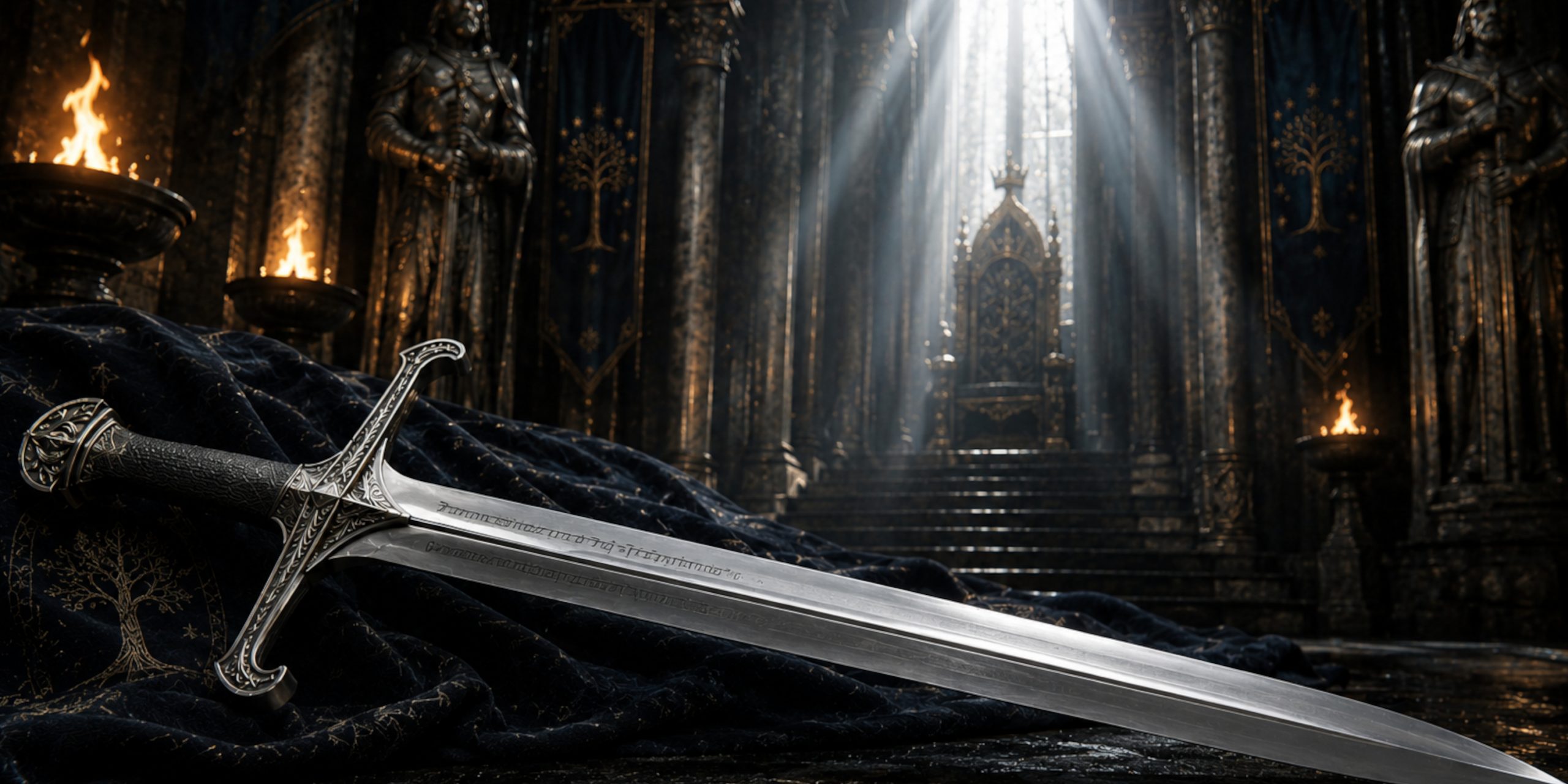
Few swords in fantasy have shaped history quite like Narsil. It is not simply a beautifully forged blade or an heirloom passed through generations. This is a weapon that literally altered the fate of Middle-earth. One king died holding it. Another enemy fell because of it. Then, after centuries lying broken, it became the symbol that united kingdoms once again.
That is quite a career for one sword.
Narsil has become one of the defining weapons in The Lord of the Rings, standing alongside Anduril, Stormbringer and Glamdring as one of fiction’s most recognisable blades. Unlike many legendary weapons, however, its greatest achievement came after it shattered.
Let’s take a closer look at the complete story behind Tolkien’s most famous broken sword.
What Is Narsil?
Narsil was the sword wielded by Elendil the Tall, High King of Arnor and Gondor during the Second Age of Middle-earth.
Forged by the legendary Dwarven smith Telchar of Nogrod during the First Age, it was already an ancient relic long before Elendil carried it into battle against Sauron.
The sword earned everlasting fame during the War of the Last Alliance, when Elendil fell beneath Sauron. As the Dark Lord crushed the king, Narsil broke beneath him. Yet its shattered blade allowed Elendil’s son, Isildur, to cut the One Ring from Sauron’s hand.
Without Narsil, there is a strong argument that Middle-earth would have fallen.
Narsil at a Glance
| Feature | Details |
|---|---|
| Creator | Telchar of Nogrod |
| Race | Dwarf |
| Age | First Age |
| Owner | Elendil |
| Later Bearers | Isildur, the Heirs of Isildur, Aragorn |
| Material | Unknown legendary steel |
| Fate | Broken, later reforged as Andúril |
| Famous Battle | Battle of Dagorlad and Siege of Barad-dûr |
The Meaning Behind the Name
Tolkien rarely chose names at random.
The name Narsil comes from Sindarin.
- Nar means fire.
- Thil or sil relates to white light or moonlight.
Together the name is usually interpreted as Fire and White Light, or Sun and Moon.
This combination reflects one of Tolkien’s recurring themes. Light overcoming darkness.
Even after breaking, Narsil continued to represent hope rather than defeat.
Who Forged Narsil?
The sword was created by Telchar, arguably the greatest Dwarven smith to appear in Tolkien’s legendarium.
Telchar worked in Nogrod, one of the great Dwarven cities of the Blue Mountains during the First Age.
His reputation bordered on mythical.
Among his other famous creations were:
- Angrist, the knife used by Beren to cut a Silmaril from Morgoth’s crown
- The Dragon-helm of Dor-lómin
- Narsil
When one craftsman produces three of the most famous artefacts in Middle-earth, you have to admit he knew his way around a forge.
Narsil Before Elendil
Little is known about the sword’s earliest owners.
By the time it appears in recorded history, Narsil had become one of the treasured heirlooms of Númenor before eventually passing to Elendil.
This reflects an important part of Tolkien’s worldbuilding.
Objects often possess histories stretching back thousands of years. Weapons carry memories, reputations and symbolism that become almost as important as the people who wield them.
Narsil in the Last Alliance
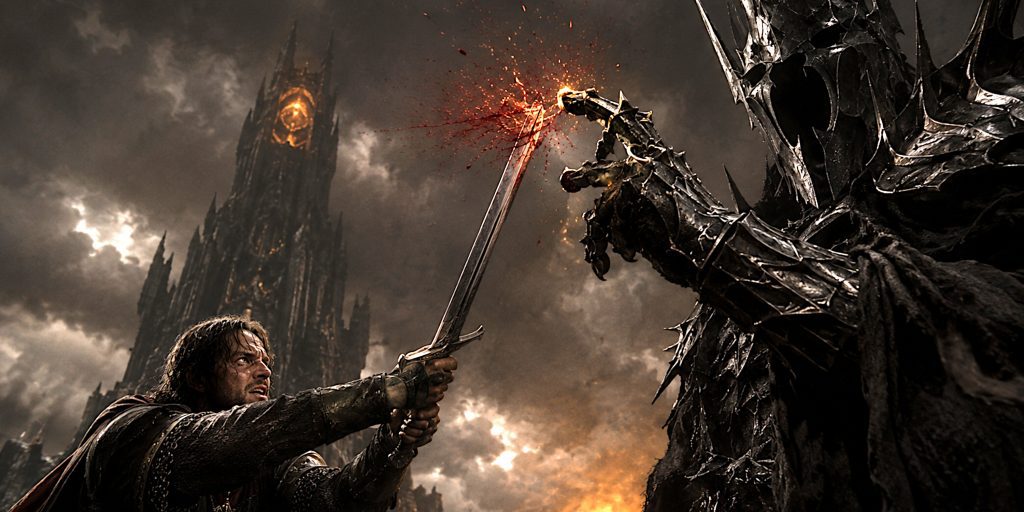
The defining moment in the sword’s history came during the closing years of the Second Age.
Elves and Men united under:
- Elendil
- Gil-galad
Together they marched against Sauron after defeating his armies on the Dagorlad.
The siege of Barad-dûr lasted seven years before the final confrontation.
During the battle:
- Elendil was killed.
- Gil-galad also fell.
- Narsil shattered beneath Elendil.
- Isildur seized the broken hilt.
- He cut the One Ring from Sauron’s hand.
Peter Jackson’s films depict this sequence with enormous dramatic weight, although Tolkien’s original account is more restrained and almost matter of fact.
Even so, its importance cannot be overstated.
The entire story of The Lord of the Rings depends on this single moment.
Why Did Narsil Break?
Tolkien never explains precisely why the sword broke.
Several possibilities exist.
The force of Sauron
The simplest explanation is that Sauron’s immense physical strength crushed Elendil, breaking the blade beneath his body.
Symbolic sacrifice
Many readers see the destruction as symbolic.
The High King’s life ended at precisely the moment the old kingdoms faced collapse. The broken sword mirrors the fractured state of Men.
A necessary transformation
Rather than marking failure, the breaking of Narsil prepared the way for its future rebirth as Andúril.
Tolkien frequently used death and renewal throughout his writing.
The Shards of Narsil
Rather than being discarded, the fragments became treasured relics.
The shards remained with the heirs of Isildur in Rivendell for nearly three thousand years.
This decision speaks volumes about the Dúnedain.
Most people would probably throw away a broken sword after a few centuries.
Instead, they preserved it because it represented hope for a future king.
Its broken state became part of its legend.
Aragorn and the Sword’s Return
When Aragorn’s true identity began to emerge, the time came for Narsil to be reforged.
The Elven smiths of Rivendell remade the ancient blade.
After reforging, it received a new name.
This transformation symbolised far more than repairing damaged steel.
It marked:
- Aragorn accepting his destiny.
- The return of the line of kings.
- Hope rising against Sauron.
- The restoration of ancient authority.
The sword became as much a political symbol as a battlefield weapon.
Narsil Versus Andúril
| Narsil | Andúril |
|---|---|
| Original sword | Reforged sword |
| Wielded by Elendil | Wielded by Aragorn |
| Broken during the Last Alliance | Forged before the War of the Ring |
| Symbol of sacrifice | Symbol of renewal |
| Ancient Númenórean heirloom | Banner of the returning king |
Was Narsil Magical?
Unlike many fantasy weapons, Tolkien rarely describes swords using modern fantasy mechanics.
Narsil does not shoot lightning or produce fireballs.
Its power lies elsewhere.
It possesses:
- Exceptional craftsmanship.
- Extraordinary durability before its breaking.
- Immense symbolic significance.
- Ancient heritage.
- Legendary reputation.
After becoming Andúril, the sword appears to radiate light and inspire those around Aragorn, though Tolkien deliberately leaves much open to interpretation.
Magic in Middle-earth often feels subtle rather than theatrical.
Narsil in Peter Jackson’s Films
The film trilogy introduced Narsil to an entirely new generation.
Several visual details helped cement its legendary status.
These include:
- The broken blade displayed in Rivendell.
- Aragorn quietly contemplating its legacy.
- Elrond presenting the reforged Andúril before the Paths of the Dead.
- The elegant leaf-shaped Elvish engravings.
- The instantly recognisable shattered silhouette.
The films also made the sword itself almost a character.
Even viewers unfamiliar with Tolkien immediately understand its importance.
Differences Between the Books and Films
| Books | Films |
|---|---|
| Aragorn already carries Andúril from the Fellowship’s departure | Aragorn receives it much later |
| Reforging happens before the quest begins | Reforging occurs before the Paths of the Dead |
| The sword is central throughout the journey | Used mainly as a dramatic reveal |
| Greater emphasis on Aragorn’s kingship from the beginning | Aragorn is portrayed as reluctant for much longer |
Both versions work well, although they tell slightly different emotional stories.
Why Narsil Still Matters
Narsil remains compelling because it represents ideas rather than simply combat.
It stands for:
- Legacy.
- Sacrifice.
- Hope.
- Renewal.
- Legitimate leadership.
- The endurance of memory.
Many fantasy swords become famous because they defeat monsters.
Narsil became legendary because it broke at exactly the right moment.
That is a far more interesting story.
Narsil in Popular Culture
The sword has inspired countless fantasy weapons across games, novels and films.
Its influence can be seen in:
- Video game weapons based on broken or reforged blades.
- Replica swords produced for collectors.
- Tabletop roleplaying games.
- Fantasy artwork.
- Cosplay and conventions.
Official licensed replicas have become particularly sought after, with museum-quality versions recreating both the shattered Narsil and the completed Andúril.
Could Narsil Exist in Real History?
From a historical perspective, Narsil reflects several real medieval traditions.
Royal swords often became symbols of legitimacy.
Examples include:
- Excalibur in Arthurian legend.
- Joyeuse, associated with Charlemagne.
- Curtana, the Sword of Mercy used during British coronations.
The concept of preserving a damaged royal weapon is also believable. Archaeologists have recovered ceremonial swords that were deliberately broken before burial, while heirloom weapons often remained treasured long after they became impractical for combat.
Tolkien, a medieval scholar, almost certainly drew upon these traditions when developing Narsil’s story.
Frequently Asked Questions
Who forged Narsil?
The Dwarven master smith Telchar of Nogrod during the First Age.
Who wielded Narsil?
Elendil, followed briefly by Isildur after the sword shattered. Its reforged form, Andúril, was wielded by Aragorn.
Why did Narsil break?
It broke beneath Elendil during his final battle with Sauron.
Is Narsil the same as Andúril?
No. Andúril is the reforged version of Narsil.
Did Narsil have magical powers?
Tolkien never describes explicit magical abilities. Its strength comes from its craftsmanship, history and symbolism.
Takeaway
Narsil occupies a unique place in fantasy literature because it refuses to fit the usual mould of a legendary weapon. Its defining moment is not a glorious victory or an impossible feat of strength. It is the instant it breaks.
That shattered blade becomes the turning point of an age, preserving just enough steel for Isildur to strike at Sauron and just enough hope for Aragorn to reclaim centuries later. In lesser hands, that might feel like a convenient plot device. In Tolkien’s world, it feels inevitable. History is full of broken things that become more meaningful than they ever were intact.
Perhaps that is why Narsil continues to resonate with readers. It reminds us that symbols often outlive the people who create them, and that sometimes the most important chapter in a sword’s story begins only after it has fallen apart.