Few characters in Sekiro: Shadows Die Twice are as quietly heartbreaking as the Sculptor. He spends much of the game hunched over a wooden Buddha, carving statues in silence while handing you prosthetic upgrades with barely a sentence to spare. At first glance he feels like the obligatory mysterious old man. By the end, you realise you’ve been sitting beside one of the game’s greatest tragedies the entire time.
Like most of FromSoftware’s storytelling, the Sculptor’s past is scattered through dialogue, item descriptions and small environmental details. Put those pieces together and an extraordinary story emerges. It is a story about war, regret, violence and the terrifying possibility that no one is ever completely free from their past.
Who Is the Sculptor?
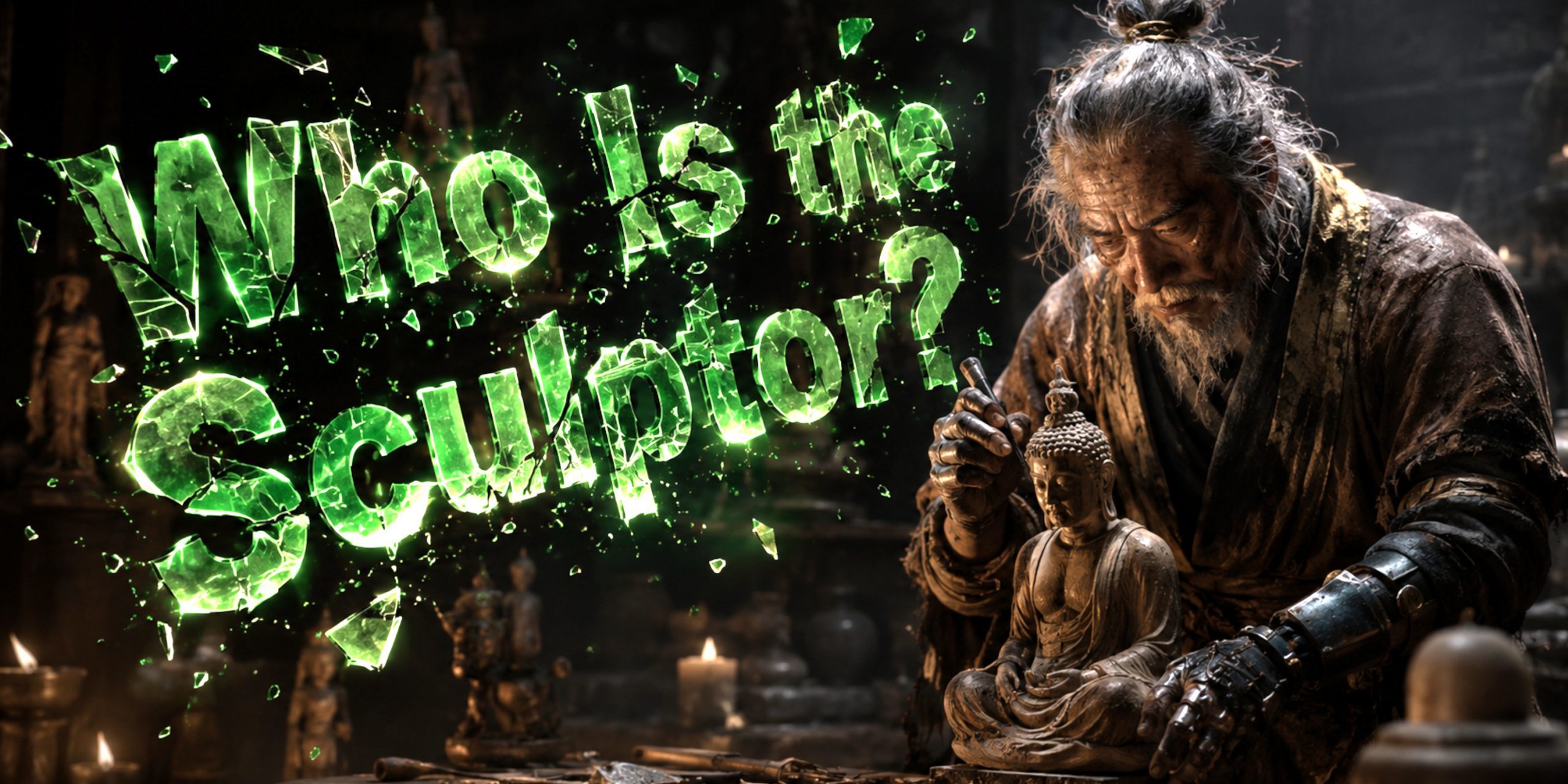
The Sculptor is an elderly shinobi who lives inside the Dilapidated Temple. After Wolf loses his left arm during his duel with Genichiro Ashina, the Sculptor fits him with the Shinobi Prosthetic, effectively giving him a second chance at survival.
Without him, there is no game.
Yet the Sculptor was never simply a craftsman. Long before Wolf arrived, he was one of Ashina’s deadliest warriors.
His real name is never confirmed.
Most characters simply refer to him as “the Sculptor”, although veterans of Ashina knew him by another nickname.
Orangutan.
That single word opens the door to one of Sekiro’s richest pieces of lore.
Orangutan: The Legendary Shinobi
Before becoming a sculptor, Orangutan was a shinobi whose skill bordered on myth.
He travelled alongside another assassin known only as Kingfisher.
Together they hunted dangerous enemies across Japan, operating far beyond Ashina’s borders.
The Finger Whistle Prosthetic Tool reveals much of this forgotten partnership.
Its description explains that the whistle originally belonged to Kingfisher, whose distinctive sound became deeply familiar to Orangutan during their years together.
When Wolf later uses the whistle against the Guardian Ape, something unusual happens.
The beast becomes enraged.
That is because the Guardian Ape had previously killed Kingfisher.
Deep within the Sunken Valley lies evidence suggesting her body remained trapped inside the ape’s lair. The whistle acts as a painful reminder of someone long dead.
It is a wonderfully subtle piece of environmental storytelling. The game never explicitly says, “This is what happened.” Instead it trusts players to connect the dots.
That confidence is part of what makes Sekiro’s lore so rewarding.
Why Did Orangutan Become the Sculptor?
The answer begins with something Sekiro repeatedly warns about.
Bloodlust.
Throughout history, skilled warriors in Sekiro risk falling into a state known as Shura. A person consumed by endless killing gradually loses every trace of humanity until violence becomes their only purpose.
Orangutan came dangerously close.
Emma explains that the Sculptor carries immense hatred within him, something he has fought to suppress for years.
Rather than continuing to kill, he abandoned life as a shinobi entirely.
Instead, he carved countless Buddha statues.
At first this seems strangely peaceful.
In reality it is therapy.
Every statue represents another attempt to quiet the endless violence inside his mind.
Judging by the enormous piles of unfinished Buddhas filling the temple, it is a battle he never truly wins.
Isshin Ashina Saved His Life
One of the most fascinating relationships in Sekiro exists between the Sculptor and Isshin Ashina.
Years before the events of the game, Orangutan lost control and came dangerously close to becoming Shura.
Isshin recognised exactly what was happening.
His solution was brutally effective.
He cut off Orangutan’s left arm.
The amputation interrupted the transformation before it could fully consume him.
At first this seems almost unbelievable.
How could removing an arm stop supernatural corruption?
The answer lies in Sekiro’s symbolism.
The sword arm represents violence itself.
By taking away Orangutan’s ability to fight, Isshin forced him away from the endless cycle of killing that was feeding Shura.
Ironically, the very arm Isshin removed later becomes Wolf’s greatest weapon.
The Shinobi Prosthetic Carries a History of Violence
The prosthetic is not simply a replacement limb.
It carries Orangutan’s legacy.
Nearly every tool Wolf acquires echoes techniques or experiences from the Sculptor’s own life.
The Loaded Axe, Flame Vent, Finger Whistle and countless upgrades all suggest decades spent adapting weapons for survival.
The Sculptor understands exactly how Wolf fights because he once fought the same way.
Sometimes he even sounds uncomfortable while discussing the tools.
It feels less like pride and more like someone remembering mistakes they’d rather forget.
Emma’s Quiet Concern
Emma understands the Sculptor better than almost anyone.
She regularly visits the Dilapidated Temple, checking on his health while carefully watching for signs that Shura is returning.
She has seen the symptoms before.
She knows the hatred never truly disappeared.
Some of the game’s most emotional conversations occur between Emma and the Sculptor because neither says exactly what they mean.
Instead, they circle difficult truths.
She worries.
He avoids the subject.
Players slowly realise why.
The Demon of Hatred Explained
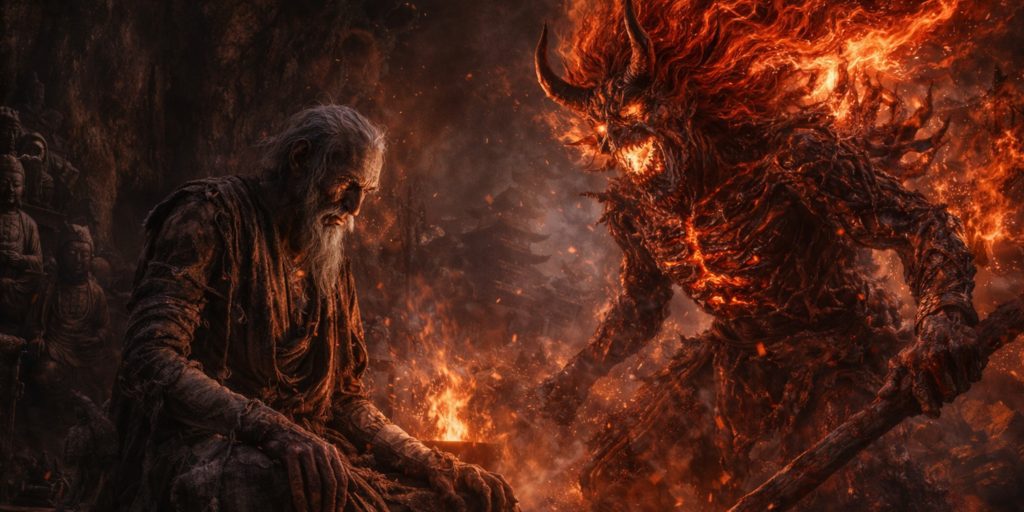
Eventually, the Sculptor loses his battle.
If players follow the standard ending routes, he disappears from the temple late in the game.
Soon afterwards, Ashina is attacked by a monstrous creature known as the Demon of Hatred.
Although it resembles a giant demon rather than a man, clues immediately point towards its true identity.
The prosthetic arm is gone.
The body resembles the Sculptor’s missing limb.
Dialogue from Emma, the Merchant and the Sculptor himself strongly suggests what has happened.
His years of suppressed rage finally erupt.
Rather than becoming the traditional sword wielding Shura feared throughout Sekiro’s history, his hatred manifests as something even more monstrous.
The result is one of the game’s saddest boss fights.
Wolf is not defeating a villain.
He is putting an old friend out of his misery.
Why Doesn’t the Sculptor Become a Traditional Shura?
This question has fascinated players for years.
The game deliberately avoids giving a completely definitive answer, but several possibilities stand out.
The Sculptor spent decades resisting his violent instincts through meditation and sculpture.
Those years changed the nature of his corruption.
Instead of becoming another sword obsessed killer, all that buried hatred exploded outward into a massive supernatural manifestation.
His transformation reflects who he had become.
The violence was no longer focused.
It had become pure destruction.
This makes the Demon of Hatred feel distinct from the Shura ending, where Wolf becomes a calculating executioner.
Both are consumed by violence.
They simply express it differently.
The Sculptor’s Connection to Wolf
Wolf and the Sculptor mirror each other throughout the game.
| The Sculptor | Wolf |
|---|---|
| Veteran shinobi | Young shinobi |
| Lost left arm | Loses left arm |
| Consumed by killing | Risks becoming Shura |
| Given another chance | Given another chance |
| Guided by regret | Guided by loyalty |
The parallels are impossible to ignore.
The Sculptor represents Wolf’s possible future.
Every warning about hatred is really a warning directed at the player.
Will Wolf remain loyal while preserving his humanity?
Or will he become another monster?
It depends entirely on the ending players pursue.
What Does the Buddha Symbolise?
The endless Buddha statues scattered around the Dilapidated Temple are among Sekiro’s most overlooked visual details.
Each carving represents an attempt at inner peace.
The Sculptor is not producing art for decoration.
He is desperately trying to calm a mind shaped by decades of murder.
There is something painfully human about this.
Many people deal with grief or trauma through repetitive hobbies.
Some paint.
Some write.
Some build model kits they swear they’ll finish one day.
The Sculptor carves Buddhas until his hands can barely continue.
Sadly, no amount of carving can erase everything he has done.
Why the Sculptor Is One of FromSoftware’s Best Characters
The brilliance of the Sculptor lies in how little he actually says.
He never delivers a dramatic confession.
There is no lengthy cinematic revealing his tragic backstory.
Players uncover his history gradually through conversations, item descriptions and careful observation.
That makes the final revelation far more powerful.
Looking back, the clues were sitting in plain sight all along.
His missing arm.
Emma’s concern.
Isshin’s cryptic comments.
The piles of Buddha statues.
The melancholy in every conversation.
They all point towards the same conclusion.
This was never the story of a wise old craftsman.
It was the story of a man trying, and ultimately failing, to outrun the person he used to be.
Frequently Asked Questions
What was the Sculptor’s real name?
His true name is never revealed. Before becoming the Sculptor he was widely known by the nickname Orangutan.
Did Isshin really cut off the Sculptor’s arm?
Yes. Isshin severed Orangutan’s left arm after recognising that he was close to becoming Shura.
Is the Sculptor the Demon of Hatred?
Yes. The game strongly confirms that the Demon of Hatred is the Sculptor after he finally succumbs to the hatred he spent decades suppressing.
Who was Kingfisher?
Kingfisher was Orangutan’s former shinobi partner. She was killed by the Guardian Ape, and her Finger Whistle later becomes one of Wolf’s Prosthetic Tools.
Why does the Sculptor carve Buddha statues?
He carves Buddha statues to calm the violent impulses within himself and resist becoming Shura. The sculptures serve as meditation and an attempt at spiritual redemption.