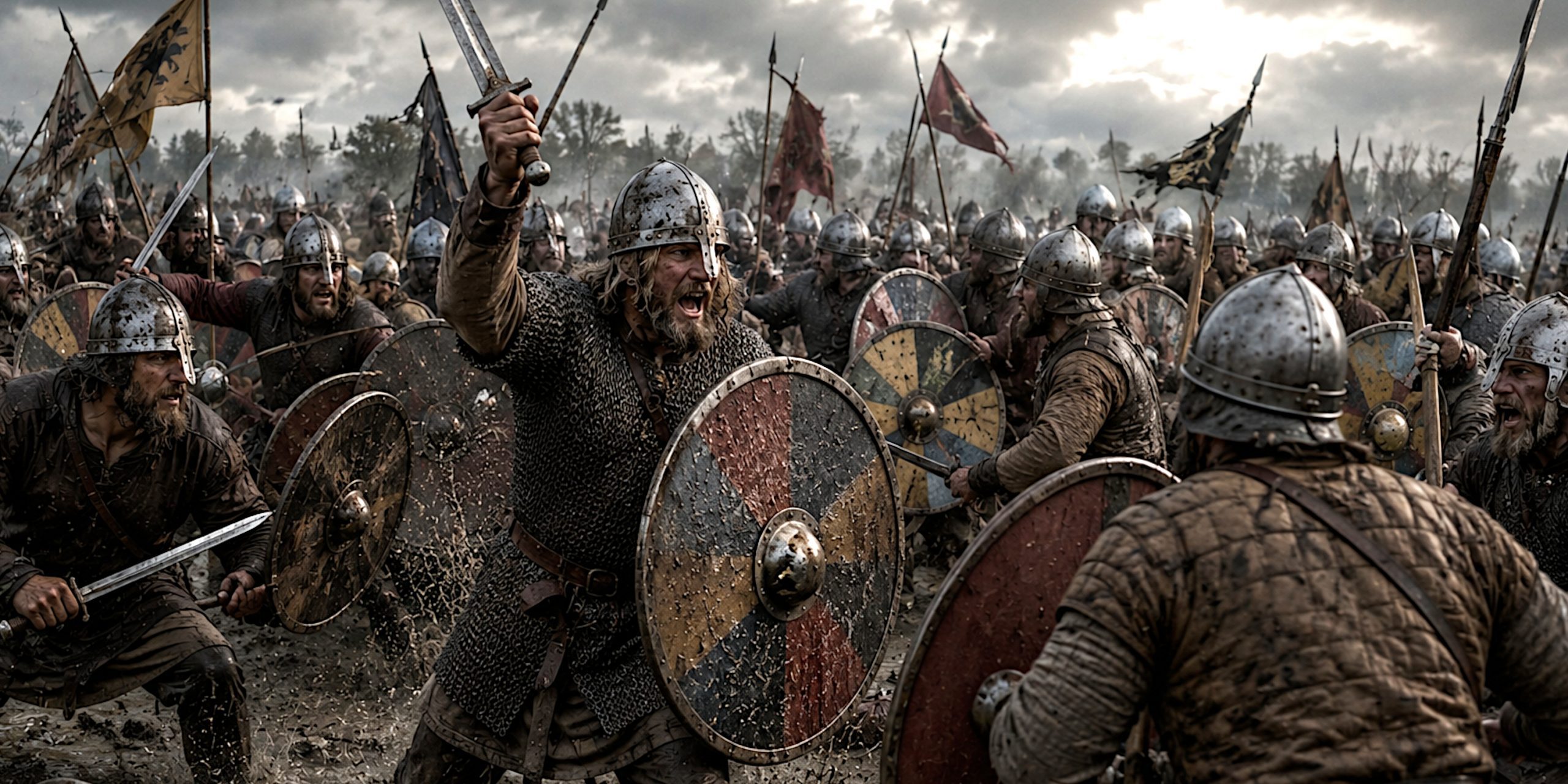
The Carolingian Empire is often remembered for its cavalry. Ask someone to picture Charlemagne’s army and they are likely to imagine mailed horsemen thundering across Europe beneath fluttering banners. It is an appealing image, but only part of the story.
Empires are rarely built by cavalry alone. The Carolingian infantry formed the indispensable foundation of Frankish military power during the eighth and ninth centuries. They stormed fortifications, defended camps, crossed rivers, marched hundreds of miles and fought in dense formations against Saxons, Lombards, Avars and Vikings. Without disciplined foot soldiers, the victories of Charlemagne would have looked rather less impressive.
The surviving evidence is frustratingly incomplete. Carolingian manuscripts, legal texts, capitularies, chronicles and archaeology offer valuable insights, although they rarely describe the ordinary soldier in detail. Even so, modern scholarship allows us to reconstruct a remarkably vivid picture of these infantrymen and the world in which they fought.
Who Were the Carolingian Infantry?
Carolingian infantry were not a permanent standing army. Instead, they were raised through the Frankish military obligation, with free landowners expected to provide military service when summoned.
The army included:
- Wealthier freemen capable of purchasing quality equipment
- Lesser landowners serving alongside local lords
- Retainers of nobles and bishops
- Professional household warriors
- Militia drawn from conquered territories
- Allied contingents from across the empire
The exact composition varied from campaign to campaign. Charlemagne’s wars stretched from northern Germany to northern Spain and from Italy to Hungary, meaning local recruitment often influenced the character of individual armies.
Despite the fame of Carolingian cavalry, infantry probably formed the numerical majority in many expeditions.
The Military Reforms of Charlemagne
One of Charlemagne’s greatest achievements was creating a more organised military system rather than inventing entirely new forms of warfare.
Royal legislation sought to ensure soldiers arrived properly equipped. Military obligations became more clearly defined, while wealthier landowners were expected to provide increasingly sophisticated arms.
The emperor also invested heavily in logistics.
Campaigns required:
- Supply wagons
- Bridges
- River transport
- Engineers
- Fortifications
- Scouts
- Armourers
Good logistics rarely inspire paintings, but armies tend to appreciate food more than artistic recognition.
Recruitment and Military Obligation
Military service remained closely tied to land ownership.
Capitularies describe how those possessing sufficient wealth had to appear armed. Smaller landowners sometimes combined their resources to equip a single soldier, ensuring the burden of service was shared.
This system produced infantry with varying levels of equipment.
Some marched with mail, helmets and fine swords.
Others carried little beyond a spear and shield.
The result was a flexible force containing both experienced professional warriors and more modestly equipped levies.
Training and Discipline
There is little direct evidence for formal training programmes, yet Carolingian armies repeatedly demonstrated considerable discipline.
Campaigns often involved:
- Long-distance marches
- Coordinated sieges
- River crossings
- Defensive camps
- Multi-column advances
Such operations required organisation that extended well beyond simply gathering armed farmers.
Household retainers probably trained regularly, while experienced veterans passed knowledge to newer recruits during campaigns.
Battlefield Tactics
Carolingian infantry were versatile.
Rather than relying upon a single tactical doctrine, commanders adapted according to terrain and the enemy.
Common battlefield roles included:
| Infantry Role | Purpose |
|---|---|
| Shield wall | Defensive fighting against frontal attacks |
| Spearmen | Holding enemy formations |
| Missile troops | Supporting advances with javelins or bows |
| Siege troops | Assaulting walls and defending siege works |
| Camp guards | Protecting supplies and headquarters |
Against Saxon forces, infantry frequently fought in woodland and broken terrain where cavalry enjoyed fewer advantages.
During sieges in Italy, infantry became the primary assault troops.
Against Viking raids, rapid infantry mobilisation proved essential before mounted forces could assemble.
Arms and Armour
Equipment reflected wealth, status and regional traditions.
The Carolingian Empire inherited both Roman and Germanic influences while also absorbing ideas from neighbouring cultures.
Swords
Not every infantryman owned a sword. They remained expensive weapons associated with prestige as much as battlefield utility.
Known sword types include:
Carolingian Sword
The iconic weapon of the period.
Characteristics included:
- Straight double edged blade
- Broad fuller
- Length between 75 and 90 cm
- Brazil nut or trilobate pommel
- Excellent balance for cutting and thrusting
These swords evolved directly from late Migration Period weapons and became one of Europe’s defining medieval sword forms.
Ulfberht Swords
Among the finest weapons of the age were the famous Ulfberht blades.
Marked with the inscription +VLFBERH+T or similar variations, these swords used exceptionally high-quality steel that often surpassed contemporary European production.
Although relatively rare, they almost certainly appeared among elite Carolingian warriors.
Pattern-Welded Swords
Earlier pattern welded blades continued in use during the early Carolingian period before gradually giving way to more homogeneous steel construction.
Many remained treasured heirlooms passed between generations.
Spears
The spear remained the primary infantry weapon.
Advantages included:
- Low cost
- Long reach
- Effective formation fighting
- Versatility for throwing or thrusting
Most soldiers probably relied on the spear as their principal weapon.
Seaxes
Many infantry carried the seax, a single edged fighting knife that doubled as an everyday utility tool.
Larger examples could function as secondary weapons during close combat.
Axes
Axes appeared throughout the empire.
Although never replacing the spear, they offered powerful chopping capability and proved effective against shields and lighter armour.
Bows and Javelins
Missile troops accompanied many armies.
Archery played a supporting rather than decisive role, while javelins remained common among infantry skirmishers.
Shields
The shield was arguably more important than the sword.
Most examples were:
- Round or oval
- Wooden construction
- Leather covered
- Iron boss at the centre
Large shields allowed infantry formations to withstand missile attacks and cavalry charges more effectively.
Helmets
Helmet ownership reflected wealth.
Examples include:
- Spangenhelm constructions
- Segmented iron helmets
- Conical helmets with nasal guards during the later period
Many ordinary infantry probably fought bareheaded or with padded caps.
Mail Armour
Mail represented the gold standard of Carolingian protection.
It consisted of thousands of interlinked iron rings forming a flexible protective garment.
Only wealthier soldiers and professional retainers could usually afford mail.
Most infantry probably relied upon:
- Quilted garments
- Thick woollen clothing
- Leather equipment
- Shields for protection
Siege Warfare
One area where infantry excelled was siege warfare.
Charlemagne captured numerous fortified settlements through patient engineering rather than dramatic assaults.
Infantry constructed:
- Siege ramps
- Earthworks
- Wooden towers
- Defensive palisades
- Ditches
Success often depended more upon engineering than individual heroics.
The most dangerous opponent was usually hunger rather than the enemy commander.
Campaigns Across Europe
Carolingian infantry served in nearly every major campaign of the empire.
Important theatres included:
- Saxon Wars
- Lombard conquest of Italy
- Spanish March expeditions
- Avar campaigns in Central Europe
- Breton frontier operations
- Viking defence during the ninth century
Different environments demanded different approaches.
Mountain passes in Italy bore little resemblance to Saxon forests or the plains of Hungary.
Archaeology
Archaeological discoveries continue to refine our understanding of Carolingian infantry.
Important evidence comes from:
Weapon Burials
Although Christian burial customs increasingly discouraged grave goods, earlier Carolingian cemeteries still preserve swords, spears, shields and seaxes.
These reveal changing weapon styles throughout the eighth and ninth centuries.
Fortifications
Excavations across Germany, France and the Low Countries have uncovered:
- Defensive earthworks
- Timber palisades
- Watchtowers
- Military camps
These sites demonstrate the logistical sophistication of Carolingian campaigning.
The Avar Treasure
The enormous wealth seized following Charlemagne’s victories over the Avars survives partly through archaeological finds.
These discoveries illustrate both the scale of Frankish success and the resources available to reward loyal warriors.
Sword Discoveries
Numerous Carolingian swords recovered from rivers, graves and settlements reveal remarkable craftsmanship.
Metallurgical analysis has shown increasingly advanced steel production during this period.
Some blades were likely produced in the Rhineland before being traded across Europe.
Contemporary Sources
Our understanding relies upon several important contemporary writers.
Einhard, Charlemagne’s biographer, admired the emperor’s military ability.
He wrote:
“He undertook many wars with the greatest wisdom and success.”
Although more interested in Charlemagne than ordinary infantry, Einhard provides valuable context for military organisation.
The Royal Frankish Annals regularly describe campaigns and note the enormous scale of military expeditions.
The Capitulare Missorum and other capitularies outline military obligations and equipment requirements, offering some of the clearest evidence for how Carolingian armies were expected to function.
Notker the Stammerer, writing slightly later, preserves colourful anecdotes illustrating Frankish military culture, although historians approach many of them with appropriate caution.
Strengths of Carolingian Infantry
Several factors made Carolingian infantry formidable.
- Strong logistical support
- Flexible tactical deployment
- High quality leadership
- Effective siege capability
- Integration with cavalry operations
- Increasingly standardised military obligations
Rather than existing independently, infantry complemented cavalry remarkably well.
Each arm strengthened the other.
Weaknesses
The system also possessed limitations.
- Variable equipment quality
- Seasonal recruitment
- Dependence upon landholding obligations
- Limited permanent professional forces
- Slow mobilisation compared with later medieval armies
As Viking raids increased during the ninth century, these weaknesses became increasingly apparent.
Fast moving raiders rarely waited politely while feudal obligations were organised.
Legacy
Carolingian infantry occupied a pivotal place between Late Antiquity and the High Middle Ages.
Their equipment influenced later Norman, German and French armies.
Their military organisation shaped feudal obligations across western Europe.
Their swords became the classic medieval knightly weapon.
Their campaigns reshaped the political map of Europe for centuries.
Modern popular culture tends to overlook them in favour of mounted knights, yet the Carolingian Empire rested firmly upon the shoulders of men who marched rather than rode. They built bridges, stormed walls, guarded camps and endured long campaigns in every imaginable weather. They were not glamorous, but history has a habit of depending upon people willing to carry heavy shields through muddy fields.
As any historian eventually learns, the infantry usually arrive first, leave last and receive only half the credit.
Frequently Asked Questions
Did Carolingian infantry use swords?
Yes. Wealthier infantry carried high-quality Carolingian swords, including prestigious Ulfberht blades. Most ordinary soldiers relied primarily upon spears.
Were Carolingian infantry professional soldiers?
Some household retainers and elite warriors served professionally, but much of the army consisted of free landowners fulfilling military obligations.
Did infantry fight alongside cavalry?
Yes. Carolingian armies integrated infantry and cavalry, with each serving complementary battlefield roles.
What armour did they wear?
Elite infantry wore iron mail and helmets. Most soldiers relied on shields, padded clothing and simpler protective equipment.
What was their most important weapon?
The spear was the most common and effective infantry weapon throughout the Carolingian period.