Sparta is remembered for disciplined warriors, scarlet cloaks and boys raised through the unforgiving agoge. Yet behind every celebrated Spartan hoplite stood an invisible workforce whose labour made that military society possible. Without the Helots, Sparta as we know it could never have existed.
The Helots were neither ordinary slaves nor free citizens. They occupied a peculiar and deeply uncomfortable position somewhere between conquered subjects and state-owned labourers. Their lives were defined by coercion, surveillance and periodic violence, yet they also farmed the land, accompanied armies on campaign and occasionally earned their freedom through military service.
As a historian, I often find that discussions of Sparta become oddly romantic. Popular culture has gifted us chiselled warriors delivering dramatic speeches while conveniently forgetting who harvested the barley, tended the vineyards and kept the entire Spartan system functioning. The Helots deserve far more attention because, uncomfortable though it may be, their story explains Sparta far better than another retelling of Thermopylae.
Who Were the Helots?
The Helots were the unfree agricultural population of ancient Sparta. Most originated from the neighbouring regions of Messenia and Laconia, territories conquered during Sparta’s expansion between the eighth and seventh centuries BC.
Unlike chattel slaves who could be bought and sold individually throughout the Greek world, Helots belonged to the Spartan state. Individual Spartan citizens were allocated Helot families to work their estates, but technically they remained state property.
This distinction mattered.
Helots could not simply be traded in distant markets like livestock, yet they enjoyed remarkably few rights. They cultivated farmland, surrendered a substantial proportion of their produce to Spartan landowners and remained permanently vulnerable to state violence.
The Greek writer Tyrtaeus celebrated Sparta’s conquest of Messenia:
“After nineteen years they left their rich fields and fled.”
The words celebrate victory. Behind them lies the beginning of centuries of forced servitude.
Origins of the Helots
Most scholars agree that the majority of Helots descended from the conquered Messenians following the First and Second Messenian Wars.
The conquest transformed an entire regional population into hereditary labourers.
Key developments included:
| Date | Event |
|---|---|
| c. 740 to 720 BC | First Messenian War begins |
| c. 685 to 668 BC | Second Messenian War consolidates Spartan control |
| Sixth century BC | Helot system fully established |
| Fifth century BC | Helot population greatly exceeds Spartan citizens |
By the Classical period, Helots probably outnumbered full Spartan citizens by at least seven to one, with some ancient estimates suggesting an even greater disparity.
Such demographics permanently shaped Spartan politics.
Life Under Spartan Rule
Daily life revolved around agriculture.
Helots cultivated:
- Wheat
- Barley
- Grapes
- Olives
- Figs
- Livestock
Each year they delivered fixed agricultural quotas to their assigned Spartan masters while keeping enough produce for their own survival.
Unlike many slaves elsewhere in Greece, Helots generally lived with their families and occupied villages rather than barracks or urban households.
This created relatively stable communities that preserved aspects of local identity despite generations of subjugation.
Their existence, however, remained precarious.
Spartan citizens viewed Helots as a permanent security threat. Any sign of rebellion could provoke brutal reprisals.
Why Sparta Needed the Helots
Spartan citizens famously devoted themselves to military training and public life.
Someone else therefore had to perform almost every form of productive labour.
Helots supplied:
- Agricultural production
- Food for Spartan households
- Economic surplus
- Military logistical support
- Domestic labour
- Skilled craftsmanship in some cases
The famous Spartan army marched because Helots planted the crops.
It is an uncomfortable truth that Sparta’s celebrated equality among citizens depended almost entirely upon the inequality imposed on everyone else.
The Krypteia and State Terror
One of Sparta’s darkest institutions was the Krypteia.
Ancient writers describe selected young Spartans roaming the countryside, killing Helots considered dangerous or influential.
Plutarch records:
“They killed any Helots whom they caught.”
According to several ancient sources, Spartan magistrates annually declared war upon the Helot population.
This legal fiction allowed Helots to be killed without religious pollution.
Modern historians continue debating exactly how frequently these killings occurred and whether later writers exaggerated aspects of the Krypteia.
Nevertheless, few dispute that organised intimidation formed an important part of Spartan rule.
Helot Revolts
Despite overwhelming Spartan control, Helots repeatedly resisted.
The Great Messenian Revolts
Several uprisings shook Sparta throughout its history.
The most dangerous followed the devastating earthquake of 464 BC.
Thousands of Helots seized the opportunity to rebel while Sparta struggled to recover.
Many occupied Mount Ithome, forcing Sparta into a prolonged conflict lasting several years.
The rebellion proved so serious that Sparta requested military assistance from other Greek states, including Athens.
The Athenians arrived.
The Spartans politely thanked them.
Then promptly sent them home because they no longer trusted them.
Diplomacy has rarely managed to sound quite so awkward.
Helots in the Spartan Army
Although denied citizenship, Helots frequently accompanied Spartan armies.
They served as:
- Equipment bearers
- Camp servants
- Rowers
- Labourers
- Light infantry
- Emergency hoplites
As Spartan manpower declined during the fourth century BC, Helots increasingly fought directly.
Those granted freedom for distinguished military service became known as Neodamodeis.
While still socially inferior, they occupied a position above ordinary Helots.
Arms and Armour
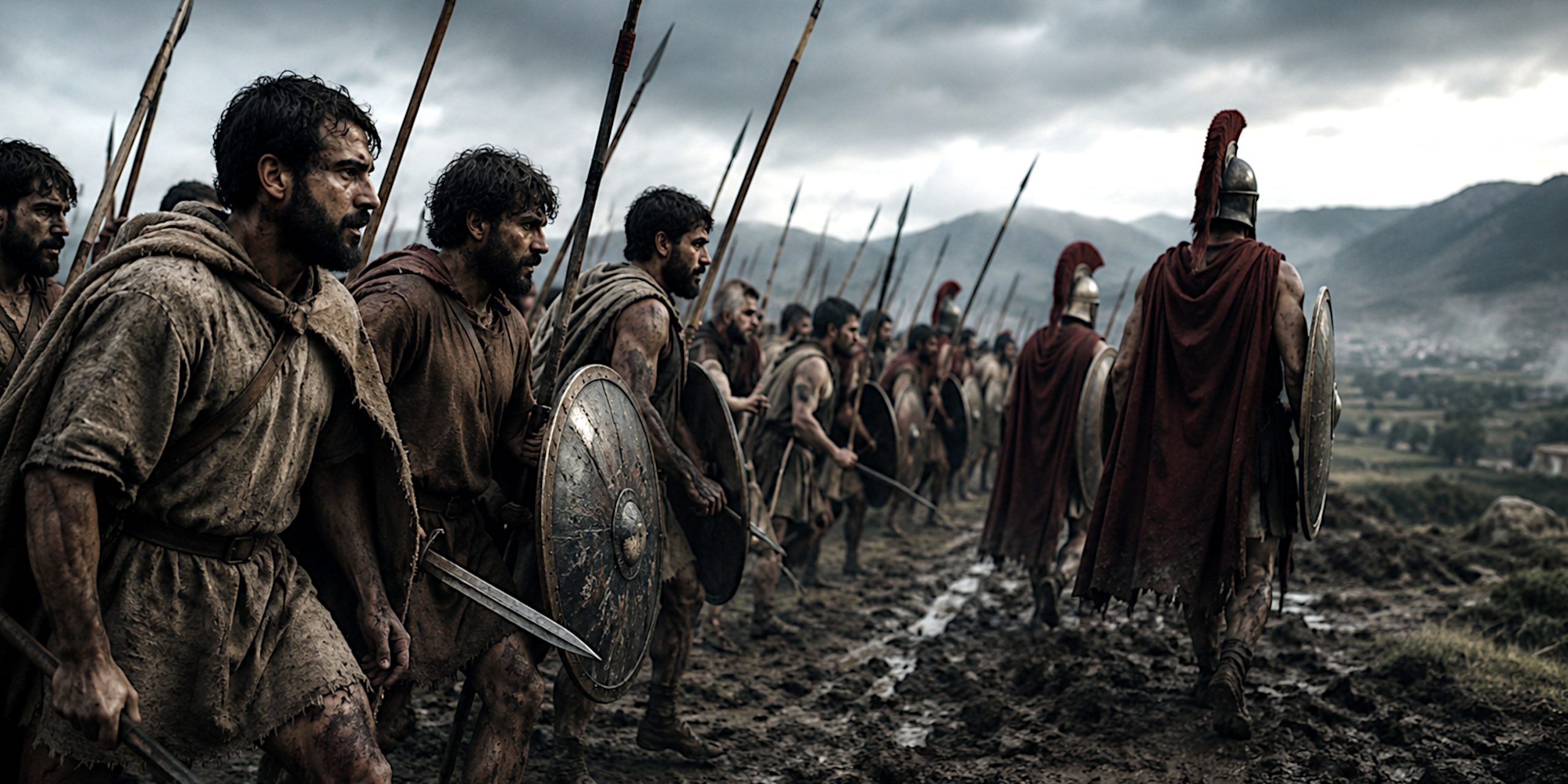
Helots generally possessed simpler equipment than Spartan citizens, though this varied according to their role.
Agricultural Equipment
Daily tools included:
- Iron sickles
- Axes
- Wooden hoes
- Mattocks
- Harvesting knives
Military Equipment
Support troops usually carried:
- Spears
- Javelins
- Slings
- Small shields
- Simple helmets when available
Those promoted to hoplite service received more substantial equipment.
Sword Types
Helots serving as armed troops may have carried several Greek sword designs depending on period and availability.
| Sword | Description | Typical Use |
|---|---|---|
| Xiphos | Straight double-edged sword around 45 to 60 cm long | Standard Greek sidearm |
| Kopis | Forward-curving chopping sword | Favoured for powerful cutting blows |
| Machaira | Single-edged curved blade | Effective against lightly armoured opponents |
The xiphos remained the standard weapon associated with Spartan hoplites.
The kopis and machaira offered greater cutting power and appear in both archaeological finds and artistic depictions across Greece.
Most Helots, however, probably spent far more time gripping farming tools than finely crafted swords.
Clothing
Helots wore practical clothing suited to agricultural work.
Typical garments included:
- Woollen tunics
- Cloaks during winter
- Leather sandals
- Broad-brimmed hats for field work
Ancient writers occasionally mention deliberately coarse clothing imposed upon Helots as a marker of inferior status.
Such visible distinctions reinforced Spartan social hierarchy.
Archaeology
Archaeological evidence for Helots is frustratingly limited.
Unlike Spartan elites, Helots left few inscriptions, monuments or luxury burials.
Even so, archaeology has steadily improved our understanding.
Important discoveries include:
Messenian Settlements
Excavations across ancient Messenia reveal villages continuously occupied before and after Spartan conquest.
These communities demonstrate that Helot populations retained local identities across generations.
Rural Farmsteads
Agricultural sites illustrate extensive cereal cultivation and olive production supporting Spartan estates.
Storage facilities indicate organised collection of produce for redistribution.
Mount Ithome
Excavations around Mount Ithome have uncovered fortifications associated with later occupations while reinforcing its significance as the centre of the great Helot revolt.
Iron Tools
Recovered farming implements reveal sophisticated agricultural practices rather than primitive subsistence farming.
The Helots were skilled agricultural workers who maintained the economic foundation of Sparta.
Contemporary Sources
Almost everything we know comes from elite Greek authors rather than Helots themselves.
That limitation requires caution.
Important writers include:
| Author | Contribution |
|---|---|
| Herodotus | Military service and Persian Wars |
| Thucydides | Revolts and political history |
| Xenophon | Spartan institutions and society |
| Aristotle | Criticism of the Helot system |
| Plutarch | Later traditions about Sparta |
Aristotle offered one of the sharpest criticisms:
“The Helots were constantly lying in wait for the disasters of the Spartans.”
Whether literally true or rhetorical, it captures the atmosphere of mutual suspicion that defined Spartan society.
Thucydides also observed:
“Most Spartan institutions have always been designed with a view to security against the Helots.”
That single sentence perhaps explains Sparta more effectively than volumes describing shields and spears.
Society and Family Life
Helot families generally remained together within village communities.
Marriage occurred without formal Spartan interference, although families could still be separated through reassignment.
Children inherited Helot status.
Education was practical rather than formal, centred on farming, household skills and local traditions.
Unlike Spartan boys entering the agoge, Helot children learned how to survive under occupation.
Religion
Helots participated in many local religious festivals while maintaining older regional traditions.
Some joined Spartan ceremonies in subordinate roles.
Sanctuaries across Messenia suggest local religious identity persisted despite centuries of Spartan domination.
Religion became one of the few areas where cultural continuity proved remarkably resilient.
Decline of the Helot System
Sparta’s military defeats gradually weakened its grip on Messenia.
The decisive turning point came after the Battle of Leuctra in 371 BC.
The Theban general Epaminondas invaded the Peloponnese and liberated Messenia.
A new independent Messenian state emerged.
Thousands of former Helots gained freedom for the first time in generations.
Sparta never fully recovered.
The loss of Messenian agriculture devastated its economy and permanently reduced its military power.
Myths and Misconceptions
Every Helot Was a Household Slave
False.
Most lived in rural communities working agricultural estates.
Helots Had No Families
Incorrect.
Family life formed the basis of Helot society.
Sparta Could Have Functioned Without Helots
Almost certainly not.
Its entire economic model depended upon their labour.
Helots Never Fought
False.
Many accompanied Spartan armies and some became fully armed soldiers.
Legacy
The Helot system remains one of history’s clearest examples of a society built upon institutionalised servitude.
Sparta’s military reputation often dominates popular imagination, yet the Helots reveal a more complicated reality.
Every famous Spartan victory rested upon an economic structure maintained through conquest, coercion and fear.
That does not diminish Spartan military achievement. It simply places it in its proper historical context.
The Helots rarely appear as heroes in films or novels. History is often written by those carrying the finest bronze shields rather than the heaviest grain sacks. Yet understanding their lives provides perhaps the clearest window into how Sparta actually functioned.
In many ways, the Helots were not simply victims of Spartan history.
They were the foundation upon which it was built.
Timeline
| Date | Event |
|---|---|
| c. 740 BC | First Messenian War begins |
| c. 720 BC | Initial conquest of Messenia |
| c. 685 to 668 BC | Second Messenian War |
| Sixth century BC | Helot system reaches maturity |
| 480 BC | Helots accompany Spartan army against Persia |
| 464 BC | Great earthquake and major Helot revolt |
| 425 BC | Helot military service expands during the Peloponnesian War |
| 371 BC | Spartan defeat at Leuctra |
| 369 BC | Liberation of Messenia and collapse of Helot rule |
Key Facts
| Feature | Details |
|---|---|
| Status | State-owned unfree population |
| Main Origin | Conquered Messenians and Laconians |
| Primary Role | Agricultural labourers |
| Military Service | Support troops, labourers and later hoplites |
| Common Weapons | Spear, javelin, xiphos, kopis, machaira |
| Major Revolt | Earthquake uprising of 464 BC |
| End of System | Liberation of Messenia after 371 BC |
| Historical Importance | Economic foundation of Spartan military society |