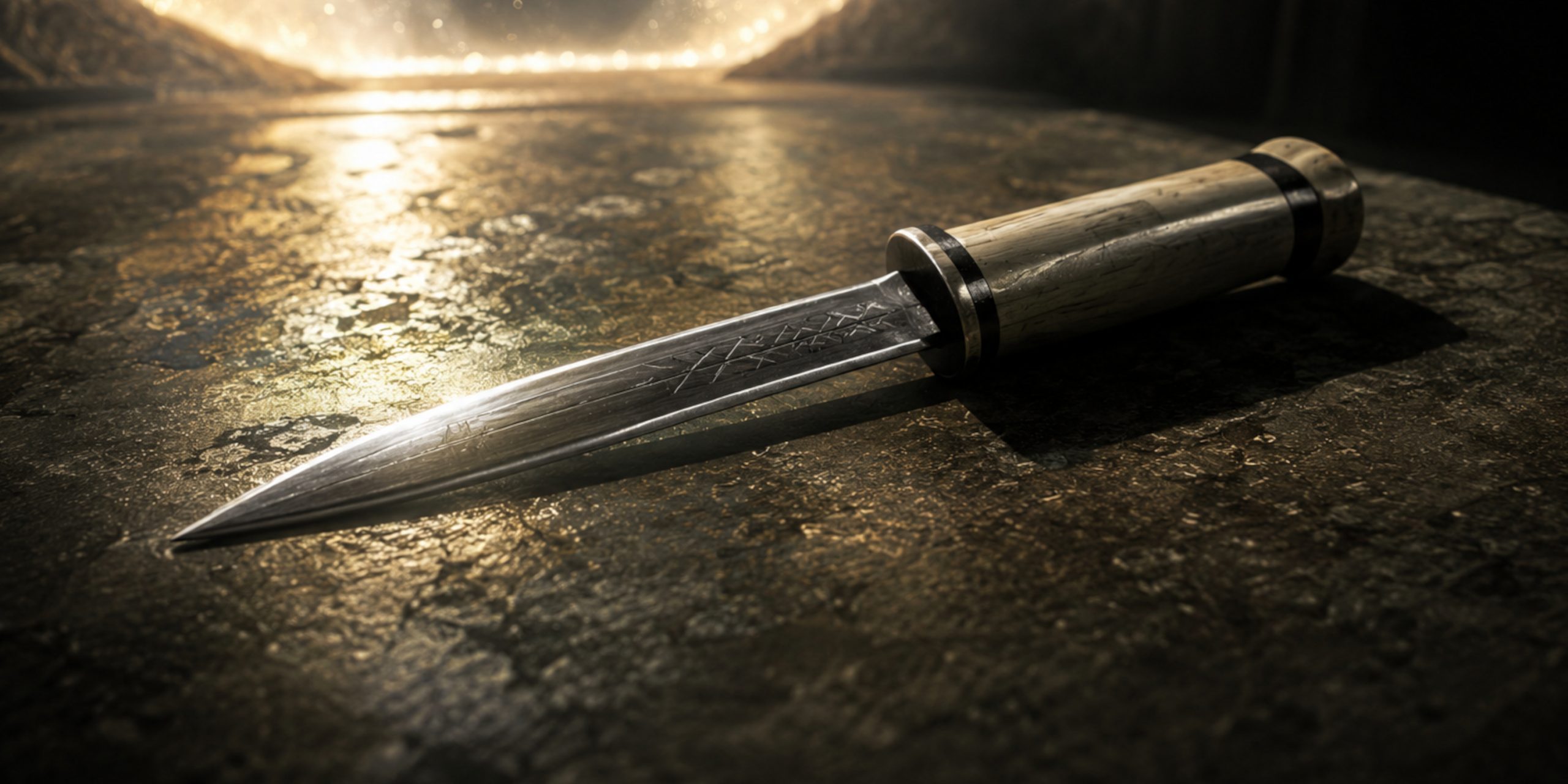
Fantasy is packed with legendary swords. Some burn with magical fire. Others are forged to slay dragons or kings. Then there is the Subtle Knife, a weapon that looks surprisingly ordinary until you realise it can slice through reality itself.
In Philip Pullman’s His Dark Materials, the Subtle Knife is arguably the most dangerous object in existence. It does not win battles through brute force. Instead, it rewrites the rules of the universe. A single careful cut can open a doorway into another world, bypass any lock, or even sever the soul from its dæmon.
That makes it less of a weapon and more of a force of nature disguised as a knife.
What Is the Subtle Knife?
The Subtle Knife, also known as Æsahættr, is an ancient magical blade capable of cutting through almost any material, including the fabric separating parallel worlds.
It first appears in the second novel, The Subtle Knife, where it becomes one of the central artefacts of the trilogy.
Unlike many fantasy weapons that exist purely to defeat enemies, the knife serves several purposes.
- Opens windows between worlds
- Cuts through any physical material
- Can separate a person from their dæmon
- Symbolises knowledge, responsibility and choice
Its powers influence every major conflict in the trilogy.
Appearance
Despite its legendary reputation, the knife is surprisingly understated.
It features:
| Feature | Description |
|---|---|
| Blade | Short, narrow knife |
| Edge One | Cuts any physical object |
| Edge Two | Cuts through the boundaries between universes |
| Hilt | Plain and functional rather than decorative |
| Size | Easily carried in one hand |
There are no glowing runes or extravagant jewels. In typical Philip Pullman fashion, the extraordinary hides beneath something almost ordinary.
That simplicity somehow makes it even cooler.
Who Created the Subtle Knife?
The knife was forged centuries before the events of the novels by scholars and philosophers living in the city of Cittàgazze.
Their civilisation specialised in exploring other universes.
At first, the knife was intended as a scientific instrument. The creators wanted knowledge rather than conquest.
Unfortunately, history demonstrates that humans rarely leave world-changing discoveries in peaceful hands for very long.
The ability to move between universes inevitably became a source of political power, espionage and conflict.
How Does the Knife Work?
The Subtle Knife possesses two distinct cutting edges.
The First Edge
One edge slices through virtually any physical substance.
Stone, steel, armour and locks offer almost no resistance.
Very few magical weapons are described as being this consistently unstoppable.
The Second Edge
The opposite edge performs the knife’s most famous ability.
It cuts microscopic openings through reality itself.
By carefully tracing an invisible seam between universes, the wielder creates a doorway connecting completely different worlds.
These openings remain stable until deliberately closed.
This ability allows characters to travel enormous distances, escape danger or explore entirely different realities.
The Rules of the Knife
The knife is incredibly powerful, but it is far from limitless.
Several important rules govern its use.
Concentration Is Essential
Opening a window requires complete focus.
The wielder must mentally locate the tiny weaknesses between worlds before making the cut.
Distraction can be disastrous.
It Can Break
Although nearly indestructible in use, the knife itself can snap if handled incorrectly.
Mental hesitation or emotional conflict can cause catastrophic mistakes during cutting.
This becomes a major turning point later in the story.
Every Window Has Consequences
Each doorway allows tiny soul-eating creatures called Spectres to spread between worlds.
Characters eventually discover that every new opening weakens the balance of existence.
Suddenly, travelling between universes is not simply convenient.
It carries an enormous moral cost.
Who Wields the Subtle Knife?
Will Parry
Will Parry becomes the knife’s most famous bearer after defeating its previous owner in Cittàgazze.
Claiming the weapon costs him two fingers, establishing an important tradition.
Every bearer sacrifices something before becoming its guardian.
Will’s calm determination makes him uniquely suited to wielding the knife.
Unlike many fantasy heroes, he rarely seeks power for its own sake.
Previous Bearers
The knife passes through a long line of guardians across generations.
Each protector inherits both extraordinary abilities and immense responsibility.
Few survive peacefully.
Possessing the knife tends to attract every ambitious person in the multiverse.
Why Is It Called Æsahættr?
Its ancient name, Æsahættr, roughly translates as God Destroyer.
That title hints at its true significance.
The knife is not simply capable of harming ordinary enemies.
It becomes one of the few objects capable of threatening the Authority itself and the oppressive structures that dominate Pullman’s universe.
The name reflects possibility more than destiny.
Like much of His Dark Materials, the story asks whether tools shape history or whether people do.
Symbolism
The Subtle Knife represents far more than magical power.
Knowledge
Opening windows symbolises intellectual curiosity.
The knife literally creates new perspectives.
Responsibility
Power without wisdom causes immense damage.
Characters repeatedly discover that every shortcut comes with hidden costs.
Growing Up
Will earns the knife through sacrifice and maturity.
Using it demands emotional discipline rather than physical strength.
That fits one of the trilogy’s central ideas.
Growing older means accepting responsibility for difficult choices.
Strengths
The knife possesses an astonishing collection of abilities.
- Cuts almost any material
- Opens portals between universes
- Extremely compact and portable
- Can bypass almost any defence
- Nearly impossible to counter directly
- Valuable for exploration as well as combat
In terms of utility, very few fantasy weapons can compete.
Weaknesses
Despite its immense power, the knife has clear limitations.
- Requires exceptional concentration
- Can break under specific circumstances
- Every use creates dangerous consequences
- Places enormous psychological pressure on the bearer
- Does not make its wielder physically stronger
Its greatest weakness is arguably the person holding it.
The knife amplifies judgement rather than replacing it.
The Subtle Knife Compared With Other Fantasy Weapons
| Weapon | Franchise | Greatest Ability |
|---|---|---|
| The Subtle Knife | His Dark Materials | Cuts between universes |
| Sting | The Lord of the Rings | Warns against nearby Orcs |
| Andúril | The Lord of the Rings | Symbol of rightful kingship |
| Nightblood | Cosmere | Consumes evil through overwhelming magical power |
| Excalibur | Arthurian legend | Divine authority and kingship |
| Stormbringer | Elric Saga | Soul-drinking sentient sword |
The Subtle Knife feels remarkably unique because it prioritises exploration over destruction.
Its greatest victories often come from opening doors rather than closing lives.
The Knife in Television
The BBC and HBO adaptation of His Dark Materials faithfully recreated the knife with a restrained design.
Rather than exaggerating its appearance, the production embraced its understated nature.
Most of the visual impact comes from the shimmering windows cut into reality instead of the weapon itself.
That choice captures the spirit of Pullman’s novels remarkably well.
Themes Behind the Blade
One reason the Subtle Knife remains memorable is that it embodies the trilogy’s biggest philosophical questions.
Should knowledge have limits?
Can extraordinary power ever be used without causing unintended harm?
Is ignorance safer than curiosity?
The knife never answers these questions.
It simply forces every character, and every reader, to confront them.
That makes it feel surprisingly mature compared with many magical artefacts in fantasy.
Legacy
The Subtle Knife stands among fantasy’s most original magical weapons.
It avoids the familiar formula of becoming “the strongest sword.” Instead, it changes what a weapon can represent.
It rewards patience over aggression.
It values understanding over domination.
Most importantly, it reminds readers that the greatest power often lies not in destroying barriers, but in deciding which ones should never be crossed.
That is probably why the knife continues to fascinate readers decades after its first appearance. It is spectacular, certainly, but also unsettling. Give someone the ability to step into any world imaginable and the real question is never whether they can. It is whether they should. That lingering question is what elevates the Subtle Knife from an excellent fantasy artefact to one of the most thoughtful weapons ever written.