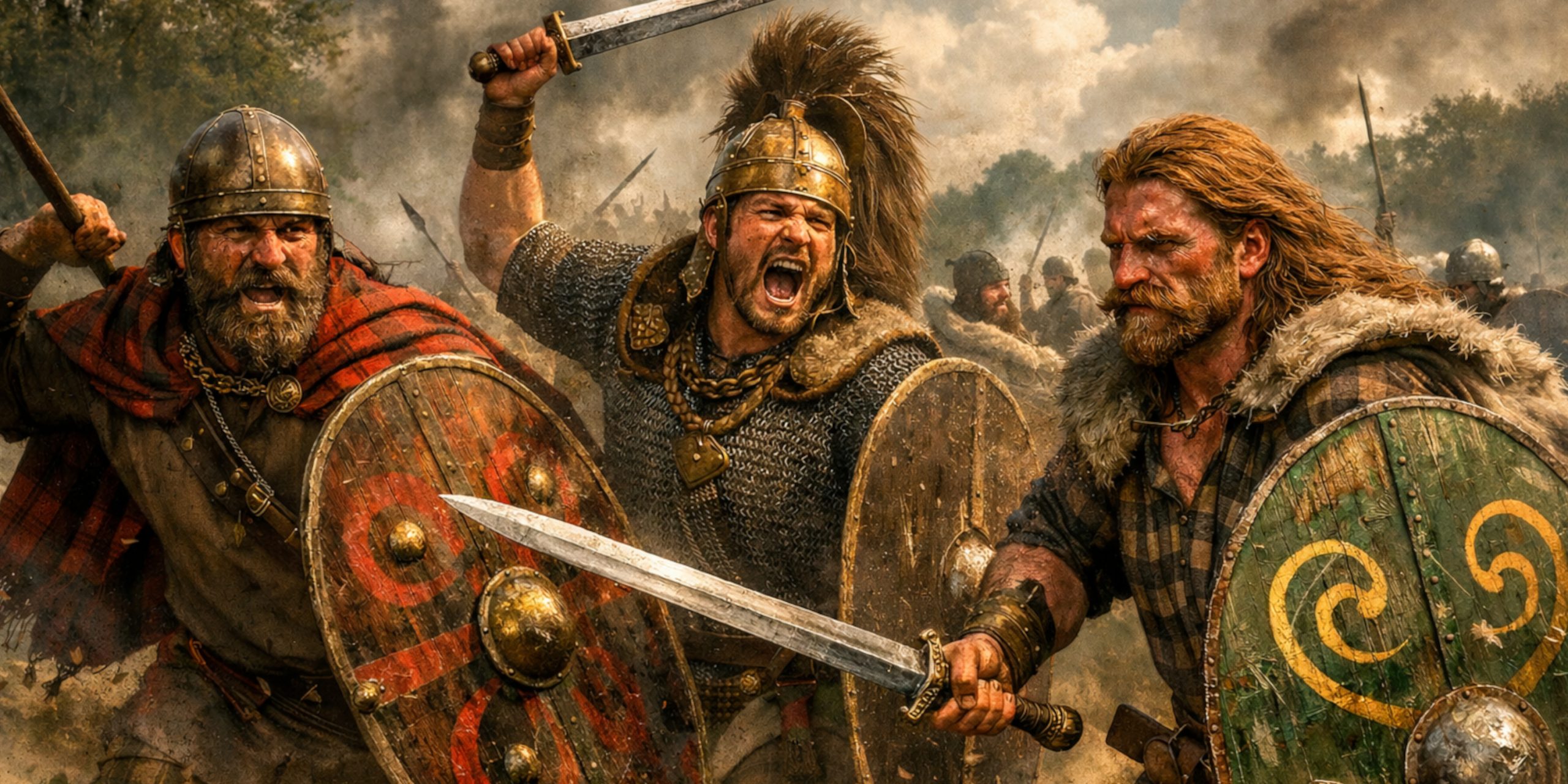
The Gallic warrior has often been flattened into a stereotype: a wild man with a moustache, a spear, and a worrying enthusiasm for charging directly at Roman legions while shouting at the top of his lungs. Ancient writers, particularly Roman ones, encouraged this image because it made their own victories look rather more impressive.
The truth is far more interesting.
From the 5th to the 1st centuries BC, the Celtic peoples of Gaul developed one of the most distinctive warrior cultures in Europe. They fought in organised tribal armies, employed skilled cavalry, produced sophisticated weapons, and built fortified settlements that could frustrate even experienced enemies. Their warriors were feared from northern Italy to Asia Minor. They sacked Rome, fought alongside Carthage, raided Greece, and eventually faced Julius Caesar in one of the most famous campaigns of the ancient world.
They were not one unified nation. Gaul was a patchwork of tribes, rival chiefs, shifting alliances, old grudges, and the occasional spectacular betrayal. In other words, very much like politics.
Who Were the Gallic Warriors?
The term “Gallic” refers to the Celtic-speaking peoples who lived across what is now France, Belgium, parts of Switzerland, western Germany and northern Italy. Between the 5th and 1st centuries BC, these tribes included the Aedui, Arverni, Helvetii, Belgae, Sequani, Parisii, Carnutes and many others.
War was deeply woven into Gallic society. Prestige, land, wealth and political power were all tied to martial success. Noble families maintained retinues of armed followers, and ambitious chiefs could build influence by leading successful raids or campaigns.
A Gallic army was usually centred around tribal warriors led by aristocratic elites. The richest nobles fought on horseback, surrounded by retainers and clients. Less wealthy men fought with spears, shields and swords. Tribal levies could swell armies into the tens of thousands, though ancient sources usually doubled or tripled those figures with the enthusiasm of a fisherman discussing the one that got away.
Gallic warfare was not simply a matter of rushing forward in a glorious but entirely impractical frenzy. Celtic armies used cavalry, skirmishers, ambushes and defended positions. Some tribes even employed chariots, though by the later period these were more common in Britain than Gaul itself.
Society and the Warrior Elite
Gallic society was sharply divided.
At the top stood the aristocracy, who controlled land, wealth and military power. These noble warriors displayed their status through richly decorated weapons, imported wine, jewellery and horses. Many were buried with their swords, helmets and even chariots.
Below them were free farmers and craftsmen, who could also serve as warriors when required. At the bottom were slaves, often taken in war.
The warrior aristocracy valued personal bravery above almost everything else. A successful fighter could gain fame, wealth and followers. Chiefs competed fiercely with one another, and tribal rivalries often prevented wider unity. Caesar, with the eye of a politician spotting a divided opposition, exploited this brilliantly during his conquest of Gaul.
Contemporary accounts suggest that Gallic warriors placed great importance on personal appearance. Hair was often worn long and lime-washed into stiff spikes. Moustaches were particularly admired. One suspects that entering a Gallic warband without a respectable moustache may have been socially awkward.
The Greek historian Diodorus Siculus wrote:
“The Gauls are terrifying in appearance and their voices are deep and altogether harsh.”
He also remarked that they were fond of bright clothing, striped cloaks and ornamented gear, which suggests that the battlefield in Gaul was rather more colourful than the greys and browns usually favoured by modern films.
Arms and Armour
The Gallic warrior was among the best-equipped fighters of Iron Age Europe. Archaeological finds from graves, rivers and battlefields show a remarkable variety of weapons and armour.
Swords
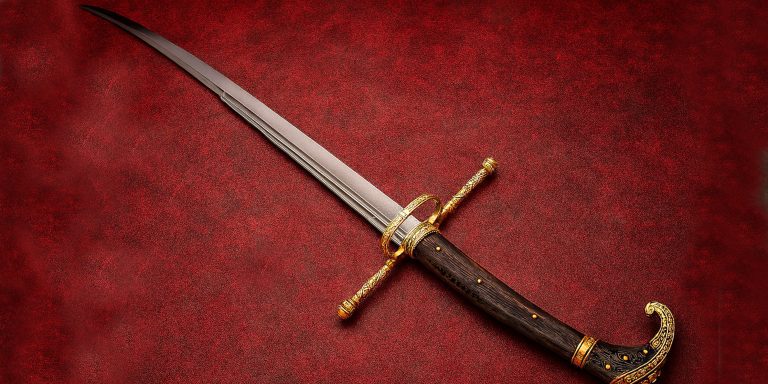
The sword was the prestige weapon of the Gallic warrior.
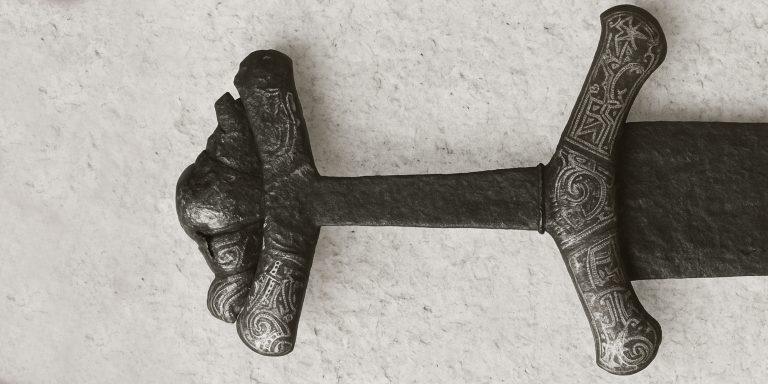
Early Gallic swords from the 5th and 4th centuries BC were often long, straight iron blades designed primarily for slashing. These developed from the La Tène culture, the archaeological culture associated with the Celts of continental Europe.
Several important sword types are known:
- Early La Tène long sword, usually around 60 to 70 cm long, with a narrow iron blade and simple hilt
- Middle La Tène sword, longer and often more refined, designed for cutting from horseback or in close combat
- Late La Tène sword, often exceeding 80 cm, sometimes with decorated scabbards and more complex hilts
- Anthropoid-hilt sword, found particularly in elite burials, with a stylised human-shaped hilt
Gallic swords were usually carried on the right side in metal scabbards suspended from chains. This is one of the clearest differences from Roman practice.
Ancient writers often claimed that Gallic swords bent easily in combat. Polybius wrote that some warriors had to straighten their blades underfoot after striking. Roman authors repeated this with obvious delight.
There is probably some truth in the criticism for certain early iron blades, though archaeology suggests the matter was exaggerated. Many Gallic swords were high-quality weapons. The Romans themselves later borrowed heavily from Celtic sword design.
Spears and Javelins
Spears were the most common Gallic weapon.
A typical Gallic warrior carried one or more thrusting spears, along with lighter throwing javelins. Spearheads varied enormously in shape and size, from small leaf-shaped heads to long, narrow thrusting blades.
Common types included:
- Leaf-shaped spearheads for general combat
- Heavy thrusting spears for use in close formations
- Lighter javelins thrown before the charge
- Long cavalry lances used by mounted nobles
The spear was cheaper and easier to make than a sword, which meant it was widely used by poorer warriors and tribal levies.
Shields
Gallic shields were large, oval or rectangular, and usually made from wood covered with leather.
Most had a central iron boss and could be highly decorated. Surviving examples from archaeology show painted designs, bronze fittings and intricate metalwork.
The shield was often just as much a symbol of status as a practical piece of equipment. Losing it was considered deeply shameful.
Diodorus wrote:
“Their shields are as tall as a man and are wrought in peculiar fashion.”
The finest shields were impressive enough to be offered to the gods. Hundreds of weapons and shields have been found in rivers and lakes, deliberately bent or broken before being deposited.
The Celts had a habit of giving expensive weapons to lakes and marshes, which must have been very frustrating for future archaeologists and perhaps even more frustrating for the local blacksmith.
Helmets and Body Armour
Most Gallic warriors probably fought without body armour, particularly poorer men. Wealthier warriors, however, could afford helmets and mail shirts.
Gallic helmets were among the finest in Europe. Famous types include:
- Montefortino helmet, widely used across Gaul and later adopted by the Romans
- Coolus helmet, a simple rounded bronze helmet
- Agen and Port helmets, later Gallic forms with reinforced neck guards
- Decorated ceremonial helmets with horns, animal figures or bronze crests
The most famous example is the richly ornamented helmet from Agris in France, covered in gold leaf and coral decoration.
Mail armour was probably invented by the Celts. By the 3rd century BC, wealthy Gallic nobles wore chainmail shirts made from thousands of linked iron rings. The Romans were so impressed that they adopted the design, turning Celtic military technology into standard Roman equipment.
Diodorus observed:
“Some wear iron breastplates wrought in chain fashion, while others fight naked.”
The latter point has become one of the most repeated details about Gallic warfare. Some warriors, especially elite champions, may indeed have fought naked or stripped to the waist, perhaps to display bravery or ritual confidence. Others likely concluded that armour was still a rather sensible idea.
Tactics and Ways of Fighting
Gallic warfare combined aggression with flexibility.
Warriors often began battle with shouting, war horns and displays intended to intimidate the enemy. Roman writers describe the din of horns, clashing weapons and tribal chants with genuine alarm.
The carnyx, a long bronze war trumpet ending in the head of a boar or dragon, was particularly distinctive. Its eerie sound seems to have been designed to unnerve opponents. Judging by the Roman descriptions, it worked.
Gallic armies usually fought in tribal groups, with nobles and their followers near the front. Warriors hurled javelins before closing with sword and spear.
Cavalry was especially important. Gallic horsemen were some of the best in Europe and often fought as elite troops. Caesar admired Gallic cavalry enough to recruit large numbers into his own army.
Gallic tactics could include:
- Sudden charges intended to break enemy morale
- Ambushes in forests and difficult terrain
- Raids and fast-moving attacks
- Defensive fighting from hillforts and fortified settlements
- Use of cavalry to outflank or pursue enemies
Their main weakness was political rather than military. Tribal rivalries often prevented sustained cooperation. Gallic chiefs could unite briefly in a crisis, as under Vercingetorix in 52 BC, but these alliances rarely lasted.
Famous Gallic Warriors and Leaders
Several Gallic leaders became famous across the ancient world.
Brennus
Brennus led the Gallic invasion of Italy and the sack of Rome around 390 BC. According to Roman tradition, when the Romans complained about the weight of gold demanded as tribute, Brennus threw his sword onto the scales and declared:
“Vae victis!”
“Woe to the conquered!”
It is one of the most memorable lines of the ancient world, and probably sounded even worse if you happened to be the conquered party.
Vercingetorix
The Arvernian chief Vercingetorix united many Gallic tribes against Julius Caesar in 52 BC.
He was intelligent, politically skilled and far more disciplined than Roman writers liked to admit. He used scorched-earth tactics, avoided direct battle when possible, and came close to forcing Caesar into disaster.
His final defeat at Alesia marked the end of independent Gaul.
Caesar wrote of him:
“He possessed great influence among all the Gauls.”
Ambiorix
Ambiorix of the Eburones led one of the most successful Gallic revolts against Rome in 54 BC. He ambushed and destroyed a Roman force under Sabinus and Cotta.
Caesar never forgave him and spent years trying, rather unsuccessfully, to catch him.
Archaeology and What It Reveals
Modern archaeology has transformed our understanding of Gallic warriors.
For centuries, most of what people knew came from Greek and Roman writers, who had their own prejudices and political motives. Archaeology provides a much clearer picture.
Important discoveries include:
- Rich warrior burials at sites such as Vix, Hochdorf and Lavau
- Weapons deposits in rivers, lakes and sanctuaries
- Fortified hill settlements, or oppida, across Gaul
- Battlefield remains from Alesia and other Roman campaigns
- Mass graves and weapon finds from Ribemont-sur-Ancre and Gournay-sur-Aronde
The sanctuary at Gournay-sur-Aronde is especially revealing. Archaeologists found large numbers of deliberately damaged weapons, shields and animal bones, showing that war and religion were closely linked.
At Ribemont-sur-Ancre, the remains of hundreds of warriors were discovered. Their bones had been arranged around a sacred enclosure, suggesting a grim ritual display after battle. The ancient Celts had many admirable qualities, though one would not necessarily wish to be on the losing side of their victory celebrations.
The discovery of Gallic mail armour, decorated helmets, imported Mediterranean goods and sophisticated fortifications has destroyed the old image of the Celts as primitive barbarians.
They were skilled metalworkers, organised fighters and participants in a vast European network of trade and warfare.
Religion, Ritual and the Warrior Cult
Religion was inseparable from warfare in Celtic Gaul.
Warriors sought the favour of gods before battle and dedicated captured weapons afterwards. Sacred groves, rivers and shrines played an important role.
The Celts also practised head-taking. Classical writers describe warriors cutting off the heads of enemies and displaying them as trophies.
Diodorus wrote:
“They cut off the heads of enemies slain in battle and fasten them to the necks of their horses.”
Archaeology confirms that this was not simply Roman exaggeration. Skulls have been found displayed at sites such as Entremont.
To the Celts, the head seems to have held spiritual significance. It was not merely a gruesome souvenir, though it was certainly that as well.
The End of the Gallic Warrior
By the 1st century BC, the independent warrior culture of Gaul was under immense pressure.
The expansion of Rome brought larger armies, greater organisation and political manipulation. Caesar’s conquest between 58 and 50 BC finally broke the power of the Gallic tribes.
After the defeat at Alesia, many Gallic warriors entered Roman service. Gallic cavalry became an important part of the Roman army, and Celtic equipment influenced Roman weapons and armour for centuries.
The Gallic warrior did not vanish completely. He simply changed sides, acquired Roman pay, and probably discovered that conquering the world was much easier when someone else dealt with the paperwork.
Legacy
The Gallic warrior remains one of the most recognisable figures of the ancient world.
Modern images often focus on wild hair, enormous moustaches and reckless bravery. Those features were certainly there. Yet beneath them stood a sophisticated military culture with advanced weapons, strong traditions and considerable skill.
The Celts shaped European warfare in ways that are often overlooked. They introduced chainmail, influenced Roman swords and helmets, developed excellent cavalry traditions and created some of the finest metalwork of the Iron Age.
They were not merely the enemies of Rome.
In many respects, they helped shape the Roman army that eventually conquered them.