Kingdom Come: Deliverance 2 is the sort of game that quietly watches you steal a loaf of bread, nods politely, then remembers it twenty hours later when a guard decides your face looks strangely familiar.
Unlike most RPGs, there is no glowing morality bar, no angel wings for helping old ladies, and no giant red warning that says “you are now evil”. Instead, morality in Kingdom Come: Deliverance 2 sits in the background like an irritated medieval priest, judging you constantly but rarely saying it out loud.
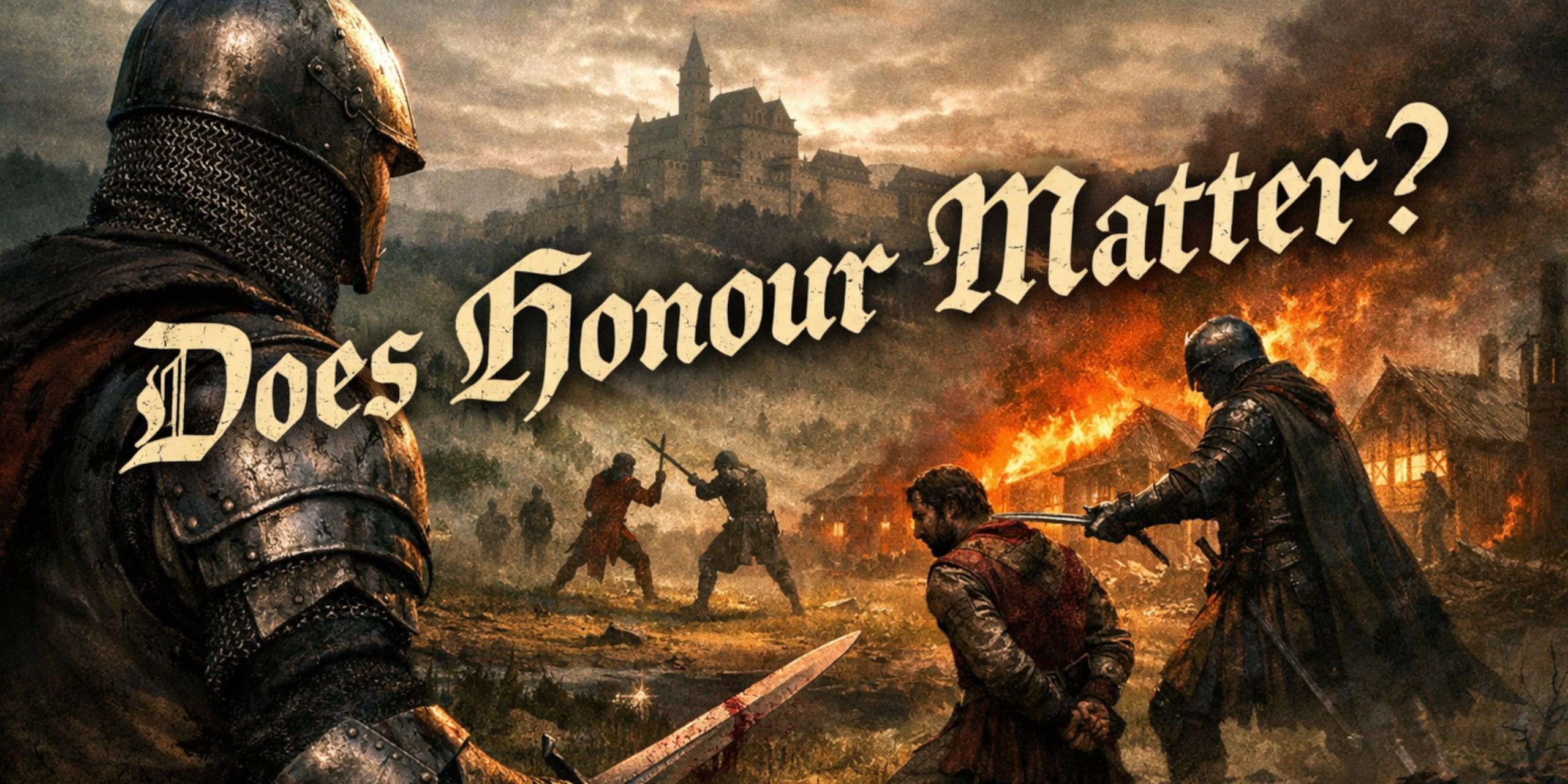
The game asks a simple question that turns out to be surprisingly awkward: does honour actually matter?
The short answer is yes. The longer answer is that honour matters, but not always in the way you expect.
Kingdom Come: Deliverance 2 Has No Traditional Morality System
If you are expecting something like Paragon and Renegade from Mass Effect, you are in for a shock roughly equivalent to being hit by a mace in full plate armour.
Kingdom Come: Deliverance 2 does not give you a clear good-or-evil meter. There is no screen telling you that helping a beggar earned +5 Virtue Points. Instead, the game tracks your actions through several interconnected systems:
- Reputation
- Crime and punishment
- Character relationships
- Dialogue consequences
- The way people react to Henry over time
This means morality is less about ticking a box and more about creating a version of Henry that feels believable. A noble, disciplined Henry who keeps his word will be treated very differently from a Henry who steals from peasants, lies constantly and has the self-control of a squirrel in a bakery.
The clever thing is that neither version is entirely wrong. The game does not punish you simply for being unpleasant. It punishes you for being careless.
Reputation Is the Real Morality System
The closest thing Kingdom Come: Deliverance 2 has to a morality meter is reputation.
Every village, town and faction remembers what you do. If you help locals, pay your debts, avoid random acts of murder and generally behave like someone who might survive more than a week in medieval society, people begin to trust you.
A good reputation can lead to:
- Better prices from merchants
- Easier persuasion checks
- More helpful NPCs
- Access to certain quests or information
- Guards being more forgiving when you accidentally commit a crime. Which, naturally, was entirely accidental.
A bad reputation has the opposite effect. Traders charge more. Guards stop you more often. NPCs become suspicious. Some characters may refuse to help you entirely.
What makes this system interesting is that it is local. You can be a heroic knight in one region and a walking public health warning in another.
That creates a weirdly funny version of Henry’s life where he might be welcomed into one tavern with applause, then chased out of the next town because he stole somebody’s goose three days earlier.
Crime Has Consequences, Even When Nobody Sees You
One of the most fascinating things about Kingdom Come: Deliverance 2 is how it treats crime.
Many RPGs let you rob an entire town blind, wait behind a barrel for thirty seconds, then return as though nothing happened. Kingdom Come has never had much patience for that sort of nonsense.
If you steal, attack innocent people or break into homes, the consequences can linger.
Guards may search you. Witnesses may remember you. Stolen goods can create suspicion. Even if you escape immediate punishment, your reputation can slowly collapse.
The game is particularly harsh if you try to play Henry as a chaotic menace with no plan whatsoever. You can absolutely become a thief, a murderer or a general medieval disaster, but you need to think about how you do it.
A sneaky, careful rogue can survive. A rogue who steals a horse in broad daylight then runs directly into the town square wearing the same clothes is not exactly criminal mastermind material.
Mercy Often Matters More Than Violence
One of the most quietly important moral choices in Kingdom Come: Deliverance 2 is what you do after you win.
It is easy to kill every enemy you defeat. Plenty of games encourage it. Kingdom Come: Deliverance 2 often makes you pause and think for a moment.
Do you spare someone who surrenders?
Do you show mercy to a defeated bandit?
Do you forgive someone who betrayed you if they had a reason?
These moments matter because the game understands that morality is rarely about grand speeches. It is usually about small choices made when nobody is forcing you to be decent.
Sometimes mercy leads to better outcomes. Sometimes it comes back to bite you in the most medieval way possible. Occasionally you spare someone and later discover they are still awful, which is a useful reminder that being honourable does not guarantee being right.
Still, the game repeatedly suggests that Henry becomes a more interesting character when he has principles. Even flawed ones.
Honour Changes How Henry Feels
This is the part that makes Kingdom Come: Deliverance 2 surprisingly clever.
Honour is not only about how the world reacts to you. It also changes how Henry feels within the story.
If you consistently play Henry as someone thoughtful, loyal and reluctant to hurt people unnecessarily, certain scenes carry more weight. His anger feels sharper. His regrets feel more genuine. His victories feel earned.
If you play him as a ruthless opportunist, the tone changes. Henry becomes harder, colder and sometimes genuinely unsettling. There is a strange fascination in watching him slowly drift away from the idealistic blacksmith’s son he once was.
Neither path is invalid. The game works either way. But it is one of the few RPGs where your behaviour shapes not only the plot, but the emotional identity of the character.
You are not choosing between “good Henry” and “evil Henry”. You are deciding what kind of person survives this world.
Can You Finish the Game as a Dishonourable Henry?
Absolutely.
You can lie, steal, betray people and solve most of your problems with a sword. The game does not suddenly stop and tell you that you have failed the morality test.
In fact, some quests are arguably easier if you are willing to be ruthless. Intimidation can work faster than diplomacy. Theft can make you rich. Killing an inconvenient character is often much simpler than dealing with them properly.
The catch is that this path usually creates more problems in the long run.
A dishonourable Henry may gain quick advantages, but he often loses trust, support and opportunities. NPCs become wary. Some quest outcomes become harsher. Certain conversations close off entirely.
Kingdom Come: Deliverance 2 does not say, “You were bad, therefore you lose.”
Instead, it says, “Fine. Live with it.”
That is far more interesting.
The Most Moral Choice Is Usually the Hardest One
The game repeatedly pushes you towards difficult decisions where there is no perfect answer.
Helping one person may harm another. Telling the truth can ruin somebody’s life. Lying can protect them. Justice and mercy do not always point in the same direction.
That is where honour in Kingdom Come: Deliverance 2 becomes genuinely compelling. It is not about blindly following rules. It is about deciding what Henry stands for when every option is messy.
There are moments where the “honourable” decision feels frustrating. You may lose money, miss a reward or make things harder for yourself. You may even sit there staring at the screen thinking, “I could solve this entire problem by robbing one incredibly wealthy idiot.”
And, to be fair, sometimes you absolutely can.
But the game has a way of making the harder choice feel more meaningful. You remember the moments where you kept your word, refused a bribe or chose mercy because those decisions feel earned.
Anyone can become rich by looting every corpse in sight. Being decent in medieval Bohemia takes considerably more effort.
Does Honour Matter in Kingdom Come: Deliverance 2?
Yes, but not because the game hands out rewards for being virtuous.
Honour matters because it changes the world around you. It changes how people see Henry, how quests unfold and how the story feels.
More importantly, it changes how you see Henry.
Kingdom Come: Deliverance 2 understands something many RPGs forget. Morality is interesting when it is awkward, inconvenient and occasionally a bit unfair. Honour is not a magic route to the best ending. It is simply a choice to hold onto some sense of who Henry is in a world that gives him plenty of reasons not to.
And honestly, that feels far more real than any glowing morality meter ever could.