For roughly a century, Rome did something rather extraordinary. It conquered almost the entire Mediterranean, acquired unimaginable wealth, built roads, temples and armies of terrifying efficiency, then promptly turned upon itself with all the subtlety of a drunken gladiator falling into a wine shop.
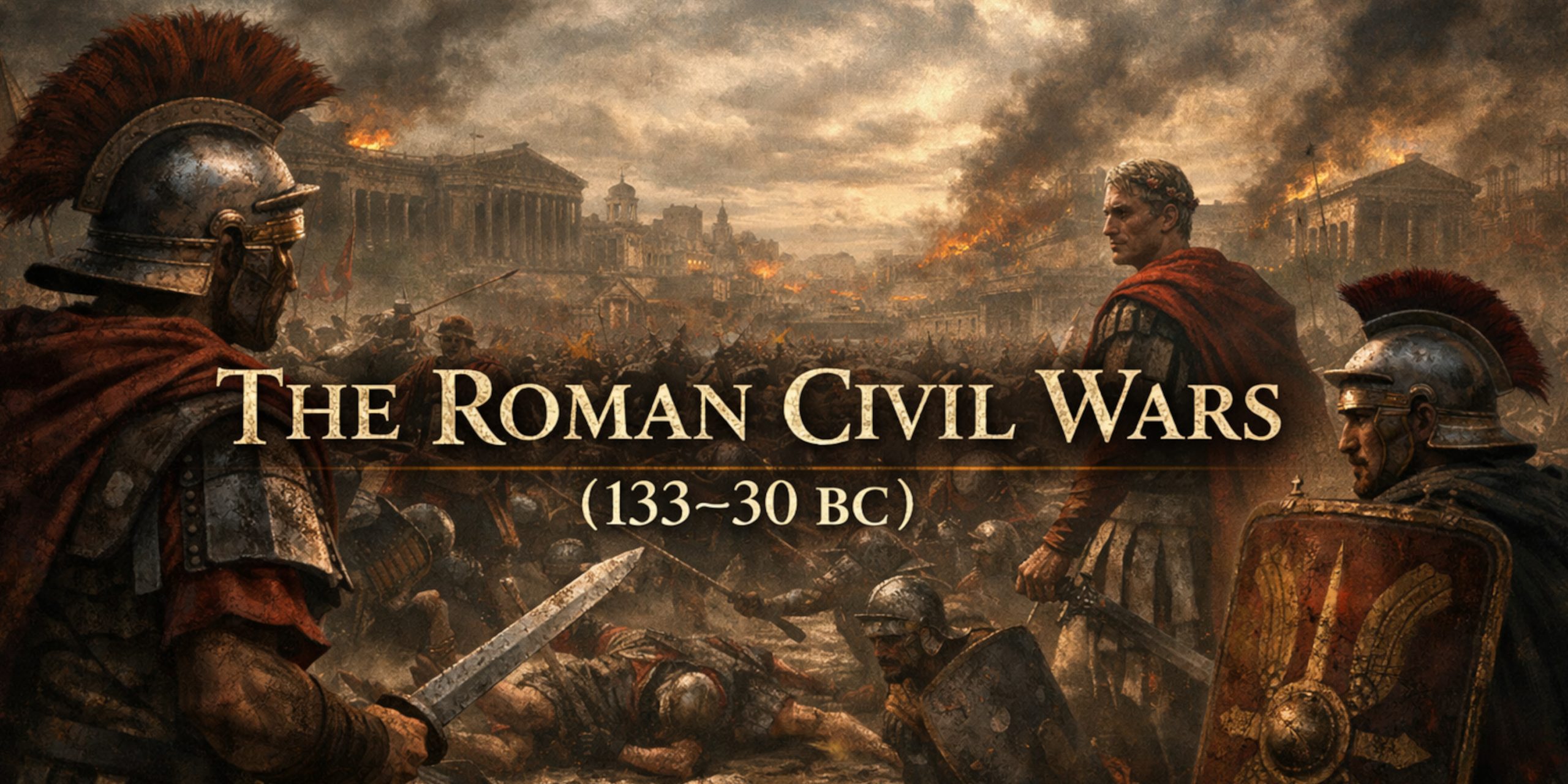
The Roman Civil Wars were not one war but a long chain of struggles that stretched from the murder of Tiberius Gracchus in 133 BC to the victory of Octavian at Actium in 31 BC and the death of Cleopatra and Mark Antony in 30 BC. During those years, Roman armies fought Roman armies, ambitious generals used soldiers as political tools, and the old Republic slowly tore itself apart.
By the end, the Senate still existed, magistrates still wore their dignified togas, and everyone still insisted they were defending liberty. Yet Rome had become something very different. The Republic was dead. The Empire, although nobody quite dared call it that yet, was already waiting in the wings.
Why the Roman Republic Fell into Civil War
The Roman Republic had always relied upon a fragile balance between aristocratic competition and public consent. By the second century BC, that balance was beginning to crack.
Rome’s conquests flooded Italy with slaves and wealth. Great estates owned by senators and nobles expanded across the countryside, while many poorer citizens lost their land. Veterans returned from long campaigns to discover that their farms had vanished or been swallowed by richer neighbours.
At the same time, political rivalry in Rome became increasingly vicious. Roman politicians had always competed fiercely, but now elections, legislation and public office began to carry far higher stakes. Wealth, military glory and personal loyalty to generals became more important than loyalty to the state.
Three problems sat at the heart of the crisis:
- Growing inequality between rich and poor
- Armies becoming loyal to generals rather than the Republic
- The inability of the Senate to compromise
The Roman Senate liked to think of itself as the guardian of order. In reality, by the first century BC it often behaved rather like a club of very wealthy men who refused to solve any problem until it had become dramatically worse.
The Gracchi and the Beginning of Violence
The first great rupture came with the brothers Tiberius and Gaius Gracchus.
In 133 BC, Tiberius Gracchus proposed land reforms designed to help poorer Roman citizens. His aim was to redistribute public land that had been monopolised by the rich. The Senate resisted fiercely.
Tiberius bypassed the Senate and appealed directly to the people. It was a dangerous precedent. Worse still, his enemies feared he wanted too much power.
In 133 BC, Tiberius and many of his supporters were clubbed to death in Rome. It was the first large-scale political bloodshed in the city for centuries.
His younger brother Gaius Gracchus tried again a decade later. He proposed further land reform, cheaper grain and wider political rights. He too ended in disaster. In 121 BC, Gaius died during violent clashes in Rome.
The murder of the Gracchi changed Roman politics permanently. Disagreement no longer ended with speeches and votes. Now it could end with bodies lying in the Forum.
Marius, Sulla and the First Civil War
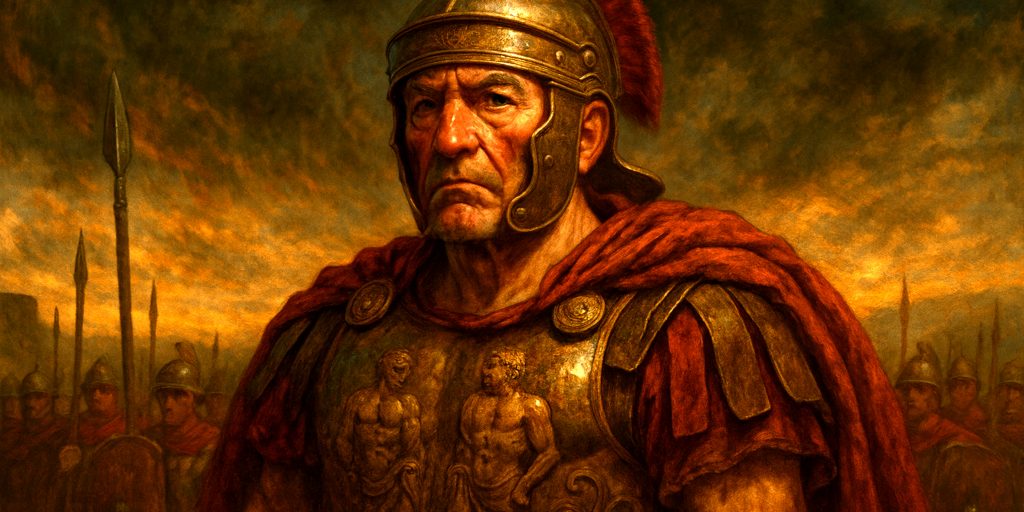
The next great phase of the crisis centred upon two men who thoroughly disliked one another: Gaius Marius and Lucius Cornelius Sulla.
Gaius Marius was a brilliant general who reformed the Roman army. He recruited poorer citizens into the legions and offered them land and rewards after service.
Lucius Cornelius Sulla was an aristocratic commander who believed the Senate should dominate Rome.
Marius’ reforms made the Roman army more professional and effective. They also created a dangerous new reality. Soldiers increasingly looked to their general, rather than the state, for wealth and advancement.
The conflict between Marius and Sulla began over who should command the war against Mithridates of Pontus. In 88 BC, Sulla did something previously unthinkable. He marched his army on Rome itself.
Roman soldiers crossing the sacred boundary of the city was shocking. It was the political equivalent of setting fire to one’s own dining room because the wine had gone warm.
Sulla seized Rome, drove out his enemies and later returned after further conflict. In 82 BC he became dictator.
Sulla introduced brutal proscriptions. Lists of enemies were published, and anyone on the list could be killed. Their property was confiscated. Thousands died.
Sulla’s Dictatorship
Sulla believed he was saving the Republic. In a grimly Roman fashion, he attempted to preserve it by means of murder, intimidation and constitutional reform.
His measures included:
- Strengthening the Senate
- Weakening the tribunes
- Increasing the number of magistrates
- Crushing political opponents
For a short while, it seemed to work. Sulla retired in 79 BC and died the following year.
Yet the deeper problems remained. Generals still commanded private loyalty. Ambitious men still sought power. Sulla had shown that a Roman general could seize Rome by force and survive.
Others were paying attention.
The Rise of Caesar, Pompey and Crassus
In the decades after Sulla, three powerful men came to dominate Roman politics:
- Gnaeus Pompeius Magnus
- Marcus Licinius Crassus
- Julius Caesar
Together they formed the First Triumvirate in 60 BC. It was not an official office. It was simply an agreement between three extremely ambitious men to divide power between themselves.
Pompey had military glory. Crassus had immense wealth. Caesar had political skill and charm. He also possessed a genius for making dangerous situations considerably more dangerous.
Caesar’s conquest of Gaul made him immensely popular and gave him a loyal army. Meanwhile, Crassus died fighting the Parthians in 53 BC, and Pompey drifted closer to the Senate.
Soon, only Caesar and Pompey remained.
Caesar Crosses the Rubicon
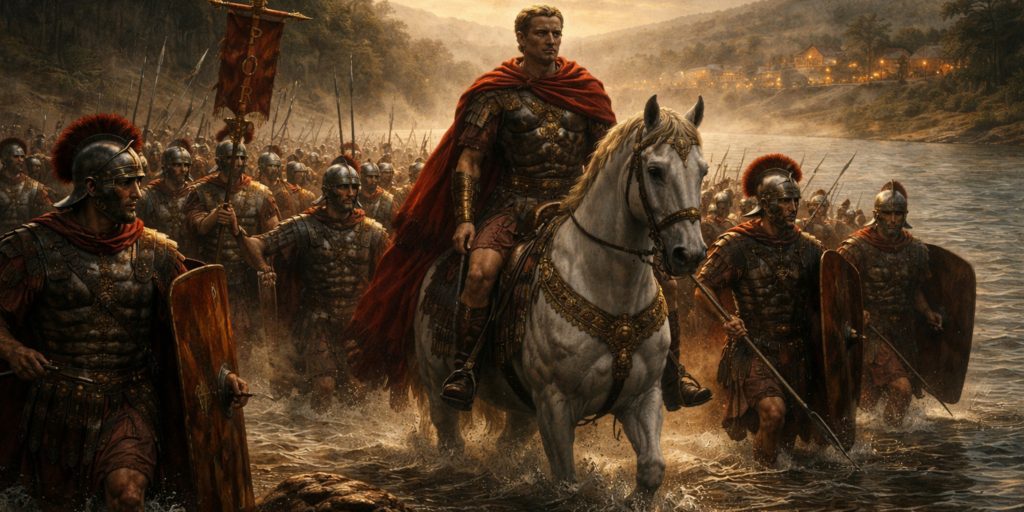
In 49 BC, the Senate ordered Caesar to surrender his command and return to Rome.
Instead, he crossed the River Rubicon with his army.
According to later tradition, Caesar declared, “The die is cast.”
The crossing of the Rubicon began another civil war. Pompey and many senators fled Rome and gathered forces in Greece.
Caesar moved rapidly through Italy, Spain and then the eastern Mediterranean.
The Great Battles of Caesar and Pompey
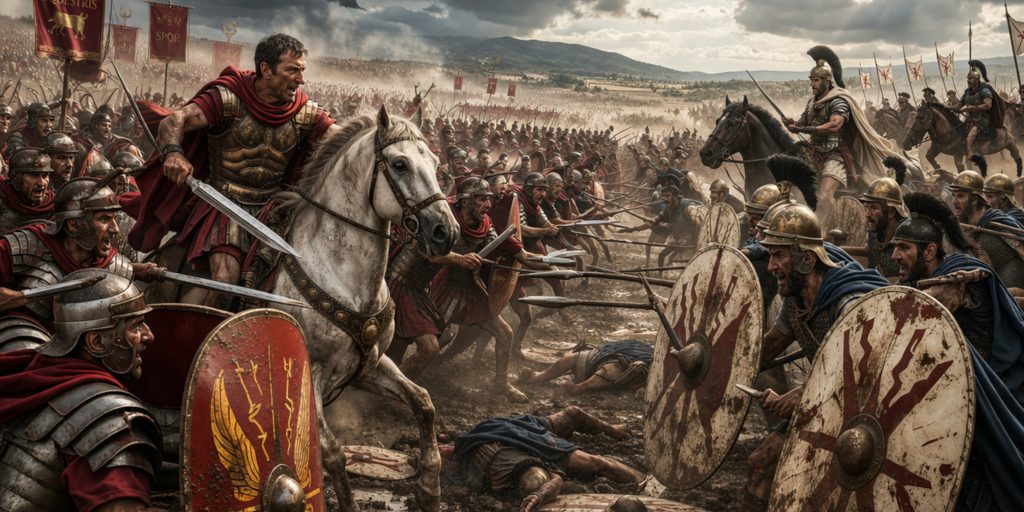
Battle of Pharsalus (48 BC)
The decisive battle between Caesar and Pompey took place at Pharsalus in Greece.
Caesar had fewer men, but his troops were experienced and fiercely loyal. Pompey’s army was larger but less cohesive.
Caesar won a crushing victory.
Pompey fled to Egypt, where he was murdered shortly after arrival. The Egyptian court, hoping to please Caesar, presented him with Pompey’s severed head.
Caesar, to his credit, appears to have been horrified. Roman politics was vicious enough already without such theatrical contributions.
Battle of Thapsus (46 BC)
After Pompey’s death, the war continued in North Africa.
At Thapsus, Caesar defeated the remaining republican forces. Many of his enemies died or took their own lives, including Cato the Younger.
Battle of Munda (45 BC)
The final major battle of Caesar’s civil war took place in Spain.
At Munda, Caesar defeated the sons of Pompey and secured complete victory.
Yet his triumph did not last long.
Caesar’s Assassination
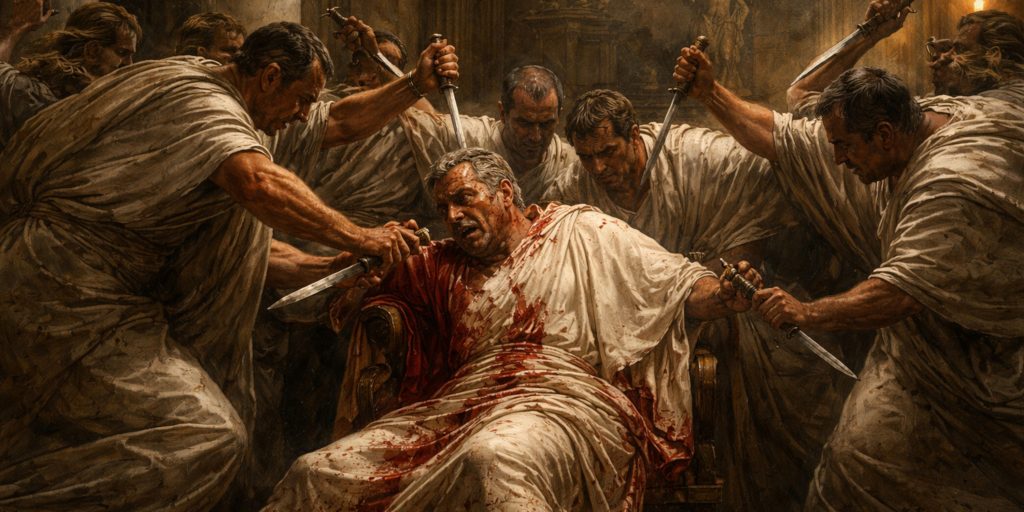
On 15 March 44 BC, the Ides of March, Caesar was assassinated in the Senate.
A group of senators, led by Brutus and Cassius, believed they were saving the Republic.
Instead, they unleashed another civil war.
The conspirators had removed Caesar, but they had not removed Caesar’s supporters, his army, or the simple fact that Rome no longer knew how to settle political disputes peacefully.
Antony, Octavian and the Final Civil War
After Caesar’s death, power passed to a new trio:
- Mark Antony
- Octavian
- Marcus Aemilius Lepidus
Together they formed the Second Triumvirate in 43 BC.
Like the first, it rested upon mutual convenience and mutual distrust. Unsurprisingly, it did not last.
First, Antony and Octavian defeated Caesar’s assassins at Philippi.
Battle of Philippi (42 BC)
At Philippi in Macedonia, the armies of Brutus and Cassius were defeated.
Both men committed suicide after the battle.
The republican cause effectively ended there. From this point onward, the struggle was no longer about saving the Republic. It was about which ambitious Roman would control what remained of it.
The Battle of Actium and the End of the Republic
Eventually, the alliance between Antony and Octavian collapsed.
Antony allied himself with Cleopatra in Egypt, which allowed Octavian to portray him as a traitor to Rome.
In 31 BC, the decisive battle took place at Actium.
Battle of Actium (31 BC)
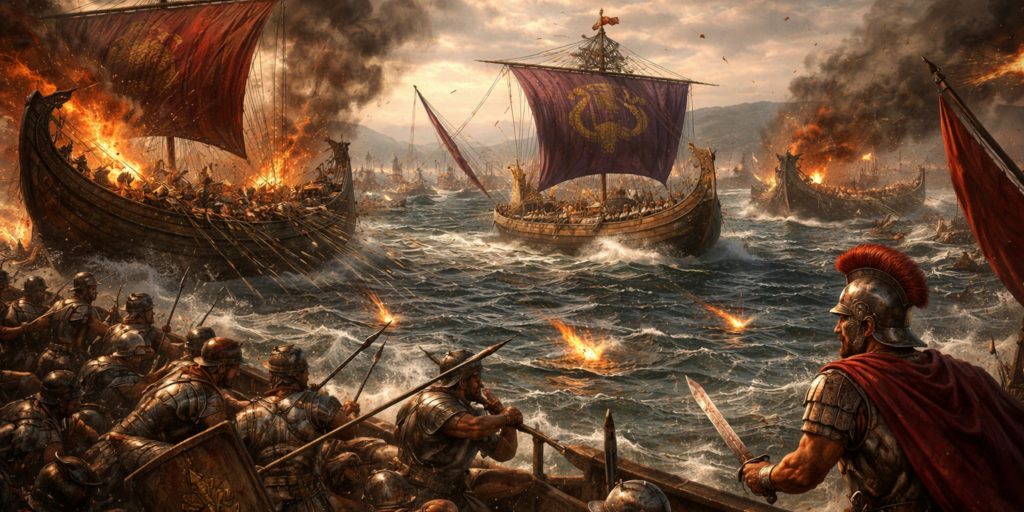
The fleets of Octavian and Antony fought off the western coast of Greece.
Octavian’s admiral, Agrippa, proved the better commander. Antony and Cleopatra fled.
Battle of Actium ended the civil wars and left Octavian as the undisputed ruler of the Roman world.
The following year, Antony and Cleopatra died in Egypt.
Octavian would later become Augustus, the first Roman emperor.
Major Battles of the Roman Civil Wars
| Battle | Date | Main Figures | Result | Significance |
|---|---|---|---|---|
| Battle of the Colline Gate | 82 BC | Sulla vs Marian forces | Sullan victory | Secured Sulla’s dictatorship |
| Battle of Sacriportus | 82 BC | Sulla vs Marius the Younger | Sullan victory | Crushed Marian resistance |
| Battle of Pharsalus | 48 BC | Caesar vs Pompey | Caesarian victory | Decisive defeat of Pompey |
| Battle of Thapsus | 46 BC | Caesar vs republican forces | Caesarian victory | Destroyed resistance in Africa |
| Battle of Munda | 45 BC | Caesar vs Pompey’s sons | Caesarian victory | Final victory for Caesar |
| Battle of Philippi | 42 BC | Antony and Octavian vs Brutus and Cassius | Triumviral victory | End of the assassins’ cause |
| Battle of Actium | 31 BC | Octavian vs Antony and Cleopatra | Octavian victory | End of the Republic |
Archaeology and What Survives
The Roman Civil Wars left physical traces across the Mediterranean.
At the site of Pharsalus battlefield, archaeologists have uncovered sling bullets, weapon fragments and remains linked to the battle. Many sling bullets bear inscriptions, some with rather rude messages aimed at the enemy. Roman soldiers, it turns out, appreciated battlefield insults almost as much as modern football crowds.
Excavations at Forum Romanum reveal evidence of the political violence of the late Republic, including rebuilding after riots and destruction.
At Curia Julia, visitors can still stand near the Senate house associated with Caesar’s final years. Caesar himself was actually killed in the nearby Theatre of Pompey, but Roman memory had a habit of simplifying matters.
Largo di Torre Argentina marks the approximate location of the Theatre of Pompey, where Caesar was assassinated.
In Egypt, excavations around Alexandria and the harbour have produced remains connected with the final years of Antony and Cleopatra.
The naval battlefield of Actium has also yielded evidence of the campaign, including harbour works, camps and military installations around Nicopolis, the city founded by Augustus after his victory.
Contemporary Quotes
Ancient writers watched the Republic collapse with a mixture of horror, fascination and, occasionally, grim satisfaction.
The Roman historian Sallust wrote of the corruption of the age:
“Ambition drove many men to become false.”
Cicero, who spent much of the period attempting to survive Roman politics with limited success, wrote:
“The Republic is utterly ruined.”
After Caesar’s murder, Mark Antony reportedly displayed Caesar’s bloodstained toga to the crowd, stirring outrage and grief.
Suetonius later claimed that Caesar’s final words were:
“You too, child?”
Whether he actually said this remains uncertain. Ancient historians were not above improving a scene if it made a better story, and Roman history is full of moments that feel suspiciously well rehearsed.
Why the Roman Civil Wars were meteoric
The Roman Civil Wars transformed the ancient world.
They destroyed the Roman Republic, created the conditions for the Roman Empire and changed the relationship between military power and politics forever.
The wars also produced some of history’s most famous figures: Caesar, Pompey, Antony, Cleopatra and Augustus. They have remained endlessly fascinating because they combine grand battles, extraordinary personalities and political collapse on a scale almost too dramatic to be believed.
There is also something uncomfortably familiar about them. Rome was wealthy, powerful and outwardly successful. Yet beneath the surface, it was divided, unequal and increasingly unable to solve its own problems peacefully.
The Romans liked to imagine that their Republic would last forever. History, with its usual lack of tact, had other ideas.