There are places in history that feel almost exaggerated, as if someone has taken a perfectly good fact and pushed it too far. Port Royal, at the edge of Kingston Harbour in Kingston, is one of those places. Except it was all real. A city of pirates, merchants, rum, and unapologetic excess, built on sand and confidence, then quite literally swallowed by the sea.
As a historian, I find it difficult not to admire it, just a little. Not the chaos, not the violence, but the sheer audacity. Port Royal did not quietly exist. It arrived, made itself rich, and then vanished in a way that feels almost theatrical.
Where It Began
Port Royal rose to prominence after the English captured Jamaica from Spain during the English conquest of Jamaica (1655). The location was ideal. It sat on a narrow spit of land guarding one of the finest natural harbours in the Caribbean.
The English needed a foothold in the region. What they got instead was a magnet for opportunists.
Privateers were invited in first. Men like Henry Morgan, who blurred the line between sanctioned warfare and outright piracy, turned Port Royal into a launch point for raids on Spanish treasure routes. Success brought wealth. Wealth brought more people. And those people, as it turns out, were not especially interested in restraint.
A City Built on Vice
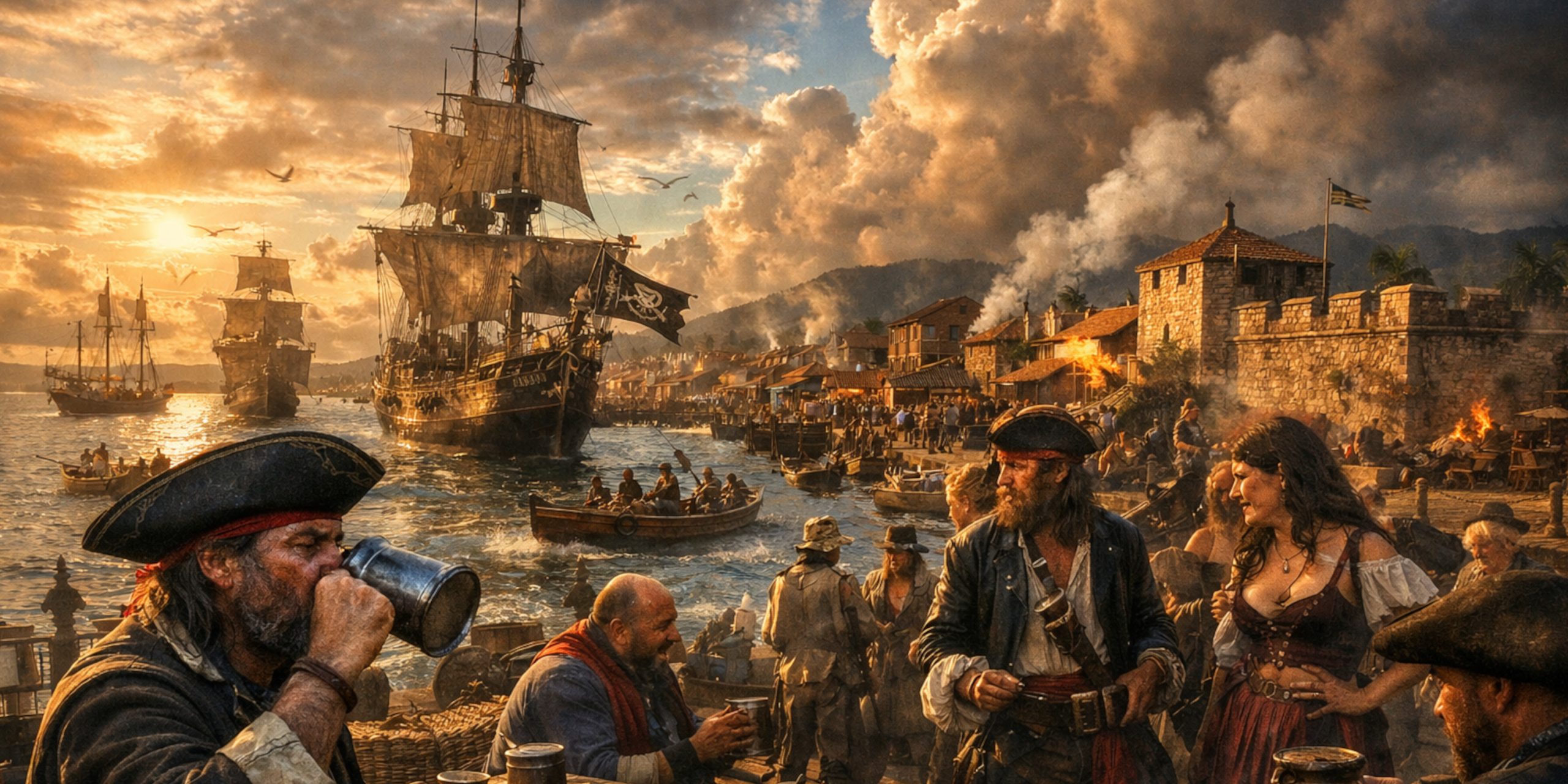
By the late 17th century, Port Royal had earned its infamous reputation. Contemporary accounts described it as one of the richest and most disorderly cities in the New World.
There were taverns on nearly every street. Gambling houses, brothels, and merchants dealing in everything from sugar to stolen Spanish silver. One observer claimed there was a tavern for every ten residents. I cannot confirm the exact ratio, but I suspect the spirit of the claim is accurate.
The wealth was extraordinary. Gold and silver flowed through the port. Sailors spent it as quickly as they acquired it. Rum was cheaper than water, which is rarely a sign of a well balanced society.
It is tempting to reduce Port Royal to caricature, all parrots and pistols, but it was also a serious commercial hub. Ships from across the Atlantic world passed through its harbour. Trade and piracy existed side by side, often indistinguishable from one another.
Pirates, Privateers and Power

Figures like Henry Morgan were central to Port Royal’s rise. Morgan’s raids on Spanish cities, particularly the sack of Panama City in 1671, brought immense wealth back to Jamaica.
What fascinates me is how respectable he eventually became. Knighted, appointed Lieutenant Governor of Jamaica, and expected to help suppress the very piracy that had made him famous. It feels a bit like asking a fox to reorganise the henhouse.
Port Royal thrived because it sat in a grey zone. Official enough to be useful, lawless enough to be profitable.
Daily Life in the Wickedest City
Life in Port Royal was fast, loud, and precarious.
Sailors, merchants, enslaved Africans, free settlers, and pirates all mixed within a tight urban space. Buildings were often hastily constructed. The ground beneath them was not much more than compacted sand.
The social structure was fluid compared to Europe. Wealth could elevate a man quickly, especially if he was willing to take risks others would avoid. That said, the risks had a habit of catching up.
Violence was common. Disease was constant. And yet people kept coming.
There is something oddly modern about it. A place driven by opportunity, fuelled by excess, and quietly aware that it might not last.
The Earthquake of 1692
On 7 June 1692, the ground gave way.
The 1692 Jamaica earthquake struck with devastating force. Much of the city, built on loose sand, liquefied and collapsed into the sea. Entire streets vanished. Buildings slid beneath the water. Ships were thrown inland.
Thousands died within minutes. Others succumbed to injuries and disease in the aftermath.
It is difficult not to see how quickly it happened and think, rather uncharitably, that the city had been tempting fate. Contemporary writers certainly thought so, interpreting the disaster as divine judgement. I tend to avoid that conclusion, though I admit the symbolism is hard to ignore.
What Remains Today
Modern Port Royal is quiet. Almost unrecognisable compared to its former self.
Archaeological work has revealed remarkably preserved remains beneath the water. Everyday objects, ceramics, bottles, even entire building foundations lie where they fell. It is often described as a time capsule of the 17th century.
Sites such as Fort Charles still stand, though they feel more reflective than defensive now.
The underwater sections of the city have drawn comparisons to Pompeii. Not identical, of course, but similar in the sense of sudden preservation.
Why Port Royal Still Fascinates
Port Royal endures in the imagination because it feels like a story that should not quite be true.
It was a city built on risk, enriched by conflict, and undone in a single afternoon. The combination is difficult to ignore. Add pirates, treasure, and a touch of moral panic, and it becomes irresistible.
As a historian, I find it sits somewhere between cautionary tale and reluctant admiration. It is easy to criticise the excess. Harder to ignore the energy that drove it.
If nothing else, Port Royal reminds us that history is not always gradual. Sometimes it builds quickly, burns brightly, and disappears before anyone quite realises what they had.
And perhaps that is why we keep returning to it.