The history of the Inca often feels strangely quiet compared with the medieval courts of Europe or the empires of China. They left no traditional writing system, few monumental inscriptions naming kings, and no tidy chronicles written by their own hands. Instead we reconstruct their past through archaeology, Spanish accounts, oral traditions, and a great deal of careful historical detective work.
Yet from this patchwork emerges one of the most remarkable ruling dynasties in world history. The Sapa Inca were not simply kings. They were divine rulers believed to be the living sons of the sun god. Their authority shaped the largest empire ever created in the Americas.
As a historian, I find the whole arrangement both impressive and faintly terrifying. Imagine ruling an empire while everyone around you insists you are literally divine. It does wonders for loyalty, but it must also make family dinners rather awkward.
What “Sapa Inca” Means
The title Sapa Inca translates roughly as “the unique Inca” or “the only Inca.” It was reserved for the emperor of the Inca state.
In Inca ideology, the ruler stood at the centre of the universe. The dynasty claimed descent from the sun god Inti, which meant that political authority and religious authority were inseparable. Obeying the emperor was not simply good governance. It was a sacred duty.
The Sapa Inca ruled from the capital of Cusco, which the Incas saw as the navel of the world. From this highland city they governed a vast state known as Tawantinsuyu, meaning “the four parts together.”
At its greatest extent in the early sixteenth century, the empire stretched across:
• Modern Peru
• Bolivia
• Ecuador
• Northern Chile
• Northwest Argentina
• Southern Colombia
It was connected by an extraordinary network of roads that ran through mountains, deserts, and jungle.
The Mythic Origins of the Dynasty
Inca traditions trace the dynasty’s origins to a semi mythical founder named Manco Cápac.
According to legend, Manco Cápac and his sister wife Mama Ocllo emerged from Lake Titicaca, sent by the sun god Inti to bring civilisation to humanity. Their mission was to found a sacred city where a golden staff sank into the earth.
That place became Cusco.
Historians treat this story with caution. It is clearly mythological, yet it also hints at something real. Archaeological evidence suggests that a small ruling group rose to prominence in the Cusco valley during the thirteenth century. Over time their prestige and military power grew.
The dynasty likely began as local highland nobility before transforming into imperial rulers.
The Early Sapa Incas
The earliest rulers are difficult to separate from legend, but traditional king lists preserved by Spanish chroniclers provide a sequence of dynastic leaders.
These early rulers include:
• Manco Cápac
• Sinchi Roca
• Lloque Yupanqui
• Mayta Cápac
• Cápac Yupanqui
These kings probably ruled a modest regional state centred on Cusco. Their authority depended on alliances, warfare, and control of agricultural land.
At this stage the Inca were one Andean kingdom among many. Nothing yet suggested that they would create an empire stretching thousands of kilometres.
History is full of such surprises.
The Rise of an Empire
The real transformation began in the fifteenth century under Pachacuti Inca Yupanqui, one of the most remarkable rulers in the dynasty.
Pachacuti came to power during a crisis. A powerful rival people, the Chanka, attacked Cusco. According to Inca tradition the reigning king fled, leaving Pachacuti to organise the defence. He defeated the invaders and seized the throne.
From that point onward the Inca state expanded rapidly.
Pachacuti reorganised the kingdom into an imperial system. He rebuilt Cusco as a monumental capital and launched campaigns across the Andes. His conquests laid the foundation of the Inca Empire.
His successors continued this expansion.
The Great Imperial Rulers
Several Sapa Incas transformed the Inca state into a continental empire.
Pachacuti Inca Yupanqui
Often regarded as the greatest Inca ruler.
His achievements included:
• Reorganising the empire into four administrative regions
• Expanding Inca territory across much of Peru
• Rebuilding Cusco with massive stone architecture
• Establishing state religion centred on the sun cult
Many of the empire’s most famous monuments date to his reign.
Topa Inca Yupanqui
The son of Pachacuti continued the expansion.
He extended Inca rule into modern Ecuador and northern Chile. Inca armies marched through some of the most difficult terrain on Earth. The logistical organisation required for such campaigns remains astonishing.
The empire’s road system expanded dramatically during this period.
Huayna Cápac
Huayna Cápac ruled during the empire’s greatest territorial extent.
His reign saw further conquests in Ecuador and the consolidation of imperial administration. He spent much of his time campaigning or governing from northern territories.
Unfortunately, his reign ended during a devastating epidemic, probably smallpox, introduced indirectly from the Old World before the Spanish even reached the Andes.
The disease killed Huayna Cápac and triggered a crisis of succession.
A historian cannot help noticing how often empires crumble not from battle but from biology.
The Inca Civil War
After Huayna Cápac’s death, two of his sons fought for the throne.
These rivals were:
• Huáscar
• Atahualpa
Huáscar ruled in Cusco and claimed legitimacy as the rightful emperor. Atahualpa commanded powerful armies in the north.
The conflict escalated into a brutal civil war that tore the empire apart. Atahualpa eventually triumphed and captured Huáscar.
Sadly for the Incas, this victory came at precisely the wrong moment.
While the empire was exhausted from civil war, a small Spanish expedition led by Francisco Pizarro arrived in the Andes.
The Fall of the Dynasty
In 1532, Atahualpa met Pizarro’s forces at Cajamarca.
Despite commanding thousands of warriors, the Inca ruler was captured in a surprise attack. Spanish cavalry, firearms, and political manipulation shattered the imperial leadership.
Atahualpa offered an enormous ransom of gold and silver for his release. The treasure was delivered, but the Spanish executed him anyway.
With the emperor dead, the empire fractured rapidly.
The Spanish installed puppet rulers from the dynasty, including Manco Inca Yupanqui, who later led a major rebellion against colonial rule.
For several decades a remnant Inca state survived in the remote region of Vilcabamba.
The last independent ruler was Túpac Amaru, captured and executed by the Spanish in 1572.
With his death the Sapa Inca dynasty effectively ended.
Royal Life and Court Ritual
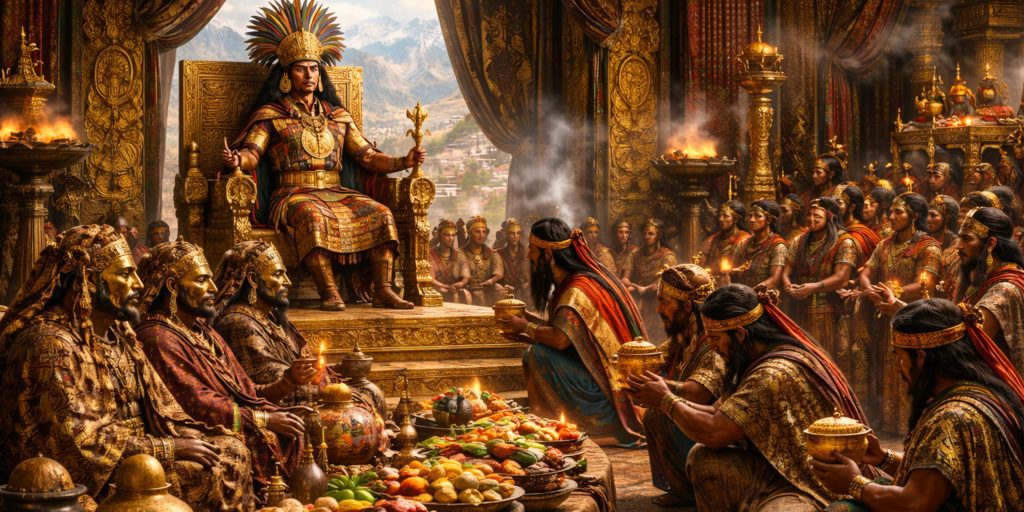
Life at the Inca court was governed by strict ceremony.
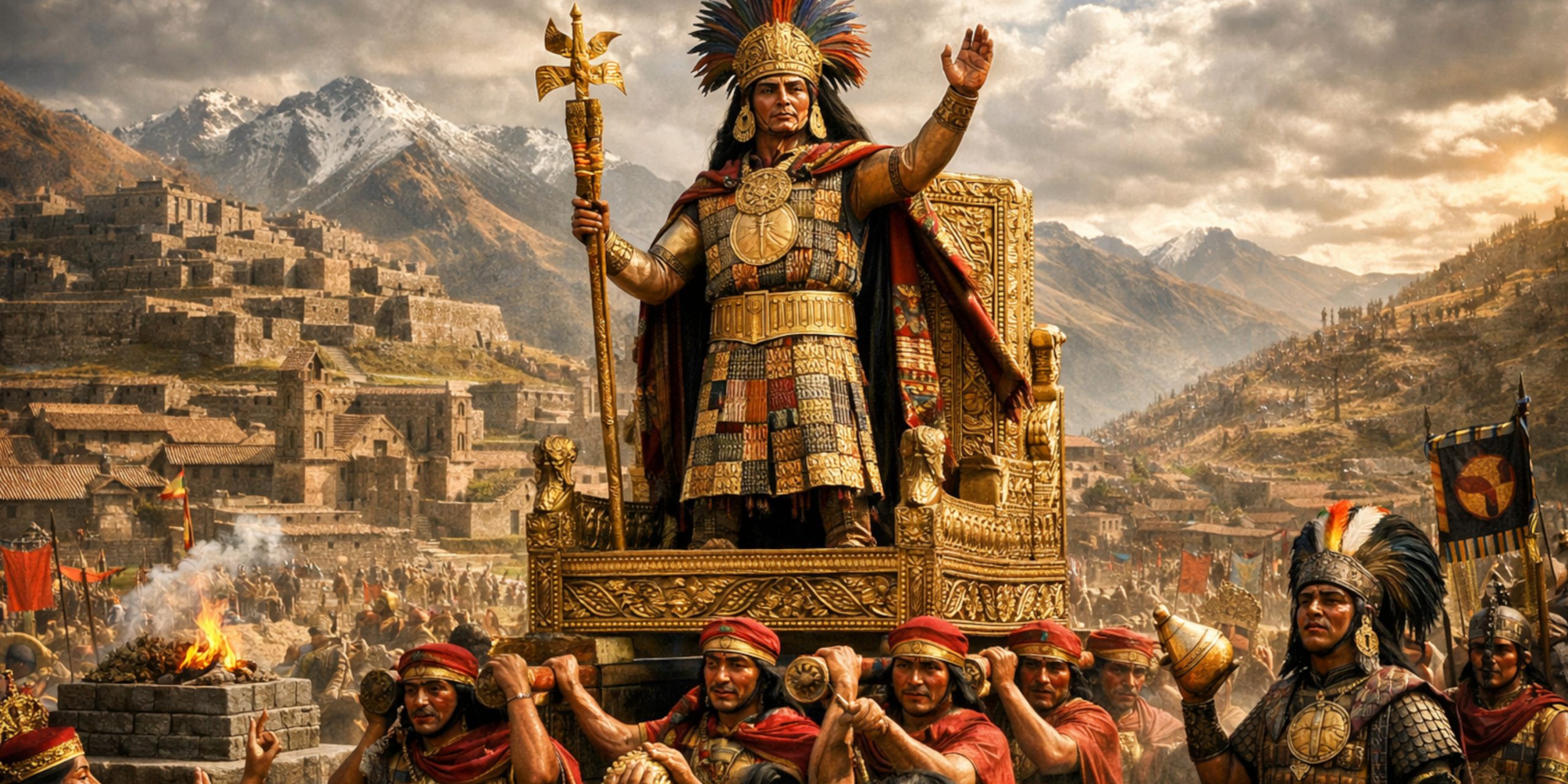
The emperor lived within palace complexes in Cusco. Servants and nobles attended him constantly. The Sapa Inca rarely walked in public and was often carried on a golden litter.
Some customs were particularly striking.
Royal mummies of previous rulers were preserved and treated as living ancestors. These mummies attended festivals, received offerings, and even owned land and estates.
Yes, that means deceased emperors continued participating in politics.
History occasionally produces customs that are difficult to explain at polite dinner parties.
Administration and Government
Despite lacking writing in the traditional sense, the Inca governed a vast empire with remarkable efficiency.
Their administration relied on:
• A hierarchy of provincial governors
• Census and labour systems
• State warehouses storing food and goods
• The quipu, a system of knotted cords used for accounting and record keeping
The empire also maintained a relay network of runners who carried messages across the road system. Information could travel hundreds of kilometres in a matter of days.
For a civilisation without wheeled transport or horses, the logistical sophistication is frankly impressive.
Archaeology and Modern Discoveries
Much of what we know about the Sapa Inca dynasty comes from archaeology.
Key sites include:
• Cusco
• Sacsayhuamán
• Machu Picchu
These cities reveal extraordinary stone construction. The Incas shaped massive blocks with such precision that many walls still stand after centuries of earthquakes.
Excavations continue to uncover details of imperial administration, agriculture, and ritual life.
Each discovery reminds historians how sophisticated this empire truly was.
The Legacy of the Sapa Incas
The Sapa Inca dynasty ruled one of the most complex states in pre Columbian history. Their empire combined engineering, agriculture, religion, and administration on a vast scale.
Even after the Spanish conquest, Inca culture did not vanish. Language, traditions, and agricultural systems survived throughout the Andes.
Today millions of people still speak Quechua, the language of the Inca state.
For historians the dynasty remains both fascinating and frustrating. We know a great deal about their empire, yet many mysteries remain. The absence of written chronicles leaves gaps that archaeology and careful interpretation must fill.
Still, the story of the Sapa Incas stands as a reminder that great empires have arisen in every corner of the world, sometimes far from the places most familiar in traditional European history.
And frankly, any dynasty that managed to run an empire while consulting the political opinions of royal mummies deserves at least a small measure of admiration.