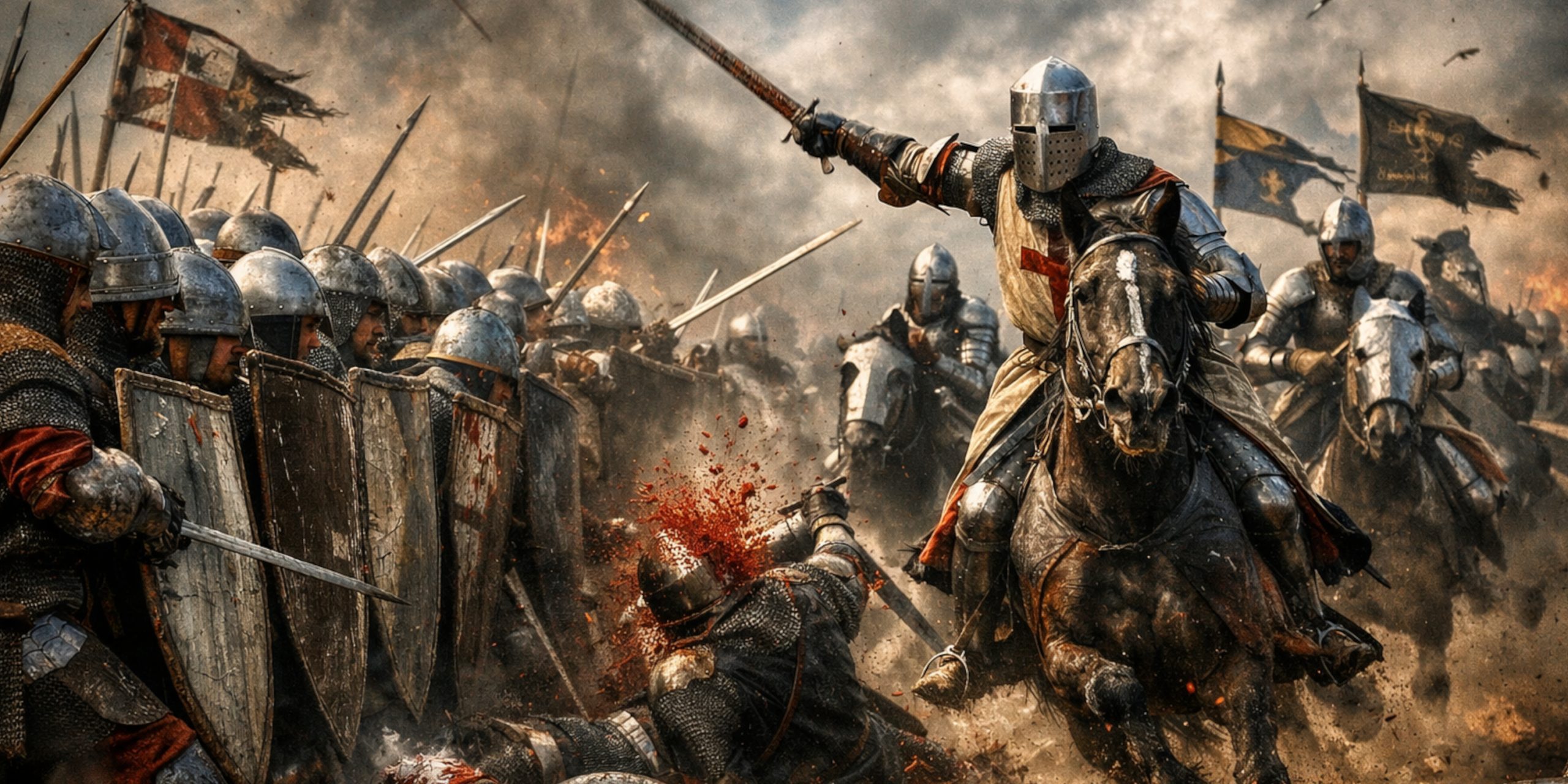
Medieval warfare rarely looked like the chaotic cinematic swirl we often imagine. Armies did not simply charge and hope for the best. Commanders understood formations, terrain, discipline, and timing. Battles were often decided before swords even crossed.
That said, medieval commanders also faced a stubborn reality. Armies were made up of feudal levies, mercenaries, professional knights, and occasionally enthusiastic peasants who had been handed a spear and pointed toward the enemy. Holding a neat formation in those circumstances required skill, intimidation, and sometimes divine optimism.
Still, over centuries of warfare across Europe and the Near East, several formations and tactical principles appeared again and again. They shaped the outcomes of famous battles and influenced military thinking for generations.
The Structure of Medieval Armies
Before discussing formations, it helps to understand how armies were organised.
Most medieval forces were divided into battles, which were large tactical divisions rather than individual engagements. A typical army deployed three main bodies.
- Vanguard – the forward division that initiated contact
- Main battle – the central force containing most troops
- Rear guard – the reserve, used to reinforce or exploit weakness
Commanders often placed their most reliable troops in the centre. Less dependable forces, or lighter troops, guarded the flanks.
This simple structure allowed commanders to manoeuvre relatively large forces with limited communication. Once battle began, orders travelled by trumpet, banner, or frantic shouting.
Which, if we are honest, was rarely ideal.
The Shield Wall
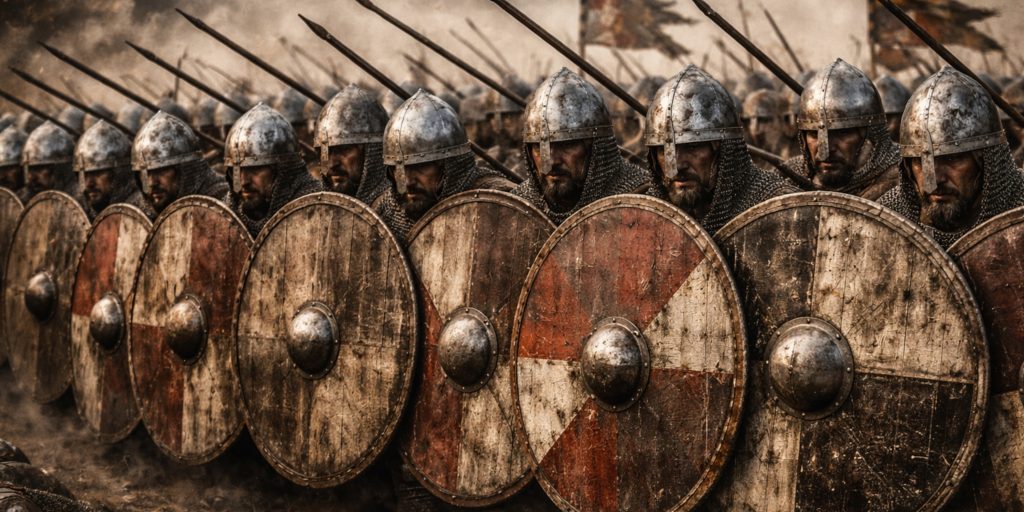
The shield wall was one of the oldest and most durable battlefield formations in medieval Europe. It was particularly associated with Anglo Saxon and Viking warfare, though variations existed across many cultures.
Soldiers stood shoulder to shoulder with overlapping shields. Spears and swords projected through the gaps. The aim was simple. Present a solid barrier that the enemy struggled to break.
Characteristics of the shield wall included:
- Tight formation with interlocked shields
- Spears used for thrusting over or between shields
- Close combat weapons once lines collided
Success depended heavily on discipline. If a few men broke ranks, gaps appeared. Once gaps appeared, the wall collapsed.
The Battle of Hastings in 1066 demonstrated both the strength and weakness of the formation. Anglo Saxon infantry held a shield wall for hours against Norman cavalry. The line only broke when parts of it pursued retreating horsemen.
The lesson was clear. Hold the wall and you might win. Lose patience and you probably would not.
The Cavalry Wedge
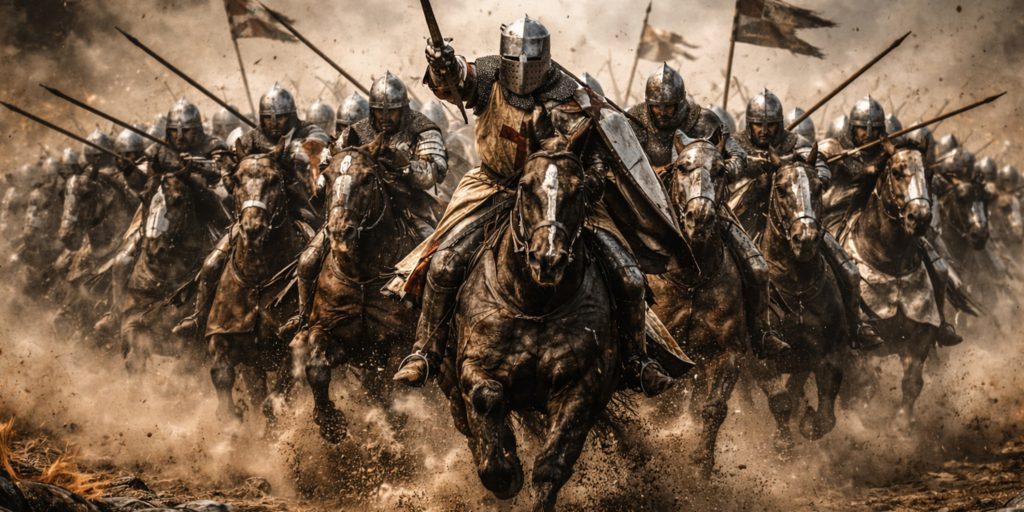
Heavy cavalry dominated many medieval battlefields, particularly between the eleventh and fourteenth centuries. Knights were expensive, heavily armoured, and terrifying when properly organised.
One of the most effective formations was the wedge.
In a wedge formation, cavalry formed a triangular spearhead with the most experienced knight at the tip. Riders behind widened the formation, creating concentrated force at the point of impact.
Advantages included:
- Maximum shock on a small section of the enemy line
- Ability to punch through infantry formations
- Strong leadership at the front of the formation
Norman cavalry frequently used this tactic. It also appeared in German and Byzantine military manuals.
However, the wedge required momentum. If infantry held firm with spears or pikes, the charge could stall. When that happened, heavily armoured knights suddenly found themselves surrounded by angry men with axes.
History suggests this was an uncomfortable place to be.
Infantry Blocks and Pike Formations
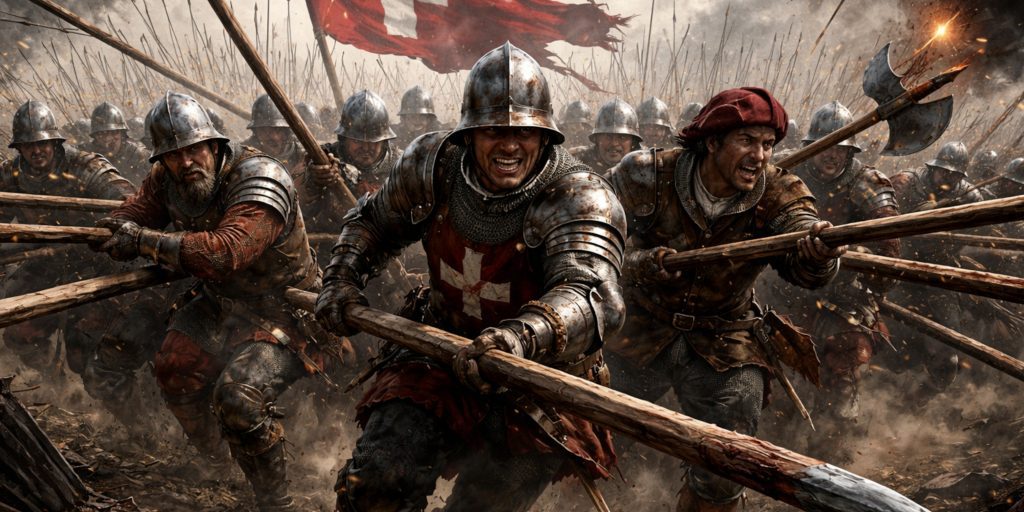
By the later Middle Ages, disciplined infantry formations began to challenge mounted knights. The Swiss and Flemish demonstrated that organised foot soldiers could dominate the battlefield.
Pike formations were dense blocks of infantry carrying very long spears. These weapons could reach four to six metres in length.
Key characteristics included:
- Dense ranks presenting multiple spear points
- Mutual protection from cavalry charges
- Strong cohesion and drilled discipline
The Battle of Courtrai in 1302 and later Swiss victories showed how effective such formations could be.
A charging knight meeting a forest of spearheads often discovered that courage alone did not solve everything.
Tactical Use of Terrain
Commanders who ignored terrain usually regretted it.
High ground offered several advantages:
- Improved visibility
- Defensive momentum against attackers
- Protection from cavalry charges
Many famous medieval victories depended on terrain. At Agincourt in 1415, muddy ground restricted French cavalry and compressed their advance into a killing zone for English longbowmen.
Forests, rivers, and narrow passes could also shape the battlefield. Medieval commanders frequently used these features to limit enemy movement and force predictable approaches.
In other words, geography often fought half the battle.
Arms and Armour on the Battlefield
Weapons influenced tactics. The tools soldiers carried determined how formations functioned.
Common Swords Used in Medieval Battles
| Sword Type | Description | Typical Users |
|---|---|---|
| Arming sword (Oakeshott Type XII, XIV) | Straight double edged sword suited to cutting and thrusting | Knights and men at arms |
| Longsword (Type XVIII variants) | Two handed weapon with greater reach and leverage | Late medieval knights |
| Falchion | Single edged cutting weapon similar to a machete | Infantry and knights |
| Messer | Large single edged blade common in German regions | Mercenaries and infantry |
These swords were usually secondary weapons. Most soldiers relied first on spears, polearms, or missile weapons.
Other Battlefield Weapons
- Spears and pikes for formation fighting
- Poleaxes and halberds against armoured opponents
- Longbows and crossbows for ranged combat
- Maces and war hammers for crushing armour
Armour evolved alongside these weapons.
Typical equipment included:
- Mail hauberks in early medieval periods
- Helmets such as nasal helms and great helms
- Later plate armour covering most of the body
Despite impressive armour, knights were far from invincible. Once dismounted and surrounded, they were often captured or killed.
Medieval warfare had little patience for heroic last stands.
Command and Battlefield Communication
Commanders relied on visual signals and sound to control armies.
Common methods included:
- Banners indicating unit positions
- Trumpets and horns signalling manoeuvres
- Mounted messengers carrying orders
Even with these tools, control was limited once battle began. Dust, noise, and panic frequently disrupted communication.
Many commanders therefore designed simple battle plans. Complex manoeuvres were rarely reliable.
The medieval battlefield was not exactly an ideal place for subtle strategy.
Archaeology and Evidence of Medieval Battles
Archaeology has transformed our understanding of medieval warfare.
Excavations at sites such as Towton, Visby, and Wisby mass graves have revealed direct evidence of combat injuries.
Findings include:
- Skull fractures from polearms and axes
- Deep sword cuts on bone
- Arrowheads embedded in skeletons
The Towton battlefield in England produced hundreds of skeletal remains showing brutal close combat. Many injuries came from behind, suggesting soldiers were killed while fleeing.
Artefacts found on battlefields also help reconstruct formations and troop movements. Arrow concentrations can indicate firing lines, while weapon fragments reveal where fighting was most intense.
In short, archaeology confirms something historians long suspected.
Medieval battles were extraordinarily violent affairs.
Contemporary Accounts
Chroniclers left vivid descriptions of medieval combat.
The historian Jean Froissart, writing about fourteenth century warfare, described battles with remarkable detail:
“The noise of the shouting and the clash of arms was so great that no man could hear another.”
The Anglo Saxon Chronicle recorded the fighting at Hastings:
“There was great slaughter on either side.”
Medieval chroniclers occasionally indulged in exaggeration, but their accounts capture the chaos and brutality of battle.
They also remind us that these events were not abstract tactical exercises. They were deeply human experiences filled with fear, courage, and confusion.
Legacy of Medieval Tactics
Medieval formations laid the foundations for later military systems.
Disciplined infantry blocks influenced Renaissance pike formations. Cavalry shock tactics evolved into early modern heavy cavalry doctrine. Missile troops paved the way for gunpowder warfare.
By the sixteenth century, firearms began to replace bows and crossbows, and battlefield tactics changed dramatically.
Yet the core principles remained familiar.
Hold formation. Control the terrain. Break the enemy’s cohesion.
Commanders from antiquity would have recognised the logic immediately.
And frankly, many of them would probably have approved.