Dracula is one of those figures who refuses to stay quietly in a grave. The name conjures images of candlelit castles, bats fluttering through moonlight, and aristocrats with suspiciously sharp teeth. Yet the story of Dracula is not just a gothic horror tale. It sits at a strange crossroads between history, folklore, and literature.
At the centre of it all is a very real medieval ruler, a mountain region in Eastern Europe full of unsettling legends, and a Victorian novelist who turned those ingredients into one of the most influential horror stories ever written.
The result is a character who has survived for centuries in one form or another. History created the seed. Folklore fed it. Literature made it immortal.
The Historical Figure Behind Dracula
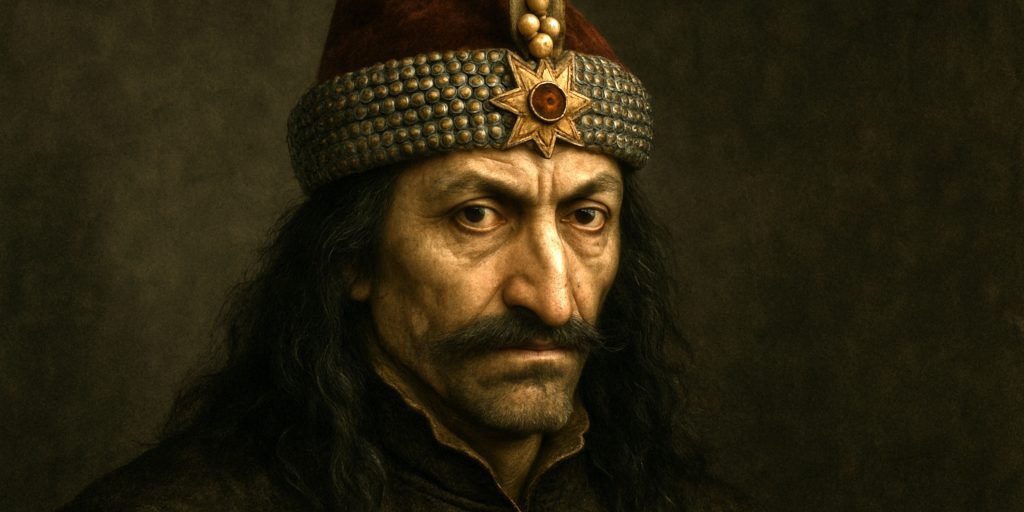
The historical inspiration for Dracula was Vlad III Dracula, the 15th century ruler of Wallachia. Today he is usually remembered by his nickname, Vlad the Impaler, which frankly tells you most of what you need to know about his reputation.
Vlad ruled Wallachia during a turbulent period in Eastern Europe. The region sat between two powerful forces: the Ottoman Empire and the kingdoms of Christian Europe. Political survival required brutality, diplomacy, and a strong stomach.
Vlad seemed to possess all three.
He earned his grim nickname through a particularly horrific method of punishment. Enemies and criminals were impaled on tall wooden stakes, sometimes left lining roads as a warning to others. Contemporary reports describe entire fields of victims displayed in this way.
Whether those accounts were exaggerated by enemies or not, Vlad’s reputation quickly spread across Europe.
Key facts about Vlad III:
- Born around 1431 in Transylvania
- Ruled Wallachia several times between 1448 and 1476
- Member of the Order of the Dragon, a chivalric order dedicated to fighting the Ottomans
- Known for brutal methods of rule and warfare
- Killed in battle in 1476
Despite the horror stories, Vlad was also seen by some as a national defender who resisted Ottoman expansion. Romanian folklore sometimes portrays him as a harsh but effective ruler who punished corruption and restored order.
So even before Bram Stoker got involved, Vlad already had a reputation that bordered on legend.
Transylvanian Folklore and Vampire Legends
Long before Dracula appeared in literature, Eastern Europe had a rich tradition of vampire folklore. The mountains and forests of Transylvania were particularly fertile ground for unsettling stories.
The region that features most heavily in Dracula lore is Transylvania, a mountainous area now part of Romania. In the medieval period it sat at the crossroads of several cultures and religions, which helped folklore travel and evolve.
Common vampire beliefs in the region included:
- The dead rising from graves to drink blood
- Corpses remaining strangely well preserved
- Plagues blamed on undead activity
- Rituals used to prevent the dead from returning
Villagers sometimes dug up graves to inspect bodies. If the corpse appeared fresh or bloated, it could be taken as proof that the deceased had become a vampire.
Preventative methods were creative:
- Driving wooden stakes through the heart
- Placing garlic near the body
- Removing the head
- Burning the corpse
These practices sound dramatic, but they were genuine attempts to explain disease outbreaks or mysterious deaths.
By the time Victorian writers began exploring gothic horror, Eastern European vampire folklore had already been circulating through travel writing and European newspapers.
All the ingredients for Dracula were quietly waiting.
Bram Stoker and the Birth of Count Dracula
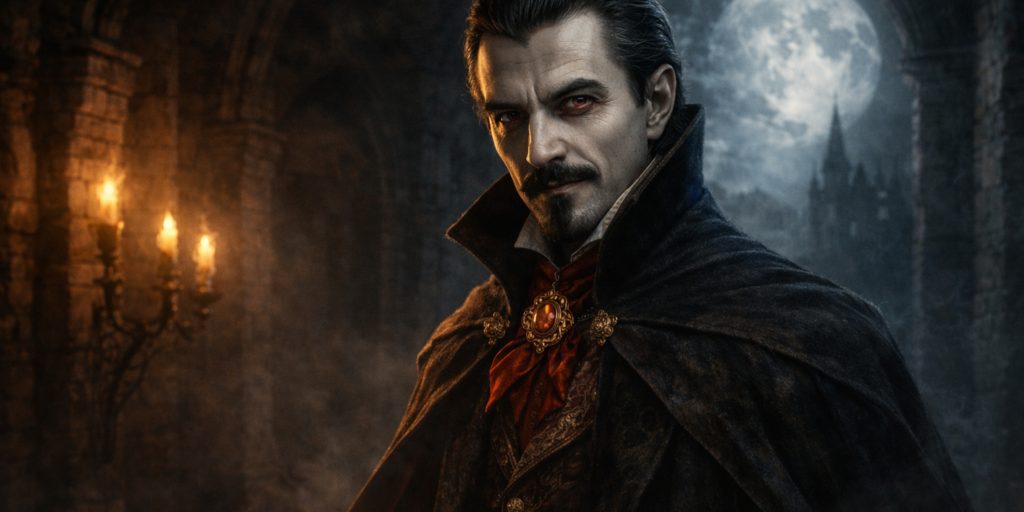
The character of Dracula as we recognise him today was created by Bram Stoker, whose novel Dracula was published in 1897.
Stoker had never visited Transylvania, which makes the result even more impressive. He built his fictional world through research, travel accounts, and folklore collections.
The novel introduced Count Dracula as an ancient vampire nobleman living in a remote castle in the Carpathian Mountains. From there he attempts to move to England, spreading his undead influence.
The book uses an unusual structure made up of letters, diary entries, newspaper clippings, and ship logs. That format helped create a sense that the story was unfolding through real documents.
The character of Dracula combined several influences:
- Vlad III’s name and reputation
- Eastern European vampire folklore
- Victorian fears about disease and immigration
- Gothic traditions of haunted castles and ancient curses
Stoker’s Dracula was not merely a monster. He was intelligent, cultured, and frighteningly patient. He could shape shift, control animals, and command supernatural powers.
That mixture of aristocratic charm and predatory menace proved irresistible to later writers and filmmakers.
Dracula in Film and Popular Culture
If Bram Stoker created Dracula, cinema made him unavoidable.
The first major film version arrived with Dracula, starring Bela Lugosi. Lugosi’s accent, formal posture, and hypnotic stare became the blueprint for the vampire count.
Later portrayals refined the character further. One of the most memorable versions came from Christopher Lee in the Hammer Film Productions horror series beginning in 1958.
Over time Dracula evolved into something more flexible than a single character. In some stories he is a terrifying predator. In others he is tragic, romantic, or even oddly sympathetic.
Modern interpretations appear in films, novels, television, and video games. The character keeps shifting shape, rather fittingly for a vampire.
Dracula’s Castle and Real Locations
One of the most famous settings in the Dracula story is his remote mountain castle. In the novel it sits somewhere high in the Carpathian Mountains, surrounded by forests and steep passes.
In the real world, the place most commonly associated with Dracula is Bran Castle.
Bran Castle looks exactly like what tourists imagine when they hear the words “vampire fortress”:
- Tall towers
- Narrow staircases
- Thick stone walls
- A dramatic mountain backdrop
However, the historical connection between Vlad the Impaler and Bran Castle is weak. He may have passed through the region or briefly been imprisoned nearby, but there is little evidence he actually lived there.
That detail rarely bothers visitors.
Today the castle draws huge numbers of tourists curious about Dracula, vampires, and gothic history.
Why Dracula Still Fascinates People
Dracula survives because he touches on several deep human fears and curiosities.
Immortality is one. The idea of living forever is tempting, but Stoker turned it into something unsettling. Dracula does not age, yet he must feed on the living to survive.
There is also the fear of the unknown. Victorian readers were fascinated and alarmed by distant regions of Europe that seemed mysterious and dangerous. Transylvania became the perfect setting.
Then there is the strange appeal of Dracula himself. He is not a mindless monster. He is intelligent, calculating, and strangely charismatic. People know he is dangerous, yet the character still pulls them closer.
Few fictional villains manage that trick.
The Legacy of Dracula
More than a century after its publication, Dracula still shapes how people imagine vampires.
Almost every modern vampire story borrows something from Stoker’s creation:
- The aristocratic vampire lord
- The castle in a remote landscape
- The ability to transform into animals
- The vulnerability to sunlight and wooden stakes
Without Dracula, the entire vampire genre would look very different.
From medieval Wallachia to modern cinema screens, the character has travelled a long and strange road. Somewhere along the way history blurred into myth, and myth turned into one of the most enduring monsters ever written.
Not bad for a story that started with a 15th century ruler who had a particularly unpleasant approach to law enforcement.