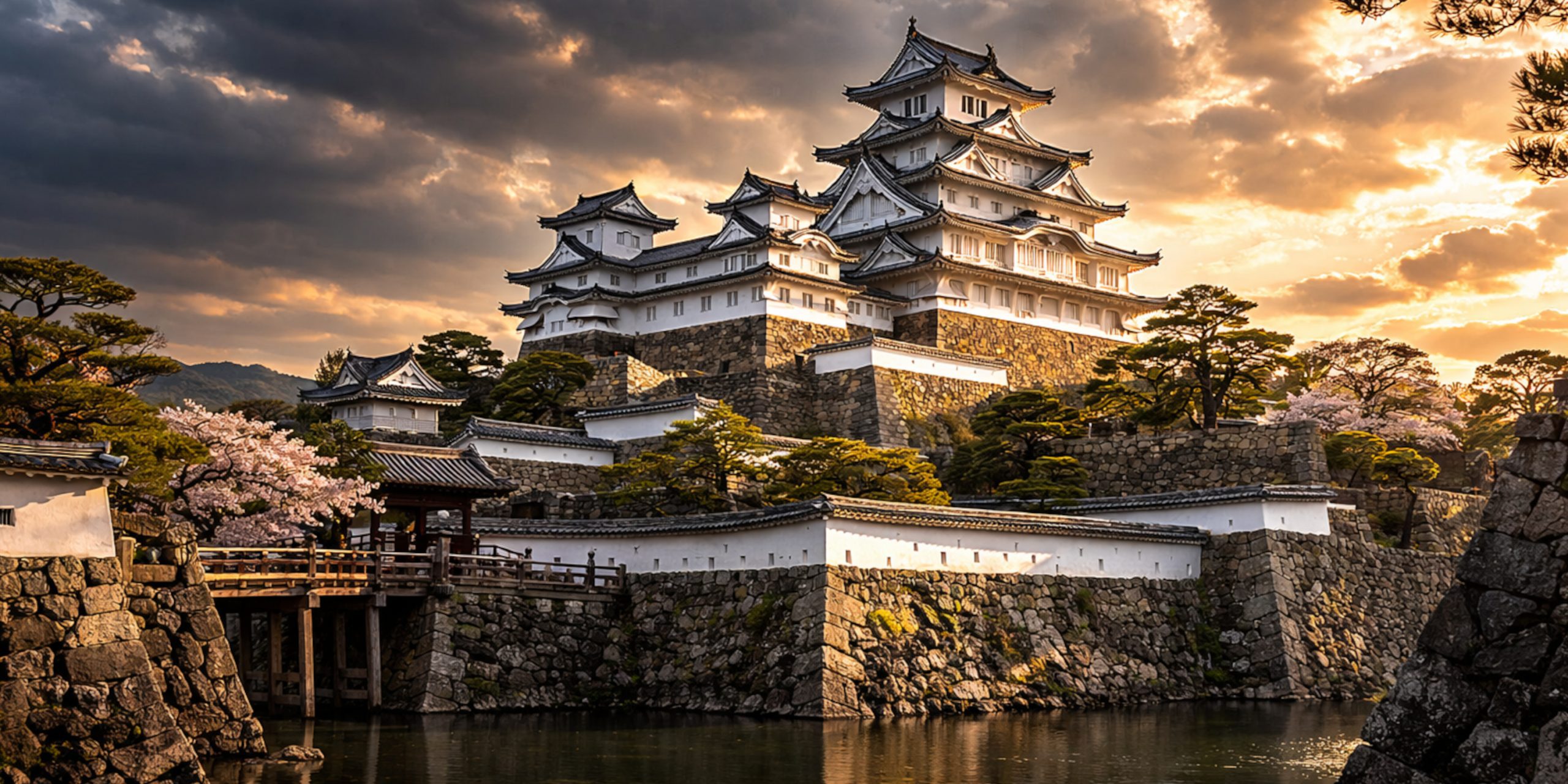
Few castles command such quiet authority as Himeji Castle. Rising above the plains of Harima, its white plastered walls and elegant roofs give it the nickname Shirasagi jo, the White Heron Castle. From a distance it appears almost delicate. Up close, it reveals itself as a fortress of calculation and intent.
Unlike many European strongholds that evolved through piecemeal rebuilding, Himeji survives as a remarkably complete early modern Japanese castle complex. It is not a romantic reconstruction. It is the real thing, shaped by war, ambition, and a relentless concern for defence.
Origins and Construction
The site began as a modest fort in the fourteenth century during the Nanboku cho period. In 1581, Toyotomi Hideyoshi strengthened it with a three storey keep. The structure we admire today, however, owes its grandeur to Ikeda Terumasa, who rebuilt the castle between 1601 and 1609 after the decisive victory at Sekigahara.
Terumasa understood that castles in the early Edo period were not merely military bastions. They were political statements. The towering main keep, multiple baileys, and complex approach routes proclaimed stability under the new Tokugawa order. The message was clear. Authority now had a permanent address.
Architectural Design and Defensive Planning
Himeji’s brilliance lies in its deceptive simplicity. The white plastered walls conceal a labyrinth of gates, angled passages, and hidden killing zones. Attackers entering the outer defences would be forced along winding routes that expose their flanks while offering little room to deploy large forces.
Key defensive features include:
- Curved stone walls designed to deflect scaling attempts
- Overhanging openings for dropping stones or pouring boiling liquids
- Narrow windows for archers and matchlock gunners
- A spiralling approach that disorients and slows any advance
The tenshu, or main keep, rises six storeys above ground with a basement below. Its internal timber framework is a masterpiece of carpentry, built without modern fasteners and remarkably resistant to earthquakes.
From the outside, it looks almost ornamental. From the inside, it feels resolute and practical. That contrast defines Japanese castle design at its best.
Sieges and Military Threats
Curiously for such a formidable fortress, Himeji has never endured a full scale siege comparable to those that battered European castles. Its greatest trials came from political upheaval rather than sustained assault.
During the upheavals of the late sixteenth century, the region saw conflict between rival warlords. Yet the grand Edo period castle, completed after Sekigahara, benefited from the relative peace enforced by the Tokugawa shogunate.
In the nineteenth century, during the Meiji Restoration, many castles across Japan were dismantled as relics of a feudal past. Himeji narrowly escaped demolition. It was sold at auction for a trivial sum, reportedly because the cost of dismantling it exceeded the value of the materials. Frugality, rather than sentiment, preserved one of Japan’s greatest monuments. Historians sometimes have to accept that luck plays a part.
Occupants Timeline
Himeji’s lords reflect the turbulent politics of medieval and early modern Japan.
Fourteenth to sixteenth centuries
- Akamatsu clan establishes early fortifications
- Toyotomi Hideyoshi expands the castle
1600 to 1613
- Ikeda Terumasa rebuilds the complex into its present form
Seventeenth century
- Honda clan assumes control
- Subsequent fudai daimyo families rotate through governance under Tokugawa oversight
Each lord modified internal residences and administrative quarters, though the main defensive core remained largely intact. The castle became less a battlefield redoubt and more a centre of governance and status display.
Archaeology and Restoration
Himeji Castle is designated a UNESCO World Heritage Site and a National Treasure of Japan. Restoration campaigns in the twentieth and twenty first centuries have aimed to preserve rather than reinvent.
Major conservation work between 2009 and 2015 involved dismantling sections of the roof and reinforcing structural timbers. Archaeological surveys during these works revealed details of original plaster composition and timber joinery techniques.
Excavations around the grounds have uncovered ceramic shards, roof tiles bearing clan crests, and remnants of earlier fortifications beneath the Edo period layers. These finds confirm that the site evolved continuously before reaching its iconic form.
Unlike some European castles reduced to foundations, Himeji offers a rare opportunity to study a near complete feudal complex. For historians of military architecture, it is a gift.
Contemporary Impressions
Seventeenth century visitors were struck by its scale and refinement. One Edo period account described it as “a vision of white rising above the fields, as though a bird had settled upon the hill.”
Later observers echoed this sense of wonder. Even in the nineteenth century, travellers remarked upon its unspoiled state when many other castles had already fallen into ruin.
There is something almost theatrical about it. Yet the theatre is grounded in hard military logic. Beauty here was not accidental. It was deliberate, and it served power.
Cultural Legacy
Himeji Castle has featured in countless films and television dramas, often standing in for other historical settings. Its silhouette has become shorthand for samurai era Japan.
More importantly, it represents the culmination of Japanese castle design before the long peace of the Edo period made large scale fortification obsolete. It is both a product of warfare and a monument to the peace that followed.
As a historian, I find it quietly ironic that the castle’s greatest triumph was never having to prove itself in a prolonged siege. Its strength deterred conflict. That, arguably, is the highest compliment any fortress can receive.
Visiting Today
Located in Hyogo Prefecture, the castle remains open to the public. Visitors climb steep wooden staircases, pass through angled gates, and follow the same confusing routes once intended to exhaust invaders. The experience makes clear that this was not merely a palace with walls attached. It was a carefully engineered defensive ecosystem.
Stand in the main keep and look out across the city. The modern world surrounds it, yet the structure itself feels composed and self assured. It has outlasted warlords, emperors, and industrialisation.
That endurance is its true legacy.