Who Were the Persian Immortals?
The Persian Immortals were the elite standing corps of the Achaemenid Empire, maintained at a constant strength of 10,000 men. Whenever one was killed, wounded or fell ill, he was replaced immediately. To outside observers, especially the Greeks, their number never seemed to diminish. Hence the name.
They served under kings such as Cyrus the Great, Darius I and Xerxes I, functioning both as royal bodyguards and as a core heavy infantry formation on campaign. They were not mythical. They were disciplined, politically important and very real.
Much of what we know comes from Greek writers, particularly Herodotus, whose admiration for Persian organisation sits alongside his cultural suspicion. It is wise to read him carefully. He loved a dramatic detail.
Origins and Development
The corps likely emerged during the reign of Cyrus in the mid sixth century BC, when the Persian state transformed from a regional power into an imperial machine. Cyrus needed a loyal, professional guard to anchor his authority across newly conquered lands.
Under Darius I, the empire became highly centralised. Administrative reform, monumental building projects and large scale campaigns required a permanent military backbone. The Immortals filled that role.
By the time Xerxes marched against Greece in 480 BC, the Immortals were already established as a symbol of imperial prestige. They accompanied him across the Hellespont, through Thrace and into central Greece.
Organisation and Structure
Herodotus describes the Immortals as:
- 10,000 strong at all times
- Primarily Persian, with some Median contingents
- Led by high ranking nobles
- Closely associated with the king’s household
The corps likely included:
- A core of aristocratic Persian warriors
- Sub units structured around officers of noble birth
- Logistical support staff travelling with the royal court
This was not a militia. It was a professional formation tied to the state’s identity.
Arms and Armour
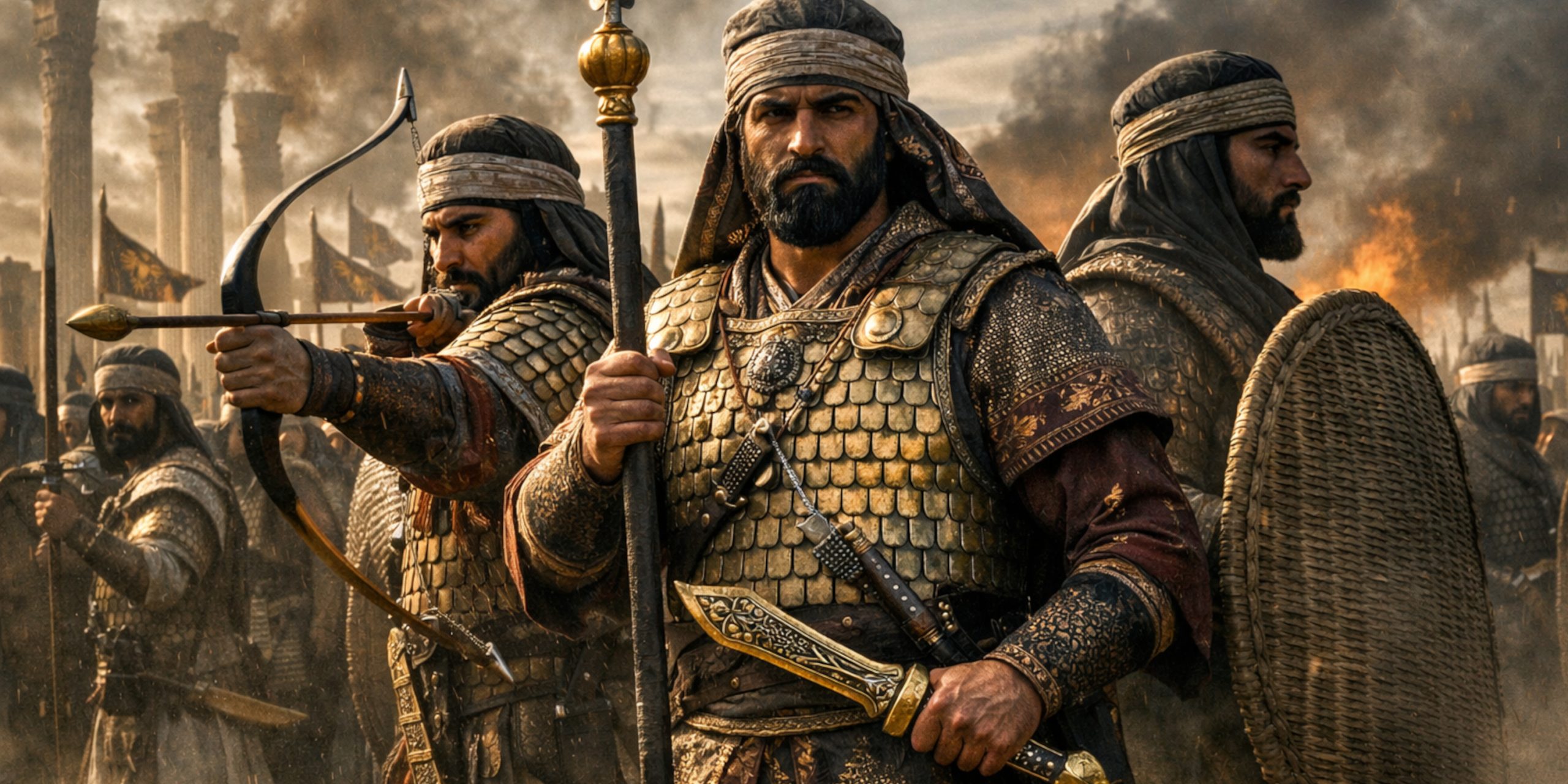
The Immortals were not heavily armoured hoplites in the Greek sense. They favoured flexibility and combined missile and melee capability.
Weapons
- Spear with a distinctive counterweight at the butt, sometimes described as apple or pomegranate shaped
- Short sword or dagger, commonly identified as the akinakes
- Composite bow, powerful and compact, suitable for field warfare
- Quiver of arrows, often elaborately decorated
The akinakes was a short, double edged blade worn at the right hip. It was ideal for close fighting once formations broke apart. Its size made it practical for a mobile infantryman rather than a heavily armoured shock trooper.
Armour
- Scale corselets made of metal or hardened leather
- Quilted or padded tunics beneath armour
- Soft felt or fabric tiaras rather than metal helmets
- Large wicker shields, known in Greek sources as sparabara
The wicker shield deserves attention. To a Greek hoplite, it might have looked flimsy. In practice it was light, flexible and effective against arrows. Persian tactics relied on coordinated archery and spear support, not shield wall collisions.
Battlefield Role
The Immortals appear in Greek accounts of major engagements during the Greco Persian Wars.
At Thermopylae, Herodotus records that Xerxes sent the Immortals against the Spartan position after initial assaults failed. He writes:
“The king, when he saw the Medes cut to pieces, sent in the Persians whom he called the Immortals.”
The Spartans, led by Leonidas I, held their narrow position with grim determination. Herodotus claims that the Immortals suffered heavily in the confined terrain. The geography of Thermopylae favoured heavy infantry fighting in tight formation, not the more flexible Persian style.
Later, at Plataea, Persian forces under Mardonius again faced Greek hoplites in open battle. The Immortals likely formed part of the central line. The final outcome was defeat for Persia, yet the corps itself endured as an institution.
Archaeology and Material Evidence
Unlike the Greeks, the Persians left no narrative histories of these campaigns. What we possess instead are reliefs and architectural decoration.
At Persepolis and Susa, repeated images of uniformed guards appear on palace stairways and walls. They carry spears, wear patterned robes and stand in serene, almost ceremonial poses.
The glazed brick friezes from Susa, now in the Louvre, show archers with intricate garments and detailed weaponry. These figures are often identified as Immortals or palace guards. The level of artistic care suggests high status.
Archaeological finds of the akinakes and scale armour fragments across former Achaemenid territories support the textual evidence. While we cannot match a specific blade to a named Immortal, the material culture aligns well with Greek descriptions.
Were They Truly “Immortal”?
The term is Greek. Herodotus writes that they were called athanatoi because their number never fell below 10,000.
It is entirely possible that the original Persian name meant something closer to “companions” or “royal guard,” and that the Greek ear transformed it into something more dramatic. The Greeks had a talent for branding their enemies.
In practical terms, the replacement system gave the corps an aura of permanence. In a world where most armies were temporary levies, that alone would have been striking.
Social Status and Court Life
The Immortals were not merely soldiers. They were part of the imperial court.
- Likely drawn from Persian nobility
- Granted access to the king
- Provided with wealth, gifts and prestige
They marched in ceremonial processions and guarded royal residences. In peacetime, their role was as political as it was military. One suspects that proximity to the Great King could be both an honour and a risk.
Contemporary Greek Views
Herodotus offers both respect and criticism. He admires Persian discipline and wealth but contrasts it with what he portrays as Greek courage.
He writes of Persian soldiers advancing “with whips behind them,” suggesting compulsion. This may reflect Greek propaganda as much as fact.
The tragedian Aeschylus, in his play The Persians, describes the grandeur of Xerxes’ army with a mixture of awe and warning. The Immortals symbolised imperial power, yet in Greek literature that power often carried the seed of hubris.
Legacy
The Persian Immortals became a template for elite guard units in later empires. The idea of a permanent, professional corps tied directly to the ruler appears again and again in history.
They also remain a fixture in popular imagination. Films and novels often exaggerate their appearance, sometimes turning them into masked phantoms. The reality was more grounded, though no less impressive.
They were disciplined infantry of a sophisticated empire, equipped with composite bows, spears and the compact akinakes. They fought across Anatolia, Egypt and Greece. They stood on palace stairways carved in stone for eternity.
Not immortal, of course. But memorable enough that we still argue about them two and a half millennia later. For a historian, that is a form of survival.
Takeaway
The Persian Immortals were neither invincible super soldiers nor fragile archers easily brushed aside. They were an elite imperial corps that reflected the administrative and military strength of the Achaemenid state.
Our understanding rests on Greek narrative, Persian art and scattered archaeological remains. Each source has its biases and limits. When placed together, they form a picture of a professional, symbolically powerful guard unit at the heart of one of the ancient world’s greatest empires.
And if the Greeks found the name dramatic, one cannot entirely blame them. Ten thousand men who never seemed to disappear would have left an impression on anyone standing across the battlefield.