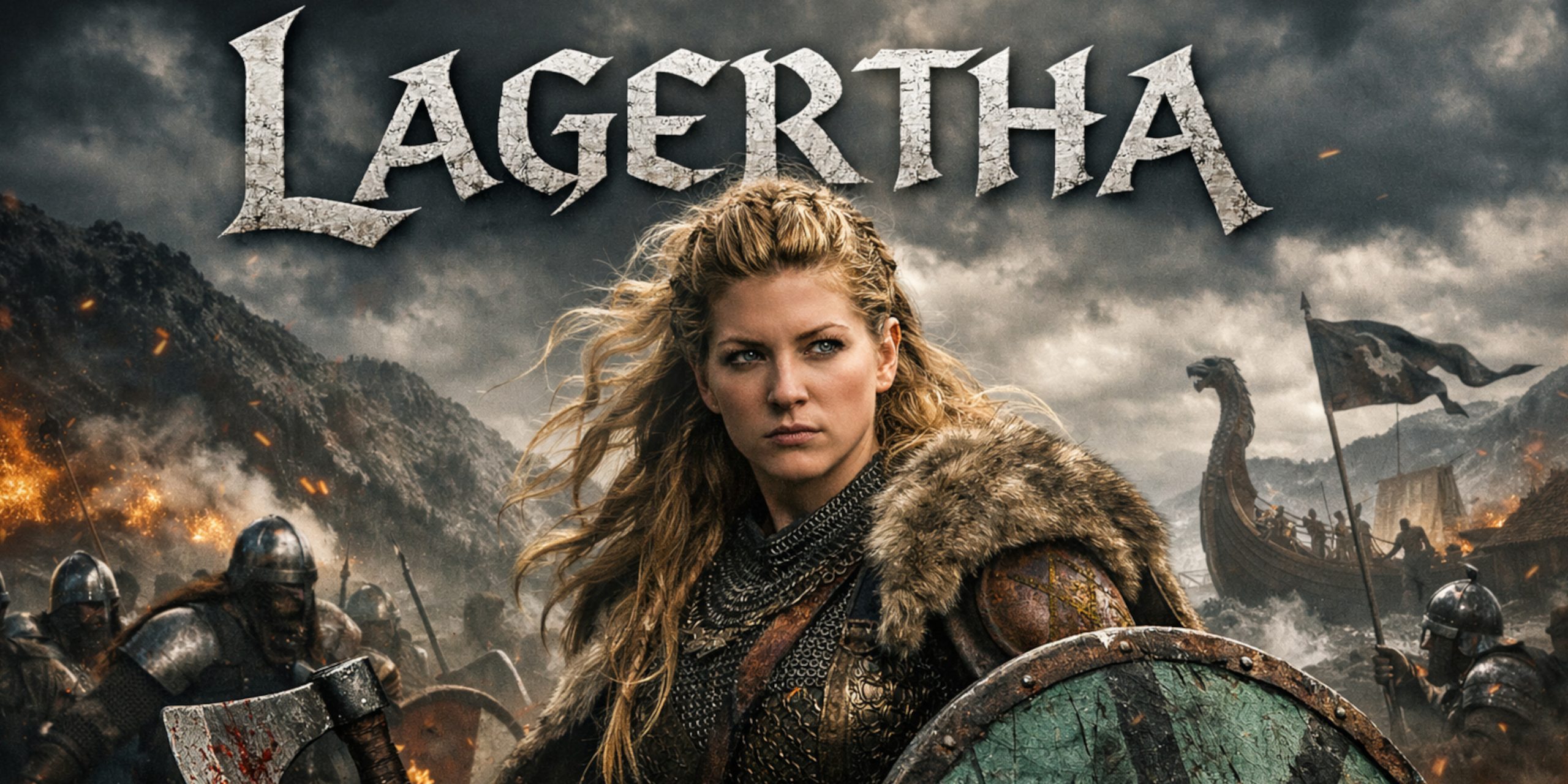
Lagertha sits in that sweet spot between legend and longing. She is fierce, clever, and inconveniently hard to pin down. Part saga heroine, part modern icon, she keeps turning up whenever we talk about Viking women who refused to stay in the background. This is not about separating myth from fact with a scalpel. It is about understanding why Lagertha still matters, and what she tells us about power, gender, and storytelling in the Viking world.
Who Was Lagertha?
Lagertha first appears in the pages of Gesta Danorum, written by Saxo Grammaticus in the late twelfth century. Saxo describes her as a fearsome warrior woman who fights alongside men and later becomes the wife of Ragnar Lothbrok.
She is not presented as a curiosity. She is competent, decisive, and dangerous in a fight. That alone makes her unusual in medieval writing, where women warriors are often sidelined or moralised into oblivion.
Key points from Saxo’s account:
- She fights in battle dressed as a man
- She commands respect through skill, not lineage
- She rules her own lands in Norway
- She ultimately refuses to be controlled
Whether Lagertha was a real person or a literary composite is still debated. What matters is that Saxo thought this kind of woman was believable to his audience.
Warrior First, Always
Lagertha’s reputation rests on her role as a shieldmaiden. Not a ceremonial fighter, but someone who steps into real combat and survives it.
In Saxo’s telling, she fights during Ragnar’s campaign against the Swedish king Frø. Her bravery is described with admiration, if a hint of discomfort. Saxo clearly does not know what to do with a woman who fights better than some of the men.
What this suggests historically:
- Viking-age women were not universally passive
- Exceptional women could step into martial roles
- Norse society had more flexibility than later medieval norms
Archaeology backs this up cautiously. The famous Birka grave, likely belonging to a high-status female warrior, has reopened the conversation around women in combat. Lagertha fits neatly into that wider reassessment.
Queen in Her Own Right
One of the most overlooked aspects of Lagertha’s story is her political independence. She does not just marry into power. She holds it.
After separating from Ragnar, Lagertha becomes ruler of her own territory. When Ragnar later needs military support, she provides it. On her terms.
Focus points on her rule:
- She governs land independently
- She commands troops and strategy
- She chooses alliance over obedience
- She exits relationships that limit her authority
For a medieval source, this is quietly radical. Saxo may not like her methods, but he cannot deny her effectiveness.
Lagertha on Screen
Modern audiences mostly know Lagertha through Vikings, where she is portrayed as a central character rather than a footnote. The show leans into her complexity, blending tenderness with brutality and ambition with loyalty.
The TV version takes liberties, but it gets one thing right. Lagertha is never just one thing.
On screen, she is:
- A frontline fighter
- A political operator
- A mother who pays real costs
- A ruler who earns loyalty through action
If Saxo’s Lagertha cracked the door open, the modern version kicks it off its hinges.
Myth, Memory, and Why She Endures
Lagertha endures because she breaks expectations without turning into a gimmick. She is not written as perfect. She is written as capable.
She also exposes a tension that still feels modern:
- Who gets to hold power
- Who decides what strength looks like
- Who history chooses to remember
In a world obsessed with Viking masculinity, Lagertha stands as proof that Norse storytelling had room for women who fought, ruled, and refused to apologise.
That makes her less of an exception and more of a reminder.
Why Lagertha works as a character
Lagertha matters because she forces us to rethink the past rather than flatten it. She shows that Viking society was messy, flexible, and sometimes surprisingly open to female authority, at least in legend.
She also reminds us that history is shaped by who tells the story. Saxo tried to frame her as an anomaly. Modern readers see something else entirely.
A woman who knew her worth, sharpened her axe, and ruled anyway.