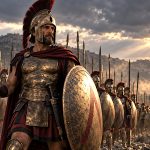
Dismounted men-at-arms sit at the centre of late medieval warfare, stubborn, well-equipped professionals who chose to fight on foot when horses were impractical, too vulnerable, or simply the wrong tool for the job. They were not desperate knights who had lost their mounts. In many battles they dismounted by design, trading speed for stability and control. If cavalry was the medieval sports car, dismounted men-at-arms were the armoured lorry that kept moving through the mud.
They appear most clearly from the late thirteenth century onward and dominate battlefields in the fourteenth and fifteenth centuries, especially in northern France, the Low Countries, and the British Isles. English, Burgundian, and French armies all relied on them. Their role evolved with armour technology, infantry tactics, and the growing threat posed by disciplined missile troops.
Who Were the Dismounted Men-at-Arms?
Men-at-arms were defined less by birth and more by equipment and pay. Many were knights, many more were esquires or well-off professionals who could afford armour and weapons. When they dismounted, they formed dense blocks intended to hold ground, push forward methodically, and absorb punishment that lighter troops could not.
They often fought alongside archers, crossbowmen, or handgunners. The relationship was simple and effective. Missile troops disrupted and weakened the enemy. Dismounted men-at-arms closed the distance and finished the argument.
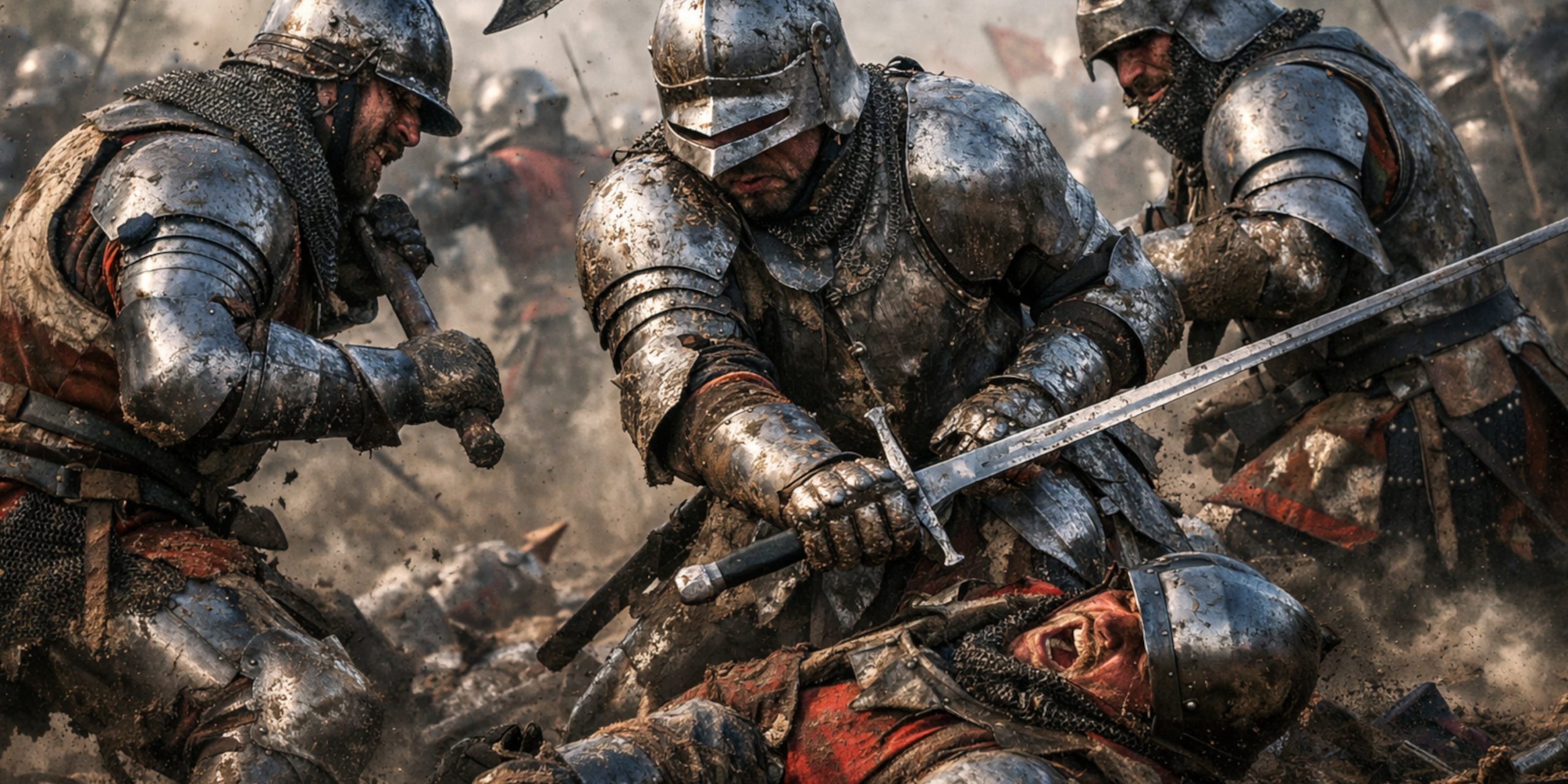
English armies in particular favoured this approach, most famously at Battle of Agincourt, where dismounted men-at-arms advanced through heavy mud in tight formation, anchoring an army otherwise dominated by longbowmen.
Why Fight on Foot?
The decision to dismount was usually pragmatic rather than ideological.
Cavalry struggled in broken ground, forests, steep slopes, and mud. Horses were vulnerable to arrows, stakes, and polearms. Once unhorsed, a knight was in serious trouble. Fighting on foot removed that risk and allowed armour to do what it was designed for, which was keeping a human alive under alarming amounts of violence.
There was also discipline. Infantry formations held together better than cavalry charges, especially when commanders needed to control tempo rather than gamble everything on a single impact. Medieval generals learned, sometimes painfully, that a knight who charged at the wrong moment was a liability no matter how noble his lineage.
Arms and Armour
By the fourteenth and fifteenth centuries, dismounted men-at-arms were among the best-protected soldiers Europe had ever seen.
Armour typically included:
- Mail with integrated plate elements in the earlier period.
- Full plate harness by the mid to late fifteenth century, tailored to the wearer.
- Great helms early on, later replaced by bascinets with visors, sallets, and armets.
- Gauntlets and plate sabatons, because losing fingers or toes was frowned upon even then.
Weapons reflected close-quarter realities rather than heroic imagery.
Common sword types included:
- Single-handed arming swords, often Oakeshott Types XII to XIV, effective for cuts and thrusts.
- Hand-and-a-half swords, especially Type XV and XVIII forms, favoured for their stiff thrusting blades against armour.
- Shorter thrust-focused blades designed to exploit gaps at the visor, armpit, or groin.
Swords were secondary more often than people like to admit. The real work was done by:
- Poleaxes, the signature weapon of dismounted men-at-arms, combining axe, hammer, and spike.
- Maces and war hammers, brutally efficient against plate.
- Daggers such as rondels for finishing an opponent once they were down.
If this sounds unpleasant, it was. Medieval sources are refreshingly honest about that.
Tactics on the Battlefield
Dismounted men-at-arms fought in close order, shields becoming less common as plate armour improved. They advanced steadily, often under missile fire, trusting their armour and formation. Once engaged, combat was physical, exhausting, and intensely personal.
Poleaxes hooked limbs, knocked opponents off balance, and punched through weak points. Once someone fell, several men would pile in, daggers out, looking for gaps. Ransom was still a motive, but only after the immediate problem had been solved.
It was not elegant. It was effective.
Archaeology and Material Evidence
Archaeology backs up the written sources. Mass graves from battles such as Visby show bodies wearing substantial armour, many with wounds consistent with poleaxe blows and dagger thrusts rather than sweeping sword cuts.
Surviving harnesses in collections across Europe demonstrate how specialised this equipment was. Armour was articulated for movement on foot, with reinforced joints and weight distributed across the body. This was not cavalry kit reluctantly repurposed. It was designed for exactly this job.
Weapon finds, especially poleaxe heads and rondel daggers, appear in contexts that align neatly with accounts of dismounted combat. The material record agrees with the chroniclers more often than it disagrees.
Contemporary Voices
Medieval writers noticed the shift toward fighting on foot and commented on it with varying degrees of approval.
The chronicler Jean Froissart described men-at-arms dismounting to fight more resolutely, noting that once on foot they stood firm “as though rooted to the earth.” It is not hard to hear a mix of admiration and mild disbelief.
Elsewhere, commanders advised dismounting precisely because it reduced chaos. One Burgundian ordinance bluntly stated that men should fight on foot “to avoid the disorder of reckless charges.” Medieval understatement has its charms.
Legacy and Decline
Dismounted men-at-arms represent a transitional peak. They combined personal skill, expensive equipment, and disciplined tactics in a way that dominated battlefields for over a century.
Their decline was not sudden. Firearms, cheaper infantry, and changes in warfare economics gradually made heavily armoured professionals less viable. By the sixteenth century, pike and shot formations replaced them, and armour began to thin.
Still, for a time, this was as close as medieval Europe came to a walking tank. Slow, determined, and very hard to stop.