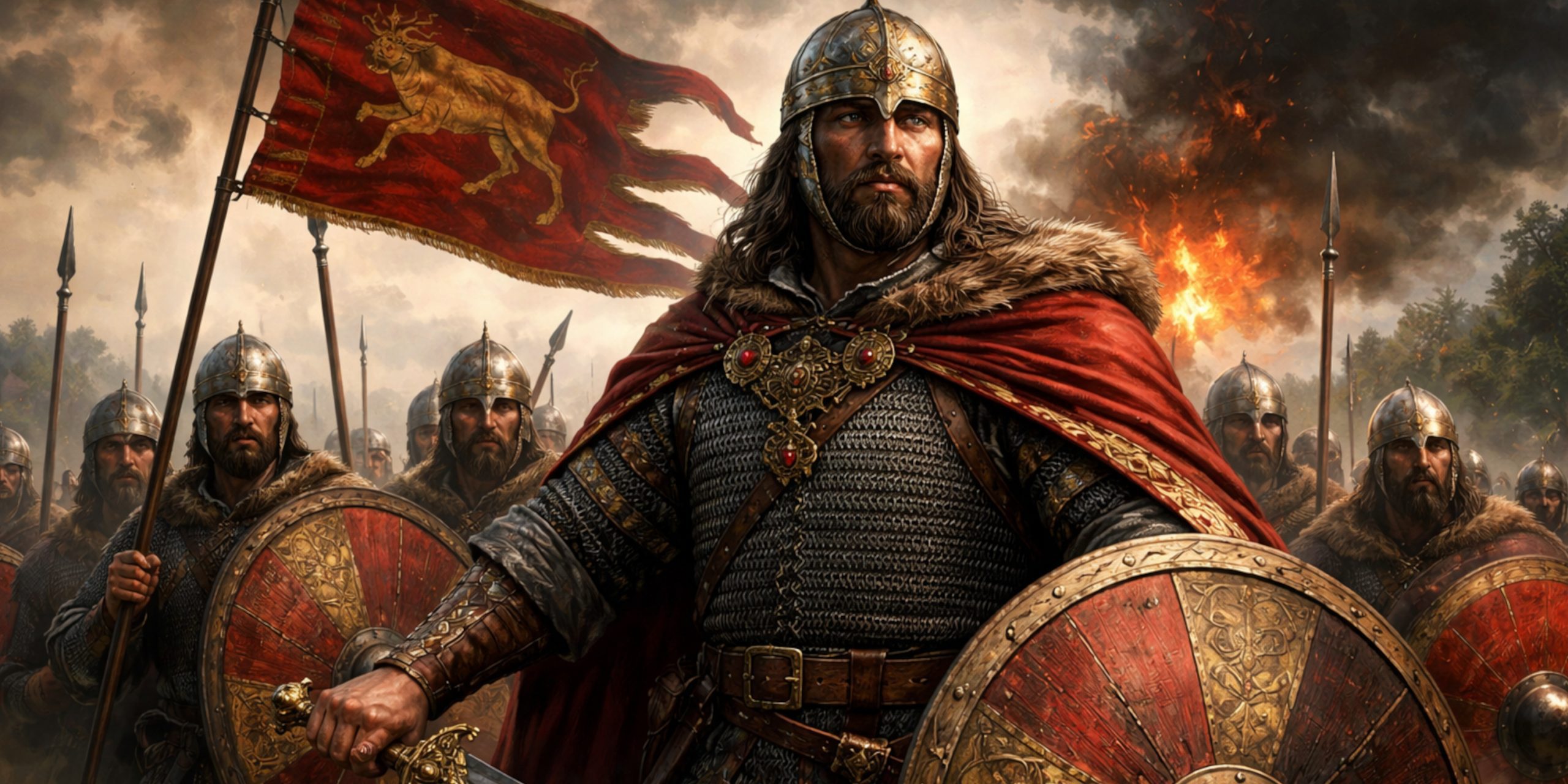
Edwin of Northumbria is one of those early English kings who feels half solid, half mist. We know his decisions reshaped northern England, we know his court drew pilgrims and princes alike, and we know his death shattered a fragile peace. Yet so much of Edwin survives through careful inference rather than neat fact. That is part of his appeal. He stands at the point where Northumbria became more than a regional power and began to think of itself as a kingdom that mattered to all Britain.
Origins and Exile
Edwin was born into the royal line of Northumbria, probably in the late sixth century. His early life was marked by violence and flight. After the death of his father Ælle, Edwin became a target for rival dynasties. He spent years moving between courts, surviving through patronage, sharp instincts, and a talent for not being in the wrong place at the wrong time.
This long exile mattered. It hardened him, but it also exposed him to different models of kingship. When Edwin finally returned to claim his throne, he did so with the outlook of a man who had seen how power worked elsewhere and how quickly it could be lost.
Rise to the Northumbrian Throne
Edwin secured the kingship around 616, defeating Æthelfrith’s heirs and reuniting Bernicia and Deira. From the start, his rule was ambitious. He aimed not merely to survive but to dominate. Contemporary sources describe roads being made safe, justice enforced, and royal authority extended far beyond the old heartlands.
Bede famously claimed that a woman could walk across the kingdom with a baby and a gold bracelet unmolested. That sounds like propaganda, but even propaganda tells us what a king wanted to be remembered for.
Battles and Military Acumen
Edwin’s military strength lay less in reckless aggression and more in calculated pressure. He expanded Northumbrian influence south into Lindsey and the Midlands, forcing neighbouring kings into submission rather than annihilation.
His fatal misstep came in 633 at the Battle of Hatfield Chase. There, Edwin faced a coalition led by Cadwallon of Gwynedd and Penda of Mercia. The defeat was catastrophic. Edwin was killed, his army broken, and Northumbria briefly collapsed into chaos.
As a commander, Edwin seems to have favoured strong positioning and political dominance over constant warfare. Hatfield Chase suggests he was capable of error, perhaps overconfident, perhaps forced into battle by shifting alliances. It is a reminder that even capable kings lose when the strategic ground shifts beneath them.
Arms and Armour of Edwin’s Warband
No arms can be firmly tied to Edwin himself, but we can reconstruct what his elite warriors would have carried. His household troops would have been equipped with pattern-welded swords, often with lobed or Brazil nut pommels, prized heirlooms passed through generations.
Spears were the backbone of Northumbrian warfare. Shields were round, wooden, and bossed, usually painted or leather-faced. Helmets were rare and valuable, likely similar in style to those later found at Sutton Hoo, with iron caps and decorative fittings.
Mail shirts existed but were exceptional. Most warriors relied on thick clothing, shields, and discipline. Edwin’s power came from organisation and loyalty rather than technological advantage.
Conversion to Christianity
Edwin’s conversion in 627 was both personal and political. Influenced by his Kentish wife Æthelburh and the missionary Paulinus, he accepted baptism at York. This tied Northumbria into the growing Christian network of Europe and reshaped royal authority.
Churches followed, as did literacy and record keeping. While Edwin did not live long enough to consolidate this change, his decision set a precedent that later kings could not ignore.
Death and Legacy
Edwin’s death was brutal and symbolic. His body was reportedly mutilated, his head displayed. For a king who had brought order, the collapse that followed felt almost cruel. Yet his reign lingered in memory. Later Northumbrian rulers inherited his ambitions, his administrative instincts, and his sense that the north could rule, not merely resist.
In that sense, Edwin failed in life but succeeded in legacy. He showed what Northumbria could be.
Archaeology and Material Evidence
No royal tomb of Edwin has been identified, but archaeology continues to flesh out his world. High-status seventh-century settlements across Northumbria show increasing wealth, imported goods, and evidence of organised lordship during his reign.
Excavations around early ecclesiastical sites in Yorkshire support Bede’s account of rapid Christianisation. Metalwork finds, especially weapon fittings and dress items, point to an elite warrior culture that fits the literary sources well.
Nothing dramatic has emerged recently, but that quiet accumulation of context is how early medieval history usually advances.
Where to See Artefacts from Edwin’s Era
While no object can be labelled as Edwin’s own, several collections bring his world into sharp focus. The Yorkshire Museum in York holds early Anglo-Saxon material linked to the Northumbrian elite. The British Museum displays weapons and metalwork from comparable contexts across England.
Bamburgh Castle’s ongoing archaeological work and local displays are also worth attention. Bamburgh was a northern power centre, and its finds give a sense of the martial culture Edwin both inherited and shaped.
Seven Swords Taleaway
Edwin of Northumbria feels real because he is flawed. He was clever, forceful, and ambitious, yet vulnerable to the same political storms that destroyed lesser kings. His reign marks a turning point when northern England briefly set the terms of power.
As a historian, I find him compelling precisely because he did not win in the end. He tried something bigger than himself, and for a moment, it worked.
Watch the documentary: