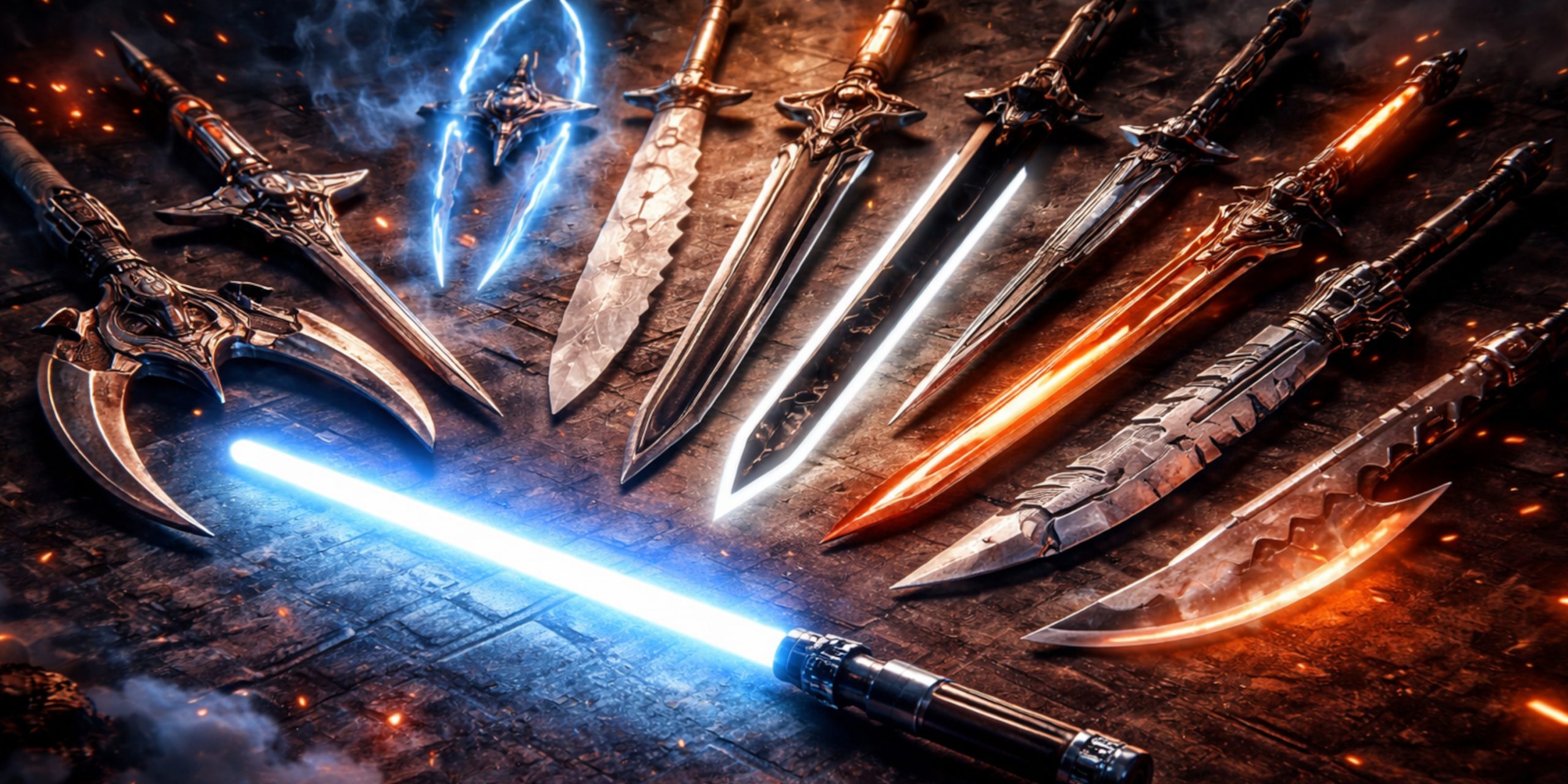
Science fiction loves scale. Planet killers, galaxy sized empires, fleets blotting out stars. Yet when stories want something personal, something that reveals character rather than firepower, they reach for a sword.
This ranking focuses on impact. Cultural weight. Narrative gravity. Not just how cool a blade looks, but how much it shapes the world around it.
10. The Jaffa Staff Blade
Stargate SG-1
The Jaffa staff blade originates within a rigid military and religious system rather than a heroic tradition. It is issued, not earned, and that distinction matters.
Forged using Goa’uld technology and Jaffa craftsmanship, the blade is primarily ceremonial but fully functional. It is powered in the most basic sense by muscle and training rather than exotic energy sources, which sets it apart in a technology heavy universe.
Its purpose is symbolic as much as martial. The blade reinforces hierarchy and obedience. A Jaffa warrior carries it as a sign of role, not personal destiny. That restraint gives it credibility.
9. The Blade of Tython
Star Wars: The Old Republic
The Blade of Tython is less a weapon than a relic of place.
Its origins lie in the early formation of the Jedi Order, forged to stand as a physical symbol of balance and continuity. Unlike personal lightsabers, it is not bound to a single individual. It belongs to the Order itself.
Power comes from a traditional kyber crystal core, but the blade is stabilised and maintained through its connection to the Force rich environment of Tython. It represents harmony rather than combat readiness, which explains why it is rarely wielded in anger.
8. The High Frequency Blade
Metal Gear Rising: Revengeance
This blade is born entirely from escalation.
Developed in a world of cyborg soldiers and mechanised warfare, the high frequency blade uses rapid molecular vibration to weaken atomic bonds. In simple terms, it cuts because reality gives up first.
Powered by advanced energy cells and integrated cybernetic systems, the blade is as much a component of its wielder as an external weapon. It reflects a future where human strength is irrelevant without technological amplification.
It exists because moderation was never on the design brief.
7. The Sword of Kahless
Star Trek: The Next Generation
The Sword of Kahless is forged in myth long before it is forged in metal.
According to Klingon tradition, it was created by Kahless himself using fire and his own blood. Whether this is literal or symbolic barely matters. The belief is what gives the sword its power.
Physically, it is an edged weapon with no advanced technology. Its strength lies entirely in cultural authority. Whoever holds it claims divine legitimacy, which is why it is more dangerous politically than militarily.
The sword is powered by faith, and Star Trek wisely treats that as a volatile energy source.
6. Vibroblades
Star Wars: Knights of the Old Republic
Vibroblades were created out of necessity rather than tradition.
As lightsabers reshaped galactic combat, armourers responded with blades reinforced with energy generators that vibrate the cutting edge at extreme frequencies. This allows vibroblades to disrupt lightsaber blades and cut through powered armour.
They are powered by compact energy cells housed in the hilt, making them maintenance heavy but brutally effective. Unlike lightsabers, they are mass produced.
Their origin story is pragmatic. When gods walk the battlefield, everyone else adapts or dies.
5. The Bat’leth
Star Trek
The bat’leth originates in Klingon myth, credited to Kahless as a weapon designed to force warriors into close, honour bound combat.
Forged traditionally from metal alloys without advanced power sources, the bat’leth relies entirely on strength, balance, and commitment. Its unusual shape encourages hooking, trapping, and brutal grappling rather than clean strikes.
It is powered by ideology. Klingon honour codes demand proximity and risk. The bat’leth enforces those values physically.
4. The Energy Sword
Halo
The Energy Sword is a product of Covenant technology and belief.
Forged using advanced plasma containment fields, the blade consists of twin arcs of superheated energy held in shape by magnetic fields. It is powered by high density energy cells integrated into the hilt.
Its origin lies in elite warrior culture. Only high ranking Covenant soldiers are permitted to wield it. That exclusivity enhances its psychological impact.
This is not a duelling weapon. It is designed for decisive, overwhelming kills.
3. The Dark Saber
The Mandalorian
The Dark Saber was forged by Tarre Vizsla, the first Mandalorian Jedi. That alone makes it an anomaly.
Powered by a kyber crystal like other lightsabers, its flat black blade suggests a unique containment or tuning process. It behaves differently, feeling heavier and more resistant to untrained wielders.
Its true power is cultural. Ownership signifies the right to rule Mandalore. You cannot claim it by inheritance. You must defeat the previous holder.
It is powered by kyber, but legitimised by combat.
2. The Crysknife
Dune
The crysknife is forged from the tooth of a sandworm, the most sacred and dangerous creature on Arrakis.
It has no technological power source. Its lethality comes from material and ritual. Fresh crysknives degrade if removed from a living body unless treated, reinforcing their connection to death and obligation.
The blade is powered by belief and scarcity. Every crysknife represents survival in an environment that kills the careless.
It is one of the few science fiction weapons that feels genuinely earned.
1. The Lightsaber
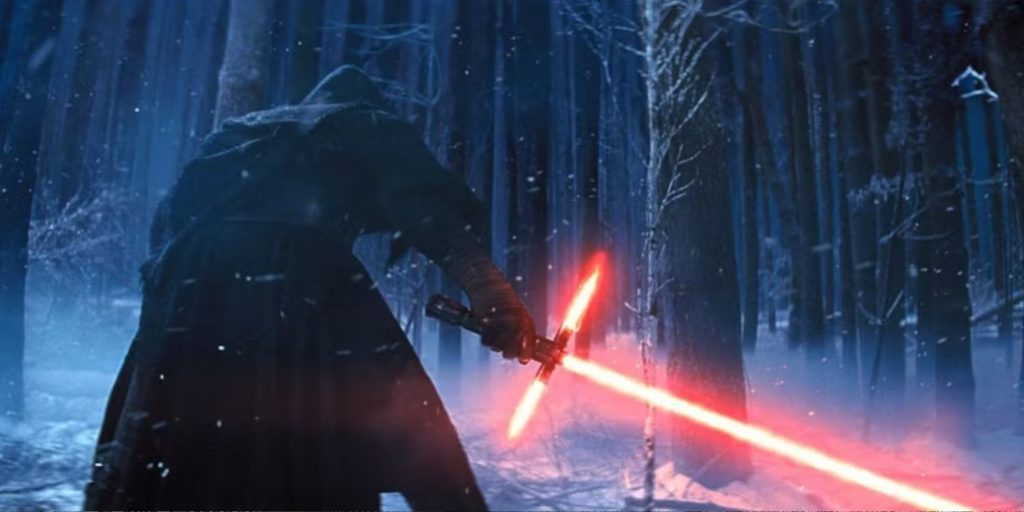
Star Wars
The lightsaber is forged through a deeply personal ritual.
Each blade is built around a kyber crystal, a Force attuned mineral that resonates with its wielder. The crystal is housed within an energy containment field that projects a plasma blade.
Power comes from both technology and the Force. Without discipline and connection, the weapon is unstable or ineffective.
What makes the lightsaber unmatched is balance. Engineering, mysticism, and symbolism all align. It is not just a weapon. It is a test of identity.
Why Swords Still Dominate Science Fiction
Swords compress conflict. They force proximity. They turn ideology into action. In galaxies full of distance and automation, a blade demands intent.
Historically, swords were never just tools. They were claims to authority, belief, and identity. Science fiction keeps returning to them because that emotional language still works.
The best sci fi swords are not the brightest or the sharpest. They are the ones that ask who gets to carry them, and what it costs when they do.ds.