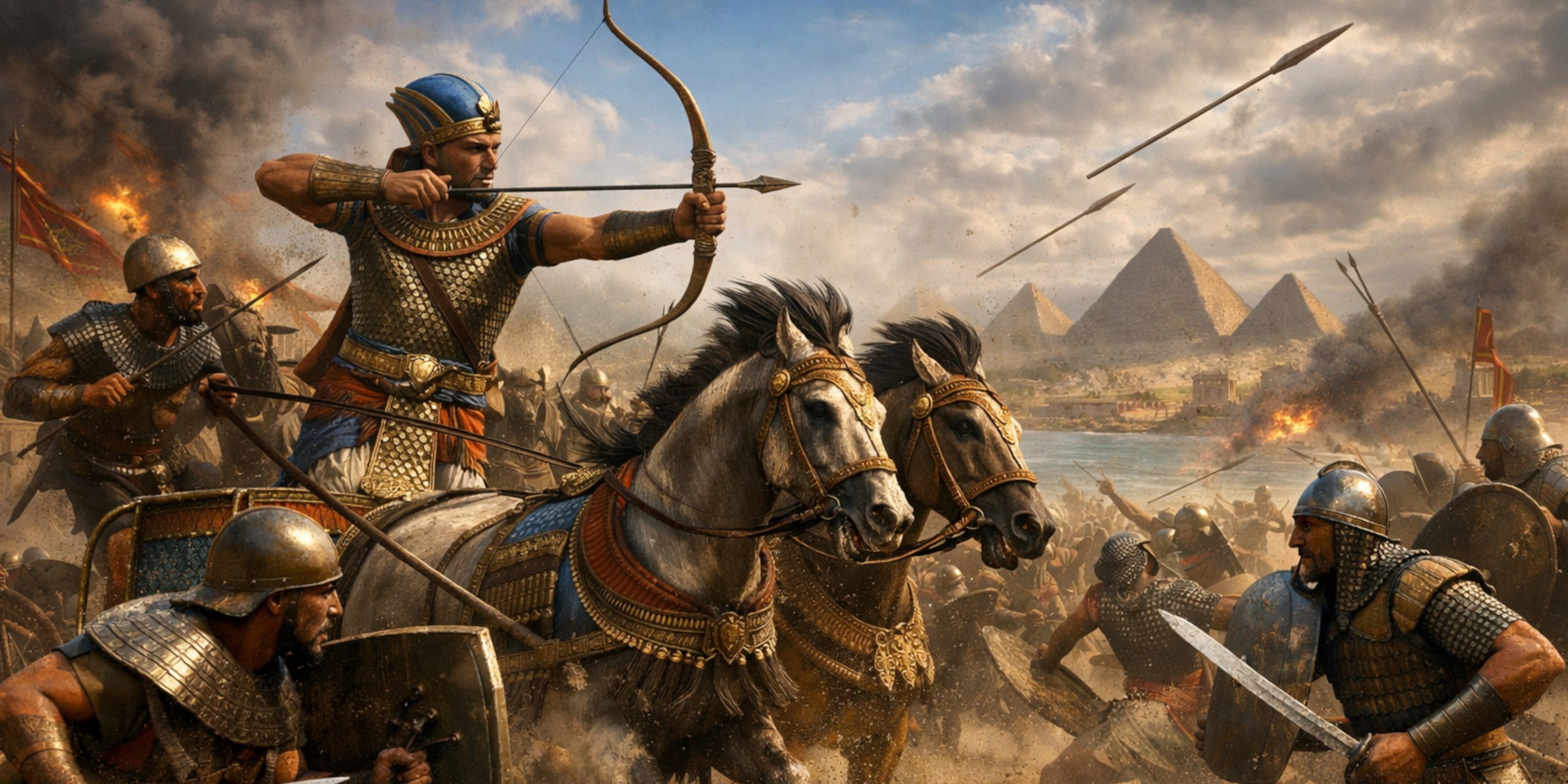
Ancient Egyptian warfare rarely chased annihilation. It aimed at control, prestige, tribute, and reminding neighbours who set the terms of the Nile world. Battles mattered when they secured trade routes, broke rival coalitions, or preserved the fiction of divine kingship. Victory was often declared with enthusiasm regardless of the messier reality, which keeps historians busy and occasionally amused. What follows is a reverse-ordered study of twenty-five of the largest and most consequential battles fought by Egyptian armies, assessed for scale, political impact, and long shadow rather than royal poetry alone.
25. Battle of Perire
Date: c. 2150 BCE
Summary: A clash during the First Intermediate Period as rival dynasties struggled to reunify Egypt.
Commanders: Local Herakleopolitan governors vs Theban forces
Troop Estimates: 5,000–8,000 combined
Weapons Used:
• Copper spearheads
• Stone mace heads
• Wooden shields with hide facing
Outcome: Theban success
Legacy: One step among many toward reunification under the Middle Kingdom.
24. Battle of Hermopolis
Date: c. 2040 BCE
Summary: A decisive Middle Kingdom engagement against northern rivals.
Commanders: Mentuhotep II
Troop Estimates: 10,000
Weapons Used:
• Bronze daggers
• Throwing spears
• Simple composite bows
Outcome: Theban victory
Legacy: Cleared the way for political reunification.
23. Battle of Sinai Campaigns
Date: c. 1900 BCE
Summary: Series of battles securing turquoise and copper mines.
Commanders: Middle Kingdom royal officials
Troop Estimates: 6,000–10,000
Weapons Used:
• Spears
• Axes
• Short bows
Outcome: Egyptian control secured
Legacy: Resource dominance sustained Egypt’s bronze economy.
22. Battle of Buhen
Date: c. 1870 BCE
Summary: Nubian resistance crushed near the Second Cataract.
Commanders: Senusret III
Troop Estimates: 15,000
Weapons Used:
• Bronze spearheads
• Shields
• Nubian bows
Outcome: Egyptian victory
Legacy: Cemented Nubia as an Egyptian military frontier.
21. Battle of Kerma
Date: c. 1750 BCE
Summary: A hard-fought campaign against the powerful Kingdom of Kerma.
Commanders: Egyptian provincial generals
Troop Estimates: 20,000
Weapons Used:
• Bronze axes
• Spears
• Composite bows
Outcome: Mixed, later reversed
Legacy: Demonstrated Nubia was no minor opponent.
20. Battle of Memphis
Date: c. 1650 BCE
Summary: Hyksos seizure of Lower Egypt’s key city.
Commanders: Hyksos chieftains
Troop Estimates: 20,000
Weapons Used:
• Composite bows
• Bronze swords
• Horse-drawn chariots
Outcome: Hyksos victory
Legacy: Introduced transformative military technology to Egypt.
19. Seige of Avaris
Date: c. 1550 BCE
Summary: Final assault on the Hyksos capital.
Commanders: Ahmose I
Troop Estimates: 30,000
Weapons Used:
• Bronze khopesh
• Chariots
• Composite bows
Outcome: Egyptian victory
Legacy: Birth of the New Kingdom. Egypt becomes imperial.
18. Battle of Sharuhen
Date: c. 1548 BCE
Summary: Three-year siege pursuing fleeing Hyksos forces into Canaan.
Commanders: Ahmose I
Troop Estimates: 20,000
Weapons Used:
• Siege weapons
• Bows
• Spears
Outcome: Egyptian victory
Legacy: Egypt projects power beyond its borders.
17. Battle of Megiddo
Date: c. 1457 BCE
Summary: Bold flanking march and decisive battle against a Canaanite coalition.
Commanders: Thutmose III
Troop Estimates: 25,000 Egyptians, similar coalition force
Weapons Used:
• Chariots
• Composite bows
• Bronze swords
Outcome: Egyptian victory
Legacy: Established Egypt as the dominant Levantine power.
16. Battle of Aruna Pass
Date: c. 1457 BCE
Summary: Risky advance preceding Megiddo.
Commanders: Thutmose III
Troop Estimates: Included in Megiddo totals
Weapons Used:
• Chariots
• Bows
Outcome: Tactical success
Legacy: Case study in calculated audacity.
15. Battle of Kadesh (first encounter)
Date: c. 1400 BCE
Summary: Early clashes for control of Syrian trade routes.
Commanders: Egyptian princes and Hittite vassals
Troop Estimates: 15,000–20,000
Weapons Used:
• Chariots
• Bronze spears
• Shields
Outcome: Inconclusive
Legacy: Prelude to a far grander confrontation.
14. Battle of Qatna
Date: c. 1370 BCE
Summary: Egyptian forces strike deep into Syrian territory.
Commanders: Amenhotep II
Troop Estimates: 20,000
Weapons Used:
• Chariots
• Bows
Outcome: Egyptian victory
Legacy: Reinforced Egypt’s northern dominance.
13. Battle of Amurru
Date: c. 1300 BCE
Summary: Contest for allegiance of a vital buffer kingdom.
Commanders: Seti I
Troop Estimates: 20,000
Weapons Used:
• Chariots
• Bronze swords
Outcome: Egyptian success
Legacy: Temporary stability before Hittite resurgence.
12. Battle of Kadesh

Date: c. 1274 BCE
Summary: Massive chariot battle against the Hittite Empire.
Commanders: Ramses II vs Muwatalli II
Troop Estimates: 20,000 Egyptians, up to 40,000 Hittites
Weapons Used:
• Light Egyptian chariots
• Composite bows
• Khopesh swords
Outcome: Tactical draw
Legacy: Produced the earliest known peace treaty, after several thousand reliefs declared total victory.
11. Battle of Dapur
Date: c. 1269 BCE
Summary: Siege of a fortified Syrian city.
Commanders: Ramses II
Troop Estimates: 15,000
Weapons Used:
• Siege ladders
• Bows
• Spears
Outcome: Egyptian victory
Legacy: Demonstrated siege warfare competence.
10. Battle of Moab
Date: c. 1250 BCE
Summary: Campaign east of the Jordan.
Commanders: Ramses II
Troop Estimates: 10,000
Weapons Used:
• Spears
• Shields
Outcome: Egyptian success
Legacy: Maintained influence over Transjordan routes.
9. Battle of Libyan Invasion
Date: c. 1230 BCE
Summary: Defence against western tribal coalitions.
Commanders: Merenptah
Troop Estimates: 20,000 Egyptians
Weapons Used:
• Spears
• Bows
• Axes
Outcome: Egyptian victory
Legacy: Preserved Delta security during late New Kingdom strain.
8. Battle of the Sea Peoples
Date: c. 1177 BCE
Summary: Naval and land defence against mass migration and invasion.
Commanders: Ramses III
Troop Estimates: 30,000
Weapons Used:
• Naval archery
• Spears
• Swords
Outcome: Egyptian victory
Legacy: Delayed Bronze Age collapse in Egypt alone.
7. Battle of Djahy
Date: c. 1178 BCE
Summary: Land campaign against Sea Peoples remnants.
Commanders: Ramses III
Troop Estimates: 25,000
Weapons Used:
• Chariots
• Bows
Outcome: Egyptian victory
Legacy: Final assertion of imperial power.
6. Battle of Tanis
Date: c. 1070 BCE
Summary: Internal struggle as central authority fractured.
Commanders: Smendes
Troop Estimates: 10,000
Weapons Used:
• Spears
• Axes
Outcome: Northern consolidation
Legacy: Marked the Third Intermediate Period.
5. Battle of Bubastis
Date: c. 945 BCE
Summary: Libyan dynasts assert control over the Delta.
Commanders: Shoshenq I
Troop Estimates: 15,000
Weapons Used:
• Spears
• Shields
Outcome: Victory
Legacy: Reasserted Egypt on the regional stage.
4. Battle of Jerusalem Campaign
Date: c. 925 BCE
Summary: Levantine expedition extracting tribute.
Commanders: Shoshenq I
Troop Estimates: 20,000
Weapons Used:
• Spears
• Chariots
Outcome: Egyptian success
Legacy: Last major foreign campaign of a united Egypt.
3. Battle of Pelusium
Date: 525 BCE
Summary: Persian invasion exploiting Egyptian tactical rigidity.
Commanders: Cambyses II vs Psamtik III
Troop Estimates: 40,000 Persians, similar Egyptian force
Weapons Used:
• Iron weapons
• Archery
Outcome: Persian victory
Legacy: End of pharaonic independence.
2. Battle of Memphis
Date: 525 BCE
Summary: Final stand after Pelusium.
Commanders: Psamtik III
Troop Estimates: 20,000
Weapons Used:
• Spears
• Shields
Outcome: Persian victory
Legacy: Egypt absorbed into the Achaemenid Empire.
1. Battle of Actium (Egyptian involvement)

Date: 31 BCE
Summary: Cleopatra’s fleets fight alongside Antony against Octavian.
Commanders: Cleopatra VII, Mark Antony
Troop Estimates: 60,000 sailors and marines
Weapons Used:
• Triremes
• Boarding weapons
Outcome: Defeat
Legacy: End of Ancient Egypt as a sovereign state. A sobering finish, if historically neat.
The Seven Swords Takeaway
Egyptian battles reveal a civilisation more interested in order than conquest for its own sake. When Egypt fought far from home, it did so carefully and usually with excellent logistics. When it failed, it failed loudly and left us magnificent reliefs explaining why it had not, actually. As a historian, I find that honesty refreshing in its own peculiar way.