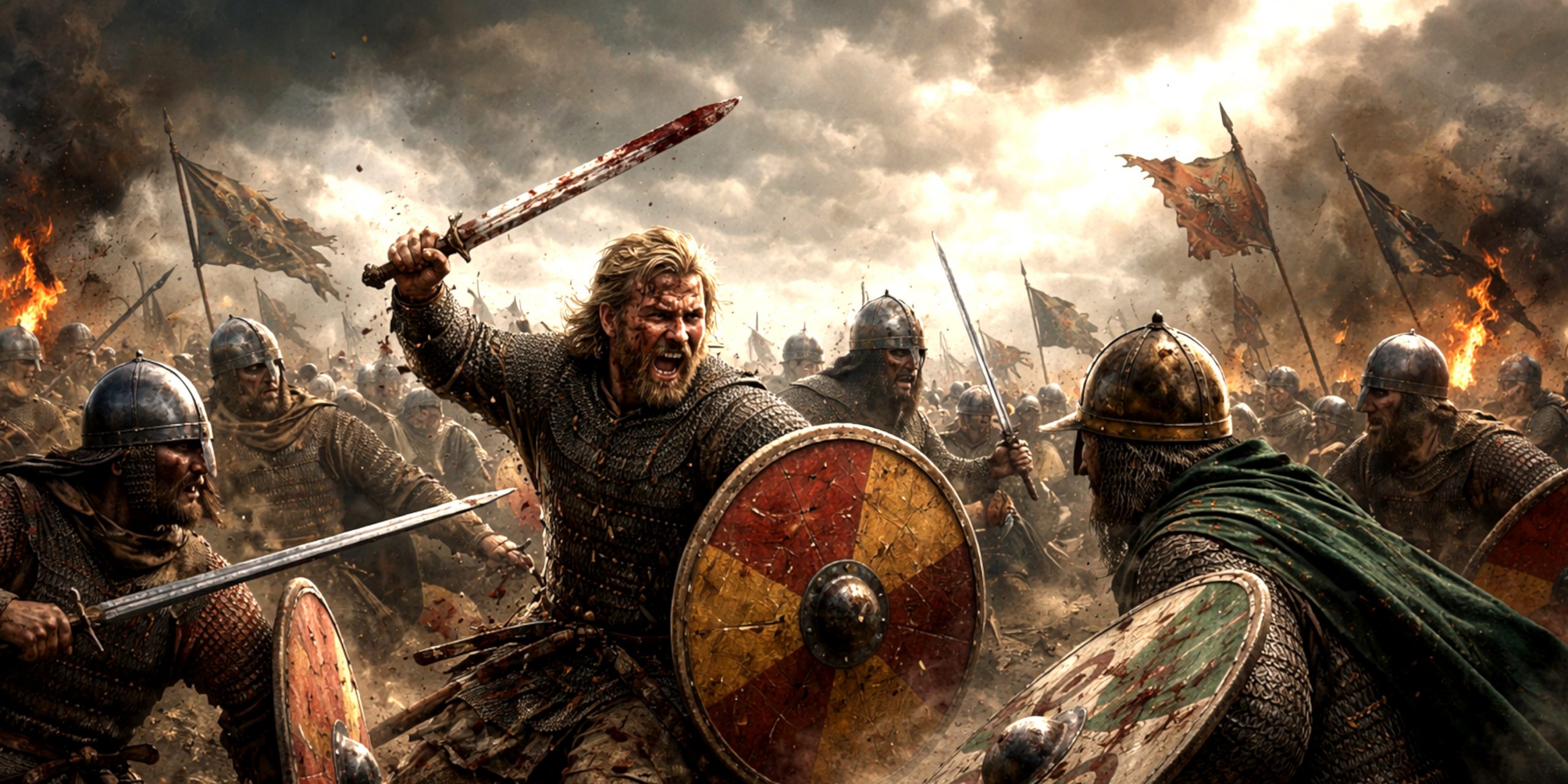
The Battle of Peonnum is one of those early medieval clashes that sits half in the light of history and half in the shadows of fragmentary sources. We know it happened. We know it mattered. Beyond that, we tread carefully, piecing together sparse annal entries, place name studies, and what we know of seventh century warfare. As a historian, that uncertainty is part of the appeal, even if it occasionally feels like trying to reconstruct a sword from three rusted fragments and a hopeful imagination.
Historical Background
Peonnum took place during a period when Anglo-Saxon kingdoms were still fluid, ambitious, and frequently at war. The conflict is usually linked to the expansion of Wessex under King Cenwalh against British forces in the west. This was not a neat clash of nations but a grinding frontier struggle, with territory changing hands field by field.
The Anglo-Saxon Chronicle records the battle briefly, noting a victory for the West Saxons. The British forces are unnamed, as is so often the case, which tells us more about the priorities of the chroniclers than the scale of the fighting.
Forces
Precise numbers are not recorded, but early medieval armies of this type were modest by later standards. These were warbands rather than massed national forces.
Estimated Strength
| Side | Estimated Numbers | Notes |
|---|---|---|
| Kingdom of Wessex | 1,000 to 2,000 | Likely a mix of royal hearth troops and local levies |
| British forces | 1,000 to 2,000 | Possibly a coalition of local Brittonic rulers |
These figures should be treated cautiously. Early chroniclers cared more about outcomes than headcounts.
Leaders and Command
Known and Probable Leaders
- Cenwalh of Wessex
- King of Wessex
- An experienced ruler with a record of western campaigns
- More politician than romantic hero, which is often how successful kings survive
- British commanders
- Unnamed in surviving sources
- Likely regional leaders defending territory rather than seeking conquest
The lack of British names is frustrating, though sadly typical. History often remembers winners by name and losers as a collective noun.
Arms and Armour
Weapons in Use
| Weapon Type | Details |
|---|---|
| Seax | Common Anglo-Saxon single edged blade, practical and lethal |
| Pattern welded sword | High status weapon, double edged, used by elite warriors |
| Spear | The most widespread battlefield weapon on both sides |
| Shield | Round wooden shields with iron bosses |
Sword Types Noted
- Pattern welded Anglo-Saxon swords
- Double edged
- Broad blades suited to cutting
- Expensive and symbolic of rank
- Brittonic swords
- Similar in form, though often simpler in construction
- Likely fewer in number, reserved for leaders and champions
Armour was limited. Most warriors fought with shields, helmets if fortunate, and little else. Anyone imagining gleaming mail lines should recalibrate their expectations sharply downward.
The Battle Itself
Likely Course of Events
- Initial contact between advancing West Saxon forces and British defenders
- Shield wall engagement, slow and brutal rather than cinematic
- Collapse of one flank, probably British
- West Saxon pursuit and consolidation of territory
Battles of this era were decided less by clever manoeuvre and more by morale, cohesion, and who ran first.
Battle Timeline
| Phase | Event |
|---|---|
| Assembly | Cenwalh gathers a warband and local levies |
| Advance | West Saxon forces move into contested territory |
| Engagement | Shield walls clash at Peonnum |
| Breakthrough | British resistance falters |
| Aftermath | Wessex secures further western ground |
Archaeology and Site Debate
The exact location of Peonnum remains disputed. Suggestions include areas in modern Wiltshire or Somerset, often based on place name similarities rather than firm material evidence.
To date:
- No confirmed battlefield archaeology
- No mass graves securely linked to the engagement
- Scattered early medieval finds in candidate regions
This is disappointing but not unusual. Early medieval battles rarely leave neat archaeological calling cards.
Contemporary Quotes
The Anglo-Saxon Chronicle provides the closest thing to a contemporary voice:
“In this year Cenwalh fought at Peonnum and drove the Welsh as far as the Parret.”
It is concise, triumphant, and utterly uninterested in nuance. A reminder that medieval chroniclers were not neutral observers but cheerleaders with quills.
Historical Significance
Peonnum matters because it marks another step in the slow westward expansion of Wessex. It helped define the future boundaries of southern England and weakened Brittonic control in the region. No single battle settled the question, but Peonnum nudged history firmly in one direction.
It is not a famous battle. It lacks a heroic death scene or a named battlefield mound. Yet it represents how England was actually forged, through incremental violence, local defeats, and victories that only later generations bothered to remember.
Seven Swords Takeaway
The Battle of Peonnum is a historian’s exercise in restraint. We resist the urge to over dramatise and accept the silences in the record. What remains is a grounded, human clash, fought by men with spears, shields, and very limited patience for chroniclers who would one day reduce their struggle to a single line of text.
Sometimes, that single line is all we get.
Watch the documentary: