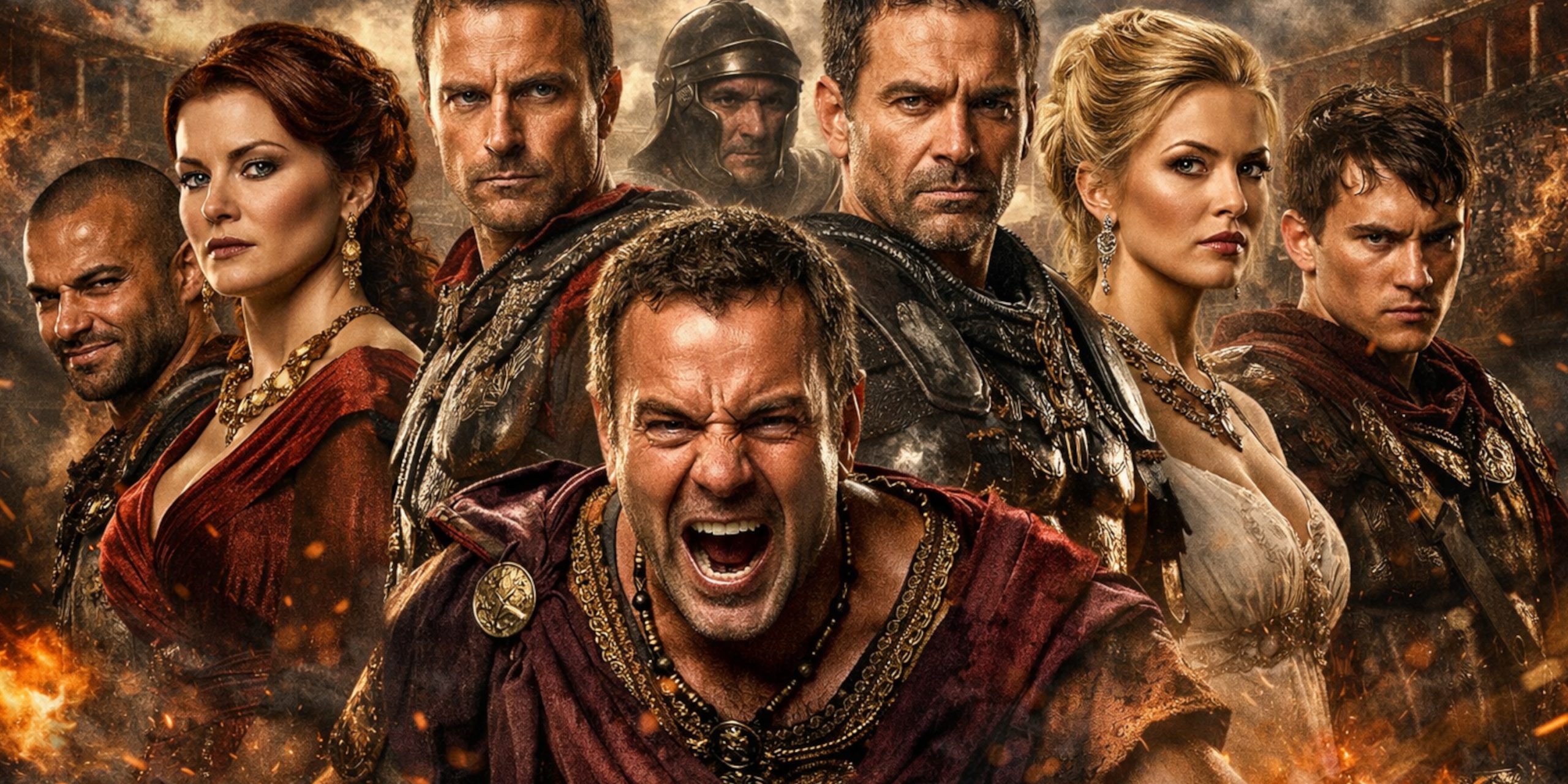
The Spartacus series never lacked enemies. Some were monsters you loved to hate. Others were walking bad decisions with power. What made the show hit harder than most historical dramas was how much effort it put into its villains. Even the worst of them usually believed they were right.
This ranking looks at every major antagonist across Blood and Sand, Gods of the Arena, Vengeance, and War of the Damned. It weighs menace, intelligence, impact on the story, and how memorable they felt once the credits rolled.
Let’s work our way up from the bottom.
10. Tiberius Crassus
Tiberius is what happens when entitlement gets armour and a command. He wants glory without earning it and respect without understanding it. The show clearly wants him to feel dangerous, but he never quite gets there.
His biggest flaw is predictability. Every bad choice feels inevitable, and not in a tragic way. More in a “someone please take his sword away” way. Compared to the sharper minds around him, Tiberius feels like a warning label rather than a true threat.
9. Numerius
Numerius exists mainly to show how rotten Roman privilege can get. He is cruel, cowardly, and completely unprepared for the consequences of his actions. His presence adds texture to the Roman elite, but as a villain he is thinly drawn.
He is unpleasant, not interesting. The show moves on from him quickly, which feels appropriate.
8. Ashur
Ashur is divisive, and that is kind of the point. He is clever, bitter, and deeply self serving. Unlike the gladiators, he fights with information and manipulation, which makes him dangerous in a different way.
The issue is that Ashur often feels like he is scrambling rather than controlling events. His survival instincts are impressive, but he never quite earns the power he keeps chasing. Still, you remember him, and that counts for something.
7. Seppius
Seppius is a reminder that Roman politics could be just as brutal as the arena. He is smug, calculating, and constantly convinced he is the smartest man in the room.
His downfall is satisfying because it is so self inflicted. Seppius talks himself into believing his own myth, and the show wastes no time punishing that arrogance.
6. Ilithyia
Ilithyia is chaotic in the most Roman way possible. She is impulsive, cruel, and convinced that status excuses everything. What makes her work is how unprepared she is for real consequences.
Her villainy is intimate rather than strategic. She ruins lives up close, often without fully realising what she is doing. Watching her panic when the walls start closing in is one of the series’ quiet pleasures.
5. Marcus Licinius Crassus
Crassus brings a different energy to the show. He is calm, disciplined, and genuinely intelligent. Unlike most Roman villains, he studies his enemy instead of underestimating them.
What holds him back from the very top is emotional distance. He is formidable, but sometimes feels more like an idea than a person. Still, every scene with Crassus carries weight, and the war changes the moment he arrives.
4. Lucretia
Lucretia is ambition sharpened to a blade. She understands power, image, and manipulation better than almost anyone in the series. Her rise and fall feel operatic, full of obsession and denial.
What makes her compelling is how human her desperation becomes. She does not just want control, she needs it. By the end, her villainy feels tragic without ever being excusable.
3. Gaius Claudius Glaber
Glaber is the embodiment of Roman pride colliding with reality. He begins as a confident officer and ends as a broken man clinging to relevance. His obsession with Spartacus drives him into increasingly reckless decisions.
The strength of Glaber’s arc is its slow collapse. You can track every mistake, every moment where he could have stepped back but did not. He is not evil for the sake of it. He is ruined by ego.
2. The Roman Republic Itself
This might feel like cheating, but Spartacus makes a strong case for Rome as the true antagonist. Slavery, spectacle, and institutional cruelty shape every conflict in the series.
Individual villains rise and fall, but the system keeps grinding on. That larger threat gives the rebellion meaning beyond personal revenge. Without it, Spartacus would just be another gladiator seeking payback.
1. Batiatus
Batiatus is the gold standard. Loud, manipulative, strangely charismatic, and endlessly quotable, he dominates every scene he is in. What sets him apart is how personal his villainy feels.
He builds relationships, betrays them, then justifies it all with ambition and wounded pride. You understand why people follow him, and exactly why they should not. His downfall hits hard because the show lets you live inside his schemes long enough to almost root for him.
That is rare, and it is why he takes the top spot.
The Seven Swords Takeaway
What makes Spartacus stand out is not just the blood or the speeches. It is how much effort goes into making its villains feel real. Some are brilliant. Some are infuriating. A few are both at once.
And honestly, that balance is what keeps the series worth revisiting. Even when you know how it ends, the enemies along the way still make the journey brutal, fascinating, and weirdly fun.