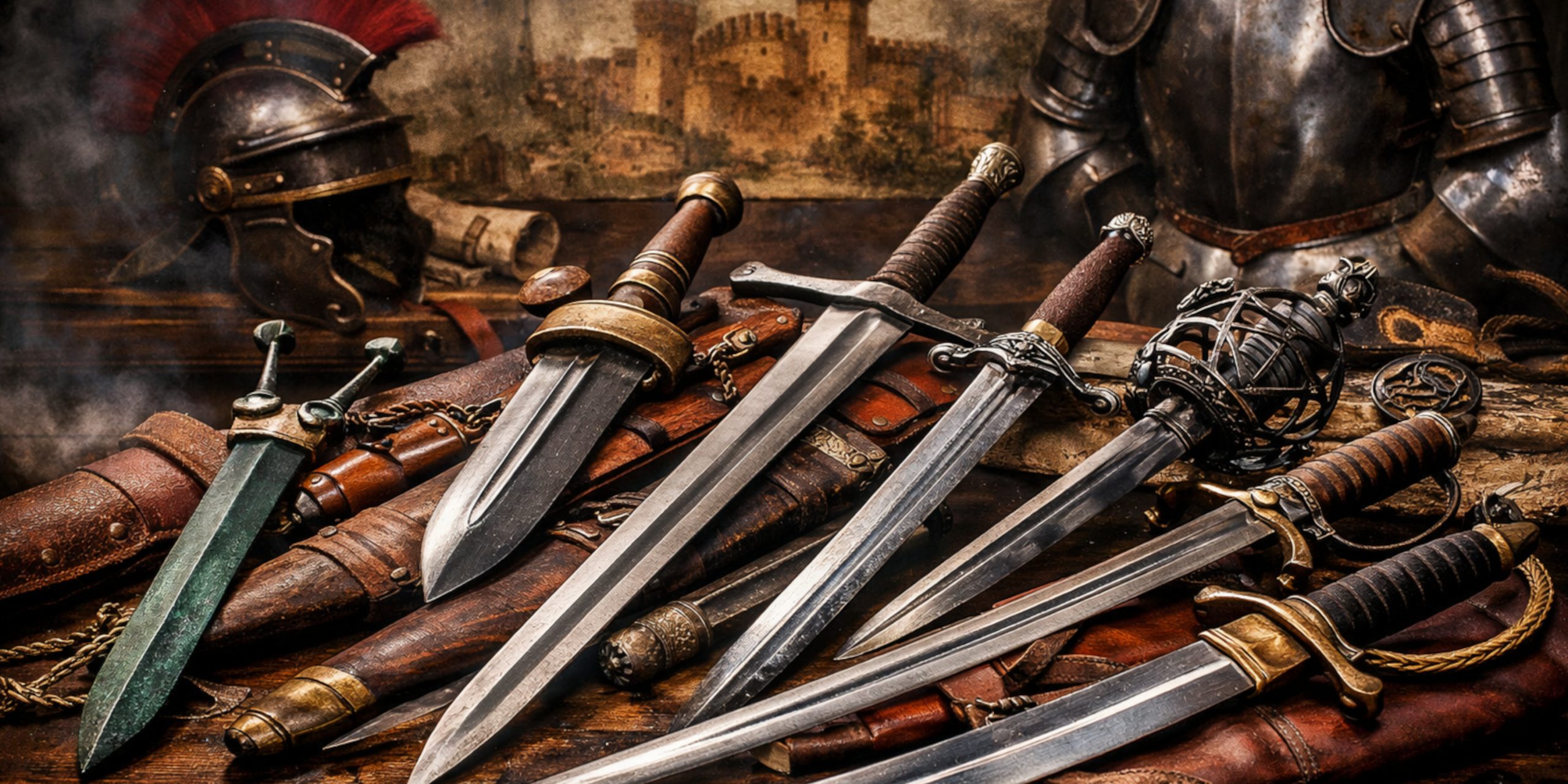
Italy has long stood at the crossroads of Mediterranean warfare, trade, and cultural exchange. From the Bronze Age to the Renaissance, its swordmaking evolved alongside its politics, from tribal leagues and Etruscan city-states to the rise of Rome and the ingenuity of the city republics. Each era brought new techniques, materials, and philosophies of combat, producing a wide spectrum of swords shaped by both local needs and international influence.
This list explores 100 Italian swords across time, grouped by historical period, with a description of the innovations and developments that defined each age.
Bronze Age and Early Iron Age (c. 1600–700 BCE)
Era Overview
In early Italy, metalworking knowledge spread from the Aegean and Central Europe. Swords were typically cast bronze, riveted at the hilt, and often ceremonial as well as functional. The Villanovan culture marked the early Iron Age, introducing harder blades and the use of iron in elite weaponry.
- Bronze Leaf Blade Sword – Typical of the Apennine culture, with a wide blade tapering to a point.
- Antenna Hilt Sword – A narrow bronze weapon with rounded terminals resembling antennae.
- Triangular Dagger-Sword – Short-bladed and heavily decorated, often buried with the dead.
- Villanovan Iron Sword – Early use of iron, with a straight double-edged form.
- Etruscan Bronze Sword – Slim and leaf-shaped, with geometric hilt fittings.
- Naue Type II Sword – Introduced from the Danube region, adopted widely across early Italy.
- Canegrate Culture Sword – Found in northern Italy, showing early cross-regional links.
- Proto-Italic Rapier – Long and thrusting in style, with a flared ricasso.
- Italic Halberd-Sword Hybrid – Transitional form used for both slashing and ceremonial display.
- Bronze Flat-Hilt Sword – Moulded as one piece, with simplified design for local warriors.
Etruscan and Italic Kingdoms (c. 700–300 BCE)
Era Overview
The Etruscans and other Italic peoples developed more refined ironworking techniques. Swords were influenced by Greek designs, especially in southern Italy, but retained uniquely local proportions and ornamentation.
- Etruscan Hoplite Sword – Modeled after Greek xiphos, with elegant proportions.
- Samnite Curved Sword – A forward-curving blade used in hill warfare.
- Faliscan Infantry Sword – Sturdy, single-handed weapon for use with a round shield.
- Oscan Leaf Sword – Balanced for cut and thrust, with a notched guard.
- Sabellian Shortsword – Compact blade ideal for close terrain.
- Lucanian Bronze-Hilt Sword – Decorative elements often etched with geometric patterns.
- Italic Horseman’s Sword – Slender, ideal for slashing from horseback.
- Apulian Iron Sword – Found in rich warrior burials, often with flared guards.
- Capuan Curved Blade – A local response to southern Greek military fashions.
- Etruscan Ceremonial Sword – Richly adorned, used in funerary or priestly contexts.
Roman Republic and Empire (c. 300 BCE–476 CE)
Era Overview
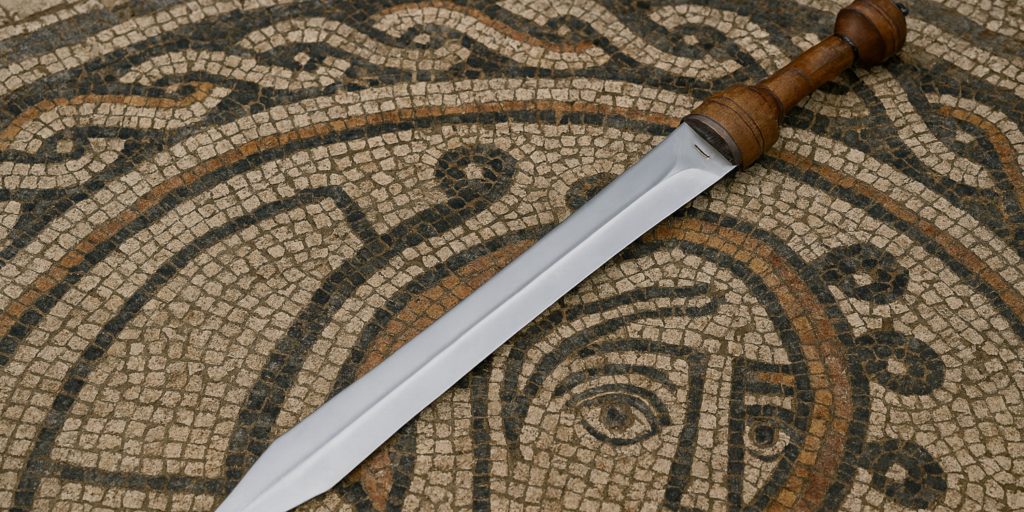
Rome’s military machine standardised weaponry while still adapting based on conquest. The iconic gladius evolved from Iberian designs, while later periods introduced longer blades to match cavalry and frontier needs.
- Gladius Hispaniensis – The early Roman sword, borrowed from Iberia.
- Gladius Mainz Type – A refined version with a wasp-waisted blade.
- Gladius Fulham Type – With a parallel-edged blade and short point.
- Gladius Pompeii Type – Straight-sided and uniform, mass-produced for legions.
- Pugio – The Roman dagger, often elaborately decorated.
- Spatha – A longer sword used by cavalry, later replacing the gladius.
- Auxiliary Spatha – Variants used by non-citizen troops and frontier forces.
- Praetorian Gladius – Slightly heavier and shorter, used by elite guards.
- Centurion’s Parade Sword – Highly decorative, worn on ceremonial occasions.
- Roman Hunting Sword – Civilian use, often richly engraved.
Early Medieval Italy (c. 476–1000)
Era Overview
After Rome’s fall, Italy fractured. Gothic, Lombard, and Byzantine rule brought in a diversity of arms. Sword production varied widely, with northern Italy leaning toward Germanic styles and the south absorbing Byzantine influence.
- Lombard Iron Sword – Straight with a broad fuller, suited to shield combat.
- Ostrogothic Warrior Sword – Heavy cutting blade with minimal taper.
- Byzantine Spathion – A narrow straight blade with Eastern Mediterranean styling.
- Italo-Gothic Shortsword – Functional and compact, often a status symbol.
- Langobardic Ridge Blade – A shallow central ridge with little curvature.
- Carolingian-Inspired Sword – Frankish influence crept into northern regions.
- Longseax (Italian Variant) – Single-edged blade for utility and war.
- Rondel-Hilt Sword – Early sign of a more elaborate hilt design.
- Patrician Sword of Ravenna – A ceremonial blade inspired by Imperial aesthetics.
- Venetian Coastal Sword – Light and fast, suited to naval skirmishes.
High Middle Ages (c. 1000–1300)
Era Overview
Italy’s city-states began to rise, and with them came new military structures. Sword types became more standardised, with cruciform designs becoming the norm. Trade routes brought steel and design innovations from the east.
- Norman Arming Sword (Sicilian) – A robust one-handed weapon.
- Italian Knightly Sword – Well-balanced, designed for armoured combat.
- Pisan Infantry Sword – Common among militias, simple in construction.
- Crusader’s Sword (Italian Make) – Influenced by eastern campaigns.
- Genoese Naval Sword – Curved slightly, for use on ships.
- Florentine Arming Sword – Balanced for close duelling in alleys and tight streets.
- Papal Guard Sword – Commissioned for elite Vatican troops.
- Romanesque Longsword – A longer blade with a strong point and fuller.
- Mantuan Mercenary Sword – Worn by condottieri in service of rival cities.
- Tuscian Parade Sword – Gilded and ceremonial, with Latin inscriptions.
Late Medieval and Renaissance (c. 1300–1600)

Era Overview
This period saw Italian swordcraft reach artistic and technical heights. The longsword, sidesword, and rapier became dominant, often accompanied by sophisticated fencing traditions. Metallurgy improved, allowing for lighter, deadlier weapons.
- Italian Longsword – Two-handed blade used in battle and duel.
- Sidesword (Spada da Lato) – Precursor to the rapier, used in both warfare and self-defence.
- Storta – A curved, cut-heavy blade used by infantry and watchmen.
- Falchion (Italian Type) – Single-edged, brutal chopping blade.
- Fiorentine Dueling Sword – Elegant and deadly, a nobleman’s choice.
- Milanese Hand-and-a-Half Sword – Heavy yet balanced, versatile in form.
- Rapier (Spada da Filo) – The gentleman’s sword, fine-pointed and slender.
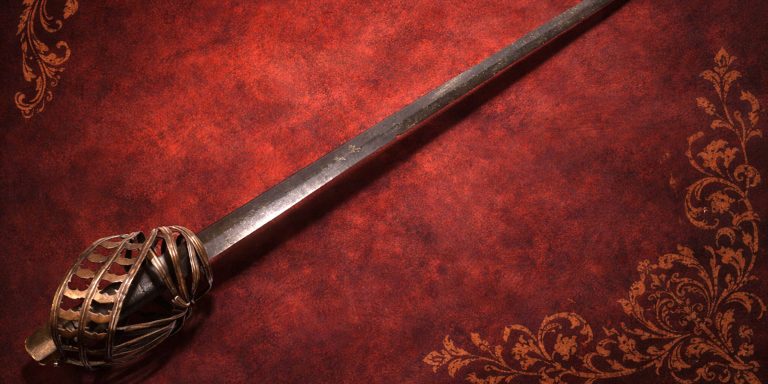
- Venetian Schiavona – A basket-hilted sword adopted by Dalmatian mercenaries.
- Estoc (Italian Variant) – A thrusting blade for piercing plate.
- Spada da Cavalleria – Cavalry sword with sweeping curve.
- Cinqueda – Broad, short civilian weapon from Bologna.
- Brescian Court Sword – Highly ornamental with etched blade.
- Ferrara Rapier – Balanced for cut and thrust, famed across Europe.
- Italian Greatsword – Rare but massive, used for display or battlefield intimidation.
- Dagger-Rapier Combo – Paired for fencing, often with flamboyant guards.
- Parrying Dagger (Main Gauche) – Used off-hand to trap or deflect.
Baroque to Napoleonic Era (c. 1600–1815)
Era Overview
Military swords became increasingly ceremonial, though duelling and cavalry combat still required function. Italy’s regional armies and shifting alliances introduced a mix of native and French-inspired designs.
- Sabre della Cavalleria – A curved cavalry sabre used across northern duchies.
- Duelling Spada da Lato – Narrow and light, used in formal bouts.
- Officer’s Court Sword (Neapolitan) – Elegant with rococo motifs.
- Piedmontese Infantry Sword – Mass-issued, single-edged blade.
- Roman Pontifical Sword – Papal army weapon with religious iconography.
- Spada alla Francese – Modelled after French smallswords.
- Corsican Machete-Sabre – Hybrid blade adapted for skirmish.
- Venetian Naval Cutlass – Short and curved, suited to cramped ship decks.
- Sardinian Infantry Sword – Practical weapon of royal troops.
- Italian Smallsword – Civilian duelling blade with light ornament.
19th to 20th Century (c. 1815–1945)
Era Overview
With unification and modernisation, Italy moved towards uniform military production. Swords were largely symbolic or cavalry-specific. The legacy of Renaissance elegance met modern battlefield practicality.
- Cavalry Sabre Model 1860 – Standard issue post-unification.
- Infantry Short Sword (Modello 1847) – Issued to engineers and artillerymen.
- Officer’s Sword (Savoy Line) – Honour weapon for formal use.
- Royal Guard Sword – Worn by ceremonial guards of the Italian monarchy.
- Fascist Blackshirt Dagger – Symbolic weapon carried during Mussolini’s regime.
- WWI Italian Cavalry Sword – Slimmer and stronger than its Napoleonic predecessor.
- Naval Officer’s Sword – Ornate and narrow, with anchor motifs.
- Bersaglieri Parade Sword – Carried by elite rifle troops.
- MVSN Officer’s Sword – Decorated with Fascist emblems.
- Carabinieri Ceremonial Sword – Still worn in formal ceremonies.