Few buildings in Britain carry the same weight as the Tower of London. It has been fortress, palace, armoury, treasury, prison, execution site, zoo, and symbol. That range alone tells you something important. The Tower was never just a building. It was an instrument of authority, adjusted to suit whoever held the crown at the time.
As a historian, I find the Tower compelling because it refuses to settle into a single identity. It is brutal and ceremonial, practical and theatrical. Even today, it still knows how to dominate its surroundings, which was always the point.
Norman Origins and the White Tower
The story begins after 1066. William the Conqueror needed to control London, not just militarily but psychologically. Stone castles were rare in England, and the Tower’s White Tower was designed to look permanent, foreign, and unavoidable.
Construction began in the late eleventh century using Caen stone imported from Normandy. That decision alone spoke volumes. This was conquest made solid. The White Tower served as a keep, royal residence, and final refuge in case the city turned hostile.
Its design followed continental models rather than Anglo Saxon traditions. Thick walls, narrow windows, and an elevated entrance all reinforced a simple message. Power lived here, and it was not going anywhere.
Expansion into a Fortress Complex
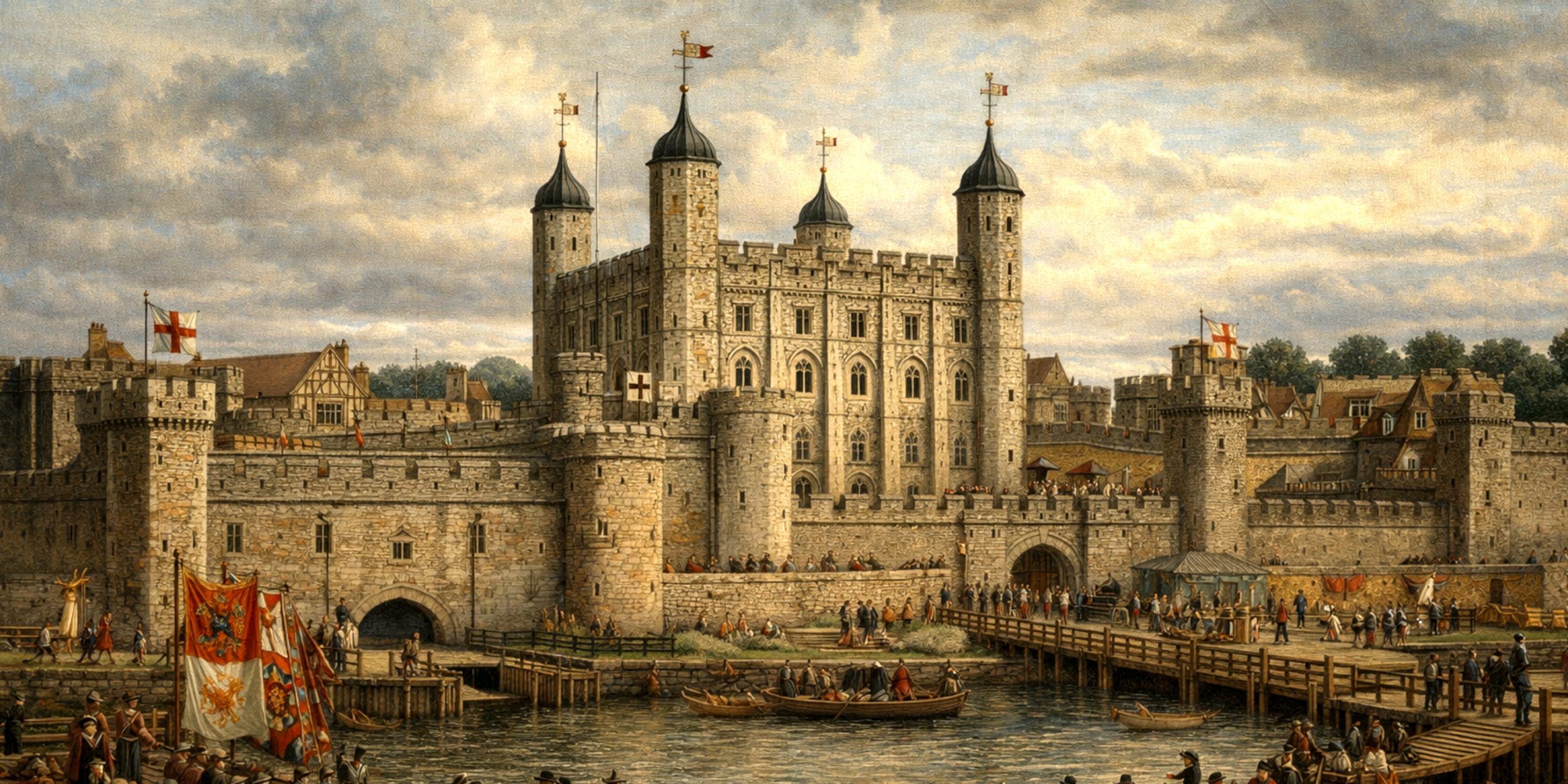
What most visitors call the Tower is really a layered fortress. Over the twelfth and thirteenth centuries, successive monarchs added curtain walls, towers, gates, and a surrounding moat. Henry III and Edward I were especially active builders.
Edward I’s additions created the concentric defences that still define the site. Multiple rings of walls meant attackers had to fight their way inward step by step. It was impressive, expensive, and effective. The Tower became less of a single stronghold and more of a small fortified town.
This expansion also made the Tower adaptable. It could house a court, store weapons, and imprison enemies, sometimes all at once.
Royal Residence and Centre of Power
It is easy to forget that the Tower was once a fashionable royal home. Medieval kings stayed there regularly, especially before coronations. The proximity to Westminster mattered, and so did the symbolism. To process from the Tower to the abbey was to make authority visible.
The royal apartments were decorated, heated, and surprisingly comfortable by medieval standards. There were gardens, chapels, and private chambers. The Tower’s grim reputation came later, shaped by memory more than daily life.
That said, no royal residence was ever free from danger. Even kings treated the Tower with caution, aware that a fortress can imprison its owner as easily as his enemies.
Prisoners, Executions, and Reputation
The Tower’s name is inseparable from imprisonment. High status prisoners were its main inmates, not common criminals. Princes, queens, bishops, and nobles passed through its gates, often during moments of political crisis.
Anne Boleyn, Catherine Howard, Thomas More, Lady Jane Grey. These names cling to the stones. Executions inside the Tower were rare and reserved for the elite, which only heightened their impact. Public beheadings on Tower Hill were more common and deliberately visible.
As a historian, I am wary of exaggeration here. The Tower was not a medieval dungeon in constant use. Its reputation owes much to Tudor politics and later storytelling. Still, when power fractured, the Tower became the place where uncertainty ended.
The Crown Jewels and Royal Treasury
From the thirteenth century onward, the Tower housed the royal treasury. That role eventually evolved into the home of the Crown Jewels. Storing them behind thick walls and armed guards made practical sense.
The jewels themselves have been lost, remade, hidden, and paraded over centuries. Their survival is not accidental. They remain one of the clearest links between medieval monarchy and the modern state.
There is something revealing about their location. The symbols of monarchy sit inside a fortress built by a conqueror. Ceremony rests on force, whether we like it or not.
The Tower as Arsenal and Zoo
Less famous but equally important was the Tower’s role as an armoury. Weapons, cannon, and supplies were stored here for centuries. Before Woolwich and other sites took over, the Tower was central to England’s military infrastructure.
It was also home to a royal menagerie. Lions, leopards, bears, and even an elephant were kept within the walls. This was not cruelty for its own sake, though it often was cruel. It was display. Exotic animals reinforced royal prestige in a world where few people travelled far.
The zoo closed in the nineteenth century, thankfully. The symbolism, however, lingered.
Yeoman Warders and Living Tradition
The Yeoman Warders, often called Beefeaters, are not decorative leftovers. They are serving members of the armed forces with ceremonial and custodial duties. Their presence keeps the Tower from becoming a static museum.
Traditions such as the Ceremony of the Keys continue nightly, just as they have for centuries. These rituals matter. They link modern Britain to its past without pretending that the past was comfortable or simple.
I have always thought the Tower works best at night, when the crowds are gone and the routine carries on quietly.
Myths, Ravens, and Popular Memory
Legends thrive at the Tower. Ravens, ghosts, lost princes. Some stories are late inventions, others warped echoes of real events. The tale that the kingdom will fall if the ravens leave is a Victorian flourish, but it has stuck.
These myths endure because the Tower invites them. It looks the part. More importantly, it played a genuine role in moments of fear and transition. Myth fills the gaps where records grow thin.
As historians, we correct the record, but we also recognise why stories survive. They tell us how people want to remember power.
Why the Tower remains important
The Tower of London is not important because it is old. It matters because it reveals how authority was built, defended, and displayed. Its stones record conquest, paranoia, ambition, and adaptation.
Standing inside the walls, I am always struck by how deliberate everything feels. Nothing here was accidental. The Tower was meant to intimidate, reassure, and endure. It succeeded on all counts.
It remains one of the clearest physical explanations of how medieval power worked, and why its echoes are still felt today.
Seven Swords Takeaway
The Tower of London defies easy summary. It is too many things, shaped by too many hands. That complexity is its strength. Rather than offering a single story, it forces us to confront the realities of rule, resistance, and memory.
For a historian, it is not a relic to be admired from a distance. It is an argument in stone, still standing, still insisting that power leaves marks behind.
Watch the documentary: