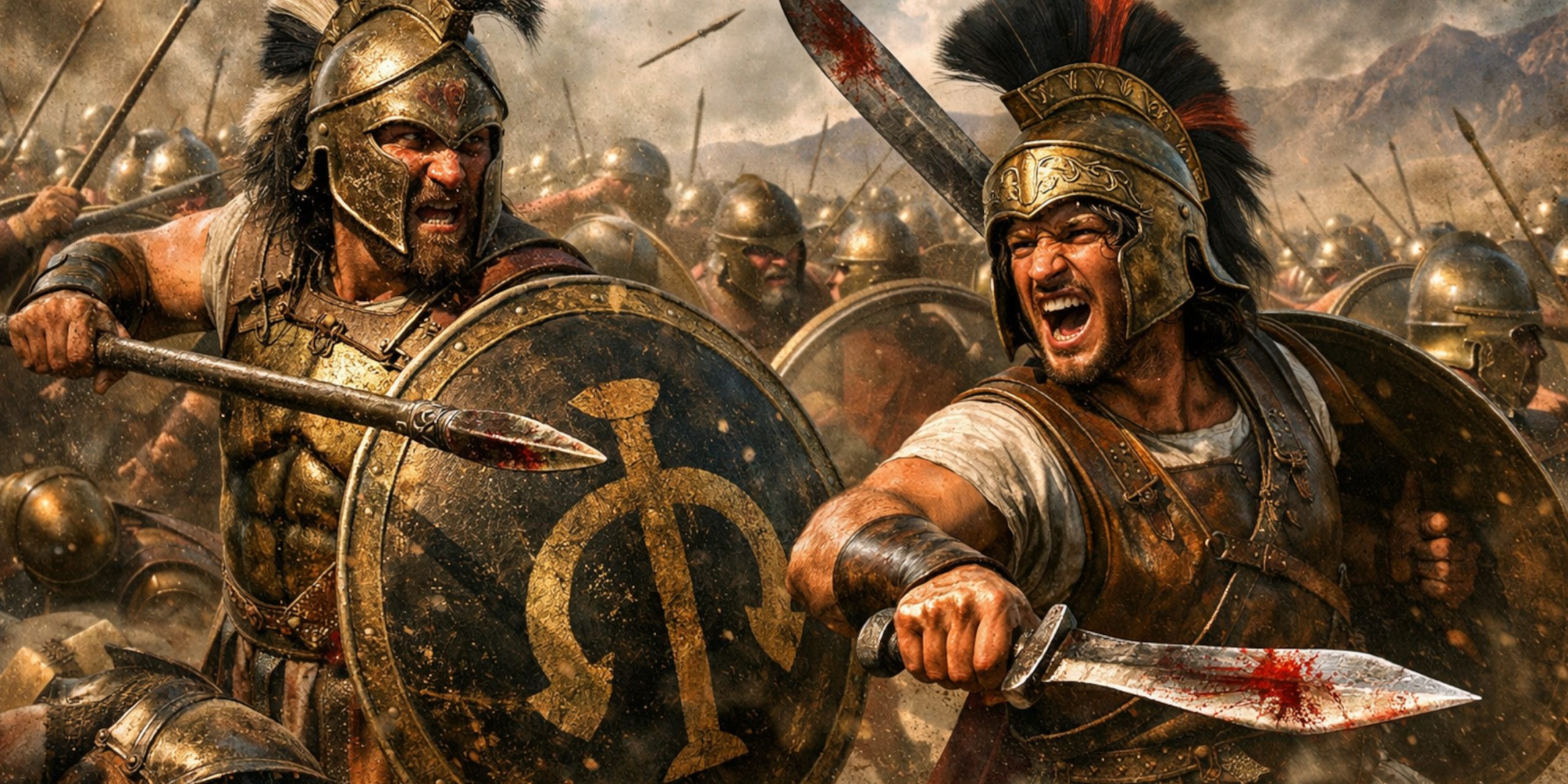
The Sacred Band of Thebes has attracted fascination for more than two thousand years. Ancient writers described them as an elite corps of 300 men, chosen not simply for their skill in battle but for their loyalty to one another. According to tradition, they fought in pairs of lovers, bound by affection, pride and the uncomfortable knowledge that one would never hear the end of it in the afterlife if he ran away first.
Their reputation rests on a remarkable run of victories in the fourth century BC. They helped shatter Spartan power at Leuctra, fought across Greece during Theban ascendancy, and finally died almost to a man at Chaeronea against Philip II of Macedon and his young son Alexander.
To a historian, the Sacred Band is one of those rare military formations that almost feels too dramatic to be real. A small body of men, drawn from a single city, who rose from obscurity, humbled Sparta and ended in a final stand worthy of legend. Ancient Greece had no shortage of boasts, tall tales and men who insisted they were descended from gods. The Sacred Band, rather irritatingly for the sceptic, seem to have been exactly as formidable as people claimed.
Origins of the Sacred Band
The Sacred Band was probably created in the early fourth century BC, although ancient sources disagree on the exact date. Most credit the Theban statesman Gorgidas with forming the unit around 378 BC, during the struggle against Spartan domination of Boeotia.
Ancient Thebes had endured decades of Spartan interference. After the Spartan seizure of the Theban citadel in 382 BC, resentment simmered across the city. When the Spartans were finally expelled, Thebes needed a permanent professional force. Most Greek armies were still temporary citizen militias who turned up, fought, and then went home to complain about the weather and the state of the harvest.
The Sacred Band was different.
It consisted of 300 selected men, supported and paid by the state. Unlike ordinary hoplites, they trained continuously and served together year-round. This made them one of the closest things the Greek world had to a standing army.
Ancient historian Plutarch wrote that the corps was made up of 150 pairs of male lovers. The idea was that a warrior would fight harder to protect the man he loved and would be less likely to disgrace himself before him.
Plutarch famously wrote:
“For men of the same tribe or family make but a poor force when danger presses; but a band cemented by friendship grounded upon love is never to be broken.”
Modern historians still debate whether every pair in the Sacred Band were genuinely lovers, or whether Plutarch was simplifying a more complex relationship of mentorship and comradeship. Either way, the belief itself mattered. The Thebans thought that deep personal bonds produced better soldiers, and the record suggests they may have been right.
Why They Were Called the Sacred Band
The exact reason for the name remains uncertain.
Some ancient writers believed the corps was called “sacred” because it swore an oath in a sanctuary, perhaps at the temple of Iolaus, companion of Heracles. Others linked the name to the fact that the unit was maintained at public expense and dedicated to the gods and the city.
There may also have been a religious connection with Theban hero cults. Thebes had a strong tradition of linking military service with divine favour. Greek armies often liked to reassure themselves that the gods were firmly on their side. This was sensible, given that they were about to stand in a field while men with long spears came towards them at speed.
Organisation and Training
The Sacred Band contained 300 men, divided into 150 pairs. It was probably commanded by a senior officer with subordinate leaders beneath him.
Unlike ordinary Greek hoplites, the Sacred Band trained constantly. They exercised in arms, marched together and developed a level of discipline uncommon in the Greek world.
Their permanent status gave them several advantages:
- They knew one another personally
- They could manoeuvre more effectively than a militia
- They had greater confidence in battle
- They could be used as shock troops at decisive moments
The Sacred Band initially served dispersed among the Theban army, placed in the front ranks to stiffen the line. Later, under Pelopidas, they appear to have fought together as a single elite formation.
This change mattered enormously. A compact, highly trained force of 300 veterans could strike at a weak point with far greater effect than if they were scattered across the battlefield.
Pelopidas and the Sacred Band
No figure is more closely associated with the Sacred Band than Pelopidas. A nobleman, statesman and general, Pelopidas became one of the leading figures of Thebes during its brief period of dominance.
Pelopidas was brave to the point of recklessness. Ancient writers admired him, though one suspects some of his fellow officers occasionally wished he would stop charging directly at things.
Under Pelopidas, the Sacred Band became the cutting edge of the Theban army. He led them in raids, pitched battles and political struggles across Greece.
Ancient writer Cornelius Nepos described Pelopidas as:
“A man of courage and integrity beyond all others of his age.”
Pelopidas used the Sacred Band aggressively. He trusted them to break enemy lines, seize key ground and exploit confusion. In an age when most Greek warfare still relied on pushing two large lines of hoplites into each other and hoping for the best, this was innovative and effective.
Arms and Armour
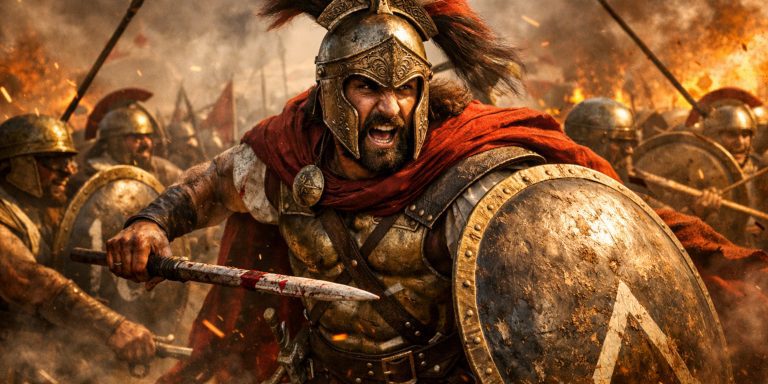
The Sacred Band fought as heavily armed hoplites. Their equipment would have been expensive and well maintained, reflecting both their elite status and the wealth of Thebes.
Typical Equipment
| Equipment | Description |
|---|---|
| Helmet | Bronze Corinthian, Chalcidian or Boeotian helmet |
| Body Armour | Bronze cuirass or linen thorax |
| Shield | Large round hoplon with bronze facing |
| Primary Weapon | Dory spear, usually around 7 to 9 feet long |
| Secondary Weapon | Sword carried for close combat |
| Greaves | Bronze greaves protecting the lower legs |
The shield was central to hoplite warfare. Each man protected himself and the man beside him. In the Sacred Band, where soldiers fought beside the same partner for years, this must have created an unusually tight bond. It also meant there was very little room for arguments about who had failed to keep formation.
Sword Types Used by the Sacred Band
The Sacred Band probably carried one of two common Greek sword types.
| Sword Type | Description | Likely Use |
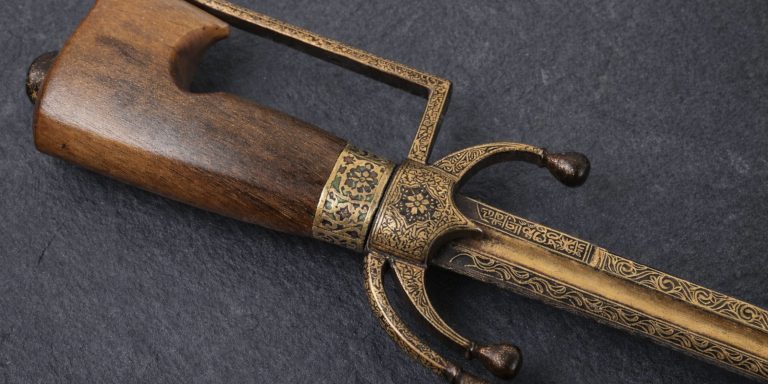
| Xiphos | Straight, double-edged sword around 45 to 60 cm long | Standard sidearm for thrusting and cutting |
| Kopis | Curved, forward-heavy blade designed for chopping blows | Favoured by some Greek cavalry and elite warriors |
The xiphos was probably the most common weapon among the Sacred Band. It was compact, practical and well suited to the cramped press of hoplite combat.
The kopis may also have appeared among wealthier or more experienced soldiers. Its heavy curved blade could deliver savage cuts once the spear line collapsed. Ancient Greek authors occasionally mention it as a fearsome weapon. Quite understandably. Being hit by one was unlikely to improve anyone’s day.
Armour and Appearance
The Sacred Band may have possessed more uniform equipment than ordinary Greek units. Ancient writers imply they were recognisable and prestigious. Some modern reconstructions suggest they may have worn matching cloaks or crests, though there is no direct evidence.
Thebes itself was associated with the Boeotian helmet, a design with a broad brim and open face that gave excellent visibility and hearing. This type later became popular with cavalry, though elite Theban infantry may also have used it.
The Battle of Tegyra
The Sacred Band first achieved lasting fame at the Battle of Tegyra around 375 BC.
Pelopidas and the Sacred Band found themselves outnumbered by a Spartan force near Orchomenus. Rather than retreat, Pelopidas attacked.
This was unusual. Spartan hoplites had an intimidating reputation, and most Greek commanders preferred to avoid them unless absolutely necessary. The Spartans, for their part, had spent decades carefully cultivating the impression that they were unbeatable. It was excellent for morale and dreadful for anyone trying to negotiate with them.
At Tegyra, the Sacred Band smashed through the Spartan line and won.
This was one of the first recorded occasions on which a smaller Greek force defeated Spartans in open battle. It proved that Spartan invincibility was a myth, though Spartans naturally remained rather reluctant to admit this.
Leuctra and the Destruction of Spartan Power
The Sacred Band played a decisive role at the Battle of Leuctra in 371 BC.
At Leuctra, the Theban general Epaminondas deployed his army in an unconventional formation. Instead of matching the Spartan line evenly, he massed his strongest troops on the left flank, fifty ranks deep.
The Sacred Band stood at the front of this concentrated wing.
When the battle began, the Theban left crashed into the Spartan right, where the Spartan king Cleombrotus commanded his best troops.
The impact was devastating. The Sacred Band and the Theban elite broke the Spartan line, killed Cleombrotus and sent the Spartans into retreat.
Leuctra transformed Greece.
For centuries Sparta had dominated the Greek mainland. After Leuctra, its power never fully recovered. The Sacred Band became famous throughout the Greek world, and Thebes entered a brief but brilliant period of supremacy.
Plutarch later wrote:
“The Lacedaemonians never before suffered such a defeat.”
Later Campaigns
After Leuctra, the Sacred Band fought in a series of Theban campaigns across Greece.
They accompanied Pelopidas into Thessaly, where he opposed the tyrant Alexander of Pherae. They fought in Boeotia, the Peloponnese and central Greece.
Pelopidas himself was killed in battle at Cynoscephalae in 364 BC. His death was a serious blow to Thebes, though the Sacred Band continued to serve.
Without Pelopidas and Epaminondas, Theban power slowly declined. The Sacred Band remained respected, but they could not reverse the broader political changes of the Greek world.
Meanwhile, a new power was rising in the north: Macedon.
The Battle of Chaeronea
The Sacred Band met its end at the Battle of Chaeronea in 338 BC.
The Thebans and Athenians faced Philip II of Macedon and his son Alexander. The Sacred Band was stationed on the Theban right.
The battle was hard fought. According to tradition, Alexander led the Macedonian cavalry charge that finally broke the Sacred Band.
The 300 men fought to the death.
Ancient accounts claim that almost none attempted to flee. When Philip later inspected the bodies, he is said to have wept.
Plutarch records his words:
“Perish miserably they who think that these men did or suffered anything disgraceful.”
This is one of the most famous scenes in Greek military history. Even Philip, conqueror of Greece, is supposed to have recognised the courage of the Sacred Band.
There is always the possibility that later writers polished the story for dramatic effect. Ancient historians loved a good speech almost as much as modern historians enjoy a footnote. Yet the essential truth seems clear. The Sacred Band stood their ground and were destroyed where they stood.
Archaeology and the Lion of Chaeronea
The strongest archaeological evidence for the Sacred Band comes from Chaeronea.
In the nineteenth century, excavations uncovered a mass grave near the famous Lion of Chaeronea monument. The lion, a great stone statue, is widely believed to mark the burial place of the Sacred Band.
The excavation revealed the remains of around 254 men buried in rows.
Many of the skeletons showed battle injuries. Some still lay arranged as if in formation. The burial seems to match the ancient accounts of the Sacred Band dying together.
Key Archaeological Finds
- The Lion of Chaeronea monument
- Mass grave containing over 250 bodies
- Spearheads and weapon fragments
- Evidence of violent combat injuries
- Burial arranged in an orderly military fashion
The Lion itself remains one of the most moving monuments of ancient Greece. It is simple, severe and utterly fitting.
Standing before it today, one is struck by how little there is to say. Three hundred men went into battle. Most did not return. The monument says the rest.
Contemporary and Ancient Quotes
Several ancient authors commented on the Sacred Band and its reputation.
Plutarch:
“A troop joined by love is unconquerable.”
Diodorus Siculus:
“These men, because of their valour and mutual affection, surpassed all others.”
Pausanias on Chaeronea:
“The Thebans who fell there have a common tomb and over it stands a lion.”
These quotations may be coloured by later admiration, but they show how powerfully the Sacred Band impressed the ancient world.
Were the Sacred Band Really Lovers?
This remains one of the most debated questions.
Greek society accepted certain forms of male relationships, particularly between older and younger men. Thebes seems to have embraced this idea more openly than many other Greek states.
Most modern historians accept that at least some of the Sacred Band fought in romantic pairs. Whether every pair did is much harder to prove.
What matters most is that the Thebans believed emotional bonds made men fight harder.
There is something oddly modern about this. Military historians often talk about cohesion, morale and trust between soldiers. The Thebans simply reached the same conclusion twenty-four centuries earlier and gave it a more dramatic flourish.
Legacy of the Sacred Band
The Sacred Band became one of the most famous elite units in military history.
Their story influenced later ideas about comradeship, military professionalism and the role of elite troops.
Today they are remembered not simply because they were brave, but because they represented a different vision of warfare. They were not just a collection of soldiers. They were a corps built on discipline, loyalty and shared identity.
The Sacred Band also occupies an important place in modern discussions of sexuality and history. They have often been celebrated as one of the earliest famous examples of openly same-sex military comradeship.
At the same time, they should not be reduced to a modern symbol alone. They were Theban soldiers first, shaped by the beliefs and values of fourth-century Greece.
That, perhaps, is what makes them so compelling. They belong entirely to their own world, yet still feel strangely familiar.
Where to See Artefacts and Sites Connected to the Sacred Band
Visitors interested in the Sacred Band can still see several important locations and finds.
| Site or Museum | What to See |
| Chaeronea Archaeological Site | Lion of Chaeronea monument and battlefield area |
| Thebes Archaeological Museum | Finds from Boeotia, including weapons and armour from the period |
| National Archaeological Museum, Athens | Greek hoplite armour, helmets and swords from the fourth century BC |
| Archaeological Museum of Chaeronea | Artefacts linked to the battle and excavations |
The Lion of Chaeronea remains the most important surviving memorial. It is difficult to visit without feeling a certain admiration for the men buried beneath it. One also feels a slight irritation at Philip of Macedon for ruining what had been, from a Theban perspective, a very good run.
The Seven Swords Takeaway
The Sacred Band of Thebes occupies a rare place between history and legend.
Unlike many famous ancient warriors, they are not remembered because they conquered an empire or ruled a kingdom. They are remembered because they fought together with extraordinary determination.
For a few decades, 300 Thebans changed the balance of power in Greece. They defeated Sparta, helped build a Theban empire and died at Chaeronea in one of the last great battles of independent Greece.
Few military units have left such a powerful memory with so little surviving evidence. Yet perhaps that is fitting. The Sacred Band was never about numbers. It was about the force created when loyalty, discipline and courage all point in the same direction.