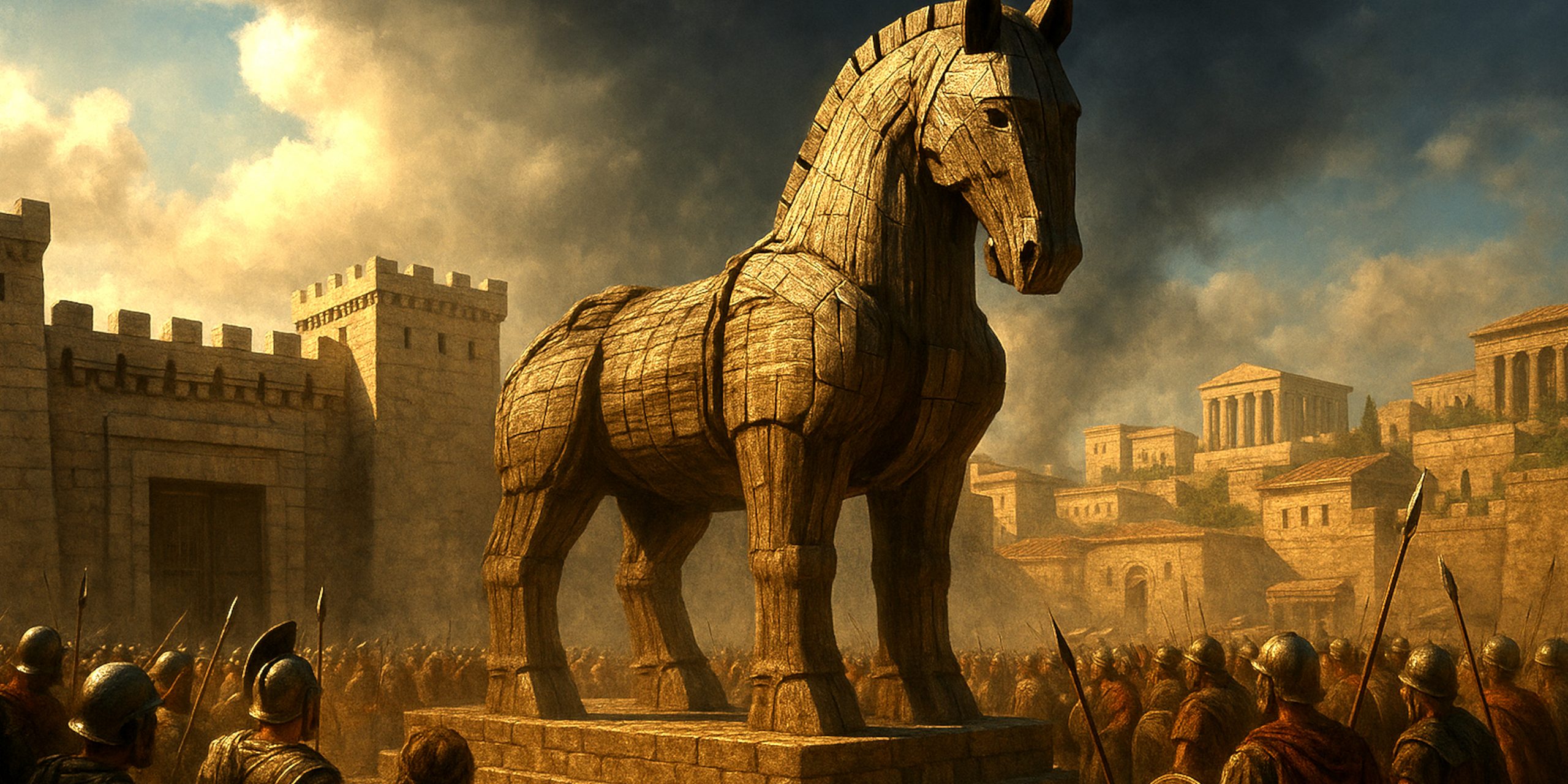
There are few episodes from the ancient world that carry the dramatic weight of Troy’s fall. Even Herodotus felt compelled to hint that the bards had perhaps embellished things a little, which, coming from a man who cheerfully reports flying snakes, feels suitably ironic. Still, beneath the poetic thunder lies a core of events that shaped early Greek identity. The Wooden Horse stratagem stands as the most audacious military deception in the classical tradition. You almost want to applaud Odysseus for sheer nerve, though I suspect the Trojans would disagree.
Forces
Greek Coalition (Achaean Forces)
| Commander | Region | Estimated Troops | Notes |
|---|---|---|---|
| Agamemnon | Mycenae | Several thousand | Overall commander, political centre of the coalition. |
| Menelaus | Sparta | Several hundred | Legitimate grievance holder, in theory. |
| Odysseus | Ithaca | Several hundred | Instigator of the stratagem. |
| Achilles* | Phthia | Myrmidon contingent | Traditionally removed before the sack due to his death. |
| Neoptolemus | Phthia | Several hundred | Key figure in final assault. |
| Ajax the Lesser | Lokris | Several hundred | Noted for rashness, paid for it in the tradition. |
Trojan Defenders
| Commander | Role | Estimated Troops | Notes |
|---|---|---|---|
| Priam | King | N/A | Political leader, not a battlefield figure in the sack. |
| Hector* | Prince | N/A | Long dead before the sack. |
| Aeneas | Noble captain | Several hundred | Leads survivors out of the city. |
| Deiphobus | Prince | Several hundred | Killed in the fighting according to later tradition. |
Arms and Armour
Achaeans and Trojans fielded similar equipment due to shared Bronze Age technology. The literary tradition paints an evocative picture that aligns surprisingly well with archaeological evidence from Mycenaean shaft graves and Anatolian citadels.
Infantry and Noble Warriors
- Bronze plate corselets or scale armour
- Boar tusk helmets among elites
- Circular or figure-eight shields
- Spears for primary contact
- Swords as secondary weapons
Specific Sword Types
| Sword Type | Culture | Use in Conflict | Notes |
|---|---|---|---|
| Naue II Type Sword | Achaean and Trojan spheres | Versatile cutting and thrusting | The most widely evidenced blade of the period. |
| Mycenaean Type G Rapier | Achaean | Precision thrusting | Elegant and worryingly thin, ideal for close duelling. |
| Hittite Style Sickle Sword (Khapsh) | Anatolian regions | Occasional Trojan use | A chopping weapon, possibly carried by Anatolian allies. |
Leaders and Troop Composition Table
| Side | Commanders | Composition | Strengths | Weaknesses |
|---|---|---|---|---|
| Greeks | Agamemnon, Odysseus, Menelaus, Neoptolemus | Mixed infantry, noble chariot fighters | Superior cohesion by the end, initiative under Odysseus | War fatigue after a decade, internal rivalries |
| Trojans | Priam’s household, Deiphobus, Aeneas | Infantry, archers, Anatolian auxiliaries | Strong defensive city, elite archers | Heavily depleted by earlier battles, morale worn thin |
The Wooden Horse Stratagem
After ten years of stalemate, Odysseus proposed leaving a monumental wooden horse as a so–called offering. In truth it hid an assault team, likely chosen for skill rather than brawn, since a great hulking warrior climbing out of a cramped wooden cavity would struggle for elegance.
The main host then sailed out of sight to the island of Tenedos. When the Trojans discovered the horse, debates unfurled. Laocoon famously shouted that the Greeks bore gifts with treachery in mind. He was promptly removed from the discussion with supernatural efficiency, a story which always strikes me as the poetic equivalent of being talked over in a meeting, except with sea serpents.
The Trojans dragged the horse into the city. Night fell. Odysseus and the concealed warriors slipped out, opened the gates, and the returned Greek fleet entered. The rest is ruin and smoke.
Archaeology
Archaeology at Hisarlik, the most likely site of Troy, reveals at least nine major settlement phases. Troy VI and VII are the principal candidates for the Late Bronze Age conflict.
- Troy VI shows signs of earthquake damage, though later destruction layers suggest burning from human activity.
- Troy VIIa reveals cramped housing and storage jars sunk into floors, which may indicate siege conditions.
- Weapons fragments, arrowheads, and signs of intense fire suggest a violent end consistent with a sack.
- Mycenaean pottery appears in abundance, though this might reflect trade as much as conquest.
As a historian, I find the tantalising blend of poetry and rubble rather irresistible. Homer gives us gods on the battlefield. Archaeology gives us collapsed walls and carbonised beams. Between the two lies the truth.
Battle Timeline
Year 10 of the War, approximate fictional chronology
• Greek council debates final strategy. Odysseus proposes deception.
• Construction of the wooden horse begins.
• Select strike force enters the horse under cover of darkness.
• Greek main host sails to Tenedos.
Day of the Sack
• Trojans discover the deserted camp.
• Horse found and dragged into the city.
• Celebrations erupt. Wine flows rather too freely.
• Night falls.
• Greeks emerge from the horse and open the Scaean Gate.
• Fleet returns silently to shore.
• Full assault begins inside the walls.
• Priam killed at the altar of Zeus Herkeios.
• Survivors scatter. Aeneas departs with his household.
Contemporary Style Quotations
Although the Trojan War is not historical in the strict sense, later Greek poets frame the events with lines that feel almost eyewitness in tone.
- Homer, Iliad (referencing Trojan distrust)
“My heart misgives me, Greeks are never weary of deceit.” - Virgil, Aeneid (on the horse)
“Whatever it is, I fear the Greeks, even when they bear gifts.” - Euripides, Trojan Women (on the sack)
“The smoke of Troy rises and will not be forgotten.”
These lines act as cultural echoes of a memory so old it slips between history and story.
The Seven Swords Takeaway
The Sack of Troy remains the most famous case study in military deception, which is impressive given that the account involves a large wooden statue filled with armed men. Yet the archaeological record hints that something traumatic occurred on the Hisarlik citadel. Whether the Greeks truly climbed out of a timber horse or whether a poet later embroidered a simpler breach, the effect was the same. A city fell. A myth was born. And historians like me are left trying to read the ashes while poets steal all the good lines.
Watch the documentary: