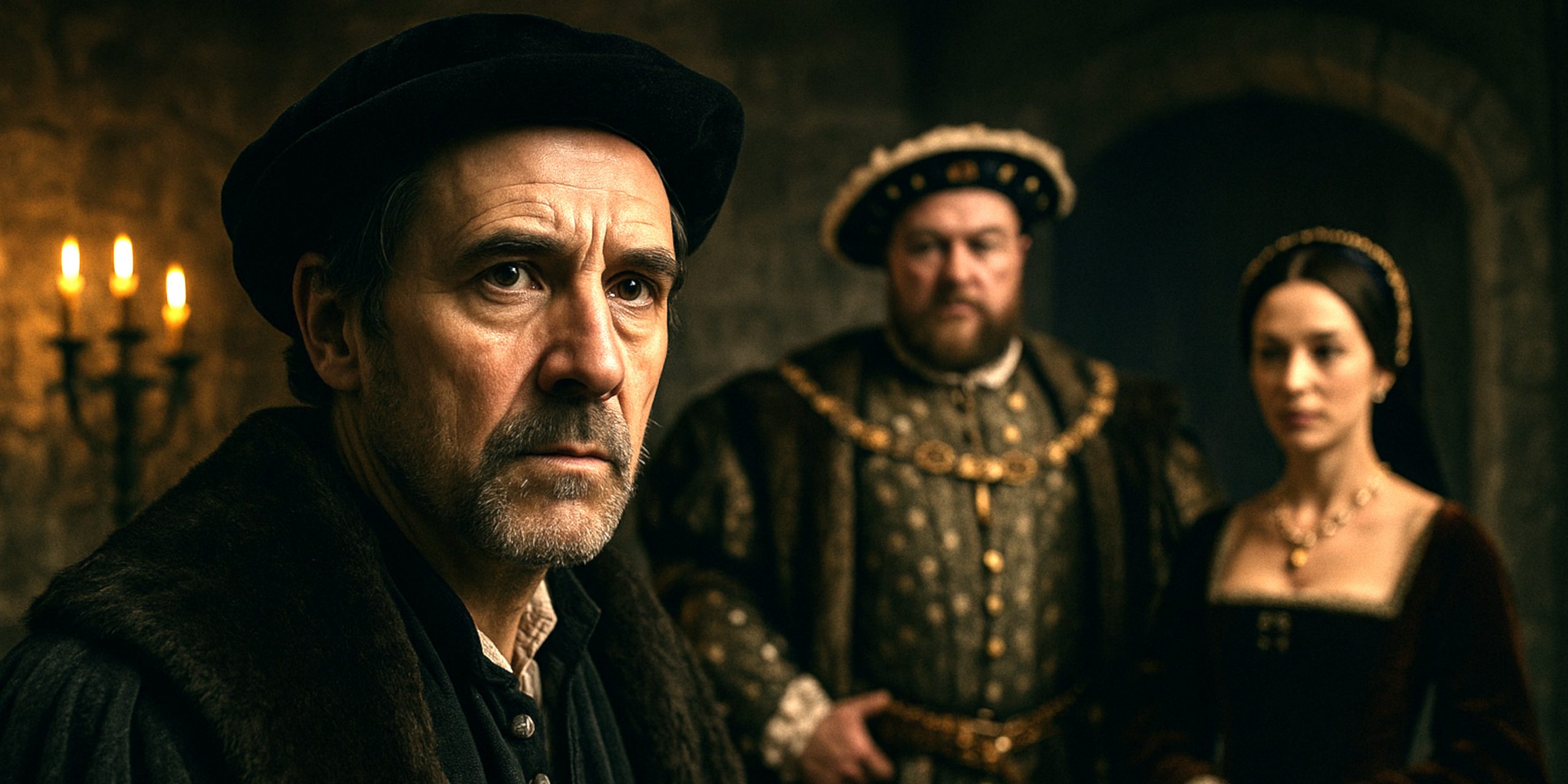
History and television never have a perfectly tidy relationship. Wolf Hall understands this better than most. It gives us Tudor politics with sharp edges, candlelit rooms, and a Thomas Cromwell who feels far more three dimensional than the flattened villain of earlier retellings. Still, no matter how grounded it looks, the series plays with history in clever ways. Some choices deepen the story. Others smooth out the chaos of real events. By the end, you are left juggling admiration and gentle suspicion, which is not a bad place to be when dealing with Henry VIII.
Below is a walk through what the show gets right, where it bends the truth, and why those tweaks may actually help the story land.
Cromwell, The Man Behind the Reputation
Wolf Hall reshapes Thomas Cromwell into someone viewers can actually understand. Historically, Cromwell was a lawyer, merchant, diplomat, fixer, and occasional bulldozer. The show embraces his intelligence but softens the rougher parts. The historical Cromwell could be ruthless in ways that do not always make it to the screen. His reforms were sharp instruments. The monasteries did not dissolve themselves out of goodwill, after all.
Yet the shift in tone makes sense. The series wants us close to Cromwell. It wants us inside his reactions, not reading him at arm’s length like a suspicious chronicler. You do not need flawless accuracy to capture the emotional truth of someone navigating Henry VIII’s court. You need nerve, subtlety, and a good tailor. Cromwell has all three.
Henry VIII, Larger Than Life, Slightly Tidied
The show presents Henry as charming, impatient, insecure, and oddly likeable in short bursts. That is not far from the historical record, although the real Henry had an extra streak of unpredictability that would make any modern adviser want to lie down in a dark room.
Wolf Hall trims some of his volatility. It keeps his shifting moods but not always the sheer force with which he could turn on a subject. The result is a king who feels human rather than monstrous, which ironically may make him more unsettling. You never forget he has the power to reorder lives with a single sentence.
Anne Boleyn, Intelligence, Charisma, and Strategy
The series gives us an Anne Boleyn who is clever, calculating, sharp, and occasionally brittle. Historians generally agree she was highly educated and politically aware, which fits well with the show. Where Wolf Hall diverges is in the exact tone of her rivalry with Cromwell. Their conflict was not simply two brilliant people circling each other across court. It was a messy clash of personal influence, factional power, and bad timing.
Still, the tension between them in the series captures something true. Both were trying to survive in a system that rewarded loyalty until the precise moment it did not. The show simply tightens the screws for dramatic clarity.
The Fall of Cardinal Wolsey, Accurate but Streamlined
Cardinal Wolsey’s downfall plays out in a fairly historical way, though in real life it was longer, more drawn out, and full of bureaucratic misery. The show conveys the emotional impact without dragging us through every legal document and council meeting. Cromwell’s loyalty to Wolsey is also emphasised a little more strongly than some historians might lean, but the relationship works on screen. It gives Cromwell a clear emotional anchor and helps the story stay focused.
Cromwell’s Rise, Smoother Than Reality
Cromwell did rise quickly, but not quite as smoothly as the series suggests. Real Tudor advancement involved endless petitions, rivalries, shifting alliances, and the kind of administrative work that would bore even the most dedicated viewer. Wolf Hall clears a straighter path so we can follow the transformation without getting lost in paperwork. It is not inaccurate, just organised with more confidence than life usually offers.
Dialogue, Tone, and Candlelight, Historically Inspired, Not Perfect
The show is famous for its dimly lit aesthetic. Tudor houses were not quite that dark, but the mood works. Dialogue is modern enough that we can follow it without grabbing a glossary. Most of the political conversations are grounded in real events, but the pacing and delivery are shaped for television. No Tudor council meeting ever went that smoothly, or that quietly.
Still, the atmosphere feels close to something authentic. The emotional truth of uncertainty, ambition, and constant risk is nailed down with surprising accuracy.
What Wolf Hall Gets Right by Changing the Facts
This is where the cleverness comes in. When the series bends history, it usually does so to highlight a deeper point. Cromwell is not simply a policy architect. He is someone who learned to read rooms the way others read books. Anne is not just a doomed queen. She is someone pushing against a system designed to limit her. Henry is not a cartoon tyrant. He is someone who could have been great if he had been less trapped by his own desires.
Historical purists may sigh at certain simplifications, but the show never feels careless. Every adjustment serves a purpose, even if it occasionally makes scholars raise an eyebrow.
Final Thoughts, A Tudor World Worth Returning To
Wolf Hall succeeds because it treats history as a living environment rather than a checklist of events. It respects the sources while also making the story something a modern audience can feel rather than simply observe. If anything, the series reminds us that the real Tudor world was even stranger and more unpredictable than fiction usually allows.
Watching it with the historical record nearby is not cheating. It is part of the fun. It is also a good way to realise that Cromwell’s world has never been that far from ours. People still manoeuvre, still overreach, and still forget that every rise has its shadow.
If only we all had Cromwell’s patience. Or his wardrobe.
Watch the Trailer: